Los Alamos National Security loses contract to manage nuclear weapons lab after 2017
Contract to manage federal nuclear weapons lab up for grabs after 2017 http://www.nwherald.com/2015/12/21/contract-to-manage-federal-nuclear-weapons-lab-up-for-grabs-after-2017/apybmgs/ By The Associated Press LOS ALAMOS, N.M. – The $2 billion contract to manage one of the federal government’s premier nuclear weapons laboratories will be up for grabs after 2017. The National Nuclear Security Administration has decided not to grant an extension of Los Alamos National Security’s contract to run the Los Alamos National Laboratory.
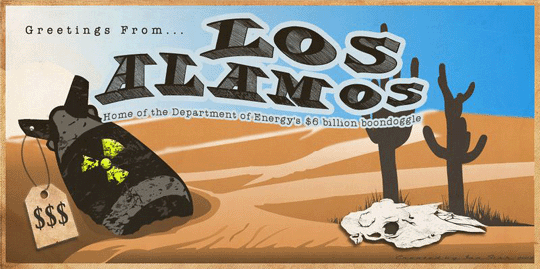
Members of New Mexico’s congressional delegation say the reasons cited by the agency include a serious safety incident involving a worker, and the handling of enriched uranium at a Nevada facility in 2014.
The lab also has shared blame for errors that led to the indefinite closure of the federal government’s only underground nuclear waste repository in 2014.
The current contract expires in September 2017.
Lab Director Charlie McMillan told employees the lab’s latest review was better than the previous two but not good enough to ensure an automatic contract extension.
Transfer of Vermont Yankee’s dangerous nuclear used fuel trash to dry storage
Vermont Yankee to start moving spent nuclear fuel into dry storage in 2017 http://www.masslive.com/news/index.ssf/2015/12/vermont_yankee_to_start_moving.html By Mary Serreze | Special to The Republican On December 20, 2015 Entergy plans to start moving Vermont Yankee’s spent nuclear fuel into dry cask storage in 2017, two years earlier than originally anticipated, reports the online Vermont Digger.
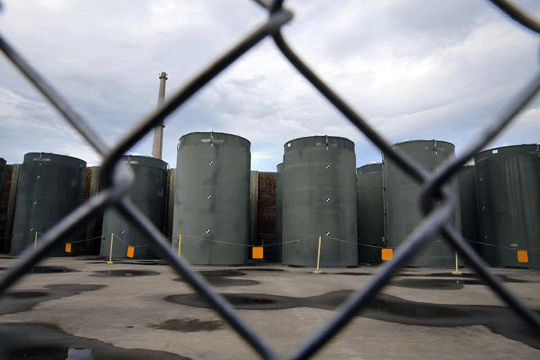
The Louisiana-based Entergy announced the decision Wednesday, but the idea was first introduced in an October filing with the Vermont Public Service Board, as part of the company’s bid for approval to build a second concrete pad for spent fuel storage at the Vernon, Vermont site, located on the banks of the Connecticut River.
The 620-megawatt Vernon plant, which began operations in 1972, stopped producing power Dec. 29, but most of its spent fuel remains in wet storage in a pool inside the plant’s reactor building.
While dry storage is considered safer than wet storage, concerns have been raised about the transfer process, in which fuel is pulled from the pool, placed in casks, loaded onto a large, tracked vehicle nicknamed “Cletus” and moved slowly to the spent fuel pad, Vermont Digger reports.
Entergy remains under a 2020 deadline to move the fuel into dry cask storage. Under the federally-sanctioned SAFSTOR process, full decommissioning could take up to 60 years. Under SAFSTOR, Vermont Yankee would be “mothballed” until its decommissioning fund reaches the level necessary to clean up the entire site.
State and regional officials, as well as critics of the plant, have raised concerns about the overall decommissioning project’s financing, as well as the presence of non-radiological and radiological waste at the site. The dry cask storage plan will be funded with a $145 million line of credit, which Entergy plans to repay by suing the U.S. Department of Energy for breach of its contract to remove spent nuclear fuel from the Vermont Yankee site.
The Nuclear Regulatory Commission has approved the use of the plant’s decommissioning trust fund to pay for long-term fuel storage, although the state has challenged that decision in federal appeals court.
Mary Serreze can be reached at mserreze@gmail.com
Marshall Islands continues the fight for nuclear disarmament, with lawsuitagainst US govt
 Marshall Islands fights back in nuclear lawsuit http://www.radionz.co.nz/international/pacific-news/292690/marshall-islands-fights-back-in-nuclear-lawsuit The Marshall Islands has pulled up the US government over its interpretation of treaty law in a continuing David and Goliath legal battle over nuclear disarmament.
The two sides have been submitting their briefs for the appeal by the Marshall Islands against a US federal judge’s decision to throw out the case.
The Marshall Islands says the US government lawyers have broadly misstated the law surrounding treaty disputes as it pushes ahead with its so-called Nuclear Zero lawsuit.
The country, which was used as a testing ground for the US’ nuclear programme in the forties and fifties, launched action last year to get the world’s nuclear powers to honour their promise to disarm under the Nuclear Non Proliferation Treaty.
But the case against the US was thrown out in February on constitutional grounds. In its appeal brief the Marshall Islands says the US courts do have the power to oversee disputes over international treaties saying no law elevates the president’s authority to make a treaty above the judiciary’s power to decide disputes.
It also argued it can bring the suit because the US has violated its treaty negotiations and because of the measurable increased danger it faces.
The government contends even if a foreign state was able to sue in US courts, it can’t challenge the president’s foreign affairs responsibilities.
The Marshalls’ Foreign Minister Tony de Brum earlier said the Marshall Islands would use every legal avenue to make sure the lawsuit is won in his lifetime.
The Court of Appeals for the Ninth Circuit will now appoint a three-judge panel to consider the briefs.
TEPCO to evaporate 800,000 m3 of Tritium water to the air ?
Tepco considers evaporating 800,000 m3 of Tritium water to the air
http://fukushima-diary.com/2015/12/tepco-considers-evaporating-800000-m3-of-tritium-water-to-the-air/ On 12/11/2015, Tepco announced the possibility of evaporating Tritium water retained in Fukushima plant area. It was reported in the task force of METI (Minister of Economy, Trade and Industry).
From their report, the estimated volume to be released is 800,000 m3. 400 m3 of Tritium water is expected to be released per day.
The maximum density of Tritium is 4,200,000,000 Bq/m3.
The water is reportedly vaporized at 900 ~ 1,000 ℃, released to the atmosphere at 60m above the ground.
Tepco states the maximum density becomes lower than 5,000 Bq/m3 at 40m area from the releasing point, which is the notice concentration limit.
Nuclear disaster drill: thousands evacuated near Japan’s Sendai Nuclear Power Plant
Thousands evacuated in disaster drills near Japan’s 1st post-Fukushima nuclear plant, Rt.com 20 Dec, 2015 About 3,600 officials and residents have taken part in nuclear disaster drills near Japan’s Sendai Nuclear Power Plant. The plant was the first to be reopened following the 2011 Fukushima disaster, despite warnings over tectonic risks.
The drills in Kagoshima Prefecture in southwestern Japan, within 30 km of the power plant, simulated a serious nuclear accident, Kyodo news reported. At least 1,200 residents who were living within 5 km from the Sendai plant were evacuated by buses and other vehicles.
These exercises assumed that the nuclear plant might have been hit by an earthquake ranked 6 or higher on the Japanese scale of 7 and the plant lost power sources which made it unable to cool its reactors……
Sendai is located near the volcanically active Kirishima mountain range. Mount Ioyama, located just 65 kilometers away from the plant, is experiencing tremors, prompting the Meteorological Agency to issue warnings. The government’s nuclear agency has dismissed volcanic risks over Sendai’s lifetime as “negligible,” however.https://www.rt.com/news/326571-japan-nuclear-plant-drills/
Danger of terrorist attacks on Japan’s nuclear plants
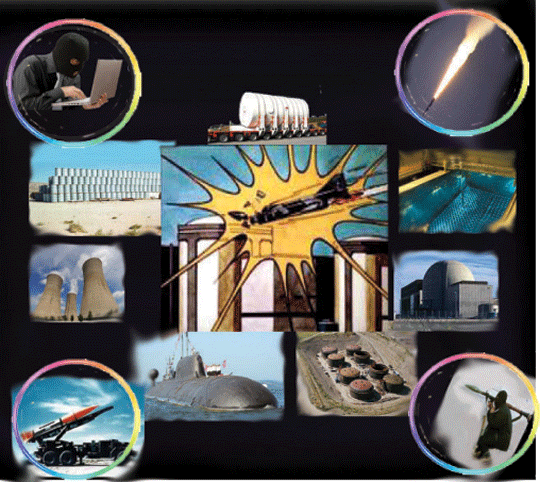
 Nuclear power plants feared vulnerable to terrorist groups, Japan Times, BY REIJI YOSHIDA STAFF WRITER 20 Dec 15, Security at France’s 58 nuclear power plants was purportedly raised to its highest level last month as a result of the terrorist attacks in Paris, stoking concern over the safety of Japan’s nuclear facilities…….
“I can understand there are concerns after terrorist attacks like the ones in Paris,” said NRA Chairman Shunichi Tanaka at a news conference on Nov. 18. “For now, we will tighten security measures by asking (for the) cooperation of related organizations like the police,” he said.
But the NRA’s recent decision to revise its requirements to cope with terrorism has fueled fears over potential attacks on Japanese plants.
The NRA’s new safety rules, introduced in July 2013 based on lessons learned from the Fukushima crisis, gave nuclear plant operators five years to set up special backup facilities to cope with possible attacks.
The rules require the building of emergency backup operation rooms, backup water pumps and multiple water intake channels leading to reactor cores. If terrorists managed to cut power and paralyze the critical functions that keep the fuel rods cool, it could cause a meltdown and release a vast amount of radioactive material — just like when tsunami knocked out the cooling system of the Fukushima No. 1 power plant, triggering meltdowns at three of the six reactors there.
But at its Nov. 13 session, the NRA delayed the starting date of the five-year period, giving utilities extra time to make the deadline.
The time by which Kyushu Electric Power Co. has to build backup facilities for its two reactors recently reactivated at the Sendai nuclear plant, for example, was extended nearly two years to March 2020.
Anti-nuclear activists argue that preparations to counter potential attacks should start immediately, particularly since Prime Minister Shinzo Abe’s administration recently enacted a law that allows the Self-Defense Forces to feasibly take part in military operations with the United States.
“The terrorist threat to Japan has increased more than ever because of the (legalization of using the) right to collective self-defense,” said Hideyuki Ban, co-representative of the Citizens’ Nuclear Information Center in Tokyo.
Experts on the Middle East say the law makes Japan more visible to terrorists like the Islamic State group, which is believed to be targeting U.S. allies.
“The Islamic State has warned the pagan nation of Japan against further endangering lives of Japan’s citizens through Japanese support of the American crusade,” the jihadi extremist group said in the latest issue of its English-language online magazine Dabiq…….
Even before the Fukushima crisis, the U.S. expressed serious concern over the apparent lack of security at Japanese nuclear plants.
In May 2011, the whistle-blower website WikiLeaks released a number of documents it claimed were cables sent from the U.S. Embassy in Tokyo to Washington in 2006 and 2007.
In one cable dated Feb. 26, 2007, the U.S. expressed concerns by reporting “armed national police are present at certain nuclear power plants . . . in Japan, but they do not guard all facilities and contract civilian guards are prevented by law from carrying weapons.”……
Hideyuki Ban, with the Citizens’ Nuclear Information Center, said Japan should not reactivate more reactors, arguing none are designed to withstand suicidal attacks with large planes like the 9/11 attacks in New York and Washington in 2001.
“The steel plate of the primary containment vessel is only about 3 cm, and the outside concrete layer is not very thick,” Ban pointed out.
“A large airplane would burst right through a containment vessel if it was directly hit.”
The Japan Times asked the NRA and Tokyo Electric Power Co. to comment on Ban’s comments, but both declined. http://www.japantimes.co.jp/news/2015/12/20/national/nuclear-power-plants-feared-vulnerable-terrorist-groups/#.VncdG7Z97Gg
India has rebuffed offers of help to make its nuclear industry safer
India’s nuclear explosive materials are vulnerable to theft, U.S. officials and experts say. But Washington has chosen not to press for tougher security while its trade with India is booming, Center For Public Integrity, By Adrian Levy R. Jeffrey Smith 17 Dec 15
“……..The Nuclear Threat Initiative, a nonprofit group in Washington, reported last year for example that India’s nuclear security practices ranked 23rd among 25 countries that possess at least a bomb’s-worth of fissile materials. Only Iran and North Korea fared worse in the analysis, which noted that India’s stockpiles are growing and said the country’s nuclear regulator lacked independence from political interference and adequate authority.
It said the risks stemmed in part from India’s culture of widespread corruption — which helped force the nation’s ruling Congress party from power in May 2014 — as well as its general political instability. “Weaknesses are particularly apparent in the areas of transport security, material control, and accounting, and measures to protect against the insider threat, such as personnel vetting and mandatory reporting of suspicious behavior,” the group’s report stated.
But India has rebuffed repeated offers of U.S. help. Gary Samore, President Obama’s coordinator for arms control and weapons of mass destruction from 2009 to 2013, said that at preparatory meetings for international summits on nuclear security in 2010 and 2012, “we kept offering to create a joint security project [with India] consisting of assistance of any and every kind. And every time they would say, to my face, that this was a wonderful idea and they should grasp the opportunity. And then, when they returned to India, we would never hear about it again.”
India also refused to collaborate with the Nuclear Threat Initiative project by sharing or confirming information about its practices, unlike 17 of the other 24 countries in the study. They responded ferociously to its conclusions, according to a researcher connected to the project, who was not sanctioned to talk about it. Officials at the Indian Atomic Energy Commission verbally attacked Ted Turner and Sam Nunn, the NTI’s founders, in conversations with Indian journalists, the researcher said……
Despite the celebration of close U.S.-Indian ties during President Obama’s visit to Delhi in January, “there is still no deep technical relationship” between the two countries on nuclear security issues, a White House official conceded in a recent interview, speaking on condition of anonymity. “We only hope that this will slowly change.”
At the moment, India is seeking three favors from Washington: It wants U.S. help to gain membership in the Missile Technology Control Regime, an international forum meant to limit the spread of nuclear-tipped missiles, which would give it access to certain otherwise restricted foreign space-launch technologies. And it wants to join the Nuclear Suppliers Group, composed of nations that agree to respect nonproliferation rules when they trade in nuclear-related technologies. Both ambitions reflect India’s desire to be accorded the status of a major world power, U.S. experts say.
It also wants to acquire U.S. defense technologies by co-producing weapons systems in India with key Pentagon contractors – an issue discussed between Secretary of Defense Ashton Carter and Indian defense minister Manohar Parrikar during the minister’s weeklong visit to Washington beginning on Dec. 4.
But the Obama administration decided not to use these issues as leverage to force better security measures for nuclear explosives, the senior U.S. official said, because of its judgment that doing so would only prompt India to walk away.
A former senior U.S. nonproliferation official said this was a mistake. Washington, he said on condition of not being named, “has allowed itself to be put into the position of not wanting to displease India for fear of putting things off-track” in its new, warming relationship, and it has wrongly “allowed the Indians to wall off things they are not interested in talking about” while its ties to the United States grow.
An official in Britain’s Foreign Office, who also spoke on condition he not be named, expressed a more jaundiced view of this reluctance to press Delhi harder.
“Nothing can be allowed to get in the way of investment in the capacious Indian market,” the British official said, describing the current American mindset. “India has effectively bought itself breathing space, over a lot of concerning issues, especially nuclear security, by opening itself up for the first time to significant trades with the U.S. and Europe.” The financial gains, he said, are “eye-watering.”
According to the U.S. Commerce Department, trade with India grew from $19 billion in 2000 to more than $100 billion in 2014. U.S. exports exceeded $38 billion — including substantial new U.S. arms shipments — supporting 181,000 U.S. jobs. Indian direct investment in the United States totaled $7.8 billion while U.S. investments reached $28 billion.
Washington, the British official explained, does not wish to provoke a spat over nuclear security simply because doing so could threaten this lucrative trade, which benefits many U.S. companies.
This is part four of a four-part series about india’s civil and military nuclear program, co-published with the Huffington Post worldwide and Foreign Policy magazine in Washington, D.C. The other articles can be found here: https://www.publicintegrity.org/national-security/nuclear-waste
R. Jeffrey Smith reported from Washington, D.C., and California. Adrian Levy is is an investigative reporter and filmmaker whose work has appeared in the Guardian, The Observer, The Sunday Times, and other publications. His most recent books are: The Meadow, about a 1995 terrorist kidnapping of Westerners in Kashmir, and The Siege: The Attack on the Taj, about the 2008 terrorist attacks in Mumbai. He reported from India and the United Kingdom. http://www.publicintegrity.org/2015/12/17/18922/india-s-nuclear-explosive-materials-are-vulnerable-theft-us-officials-and-experts
Time that US presidential candidates stood up to the nuclear weapons lobby
 The real nuclear danger http://www.concordmonitor.com/opinion/20114801-95/letter-the-real-nuclear-danger ARNIE ALPERT and JUDY ELIOTT December 20, 2015 Hillary Clinton and the editors are right to lose sleep over the danger of “loose nukes.” But a larger nuclear danger ought to cause the utmost concern.
Consider the recent incident in which Turkey shot down a Russian fighter using U.S.-made weapons. It’s not hard to imagine escalation that could draw Turkey’s NATO allies into the conflict. Now consider that both the U.S and Russia have nuclear-armed missiles on hair-trigger alert, ready to launch within minutes.
Dozens of incidents have occurred in which the U.S. or Russia came close to launch due to faulty warning systems, misinterpretation of technical data and human error. We are one misjudgment away from all-out nuclear war. Most of the world’s nuclear weapons are still in the arsenals of the USA and Russia. Instead of complying with treaty obligations to pursue negotiations toward worldwide nuclear abolition, both countries still seek an impossible-to-achieve nuclear advantage.
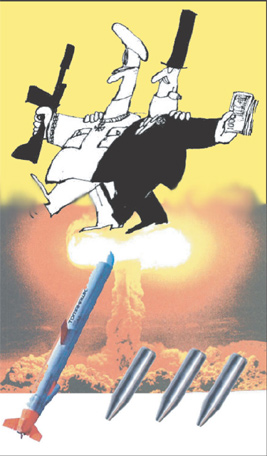
Congress backs a trillion-dollar agenda for a new generation of warheads and the submarines, missiles and bombers to deliver them. This will mean enormous profits for companies such as Lockheed Martin, but will do nothing to reduce the threat that nuclear weapons would be used. It will have no impact whatsoever on access to “loose nukes” by terrorists, rogue states or anyone else.
Hillary Clinton and the other candidates ought to tell us what they will do to stand up to the nuclear weapons lobby and put us on the road toward nuclear weapons reduction and eventual abolition.
Increasing risk of nuclear war
Is nuclear war risk rising? Experts say yes, Reuters,By Peter Apps December 20, 2015
On Sunday, November 28, Californians watched with bemusement and in some cases alarm as a bright light moved across the sky. It wasn’t a UFO. It was a U.S. Navy Trident ballistic missile.
It was, of course, just a test — the first of two in three days. They coincided with tough talk from U.S. Secretary of Defense Ashton Carter, who earlier that month had criticized Russia for engaging in “challenging activities” at sea and air, in space and cyberspace. Days earlier, he had been in the South China Sea aboard an aircraft carrier, sending a similarly robust message to China about its actions in the disputed region.
I was eight years old when the Berlin Wall fell in 1989. No sooner had I become even barely aware of the threat of nuclear war than it was gone, apparently forever.
Now, however, it has quietly returned.
The Project for Study of the 21st Century recently published its survey of major conflict risk. Over six months, we polled 50 national security experts on the risk of a variety of potential wars.
The results make interesting reading. The most striking thing, though, is not the numbers themselves — it is the fact that there now seem to be multiple potential routes to a variety of potentially devastating state-on-state wars.
Our poll showed the experts — who ranged from current and former military officials to international relations professors and insurance and risk specialists — putting a 6.8 percent chance on a major nuclear war in the next 20 years killing more people than World War Two. That conflict killed roughly 80,000,000 at upper estimates.
To be sure, it’s impossible to put an exact number on the risk of a nuclear war. But the risk is clearly more than zero. Sixty percent of our respondents felt it had risen over the last decade — and 52 percent expected it to rise further in the decade to come.
The increasing confrontations with China and Russia have, of course, become increasingly obvious. Of our respondents, 80 percent said they expected a further rise in the kind of “ambiguous” or “asymmetric” conflict between major states………http://blogs.reuters.com/great-debate/2015/12/20/whats-the-likelihood-of-nuclear-war-in-the-next-20-years/
Donald Trump has no clue what the nuclear triad is
 Paul: Trump has no clue what the nuclear triad is http://thehill.com/blogs/ballot-box/presidential-races/263863-paul-trump-has-no-clue-what-the-nuclear-triad-is By Alexander Bolton, 20 Dec15 Republican presidential candidate Rand Paul (R-Ky.) on Sunday accused front-runner Donald Trump of having “no clue” about the nation’s nuclear delivery capability. “This is the worrisome thing, during the debate absolutely Donald Trump had no clue what the nuclear triad is,” Paul said on CNN’s “State of the Union,” referring to the strategic bombers, intercontinental ballistic missiles and submarine-launched missiles capable of delivering nuclear payloads.
“Now that they’ve discovered what it is, they’re ready to use it?” the senator added, in reference to Trump spokeswoman Katrina Pierson’s recent statement that Trump would not be afraid to use nuclear weapons as president.
“What good does it do to have a good nuclear triad if you’re afraid to use it?” she asked.
Paul said he was also alarmed by New Jersey Gov. Chris Christie’s (R) statement at the last GOP presidential debate that he would be willing to order American military pilots to shoot down Russian planes if they violated a no-fly zone over Syria.
“This is what is very worrisome not only about Trump but Christie and others on the stage who are really eager to have war, really eager to show how strong they are,” he said. “That’s why it very much worries me to have someone like Donald Trump or Chris Christie in charge of our nuclear arsenal.”
1 This Month

of the week – Shut Down Drone Warfare!


Tell the Ukrainian Government to Drop Prosecution of Peace Activist Yurii Sheliazhenko

Petition to revoke the licensing of the Near Surface Nuclear Disposal Facility (NSDF) at Chalk River. https://www.ourcommons.ca/petitions/en/Petition/Details?Petition=e-7247
To see nuclear-related stories in greater depth and intensity – go to https://nuclearinformation.wordpress.com
-
Archives
- March 2026 (230)
- February 2026 (268)
- January 2026 (308)
- December 2025 (358)
- November 2025 (359)
- October 2025 (376)
- September 2025 (257)
- August 2025 (319)
- July 2025 (230)
- June 2025 (348)
- May 2025 (261)
- April 2025 (305)
-
Categories
- 1
- 1 NUCLEAR ISSUES
- business and costs
- climate change
- culture and arts
- ENERGY
- environment
- health
- history
- indigenous issues
- Legal
- marketing of nuclear
- media
- opposition to nuclear
- PERSONAL STORIES
- politics
- politics international
- Religion and ethics
- safety
- secrets,lies and civil liberties
- spinbuster
- technology
- Uranium
- wastes
- weapons and war
- Women
- 2 WORLD
- ACTION
- AFRICA
- Atrocities
- AUSTRALIA
- Christina's notes
- Christina's themes
- culture and arts
- Events
- Fuk 2022
- Fuk 2023
- Fukushima 2017
- Fukushima 2018
- fukushima 2019
- Fukushima 2020
- Fukushima 2021
- general
- global warming
- Humour (God we need it)
- Nuclear
- RARE EARTHS
- Reference
- resources – print
- Resources -audiovicual
- Weekly Newsletter
- World
- World Nuclear
- YouTube
-
RSS
Entries RSS
Comments RSS
 nuclear-news