The nuclear charlatans’ last refuge – their myth about climate change
Praise the Lord and pass the ammunition: Nuclear power and climate progress in the 21st century http://thebulletin.org/commentary/praise-lord-and-pass-ammunition-nuclear-power-and-climate-progress-21st-century 17 DECEMBER 2015 Peter A. Bradford adjunct professor, Vermont Law School and former Nuclear Regulatory Commission member
In the 15th year of the era formerly known as “the nuclear renaissance,” not a single molecule of carbon dioxide emission has been avoided by a renaissance reactor built in the United States or in Europe. Unless the 40-year-old Watts Bar 2 reactor scheduled to operate in Tennessee early in 2016 is called “renaissance,” this situation will not change for several more years.
Climate change, so urgent and so seemingly intractable, has become the last refuge of nuclear charlatans throughout the Western world. From well-meaning ideologues and editorial writers claiming that the unknowable is theirs to state with certainty, to paid advocates more skilled in pleasing and persuading government officials than furthering consumer and environmental well-being, prophetic arguments have swollen from a stream to a river and now merge with the Seine in Paris, threatening to submerge the world under a layer of nonsense rising as inexorably as the seas themselves.
We are told that:
- Energy efficiency and renewables cannot save us because they are too costly, too small and too variable, despite their falling costs, rapidly rising deployment, and particular success in the world’s fourth largest economy in Germany.
- The power markets that that have functioned reliably and efficiently for 20 years and that repeatedly reject nuclear as too expensive are “flawed” because they don’t reward nuclear for its benefits as to fuel diversity and reliability, and—in a valid criticism not fixable by uniquely nuclear subsidies—do not reflect the lack of carbon pricing in most of the United States.
- Nuclear power’s problems of cost, delay, and inflexibility will soon be solved by new designs, if only misguided regulators and environmentalists will get out of the way, never mind that regulators and environmentalists have had no hand in the cancellation of some 25 renaissance reactors.
James Hansen, perhaps the most visible of the climate scientists who advocate heavy reliance on breeder or other innovative reactor designs without paying any attention to their track record of long and costly failure, has become ever more reminiscent of Groucho Marx leaping from a paramour’s bed to confront a disbelieving husband with: “Who are you going to believe, me or your eyes?”
Our eyes tell us that the breeder reactor technology has been abandoned in the United States, in France, in Germany, and in Britain. In Japan, the Monju breeder has operated one year out of the last 20. (See von Hippel et al, “Fast Breeder Reactor Programs: History and Status”). Of course success in technology often builds from many failures, but there are no signs of success on this horizon, and delay—as Hansen among others often tells us—allows ever more CO2 to concentrate in the skies to accelerate warming for decades regardless of the technologies deployed 20 years from now.
The op-ed that Hansen and three other scientists signed from Paris says that by building 115 reactors per year from now until 2050, we could eliminate fossil fuels from the electric sector. What these four nuclear horsemen don’t mention is that, using the cost of Britain’s proposed Hinkley station as a proxy (even though breeders and their attendant reprocessing facilities would surely cost more), this commitment would cost some $2 trillion per year, or $70 trillion altogether.
Making assumptions about renewables and efficiency plus electrical storage capacity that are more plausible than Hansen’s assumptions about an immediate reversal in the fortunes of breeder reactors, equivalent carbon reductions can be achieved at much lower cost and in less time, leaving money over for continuing research and development, even nuclear R&D.
Another group of scientists (including one of Hansen’s cosigners), also writing from Paris, said, “Our nation’s gross domestic product (GDP) has grown since 2007 without increases in energy consumption due in large part to major advances in fuel economy in vehicles and energy efficiency in buildings. Solar power comprised 32 percent of all new electric generating capacity in the U.S. last year—a twelvefold increase in the amount of solar photovoltaic installations since just five years ago. Wind power now generates about five percent of our nation’s electricity, and in some regions already costs less than natural gas and coal-fired generation. Texas alone nearly doubled its wind energy generation between 2009 and 2014. Propelled by remarkable gains such as these, states and cities across our nation are setting ambitious targets for reducing carbon emissions.”
Our real challenge is to develop market rules and regulatory processes that allow low-carbon technologies to reap the rewards of their relative cleanliness while competing vigorously with each other to meet the needs of developing and developed nations. The economists who succeed in this urgent task are a much better bet than scientists who claim the gift of prophesy.
The Hansen letter contains these remarkably unself-aware sentences:
“To solve the climate problem, policy must be based on facts and not on prejudice.”
“The climate issue is too important for us to delude ourselves with wishful thinking.”
“The future of our planet and our descendants depends on basing decisions on facts, and letting go of long held biases when it comes to nuclear power.”
Amen, brother.
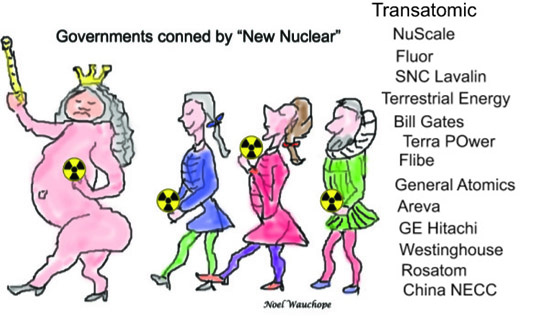
The nuclear snake oil salesmen now pitching Small Reactors as “green”

The Sierra Club says it has all the makings of a snake-oil sale. The organization would prefer the Obama administration abandon the extremely costly pursuit of advanced nuclear power in favor of greater investment in renewable energy such as solar and wind power.
Small-scale nuclear plants being pitched as new green, Albuquerque Journal, December 20th, 2015“……….State leaders aren’t necessarily rushing to embrace the vision in a place where all but one nuclear plant have been mothballed and where old-guard nuclear safety advocates warn that so-called advanced nuclear technologies are an attempt to put shiny earrings on the same old pig.
But the investors and nuclear scientists opening startup labs in the office parks of California’s technology hubs and within the research centers of universities see a more influential ally in the White House.
‘All of the above’ strategy Nuclear power is at the nub of the Obama administration’s “all of the above” strategy for reinventing the energy industry in an era of climate change, and its faith in the fraught power source has captured the imagination of some notable and deep-pocketed West Coast thinkers.
Investors, including Microsoft founder Bill Gates and PayPal co-founder Peter Thiel, have poured about $2 billion into a few dozen small outfits, many of which are concentrated in the West. …….
Nuclear déjà vu That may all be possible someday, say the nuclear experts at the Union of Concerned Scientists, but that day is probably several decades and many tens of billions of dollars away. The sudden excitement around nuclear makes them nervous. They say they have seen this before. Continue reading
Paris climate agreement – countries see that their national interest is served by the common good
 In Paris, the United Nations showed its ability to deliver hope and healing to the
  world, The Age, December 20, 2015 Ban Ki-moon
Governments have ushered in a new era of global co-operation on climate change – one of the most complex issues ever to confront humanity. In doing so, they have significantly advanced efforts to uphold our charter mandate to “save succeeding generations”.
The Paris agreement is a triumph for people, the environment, and for multilateralism. It is a health insurance policy for the planet. For the first time, every country in the world has pledged to curb their emissions, strengthen resilience and act internationally and domestically to tackle climate change.
Together, countries have agreed that, in minimising risks of climate change, the national interest is best served by pursuing the common good. It is an example we could gainfully follow across the political agenda……
The Paris agreement delivered on all the key points I called for. Markets now have the clear signal they need to scale up investments that will generate low-emissions, climate-resilient development.
All countries have agreed to work to limit global temperature rise to well below 2 degrees and, given the grave risks, to strive for 1.5 degrees. This is especially important for the nations of Africa, small island developing states and least developed countries.
In Paris, countries agreed on a long-term goal to cap global greenhouse gas emissions as soon as possible in the second half of the century. One hundred and eighty-eight countries have now submitted their intended nationally determined contributions, which show what they are prepared to do to reduce emissions and build climate resilience.
These national targets have already significantly bent the emissions curve downwards. But, collectively, they still leave us with an unacceptably dangerous 3 degrees temperature rise. That is why countries in Paris pledged that they will review their national climate plans every five years, beginning in 2018. This will allow them to increase ambition in line with what science demands.
The Paris agreement also ensures sufficient, balanced adaptation and mitigation support for developing countries, especially the poorest and most vulnerable. And it will help to scale up global efforts to minimise loss and damage from climate change.
Governments have agreed to binding, robust, transparent rules of the road to ensure that all countries do what they have said they would do. Developed countries have agreed to lead in mobilising finance and to scale up technology support and capacity building. And developing countries have assumed increasing responsibility to address climate change in line with their capabilities……
Now, with the Paris agreement in place, our thoughts must immediately turn to implementation. By addressing climate change we are advancing the 2030 Agenda for Sustainable Development. The Paris agreement has positive implications for all the sustainable development goals. We are poised to enter a new era of opportunity.
As governments, business and civil society begin the mammoth project of tackling climate change and realising the sustainable development goals, the UN will assist member states and society at large at every stage. As a first step in implementing the Paris agreement, I will convene a high-level signing ceremony in New York, on April 22 next year.
I will invite world leaders to come to help keep and increase momentum. By working together, we can achieve our shared objective to end poverty, strengthen peace, and ensure a life of dignity and opportunity for all.
Ban Ki-moon is Secretary-General of the United Nations. http://www.theage.com.au/comment/united-nations-has-proven-its-ability-to-deliver-hope-and-healing-to-the-world-20151220-glrslx.html#ixzz3uvsOVMH3
South Carolina nuclear workers made sick, and dying, by radiation
Editorial: Nuclear workers show America’s darker side http://www.islandpacket.com/opinion/editorials/article50722150.html ISLANDPACKET newsroom@islandpacket.com The numbers are sobering. The problem is immense.
In a special report presented over the past week, our fellow McClatchy journalists put faces on the heavy and often hidden cost of America’s atomic weaponry.
A total of 107,394 workers have been diagnosed with cancers and other diseases after building the nation’s nuclear stockpile over the last seven decades. At least 33,480 former nuclear workers are dead after helping the U.S. win World War II and the Cold War before getting sick enough to qualify for government compensation.
Taxpayers have spent $12 billion so far treating and compensating more than 53,000 sick nuclear workers.
But fewer than half the workers who sought help had their claims approved. More than 54,000 workers have been denied government help. Some say the government’s tactic is to “Delay, deny, until you die.”

South Carolina, home to the Savannah River Site outside Aiken, has certainly paid a toll to the silent killer.The site that turned 65 this year was established by President Truman to produce the basic materials used in the fabrication of nuclear weapons.
Nearly 40 million gallons of highly radioactive nuclear waste remains at SRS — 90 miles up the Savannah River from where much of Beaufort County’s drinking water is withdrawn. The waste is stored in aging tanks.
And the federal government’s poor record for helping its workers is matched or exceeded by its miserable record of dealing with the nuclear waste that will threaten workers and communities ad infinitum.
Earlier, McClatchy reported that the United States already has generated more than 80,000 tons of spent nuclear fuel and high-level nuclear waste, and the toxic materials are stored at some 80 sites in 35 states…….
What we see is a nation in denial. We see a nation willing to consider workers in its hodgepodge of nuclear sites to be collateral damage. We see a nation that has grossly underestimated the cost to the workers.
And we see a nation that for pure politics will endanger entire communities and states by failing to confront its sick legacy of the atomic age.
We see a nation that should do much better by its own people.http://www.islandpacket.com/opinion/editorials/article50722150.html
1 This Month

of the week – Shut Down Drone Warfare!


Tell the Ukrainian Government to Drop Prosecution of Peace Activist Yurii Sheliazhenko

Petition to revoke the licensing of the Near Surface Nuclear Disposal Facility (NSDF) at Chalk River. https://www.ourcommons.ca/petitions/en/Petition/Details?Petition=e-7247
To see nuclear-related stories in greater depth and intensity – go to https://nuclearinformation.wordpress.com
-
Archives
- April 2026 (91)
- March 2026 (251)
- February 2026 (268)
- January 2026 (308)
- December 2025 (358)
- November 2025 (359)
- October 2025 (376)
- September 2025 (257)
- August 2025 (319)
- July 2025 (230)
- June 2025 (348)
- May 2025 (261)
-
Categories
- 1
- 1 NUCLEAR ISSUES
- business and costs
- climate change
- culture and arts
- ENERGY
- environment
- health
- history
- indigenous issues
- Legal
- marketing of nuclear
- media
- opposition to nuclear
- PERSONAL STORIES
- politics
- politics international
- Religion and ethics
- safety
- secrets,lies and civil liberties
- spinbuster
- technology
- Uranium
- wastes
- weapons and war
- Women
- 2 WORLD
- ACTION
- AFRICA
- Atrocities
- AUSTRALIA
- Christina's notes
- Christina's themes
- culture and arts
- Events
- Fuk 2022
- Fuk 2023
- Fukushima 2017
- Fukushima 2018
- fukushima 2019
- Fukushima 2020
- Fukushima 2021
- general
- global warming
- Humour (God we need it)
- Nuclear
- RARE EARTHS
- Reference
- resources – print
- Resources -audiovicual
- Weekly Newsletter
- World
- World Nuclear
- YouTube
-
RSS
Entries RSS
Comments RSS
 nuclear-news