safety problems with Britain’s Trident ballistic missile submarine program
 Britain’s nuclear arsenal is a ticking time bomb, The Week, Tom Barlow Brown, 18 Dec 15 the United Kingdom’s nuclear deterrent, the Trident ballistic missile submarine program, worth keeping?
For the British Parliament and much of the media, the problem is mainly the vast amounts of money spent to keep it going. According to the U.K. Ministry of Defense, the program’s total cost is £15-20 billion. Anti-nuclear campaigners give a figure of around £100 billion, give or take. At least, that’s how much it should rack up in costs over its 40 year lifespan.
However, what is less talked about is how both the submarines and the bases that maintain them have suffered from a series of glaring safety mishaps.
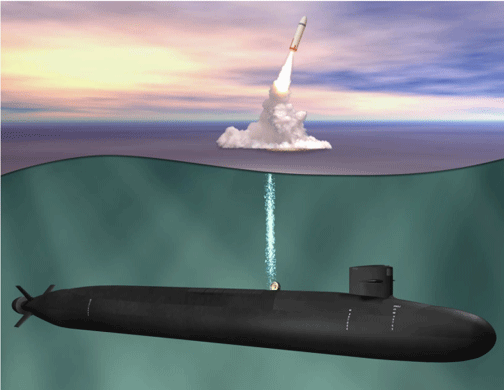
There are four Vanguard-class ballistic missile submarines currently in service with the Royal Navy. These 149.5-meter long, nuclear-powered vessels are relatively new — all of them having launched in the 1990s — but are aging fast. Each Vanguard-class submarine can carry up to 16 Trident II missiles, each one packing 12 independently-targetable nuclear warheads, meaning the nukes split off from the missile and explode in multiple locations. The actual number of deployed missiles and warheads, however, is a closely guarded secret.
Her Majesty’s Naval Base, Clyde in Scotland — otherwise known as Faslane — is the main base for the Royal Navy’s Trident subs, and has been exceedingly prone to accidents. The latest details come from a Royal Navy sailor-turned-whistleblower William McNeilly who published an 18-page report before going on the run.
McNeilly, writing under the pseudonym William Lewis, attacked the “military spin doctors” that he claimed distort the public’s knowledge of safety lapses. He detailed 30 accidents which range from the chilling to the ridiculous.
Among these were a fire in a missile compartment caused by a toilet rolls set too close to a cable, a range of problems with hydraulic systems and a general failure to follow safety procedures. The document also makes it clear that a number of safety issues were due to heavy cutbacks, resulting in a lack of qualified personnel…….
There are other concerns about safety at a different naval base in the United Kingdom — the Devonport dockyard, which is the largest naval base in Western Europe.
The most frightening of these accidents was the loss of power to the “nuclear ring” reactor cooling system of one submarine for 90 minutes. Had power not been restored, such an incident could have had potentially catastrophic consequences resulting in a major nuclear incident.
The dockyard is within walking distance of the city of Plymouth, home to around 250,000 people. Most of these residents would be in danger in the event of a reactor meltdown.
In 2011, a previously classified document authored by the base’s ex-safety regulator Commodore Andrew McFarlane warned that the reactors powering nuclear submarines based at Devonport were possibly unsafe……..
A House of Commons vote to renew Trident is expected in 2016.
After that, a fleet of replacement submarines will enter service in the early 2030s… if everything goes to plan. However, that is still a long way off, and the current class of Vanguard submarines will needs increasing amounts of maintenance to keep them running through the next decade.
The issue of Trident is back in the political limelight again with the current Labour Party and opposition leader Jeremy Corbyn looking to put scrapping the program on his party’s political agenda. In the meantime, it remains to be seen whether the Ministry of Defense will take any action on the program’s safety.
If they don’t, the consequences could be deadly serious.http://www.theweek.com/articles/594745/britains-nuclear-arsenal-ticking-time-bomb
No comments yet.
1 This Month

of the week – Shut Down Drone Warfare!


Tell the Ukrainian Government to Drop Prosecution of Peace Activist Yurii Sheliazhenko

Petition to revoke the licensing of the Near Surface Nuclear Disposal Facility (NSDF) at Chalk River. https://www.ourcommons.ca/petitions/en/Petition/Details?Petition=e-7247
To see nuclear-related stories in greater depth and intensity – go to https://nuclearinformation.wordpress.com
-
Archives
- March 2026 (244)
- February 2026 (268)
- January 2026 (308)
- December 2025 (358)
- November 2025 (359)
- October 2025 (376)
- September 2025 (257)
- August 2025 (319)
- July 2025 (230)
- June 2025 (348)
- May 2025 (261)
- April 2025 (305)
-
Categories
- 1
- 1 NUCLEAR ISSUES
- business and costs
- climate change
- culture and arts
- ENERGY
- environment
- health
- history
- indigenous issues
- Legal
- marketing of nuclear
- media
- opposition to nuclear
- PERSONAL STORIES
- politics
- politics international
- Religion and ethics
- safety
- secrets,lies and civil liberties
- spinbuster
- technology
- Uranium
- wastes
- weapons and war
- Women
- 2 WORLD
- ACTION
- AFRICA
- Atrocities
- AUSTRALIA
- Christina's notes
- Christina's themes
- culture and arts
- Events
- Fuk 2022
- Fuk 2023
- Fukushima 2017
- Fukushima 2018
- fukushima 2019
- Fukushima 2020
- Fukushima 2021
- general
- global warming
- Humour (God we need it)
- Nuclear
- RARE EARTHS
- Reference
- resources – print
- Resources -audiovicual
- Weekly Newsletter
- World
- World Nuclear
- YouTube
-
RSS
Entries RSS
Comments RSS
 nuclear-news
Leave a comment