Nuclear news this week
 Investigative journalism lives! In this media climate of the 24 hr news cycle, and of journalists losing their jobs – it can still happen! This week:
McClatchy News Service’s Washington Bureau’s Rob Hotakainen, Lindsay Wise, Frank Matt and Samantha Ehlinger spent a year, over 100 interviews across USA, and analysing over 70 million records in a federal database obtained under the Freedom of Information Act, for this story:
At least 33,480 American nuclear workers dead from radiation-caused illness
The Center For Public Integrity’s India’s nuclear industry pours its wastes into a river of death and disease, and also India’s repression of activists who protest about its poor safety record.
The mind boggles – in reading about America’s sick nuclear workers – to think what the situation might be in Russia, or China, where no investigative journalist would get a chance to study and publicise it!
Study: Environmental Exposures Account for Vast Majority of Cancers.
Global trend towards bankruptcy for the nuclear industry.
CLIMATE. The Paris Agreement on climate — a good start, but… SO FAR, nuclear lobbyists have not managed to hijack climate action funding. Nuclear lobby in frantic mode at Paris Climate Summit. The new climate denialism – that renewable energy “doesn’t work”. Sea level rise threatens nuclear stations and nuclear waste dumps. Corporate Astroturf “Nuclear for Climate” is really a lobby group of 140 pro nuclear societies. USA govt’s Mission Innovation should not send tax-payer money to Bill Gates’ nuclear dream.
GERMANY abandoning nuclear fission, but has developed research nuclear fusion reactor. Belgium’s nuclear restart causes anxiety in adjacent North Rhine-Westphalia.
USA. Former Clinton Defense Secretary offers dire warning on nuclear war risk. Donald Trump shows abysmal ignorance about USA’s nuclear weapons. Endless delays – that’s the system for Hanford nuclear waste clean-up. Nuclear Regulatory Commission: obfuscation when it comes to Freedom of Information. Gloomy prediction for USA’s nuclear industry. Strong wind power takes over New York’s electricity as nuclear station shut down. New York Governor Cuomoorders investigation of Indian Point Nuclear Station. Dangers of USNRC Approval of Broken Nuclear Spent Fuel Rod Storage
Kansas’ nuclear workers with cancer from exposure to radiation. Idaho nuclear workers: 360 killed by by exposure to radiation. Texas nuclear workers sick and dying from exposure to radiation. Mississipi nuclear workers victims of radiation Huge increase in medical insurance claims by nuclear workers.
INDIA‘s secret nuclear weapons building city. Japan-India nuclear deal sounds good, but not likely in practice.
JAPAN. Declassified report shows Fukushima nuclear situation much worse than we were told. Enormous increase inradiation levels in Fukushima underground ducts. High level nuclear waste into the ocean: Japanese govt’s latest idea. Cover-up of radiation effects makes Fukushima victims’ lives even worse.
UKRAINE troubles continue with the toxic Chernobyl site
UK Tax-payer funding to go to Britain’s small nuclear reactor companies! Toshiba’s financial travails threaten UK’s nuclear power plans. Britain’s heavy burden – its Trident nuclear programme.
IRAN IAEA concludes its probe in Iran’s history of nuclear weapons research
RUSSIA Missing highly enriched uranium canisters probably came from Mayak nuclear facility
CHINA Concerns about China’s nuclear technology: is it safe?
Anxieties about terrorism prompt Japan to increase nuclear security measures
 Japan Is Trying to Terror-Proof Its Recently Reopened Nuclear Reactors http://gizmodo.com/japan-is-trying-to-terror-proof-its-recently-reopened-n-1748754635 Bryan Lufkin In August, Japan reopened its first nuclear reactors after an almost two-year hiatus that followed the 2011 earthquake and tsunami. Now, months later, Kyushu Electric Power Co. is preparing to guard the controversial energy source against terrorist attacks, too.
Asahi Shimbun reports that Kyushu Electric Power Co. will build off-site terror response centers near the two rebooted reactors at Sendai Nuclear Power Plant in Kagoshima Prefecture on Japan’s southern tip. That’s on the opposite side of the country from where the Fukushima quake, tsunami, and resultant nuclear disaster at the Daiichi power plant unfolded—but the government had issued a nationwide nuclear shutdown following the crisis.
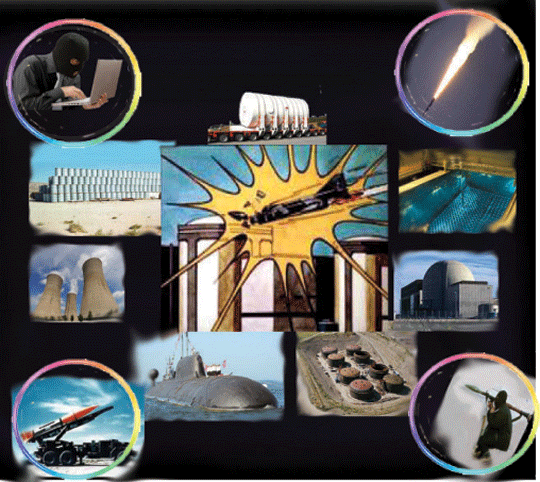
The $775 million emergency centers aren’t a direct response to recent terrorist attacks across the globe. Their installation is part of nuclear safety guidelines that were rolled out in 2013. They will be installed in Kagoshima first, and will then be built elsewhere in Japan.
Among other safeguards, there’ll be a control room from which staff can remotely cool reactors in case an aircraft crashes into them. The company hopes to have installation finished by 2020, the same year nearly a million foreigners will be in the country for Tokyo’s Summer Olympic Games.
Japan—one of the most quake-prone nations on Earth—has seen a lot of public opposition in the face of the government’s return to nuclear energy after the Fukushima tragedy. Problem is, the island country is largely mountainous and fairly small, so it lacks a lot of natural resources, and importing energy like natural gas is expensive. (Japan is the world’s largest importer of liquefied natural gas.)
Meanwhile, with the heightened global presence of Islamic State supporters, the Japanese government has been more concerned about facing possible terror threats in the future. Earlier this year, ISIS kidnapped and executed two Japanese journalists in Syria.
While there’s no way to truly terror-proof something, at least these steps are barriers to catastrophe.
Germany abandoning nuclear fission, but has developed research nuclear fusion reactor
 Germany Tests Fusion Reactor, But Will Abandon Nuclear By 2022 The Daily Caller ANDREW FOLLETT , 18 Dec 15 Germany tested an experimental fusion reactor last week, but the country is set to abandon conventional nuclear fission power entirely by 2022 in favor of solar and wind.
German engineers from the Max Planck Institute have successfully activated an experimental nuclear fusion reactor and successfully managed to suspend plasma for the first time. The reactor took 19 years and €1 billion euros ($1.1 billion) to build, and contains over 470 tons of superconducting magnets, all of which need to be cooled to absolute zero.The reactor passed the major technical milestone of generating its first plasma, which had a duration of one-tenth of a second and achieved a temperature of around one million degrees Celsius. If the reactor fulfills the research team’s expectations, it could demonstrate the first stable artificial nuclear fusion reaction within the next year.

World’s largest nuclear fusion reactor launched by Germany
Germany launches world’s largest nuclear fusion reactor The rocky road to nuclear fusion power, DW, 18 Dec 15 Innovative designs using modern superconductors are supposed to bring us nuclear fusion power plants soon – some optimists say. Fusion experts predict, however, that a practical application will take many more decades. Nuclear fusion is considered a potential energy source of the future. It’s clean nuclear energy. But what is it, exactly and why is it so difficult to generate? Let’s start with the difference between classical nuclear fission and nuclear fusion.
Nuclear fission means that radioactive isotopes, like uranium or plutonium are being split up and turned into other highly radioactive isotopes that then have to be deposited or reprocessed.
Nuclear fusion means that two isotopes of hydrogen – called deuterium and tritium – merge together – they “fuse.” And that leaves behind only non-poisonous helium and one single neutron, but no nuclear waste.
Huge amounts of energy caught in a plasma
Nuclear fusion takes place in the sun for example – or in a hydrogen bomb – and that’s the big challenge for engineers – how do you control the high energy fusion process in a power plant?
That’s what scientists have been working on since the 1960s. One model-fusion-reactor called Wendelstein 7-X has just started operating in the northern German town of Greifswald. It is not designed to generate a nuclear fusion reaction yet – so far it’s just a specific reactor design that’s being tested.
What all fusion reactors have in common is a ring-shaped form. The idea behind it is to take powerful electromagnets and create a strong electromagnetic field, which is shaped somewhat like an inflated bicycle tube.
That electromagnetic field must be so dense that when it is being heated by a microwave oven to about one million degrees centigrade, a plasma will emerge in the very center of the ring. And that plasma can then be ignited to start the nuclear fusion process.
Research reactors show what’s possible
In Europe, two prominent fusion experiments are under way. One is Wendelstein 7-X, which just generated its first helium plasma last week – albeit without actually going into nuclear fusion. The other one is ITER – a huge experimental project in southern France, which is still under construction and won’t be ready to run before 2023.
ITER is supposed to do real nuclear fusion – but only for short periods of time, certainly not for any longer than 60 minutes. And ITER is just one of many steps towards turning the idea of nuclear fusion into a practical application.
Are smaller, alternative designs feasible?………
Hot, hot, hot
The heat is also problematic. In the core of the nuclear-fusion plasma, the temperature would be around 150 million centigrade. This extreme heat stays put – right there in the center of the plasma. But even around it, it still gets seriously hot – 500 to 700 degrees at the breeding blanket – which is the inner layer of the metal tube that contains the plasma and which will serve to “breed” the tritium that is needed for the fusion reaction.
Even more problematic is the so called “power-exhaust.” That is the part of the system, where the used-up fuel from the fusion process is being extracted – mostly helium. The first metal components hit by hot gases are called the “diverter.” It can get hotter than 2,000 degrees centigrade.
The engineers are trying to use the metal tungsten, used in old-fashioned light bulbs – to withstand such temperatures. They have a melting point of around 3,000 degrees. But there are limits.
“In the case of ITER we can do it, because the heat is not there constantly. Only one to three percent of the time, ITER will eventually be running.” Hesch says. “But that is not an option for a power plant, which has to run 24/7. And if someone pretends to build a smaller reactor with the same power as ITER, I can definitely say – there is no solution for that diverter-problem.”
Several decades to build a real power plant
Nonetheless Hesch is optimistic that the development of nuclear fusion power reactors will go ahead – but not quite as fast as some of the industry optimists predict.
“With ITER we want to show that fusion can actually deliver more energy than we have to put into it to heat the plasma. The next step would be to build an entirely new fusion demonstrator power plant, which will actually generate electricity.”
The engineers are already working on the designs now. They will have to learn lessons from ITER, which is scheduled to start operating in 2023. Taking the necessary time for design, planning and construction into account, it looks very unlikely the first nuclear-fusion power plant will be up and running much before the middle of the century. http://www.dw.com/en/the-rocky-road-to-nuclear-fusion-power/a-18927630
safety problems with Britain’s Trident ballistic missile submarine program
 Britain’s nuclear arsenal is a ticking time bomb, The Week, Tom Barlow Brown, 18 Dec 15 the United Kingdom’s nuclear deterrent, the Trident ballistic missile submarine program, worth keeping?
For the British Parliament and much of the media, the problem is mainly the vast amounts of money spent to keep it going. According to the U.K. Ministry of Defense, the program’s total cost is £15-20 billion. Anti-nuclear campaigners give a figure of around £100 billion, give or take. At least, that’s how much it should rack up in costs over its 40 year lifespan.
However, what is less talked about is how both the submarines and the bases that maintain them have suffered from a series of glaring safety mishaps.
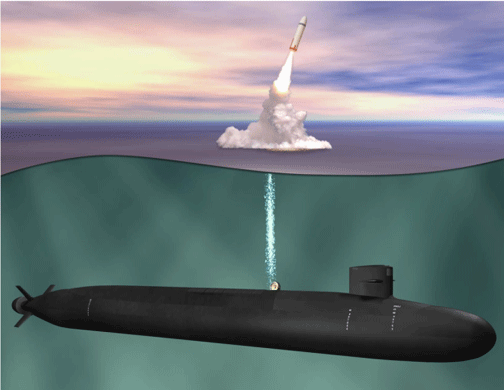
There are four Vanguard-class ballistic missile submarines currently in service with the Royal Navy. These 149.5-meter long, nuclear-powered vessels are relatively new — all of them having launched in the 1990s — but are aging fast. Each Vanguard-class submarine can carry up to 16 Trident II missiles, each one packing 12 independently-targetable nuclear warheads, meaning the nukes split off from the missile and explode in multiple locations. The actual number of deployed missiles and warheads, however, is a closely guarded secret.
Her Majesty’s Naval Base, Clyde in Scotland — otherwise known as Faslane — is the main base for the Royal Navy’s Trident subs, and has been exceedingly prone to accidents. The latest details come from a Royal Navy sailor-turned-whistleblower William McNeilly who published an 18-page report before going on the run.
McNeilly, writing under the pseudonym William Lewis, attacked the “military spin doctors” that he claimed distort the public’s knowledge of safety lapses. He detailed 30 accidents which range from the chilling to the ridiculous.
Among these were a fire in a missile compartment caused by a toilet rolls set too close to a cable, a range of problems with hydraulic systems and a general failure to follow safety procedures. The document also makes it clear that a number of safety issues were due to heavy cutbacks, resulting in a lack of qualified personnel…….
There are other concerns about safety at a different naval base in the United Kingdom — the Devonport dockyard, which is the largest naval base in Western Europe.
The most frightening of these accidents was the loss of power to the “nuclear ring” reactor cooling system of one submarine for 90 minutes. Had power not been restored, such an incident could have had potentially catastrophic consequences resulting in a major nuclear incident.
The dockyard is within walking distance of the city of Plymouth, home to around 250,000 people. Most of these residents would be in danger in the event of a reactor meltdown.
In 2011, a previously classified document authored by the base’s ex-safety regulator Commodore Andrew McFarlane warned that the reactors powering nuclear submarines based at Devonport were possibly unsafe……..
A House of Commons vote to renew Trident is expected in 2016.
After that, a fleet of replacement submarines will enter service in the early 2030s… if everything goes to plan. However, that is still a long way off, and the current class of Vanguard submarines will needs increasing amounts of maintenance to keep them running through the next decade.
The issue of Trident is back in the political limelight again with the current Labour Party and opposition leader Jeremy Corbyn looking to put scrapping the program on his party’s political agenda. In the meantime, it remains to be seen whether the Ministry of Defense will take any action on the program’s safety.
If they don’t, the consequences could be deadly serious.http://www.theweek.com/articles/594745/britains-nuclear-arsenal-ticking-time-bomb
Radioactive matter travels faster than expected through carbonate rock
Radioactive matter migrates more quickly through fractured carbonate rock, Science Daily December 18, 2015
- Source:
- American Associates, Ben-Gurion University of the Negev
- Summary:
- A new study has determined the impact of intrinsic colloid formation on increased migration of leaked radioactive materials in the environment. Colloids are microscopic inorganic or organic solids that remain suspended in water. Intrinsic colloids are formed when radioactive waste mixes with other dissolved components in the groundwater, such as bicarbonate.
- Researchers at Ben-Gurion University of the Negev (BGU) have found that radioactive matter migrates more quickly in carbonate bedrock formations once it has leaked from a tank from near surface waste sites and geological repositories.
Corroded stored waste containers can lead to radionuclide (radioactive) leakage, which may reach groundwater.
The study, published in the online journal Environmental Science & Technology (ACS Publications), determined the impact of intrinsic colloid formation on increased migration of leaked radioactive materials in the environment. Colloids are microscopic inorganic or organic solids that remain suspended in water. Intrinsic colloids are formed when radioactive waste mixes with other dissolved components in the groundwater, such as bicarbonate.
“This study showed that intrinsic colloids formed by interactions between soluble Cerium (Ce) and carbonates significantly increase the mobility of Ce injected into a carbonate rock fracture,” explains BGU Zuckerberg Institute for Water Research Director Prof. Noam Weisbrod, Ph.D. “The formation of intrinsic colloids, if not accounted for, could result in the under prediction of radionuclide migration through fractures in fine-grained carbonate bedrock, such as chalk.”……..http://www.sciencedaily.com/releases/2015/12/151218110259.htm
India’s PM Narendra Modi off to Russia to negotiate nuclear reactor purchases
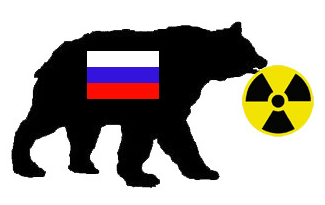
 India, Russia eye nuclear, helicopter deals prior to Modi visit, Hindustan Times, Reuters, New Delhi Dec 18, 2015 Prime Minister Narendra Modi is expected to promote deals for Russian nuclear reactors and military helicopters worth billions of dollars on a trip to Moscow next week, attracted by promises to transfer technology that Western nations have been slow to make…….
Modi, who heads for Moscow on December 23, will also offer Russia a site in Andhra Pradesh to build six nuclear reactors of 1,200 megawatts (MW) each, the same sources added.
That is in addition to the six Russia is constructing in neighbouring Tamil Nadu, said the officials, who spoke on condition of anonymity because they were not authorised to speak to the press.
New Delhi has turned to Russia as US firm General Electric and Westinghouse, a US-based unit of Japan’s Toshiba, are still weighing an entry into India’s nuclear energy sector because of a law that makes reactor suppliers liable in case of an accident………
Russian President Vladimir Putin is banking on India’s drive to manufacture at home to regain market share…….http://www.hindustantimes.com/india/india-russia-eye-nuclear-helicopter-deals-prior-to-modi-visit/story-wdxOqkpbmKbbi8hu8QxHjM.html
China should not be supplying nuclear reactors to Pakistan – says India
India red flags fresh nuclear reactors in Pakistan with China’s help By Dipanjan Roy Chaudhury, ET Bureau | 18 Dec, 2015 NEW DELHI: India has red flagged fresh nuclear reactors that are being set up in Pakistan with Chinese assistance and asserted that it is taking adequate steps to safeguard any challenge to the country’s security due to these developments.
“The government remains committed to taking all necessary steps to safeguard India’s national security interests,” he said.
Earlier this year a Chinese official publicly confirmed that Beijing is involved in at least six nuclear power projects in Pakistan and is likely to export more to the country. …….
Revelations about the growing Sino-Pakistan nuclear partnership comes amid continuing concerns in some quarters that ongoing cooperation is happening without the sanction of the Nuclear Suppliers Group (NSG) which helps supervise the export of global civilian nuclear technology. China is a member of the NSG and existing regulations prohibit members from exporting such technology to nations such as Pakistan which does not have full-fledged safeguard mechanism……
http://economictimes.indiatimes.com/articleshow/50227479.cms?utm_source=contentofinterest&utm_medium=text&utm_campaign=cppst
1 This Month

of the week – Shut Down Drone Warfare!


Tell the Ukrainian Government to Drop Prosecution of Peace Activist Yurii Sheliazhenko

Petition to revoke the licensing of the Near Surface Nuclear Disposal Facility (NSDF) at Chalk River. https://www.ourcommons.ca/petitions/en/Petition/Details?Petition=e-7247
To see nuclear-related stories in greater depth and intensity – go to https://nuclearinformation.wordpress.com
-
Archives
- March 2026 (244)
- February 2026 (268)
- January 2026 (308)
- December 2025 (358)
- November 2025 (359)
- October 2025 (376)
- September 2025 (257)
- August 2025 (319)
- July 2025 (230)
- June 2025 (348)
- May 2025 (261)
- April 2025 (305)
-
Categories
- 1
- 1 NUCLEAR ISSUES
- business and costs
- climate change
- culture and arts
- ENERGY
- environment
- health
- history
- indigenous issues
- Legal
- marketing of nuclear
- media
- opposition to nuclear
- PERSONAL STORIES
- politics
- politics international
- Religion and ethics
- safety
- secrets,lies and civil liberties
- spinbuster
- technology
- Uranium
- wastes
- weapons and war
- Women
- 2 WORLD
- ACTION
- AFRICA
- Atrocities
- AUSTRALIA
- Christina's notes
- Christina's themes
- culture and arts
- Events
- Fuk 2022
- Fuk 2023
- Fukushima 2017
- Fukushima 2018
- fukushima 2019
- Fukushima 2020
- Fukushima 2021
- general
- global warming
- Humour (God we need it)
- Nuclear
- RARE EARTHS
- Reference
- resources – print
- Resources -audiovicual
- Weekly Newsletter
- World
- World Nuclear
- YouTube
-
RSS
Entries RSS
Comments RSS
 nuclear-news