The climate risks of nation-states’ coal industries, and of continuing exploration for oil and gas
There is a new form of climate denialism to look out for – so don’t celebrate yet, Guardian, Naomi Oreskes, 17 Dec 15 “………And here, there are some interesting facts that most people don’t know. In a recent study that I did with my colleague Richard Heede, we examined the potential impact of using the proven reserves of fossil fuels in the world. We discovered a surprising fact: if all the reserves in the hands of investor-owned companies were to be burned, we would not exceed the 2C (3.6F) target.
What puts the world at risk are the reserves in the hands of nation-states – which are mostly coal – and the continued exploration for more oil and gas by private companies like Exxon-Mobil, Chevron, BP and Shell. Most of the coal reserves are in developing nations such as China, which increasingly recognizes the very serious damage that coal use entails and is looking for alternatives modes of development. So this leaves us with the investor-owned companies seeking new reserves, and it means that we must find a way to convince – or prevent – these companies from continued exploration.
So far no one has proposed a plan to do that, and we probably won’t get very far if the alternatives to fossil fuel – such as renewable energy – are disparaged by a new generation of myths. If we want to see real solutions implemented, we need to be on the lookout for this new form of denial.
There have been important signs of late of cracks in the Republican rejection of climate science, as some party leaders have signaled their willingness to consider carbon pricing. Still, as new forms of denialism continue to emerge, it is hard to imagine federal implementation of a climate plan any time soon, much less the sort of ambitious plan that would help keep the world below the 1.5-2C (2.7-3.6F) level of warming, per the Paris agreement.
When President Obama rejected the Keystone XL pipeline, many critics of the decision (and even some supporters) said it was merely symbolic. Symbols matter – so even if it were, that would not necessarily be bad. But rejecting XL was a crucial step in the direction of rejecting new commitments to fossil fuel infrastructure. ……….http://www.theguardian.com/commentisfree/2015/dec/16/new-form-climate-denialism-dont-celebrate-yet-cop-21
Increased risk of nuclear war by accident, by miscalculation
 Red lines and mushroom clouds, Online opinion, By Marko Beljac , 16 December 2015 When the great powers set red lines they do so under the shadow cast by mushroom clouds.It’s just as hard to miss the tinge of red in the mushroom clouds produced by the explosion of a hydrogen bomb as it is the setting of “red lines” that has coloured much international relations over recent times.
In June 1983 the General Secretary of the Central Committee of the Communist Party of the Soviet Union, Yuri Andropov, warned US envoy Averell Harriman that the actions and rhetoric of the Reagan administration were leading the US and the USSR toward “the dangerous red line” of nuclear war through “miscalculation.” Six months later that red line was reached, but thankfully, was not breached. It was a close run affair, we now know……
Today all the nuclear powers, so far as we are aware, are modernising their nuclear weapons precisely as they are setting new red lines. They are doing so because they understand that red lines stay bright red when the shadow cast by the mushroom cloud remains clear to all and sundry.
All this moves us toward the “dangerous red line” of nuclear war through “miscalculation.” This is because the nuclear weapons of the US and Russia remain on high alert, a posture known as “launch on warning.” In a crisis high alert levels lead to a “use them or lose them” dynamic that puts a premium on striking first…….
To make matters worse the red line that the United States casts for Russia now sits on her very borders. That has been perhaps the most significant long term strategic affect of the crisis in Ukraine. We now have both Washington and Moscow thinking they can play cat and mouse with nuclear weapons, and that when the red lines sit upon the Rodina herself.
The United States has no red lines; it is free to subvert, bomb and invade at will in order to advance its interests. Russia, by contrast, cannot act to secure its interests beyond the red line…….
Despite what may be the case on the ground the most important strategic affect of the Ukraine crisis is the official extension of the US red line to the borders of Russia.
The imposition of sanctions, the isolation of Russia politically, and the significant freezing of US-Russian relations means precisely this……..
In Syria we see the deployment of military firepower by both Russia, US allies such as Turkey and, of course, the United States itself. These deployments seek to establish and maintain red lines, as demonstrated by Turkey’s shooting down of a Russian military aircraft, a dangerous precedent, and Russia’s deployment of firepower to prevent anti Assad forces from crossing red lines in the internal conflict. The United States has also set red lines in Syria which Assad dare not cross.
The scramble to set red lines also occurs in the Asia Pacific as witnessed by the interplay between China, the United States and Japan. China is setting red lines a little bit beyond its borders in strategically and economically significant islands.
However, as with Russia, the United States has set its red line on China’s border as evidenced by its efforts to counter what it calls Beijing’s strategy of “anti access/area denial,” which is designed, we are told, to deny the Pentagon access to China’s red lines namely her borders…….
As the world slowly becomes more multipolar the expansive US setting of red lines, whilst maintaining freedom of action for itself, undermines global strategic stability, for the setting and counter setting of red lines compels the military forces of the great powers to increasingly engage in military exercises in close proximity to each other…..
In the nuclear age more than ever security is a common property or a common resource. This is because, despite all the efforts to achieve escalation control, the nuclear powers are locked into a condition of interdependency that technology and strategy cannot break.
To reignite an impetus for common security will require remobilising the peace movement; one of the benefits of the end of the cold war for elites was that it had the affect of demobilising the movement. Although it sprang up again in the context of Iraq and the “war on terror” it lacked an encompassing vision for common security, was largely reactive, and so as a consequence was easily dispersed.
We need to rearticulate a programme of common security and fight for it using the panoply of mobilisations and direct actions that the peace movement of the 1980s was noted for.
Meaningful human survival will depend upon an aroused global citizenry that dares once again to set red lines for the world’s elites. http://www.onlineopinion.com.au/view.asp?article=17898
Corporate Astroturf “Nuclear for Climate” is really a lobby group of 140 pro nuclear societies.
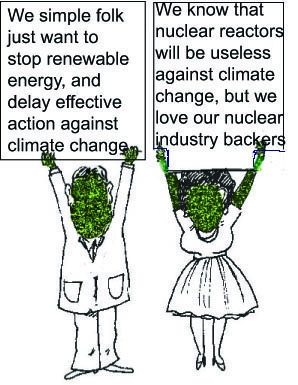 Nuclear for Climate isn’t a network of grassroots environmentalists, it’s a network of more than 140 nuclear societies. It isn’t grassroots environmentalism, it’s corporate astroturf.
Nuclear lobbyists’ epic COP21 fail. Our next job? Keep their hands off climate funds, Ecologist, Jim Green16th December 2015 “……..Robert Stone, director of the Pandora’s Promise pro-nuclear propaganda film, launched a ‘resource hub’ called Energy For Humanity, promoting “more advanced, mass-producible, passively safe, reactor designs”.
Rauli Partanen and Janne Korhonen, members of the Finnish Ecomodernist Society, have been attacking environmentalists for opposing nuclear power. Rebutting a rebuttal by Michael Mariotte from the Nuclear Information and Resource Service, Partanen and Korhonen offer this gem:
“Even the much-maligned Olkiluoto 3 nuclear project [in Finland] turns out to be very fast way of adding low-carbon energy production when compared to any real-world combination of alternatives.”
A single reactor that will take well over a decade to build (and is three times over budget) is a “very fast way” of adding low-carbon energy? Huh? Maybe that’s why a second reactor of the same EPR design to be built at Okiluoto was cancelled in May 2015, while the main players are locked in a €10 billion legal battle.
‘The instransigent network of anti-nukes’ versus Astroturf
Partanen and Korhanan authored a booklet called ‘Climate Gamble: Is Anti-Nuclear Activism Endangering Our Future?‘, and crowdfunded the printing of 5,000 copies which were distributed for free at the COP21 conference.
James Hansen and three other climate scientists were in Paris to promote nuclear power. Hansen attacks the “intransigent network of anti-nukes” that has “grown to include ‘Big Green,’ huge groups such as the Natural Resources Defense Council, Environmental Defense Fund and World Wide Fund for Nature. They have trained lawyers, scientists, and media staff ready to denounce any positive news about nuclear power.”
By way of sharp contrast, the impoverished US nuclear industry could only rustle up US$60 million (€55m) to lobby Congress and federal agencies in 2013-14.
So is there an undercurrent of grassroots pro-nuclear environmentalism waiting to burst forth if only their voice could cut through Big Green hegemony? Perhaps Nuclear for Climate, promoted as a ‘grassroots organization‘, is the environmental network to take on Big Green?
Well, no. Nuclear for Climate isn’t a network of grassroots environmentalists, it’s a network of more than 140 nuclear societies. It isn’t grassroots environmentalism, it’s corporate astroturf.
And the list of 140 associations includes 36 chapters of the ‘Women in Nuclear’ organisation and 43 chapters of the ‘Young Generation Network’. One wonders whether these organisations have any meaningful existence. Does Tanzania really have a pro-nuclear Young Generation Network? Don’t young people in Tanzania have better things to do?
Nuclear for Climate has a website, a hashtag, a twitter handle and all the modern social media sine qua non. But it has some work to do with its messaging. One of its COP21 memes was: ‘The radioactive waste are not good for the climate? Wrong!’ So radioactive waste is good for the climate?! http://www.theecologist.org/News/news_analysis/2986693/nuclear_lobbyists_epic_cop21_fail_our_next_job_keep_their_hands_off_climate_funds.html
India moves closer into nuclear industry of dubious safety
The strange love for nuclear energy http://www.thehindu.com/opinion/lead/on-the-indiajapan-civil-nuclear-deal/article7996972.ece M.V. RAMANA SUVRAT RAJU
The prospect of a nuclear deal with Japan is worrying because it ignores voices on the ground and takes India a step closer to the construction of untested and expensive reactors
During Japanese Prime Minister Shinzô Abe’s visit to India last week, Japan and India reportedly made progress on a nuclear deal that they have been discussing for more than seven years. The governments did not actually conclude the deal: the Joint Statement released by the Prime Ministers only includes a droll phrase welcoming the “agreement reached… on the Agreement… for Cooperation in the Peaceful Uses of Nuclear Energy” and expresses the hope that “this Agreement will be signed after the technical details are finalised”.
- These “details” include deep concerns about India’s growing weapons arsenal within Japan’s polity that even Mr. Abe’s militaristic government has found difficult to ignore. Nevertheless, even the prospect of an India-Japan nuclear deal is worrying because it takes the country a step closer to the construction of untested and expensive reactors. Moreover, despite the Narendra Modi government’s “Make in India” rhetoric, the agreement will primarily benefit multinational corporations based in Japan. Continue reading
India’s secret nuclear weapons building city
 India Is Building a Top-Secret Nuclear City to Produce Thermonuclear Weapons, Experts Say The weapons could upgrade India as a nuclear power — and deeply unsettle Pakistan and China. Foreign Policy.com BY ADRIAN LEVY DECEMBER 16, 2015 “………..Only after construction on the site began that year did it finally become clear to the tribesmen and others that two secretive agencies were behind a project that experts say will be the subcontinent’s largest military-run complex of nuclear centrifuges, atomic-research laboratories, and weapons- and aircraft-testing facilities when it’s completed, probably sometime in 2017. Among the project’s aims: to expand the government’s nuclear research, to produce fuel for India’s nuclear reactors, and to help power the country’s fleet of new submarines.
But another, more controversial ambition, according to retired Indian government officials and independent experts in London and Washington, is to give India an extra stockpile of enriched uranium fuel that could be used in new hydrogen bombs, also known as thermonuclear weapons, substantially increasing the explosive force of those in its existing nuclear arsenal.
India’s close neighbors, China and Pakistan, would see this move as a provocation: Experts say they might respond by ratcheting up their own nuclear firepower. Pakistan, in particular, considers itself a military rival, having engaged in four major conflicts with India, as well as frequent border skirmishes.
New Delhi has never published a detailed account of its nuclear arsenal, which it first developed in 1974, and there has been little public notice outside India about the construction at Challakere and its strategic implications. The government has said little about it and made no public promises about how the highly enriched uranium to be produced there will be used. As a military facility, it is not open to international inspection.
But a lengthy investigation by the Center for Public Integrity (CPI), including interviews with local residents, senior and retired Indian scientists and military officers connected to the nuclear program, and foreign experts and intelligence analysts, has pierced some of the secrecy surrounding the new facility, parts of which are slated to open in 2016. This new facility will give India a nuclear capability — the ability to make many large-yield nuclear arms — that most experts say it presently lacks.
A nuclear stockpile in a dangerous neighborhood
The independent Stockholm International Peace Research Institute (SIPRI)estimates that India already possesses between 90 and 110 nuclear weapons, as compared to Pakistan’s estimated stockpile of up to 120. China, which borders India to the north, has approximately 260 warheads…..
India, according to former Australian nonproliferation chief John Carlson, is one of just three countries that continue to produce fissile materials for nuclear weapons — the others are Pakistan and North Korea. The enlargement of India’s thermonuclear program would position the country alongside the United Kingdom, the United States, Russia, Israel, France, and China, which already have significant stockpiles of such weapons.
Few authorities in India are willing to discuss these matters publicly, partly because the country’s Atomic Energy Act and the Official Secrets Act shroud everything connected to the Indian nuclear program and in the past have been used to bludgeon those who divulge details. Spokesmen for the two organizations involved in the Challakere construction, the Defense Research and Development Organisation (DRDO) and the Bhabha Atomic Research Centre (BARC), which has played a leading role in nuclear weapons design, declined to answer any of CPI’s questions, including about the government’s ambitions for the new park. The Indian Ministry of External Affairs also declined to comment.
The secret city emerges
Western analysts, speaking on condition of anonymity, say, however, that preparation for this enrichment effort has been underway for four years, at a second top-secret site known as the Rare Materials Plant, 160 miles to the south of Challakere, near the city of Mysore.
Satellite photos of that facility from 2014 have revealed the existence of a new nuclear enrichment complex that is already feeding India’s weapons program
Satellite photos of that facility from 2014 have revealed the existence of a new nuclear enrichment complex that is already feeding India’s weapons program and, some Western analysts maintain, laying the groundwork for a more ambitious hydrogen bomb project. It is effectively a test bed for Challakere, they say, a proving ground for technology and a place where technicians can practice producing the highly enriched uranium the military would need……..
Gary Samore, who served from 2009 to 2013 as the White House coordinator for arms control and weapons of mass destruction, said there was little misunderstanding. “I believe that India intends to build thermonuclear weapons as part of its strategic deterrent against China,” said Samore. It is unclear, he continued, when India will realize this goal of a larger and more powerful arsenal, but “they will.”
A former senior British official who worked on nuclear issues likewise said intelligence analysts on both sides of the Atlantic are “increasingly concerned” about India’s pursuit of thermonuclear weapons and are “actively monitoring” both sites. U.S. officials in Washington said they shared this assessment. “Mysore is being constantly monitored, and we are constantly monitoring progress in Challakere,” a former White House official said.
Robert Kelley, who served as the director of the Iraq Action Team at the International Atomic Energy Agency (IAEA) from 1992-1993 and 2001-2005, is a former project leader for nuclear intelligence at the Los Alamos National Laboratory. He told CPI that after analyzing the available satellite imagery, as well as studying open source material on both sites, he believes that India is pursuing a larger thermonuclear arsenal. Its development, he warned, “will inevitably usher in a new nuclear arms race” in a volatile region.
However, Western knowledge about how India’s weapons are stored, transported, and protected, and how the radiological and fissile material that fuels them is guarded and warehoused — the chain of custody — remains rudimentary. After examining nuclear security practices in 25 countries with “weapons-usable nuclear materials,” the Nuclear Threat Initiative (NTI), a nonprofit organization headquartered in Washington, in January 2014 ranked India’s nuclear security practices 23rd, above only Iran and North Korea. An NTI analyst who asked to remain unnamed told CPI that India’s score stemmed in part from the country’s opacity and “obfuscation on nuclear regulation and security issues.”
But the group also noted the prevalence of corruption in India and the insecurity of the region: the rise ofIslamist jihad fronts in India and nearby Bangladesh, Pakistan, and Afghanistan, as well as homegrown leftist insurgencies. “Many other countries, including China, have worked with us to understand the ratings system and better their positions.” But India did not, the NTI analyst said.
A culture of quiet
Like the villagers in Challakere, some key members of the Indian Parliament say they know little about the project. ….http://foreignpolicy.com/2015/12/16/india_nuclear_city_top_secret_china_pakistan_barc/
Kansas’ nuclear workers with cancer from exposure to radiation
A 2008 government investigation uncovered processes that produced radioactive dust that workers would have inadvertently breathed in and eaten – and buildings given a soap-and-water cleanup and repurposed after Spencer sold off its nuclear operations.
National Institute for Occupational Safety and Health – a division of the Centers for Disease Control and Prevention – did conclude that because of deficiencies found in the way materials were handled, it was likely that workers outside the nuclear operation were also exposed to dangerous levels of radioactive materials
 Kansas cancer survivors fight for compensation for radiation exposure decades ago
Cancer survivors seeking compensation complain of delays, red tape
THE WICHITA EAGLE, BY DION LEFLER dlefler@wichitaeagle.com GALENA , 17 Dec 15
Robert and Sharon Houser are part of a “Special Exposure Cohort.”
It’s an honor they’d just as soon have done without.
What it means is that it may be marginally easier for them to get compensation from the government for the cancers they’ve suffered, which could be related to radiation exposure from when they worked at the Spencer Chemical Co.’s Jayhawk Works just north of Galena.
They were there when the company made a brief foray into processing uranium for the fledgling nuclear power industry in the 1950s and 1960s. Continue reading
Belgium’s nuclear restart causes anxiety in adjacent North Rhine-Westphalia
Belgium ‘playing Russian roulette’ with relaunch of nuclear reactor, says fuming Germany, Rt.com 16 Dec, 2015 Belgium, plagued by a series of nuclear mishaps in recent years, has restarted its ageing Tihange 2 reactor after a nearly two-year shutdown. Neighboring Germany is angered by the relaunch amid fears it could result in a Fukushima-style meltdown.
Belgian power utility Electrabel says it put Tihange 2, first launched in 1983, back in service on Tuesday night “in complete safety.” But officials in adjacent North Rhine-Westphalia (Germany’s most-populous state) say there’s a storm brewing, recalling the fact that three of Belgium’s seven reactors were closed at one point, in two cases due to the discovery of micro-cracks in Tihange 2’s reactor casings.
“The Belgian government is playing Russian roulette. Tihange is a reactor in ruins,” North Rhine-Westphalian Environment Minister Johannes Remmel said Tuesday, according tosudinfo.be.
North Rhine-Westphalia’s economy minister, Garrelt Duin, also warned against the relaunch of Tihange, calling it “a big mistake.”
Four of Germany’s 10 biggest cities (Cologne, Düsseldorf, Dortmund and Essen) are in North Rhine-Westphalia. The city of Aachen, only 60km from Tihange, said it had explored legal options to stop the reopening of the reactor, but those efforts were in vain.
“To restart a reactor that has cracks is irresponsible and dangerous. Given the proximity to the border, the German government should have long been working towards its closure,” Sylvia Kotting-Uhl, spokesman for the German Green Party said in a statement, according to AFP.
“If a failure of the reactor tank leads to a nuclear accident, Germany would also become highly exposed to radiation due to the persistent wind from the west,” she warned.
Growing safety concerns have fallen on deaf ears in Belgium, however. ……https://www.rt.com/news/326086-nuclear-reactor-relaunch-tihange/
Strong wind power takes over New York’s electricity as nuclear station shut down
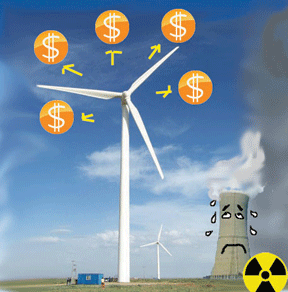 Wind Rescues New York Power After Nuclear Plant Shutdown Naureen Malik , Bloomberg, December 16, 2015 A nuclear reactor that supplies Manhattan unexpectedly went offline Monday night, though you wouldn’t know it to look at power prices.
The Indian Point 3 plant, 27 miles (43 kilometers) north of New York City, automatically shut down at 7 p.m. because of an electrical disturbance, owner Entergy Corp. said in an e-mailed statement late Monday. The last time that happened,spot power more than doubled. Tuesday, wind turbines in the state came to the rescue, running close to capacity and compensating for the loss of the reactor.
While renewables make up a small portion of U.S. generating capacity, wind and solar have subdued prices and at times curtailed the need for plants that rely on coal and natural gas. Meanwhile, Entergy is facing political and economic pressure as Governor Andrew Cuomo seeks to shut the plant while power prices in December head for the lowest monthly average on record.
Spot wholesale power for New York City fell $27.34, or 56 percent, to $21.33 per megawatt-hour in the hour ended at 1 p.m. compared with the same period Monday, according to grid data compiled by Bloomberg……..http://www.bloomberg.com/news/articles/2015-12-15/wind-rescues-new-york-power-prices-after-nuclear-plant-shutdown
New York Governor Cuomo orders investigation of Indian Point Nuclear Station
 Cuomo calls for investigation of Indian Point nuclear plant http://news10.com/2015/12/16/cuomo-calls-for-investigation-of-indian-point-nuclear-plantcuomo-calls-for-investigation-of-indian-point-nuclear-plant/By Ali Stewart December 16, 2015 ALBANY, N.Y. (AP) – Gov. Andrew Cuomo has directed state utility regulators to begin a full investigation of the operations and safety protocols at the Indian Point nuclear power plant on the Hudson River about 30 miles north of Manhattan.
Plant owner Entergy says federal regulators with nuclear expertise say the plant is safe.
Monday evening, one reactor was automatically shut down. The company says the disturbance on the non-nuclear side of the plant is related to a high voltage transmission line. There was no release of radioactivity and no threat to the public.
The other reactor was shut down for three days earlier this month due to a tripped circuit breaker. The two reactors together supply about one-quarter of the power used in New York City and Westchester County.
Still hope fpor the planet in the the Anthropocene Epoch
Our dominance on Earth comes with great responsibility. The Paris climate deal proves that there is hope for our planet – as long as we remember that omo sapiens has become so dominant a force shaping the properties of the biosphere that scientists now refer to the past two centuries as the Anthropocene Epoch – the age of the human. This role comes with a huge responsibility; one that, it seems, we have lived up to in the climate deal recently agreed in Paris.
We are an infant species, evolving perhaps 150,000 years ago in Africa. For most of our short existence, we were nomadic hunter-gatherers, carrying our possessions while in search of food and anything useful. Compared to the vast herds of mammals in parts of the world, human numbers were small, our technology simple and our ecological impact readily absorbed by the biosphere.
Very suddenly, in evolutionary terms, we’ve exploded into a major global force, altering the air, water, soil and species diversity on a geological scale. We are the most numerous mammal on Earth, empowered by technological innovation, demanding ever more consumer items to satisfy our “wants” instead of our “needs”, driven by corporate hunger for constantly increasing profit in a globalized economy.
Climate change caused by human generation of greenhouse gases is just one of the degradations of our most fundamental needs caused by our shortsighted actions. Pollution of water, soil and air, destruction of habitat, species extinction and ocean degradation are a few of the others………
Our most fundamental needs for survival and wellbeing must be protected above all else, otherwise we will constantly elevate our parochial interests above the protection of our life-support systems.
In Paris, humanity has demonstrated that the “age of the human” won’t necessarily lead to an age of destruction. There is hope – as long as we remember that our dominance on Earth comes with great responsibility. http://www.theguardian.com/commentisfree/2015/dec/17/paris-climate-deal-cop21-age-of-the-human-destruction
Battery storage for solar now a very big deal
 This huge deal is the latest evidence that the battery revolution has arrived, WP By Chris Mooney December 15 At the Paris climate change conference earlier this month, all eyes were on some massive announcements in the solar and wind energy space — including plans in Africa to install 300 gigawatts of renewable energy capacity across the continent by the year 2030. A gigawatt is a billion watts — and this would be nearly double the electricity capacity that the continent currently supports.
Less noticed, however, is that a key enabling technology for solar — and for the future of clean energy — is also starting to grow: Energy storage. When solar systems are connected with batteries or other forms of storage, they can cease to be dependent upon whether the sun is shining and how strong its rays are at a given moment. Rather, solar energy can be stored and used at a later time. Including at night.
And now AES, a large energy company headquartered in Arlington, Va., has announced a very large deal in the battery space. It is gaining access to 1 gigawatt-hour worth of lithium ion batteries from Seoul-based LG Chem, a chemicals giant that also has a strong business in making lithium ion batteries for electric and hybrid electric vehicles. The batteries will be deployed in AES’s Advancion platform, which provides large scale grid energy storage to utility companies.
Power – in this case, a gigawatt – refers to the amount of electricity that can be discharged instantaneously. But when it comes to batteries, what’s also important is how long the battery can operate — its energy. Thus, 1 gigawatt hour would refer to the capacity to discharge that much power for one hour — but it could also refer to the ability to discharge 250 megawatts (or million watts) for four hours.
Either way, that’s a very large amount of batteries. For comparison, GTM Research recently forecast that the U.S. will deploy a record 192 megawatts of energy storage in 2015.
But for now, the biggest business for batteries isn’t in the home, where they can serve a backup role in the event of an outage or pair with a rooftop solar system; it’s on the grid, where there is a constant need to be able to manage shifting electricity demand at different times of the day. Batteries that can switch on automatically at key moments can provide a major grid service, which is why they’re seeing more and more demand.
Thus, AES is in effect packaging lots of batteries, provided by LG Chem, into large systems that large power companies can purchase and then install or integrate on the grid wherever they need this new capacity. AES directly advertises its batteries as the “complete alternative” to “peaking power plants.”
South Africa’s govt quietly confirms nuclear power deal

 Cabinet quietly endorses nuclear deal http://www.bdlive.co.za/business/energy/2015/12/15/cabinet-quietly-endorses-nuclear-deal BY NATASHA MARRIAN, 15 DECEMBER 2015, FINANCE MINISTER PRAVIN GORDHAN CONFIRMED ON MONDAY THAT A DECISION WAS TAKEN BY THE CABINET IN ITS MEETING LAST WEEK TO START THE NUCLEAR PROCUREMENT PROGRAMME.
This opens the path for the Department of Energy to call for proposals to provide 9.6GW of nuclear power without first doing a cost-benefit analysis. But Mr Gordhan was adamant on Monday the procurement would go head only if it was “affordable”. Mr Gordhan confirmed that the decision had been made, yet in a post-Cabinet statement and a media briefing last week, no mention was made of the procurement decision.
On Monday, Business Day reported on the decision and that was the first time it was mentioned in public.
Acting Cabinet spokeswoman Nebo Legoabe said on Monday she did not know why the information was not contained in the Cabinet statement. She had not been in the Cabinet meeting and was unaware of what was discussed.
Mr Gordhan said he was not in the Cabinet meeting either last week as he had been unwell, but confirmed the decision.
“There is, I think, a decision on Wednesday that we are going to move in that direction. Part of that decision … is that there will be a formal procurement process in accordance with South African law.’’
He reiterated that the Treasury would only proceed with plans that were affordable. We can’t spend money that we don’t have and we can’t make commitments when we know we are not going to get the money that is required to be spent in this particular regard,” the minister said.
Mr Gordhan added, however, that this did not mean it would never happen, just that it may have to wait.
Former finance minister Nhlanhla Nene has said repeatedly that nuclear energy would not be procured if SA could not afford it. The African National Congress has also expressed caution, passing a resolution at its national general council in October, calling for ‘‘a full, transparent and thorough cost-benefit analysis of nuclear power’’.
With Carol Paton
Mainstream press spins Fukushima nuclear radiation as an issue of no concern
 Massive Fukushima radiation cover-up as government-funded scientists now claim radiation won’t hurt you, December 17, 2015 by: David Gutierrez, staff writer (NaturalNews) The alarming findings that levels of Fukushima radiation off the North American coast are higher now than they have ever been, is being spun by the press as an issue of no concern……
In a study presented at the conference of the American Geophysical Union in San Francisco on Dec. 14, researchers found that radiation levels from Alaska to California have increased since samples were last taken. The highest levels yet of radiation from the disaster were found in a sample taken 2,500 kilometers (approx. 1,550 miles) west of San Francisco.
Lead researcher Ken Buesseler of Woods Hole Oceanographic Institution was one of the first people to begin monitoring Fukushima radiation in the Pacific Ocean, with his first samples taken three months after the disaster started. In 2014, he launched a citizen monitoring effort – Our Radioactive Ocean – to help collect more data on ocean-borne radioactivity.
The researchers track Fukushima radiation by focusing on the isotope Cesium-134, which has a half-life of only two years. All Cesium-134 in the ocean likely comes from the Fukushima disaster. In contrast, Cesium-137 – also released in huge quantities from Fukushima – has a half-life of 30 years, and persists in the ocean, not just from Fukushima, but also from nuclear tests conducted as far back as the 1950s.
The most recent study added 110 new Cesium-134 samples to the ongoing studies. These samples were an average of 11 Becquerels per cubic meter of sea water, a level 50 percent higher than other samples taken so far…….
Situation still worsening
The reality, however, is that radiation along the West Coast is expected to keep getting worse. According to a 2013 study by the Nansen Environmental and Remote Sensing Center in Norway, the oceanic radiation plume released by Fukushima is likely to hit the North American West Coast in force in 2017, with levels peaking in 2018. Most of the radioactive material from the disaster is likely to stay concentrated on the western coast through at least 2026……..
“Despite the fact that the levels of contamination off our shores remain well below government-established safety limits for human health or to marine life,” he said, “the changing values underscore the need to more closely monitor contamination levels across the Pacific.” http://www.naturalnews.com/052348_Fukushima_radiation_US_west_coast_contamination.html#ixzz3ucfYEtY6
1 This Month

5 March -Online – Reversing nuclearization:
From nuclear weapons in Belarus and NATO host countries to a European-Nuclear-Weapon Free Zone
11am-12:30pm Eastern Time USA / 5pm-6:30pm CET

of the week – Advocating for a
nuclear free beach – https://www.samuellawrencefoundation.org/
The Samuel Lawrence Foundation advocates for a Nuclear Waste Free Beach at San Onofre, join us and take action!

10 March A LIVE WEBINAR THE REAL EFFECTS OF NUCLEAR POWER
What the Industry Isn’t Telling Us
1:00 PM Mountain, 2 pm Central, 3 pm Eastern. Live on the Keepers of the Water Facebook page


18 March Webinar @ 1 PM EST: An Assessment of SMR Projects: The Case of Canada
register for the zoom:
https://us02web.zoom.us/webinar/register/WN_o8BIIOUvQ2ONJR1nta65DQ#/registration

of the week – STOP SMALL MODULAR REACTORS IN CANADA
To see nuclear-related stories in greater depth and intensity – go to https://nuclearinformation.wordpress.com
-
Archives
- March 2026 (38)
- February 2026 (268)
- January 2026 (308)
- December 2025 (358)
- November 2025 (359)
- October 2025 (376)
- September 2025 (258)
- August 2025 (319)
- July 2025 (230)
- June 2025 (348)
- May 2025 (261)
- April 2025 (305)
-
Categories
- 1
- 1 NUCLEAR ISSUES
- business and costs
- climate change
- culture and arts
- ENERGY
- environment
- health
- history
- indigenous issues
- Legal
- marketing of nuclear
- media
- opposition to nuclear
- PERSONAL STORIES
- politics
- politics international
- Religion and ethics
- safety
- secrets,lies and civil liberties
- spinbuster
- technology
- Uranium
- wastes
- weapons and war
- Women
- 2 WORLD
- ACTION
- AFRICA
- Atrocities
- AUSTRALIA
- Christina's notes
- Christina's themes
- culture and arts
- Events
- Fuk 2022
- Fuk 2023
- Fukushima 2017
- Fukushima 2018
- fukushima 2019
- Fukushima 2020
- Fukushima 2021
- general
- global warming
- Humour (God we need it)
- Nuclear
- RARE EARTHS
- Reference
- resources – print
- Resources -audiovicual
- Weekly Newsletter
- World
- World Nuclear
- YouTube
-
RSS
Entries RSS
Comments RSS
 nuclear-news