Russia suspends work on Turkish Nuclear Station
Russia ‘Halts Work’ At Turkish Nuclear Plant, Radio Free Europe, December 09, 2015 Turkish officials say Russia has stopped construction work at Turkey’s first planned nuclear power plant, amid a bitter row between Moscow and Ankara.
Turkey shot down a Russian warplane on the Syrian border on November 24, prompting Moscow to impose economic sanctions on Ankara.
Unientified Turkish energy officials were quoted as saying on December 9 that Russia’s state nuclear company, Rosatom, had not terminated the contract for the building of the plant in the southern Turkish town of Akkuyu, and is reluctant to do so because of the heavy compensation clauses.
However, the officials said Turkey was assessing other potential candidates for the $20 billion project…….http://www.rferl.org/content/russia-turkey-nuclear-plant-work-halted/27417247.html
India’s PM Modi visiting Russia re nuclear purchase deal
 Nuclear expansion on agenda of PM visit to Russia, Zee News, , December 9, 2015 – New Delhi: The upcoming visit of Prime Minister Narendra Modi to Russia is expected to see the two countries deciding on expansion of nuclear programme, government told theLok Sabha on Wednesday. Minister of State for PMO Jitendra Singh said the earlier visits of the Prime Minister to various countries were also marked by signing of agreements to procure uranium and give boost the nuclear programme…….
He said during Modi’s visit the US, a deal was finalised for the construction of nuclear reactors in Gujarat and during the visit to France, a deal was finalised with AREVA, world’s leading nuclear power company.
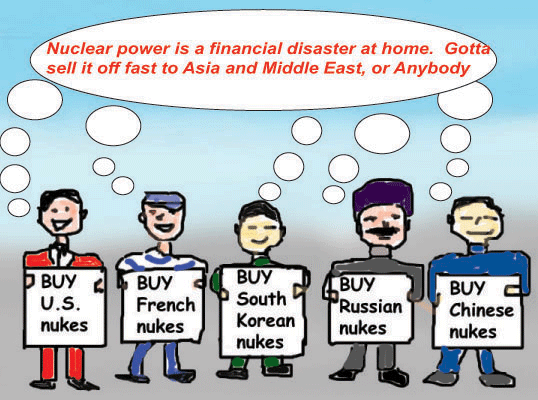
“For the visit of the Prime Minister to Russia, a programme has been finalised for expansion of nuclear programme,” he said about the trip expected later this month……http://zeenews.india.com/news/india/nuclear-expansion-on-agenda-of-pm-visit-to-russia_1832478.html
Kim Jong-un’s claim that North Korea has a hydrogen bomb
North Korea has a hydrogen bomb, says  , Guardian, 11 Dec 15
International experts sceptical as leader describes the DPRK as ‘a powerful nuclear state ready to defend its dignity’ Kim Jong-un has suggested that North Korea has the capacity to launch a hydrogen bomb, a step up from the less powerful atomic bomb, although international experts are sceptical of the claim.
The North Korean leader made the comments on a tour of the Phyongchon Revolutionary Site, which commemorates the achievements of his father Kim Jong-il and his grandfather, Kim Il-sung, on Thursday, the official KCNA news agency reported.
The work of Kim Il-sung “turned the DPRK into a powerful nuclear weapons state ready to detonate a self-reliant A-bomb and H-bomb to reliably defend its sovereignty and the dignity of the nation,” Kim Jong-un was quoted as saying.
A hydrogen bomb, also known as a thermonuclear bomb, uses more advanced technology to produce a significantly more powerful blast than an atomic bomb.
North Korea conducted underground tests to set off nuclear devices in 2006, 2009 and 2013, for which it has been subject to UN Security Council sanctions banning trade and financing activities that aid its weapons programme.
An official at South Korea’s intelligence agency told Yonhap news agency there was no evidence that the North had hydrogen bomb capacity, and said he believed Kim was speaking rhetorically…….http://www.theguardian.com/world/2015/dec/10/north-korea-hydrogen-bomb-kim-jong-un-nuclear
Bill in Wisconsin to lift the State’s moratorium on new nuclear power stations

 Panel OKs bill lifting nuclear moratorium http://www.postcrescent.com/story/news/2015/12/09/panel-oks-bill-lifting-nuclear-moratorium/77052324/ MADISON – A legislative committee has approved a bill that would lift Wisconsin’s moratorium on new nuclear power plants.
Under current law, state regulators can’t approve a new nuclear power plant unless a federal storage facility for waste from nuclear plants nationwide exists and the plant wouldn’t burden ratepayers. No centralized federal repository exists. Nuclear plants have been storing waste on-site.
Republican Rep. Kevin Peterson’s bill would erase the storage facility and ratepayer language from state law, in effect clearing the way for new plants.
The Assembly’s energy committee approved the bill unanimously without discussion during a hearing Wednesday. A spokeswoman for Assembly Speaker Robin Vos says the full chamber will take up the measure next month.
Wisconsin is currently home to only one operational nuclear plant.
Ontario’s nuclear emergency plan is inadequate
Activists say Ontario’s 10 km primary response zone at nuclear plants isn’t safe enough http://news.nationalpost.com/news/canada/activists-say-ontarios-10-km-primary-response-zone-at-nuclear-plants-isnt-safe-enough Keith Leslie, The Canadian Press | December 10, 2015 TORONTO — Environmentalists want the Ontario government to provide evidence for its 10-kilometre limit around nuclear power plants for distribution of potassium iodide (KI) pills that help fight radiation, and say it should be expanded.
Greenpeace and the Canadian Environmental Law Association filed a request under the Ontario environmental bill of rights asking the ministry of health to do an evidence-based review of the policy surrounding distribution of the KI pills.
Radioactive iodine is released in the event of a nuclear accident, and the potassium iodide pills can help protect against thyroid cancer.
The pills were sent to about 200,000 households and businesses around the Pickering, Darlington and Bruce nuclear stations in October, and were given to another 12,500 people who asked for them.
Stensil believes the evidence will show the distribution zone for the pills should be expanded to as much as 50 kilometres.
“Four years after the (2011) Fukushima disaster in Japan — cancer takes a while to develop — a study found increased incidences of thyroid cancer 50 kilometres from the plant,” he said. “All we’re saying is let’s make the decision based on evidence.”
Most nuclear issues are a federal responsibility, but off-site safety plans are the province’s responsibility. Greenpeace says a little-used section of Ontario’s environmental bill of rights requires a government response to their request for a medical review of the policy, and if it refuses, the environmental commissioner must investigate and report to the public.
Last week, the city of Toronto’s executive committee asked the medical officer of health and office of emergency management to investigate the “appropriateness” of the 10 kilometre zone at nuclear plants and whether it should be expanded to 50 kms.
Ontario Power Generation’s Pickering nuclear generating station is 50 kilometres from downtown Toronto.
“Real-world experience and international best practices suggest Ontario’s nuclear emergency plans aren’t sufficient to protect Ontarians in the event of a nuclear accident,” said Theresa McClenaghan, Executive Director of the CELA.
The province initially balked at the Canadian Nuclear Safety Commission’s order to distribute the pills, insisting the federal regulator didn’t have jurisdiction to issue it, so the CNSC made it a condition of renewing licences for Ontario’s nuclear plants.
“The federal regulator stepped into the provincial realm because it felt Ontario was avoiding its responsibility to protect the public in the event of a nuclear accident,” said Stensil.
Germany’s process of decommissioning nuclear power plant
This Is How You Decommission a Nuclear Power Plant [great photos] German Chancellor Angela Merkel called time on nuclear energy in her country in 2011, after a tsunami severely damaged the Fukushima power plant in Japan, causing a major radioactive leak. Almost five years later, that process is in full swing – with an estimated cost of up to €77 billion ($84 billion). The operation to decommission Germany’s Greifswald nuclear power plant is described by German energy officials as the largest project of its kind in the world. Once the largest power plant in the former East Germany, Greifswald was closed in 1990 during German reunification. This is how it is being made safe. Bloomberg Tino Andresen , 10 Dec 15
Alexander Jones Germany’s nuclear plant operators are seeking public agreement on how to manage the burden of decommissioning the country’s atomic power stations. Chancellor Angela Merkel’s government decided in 2011 to phase out nuclear power by 2022 in light of the Fukushima disaster in Japan. ……..
The decommissioning process could force those footing the bill to set aside anything from €25 billion to €77 billion, according to scenarios.
Germany’s Economy Ministry believes that utility companies do have enough funds to pay for the shutdown and cleanup of nuclear power plants……..
Depending on the severity of contamination, some of the components will go on to be housed in temporary disposal sites before a final storage solution is found….http://www.bloomberg.com/news/photo-essays/2015-12-10/this-is-how-you-decommission-a-nuclear-power-plant
1 This Month
19 February – VIRTUAL EVENT-Decision Time: AI and Our Nuclear Arsenal
12:45 p.m. Central / 1:45 p.m. Eastern
To see nuclear-related stories in greater depth and intensity – go to https://nuclearinformation.wordpress.com
-
Archives
- February 2026 (141)
- January 2026 (308)
- December 2025 (358)
- November 2025 (359)
- October 2025 (376)
- September 2025 (258)
- August 2025 (319)
- July 2025 (230)
- June 2025 (348)
- May 2025 (261)
- April 2025 (305)
- March 2025 (319)
-
Categories
- 1
- 1 NUCLEAR ISSUES
- business and costs
- climate change
- culture and arts
- ENERGY
- environment
- health
- history
- indigenous issues
- Legal
- marketing of nuclear
- media
- opposition to nuclear
- PERSONAL STORIES
- politics
- politics international
- Religion and ethics
- safety
- secrets,lies and civil liberties
- spinbuster
- technology
- Uranium
- wastes
- weapons and war
- Women
- 2 WORLD
- ACTION
- AFRICA
- Atrocities
- AUSTRALIA
- Christina's notes
- Christina's themes
- culture and arts
- Events
- Fuk 2022
- Fuk 2023
- Fukushima 2017
- Fukushima 2018
- fukushima 2019
- Fukushima 2020
- Fukushima 2021
- general
- global warming
- Humour (God we need it)
- Nuclear
- RARE EARTHS
- Reference
- resources – print
- Resources -audiovicual
- Weekly Newsletter
- World
- World Nuclear
- YouTube
-
RSS
Entries RSS
Comments RSS
 nuclear-news