Japan should move nuclear power into terminal phase
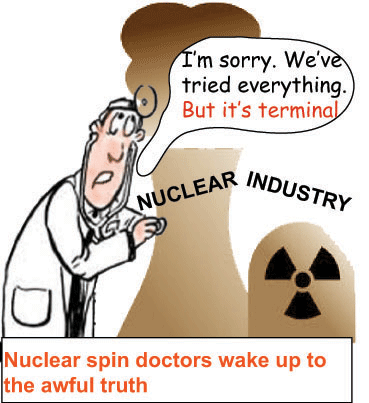
 The electric utilities would doubtless resist any plan to scrap the remaining reactors and reduce the nation’s dependence on nuclear power to zero, but they could probably be induced to go along if the authorities simultaneously drew up measures to cushion the financial blow. The government will also need to compensate localities for the loss of jobs and subsidies associated with the nuclear power plants by funding programs to foster the growth of other industries. Now is the time to plan for a shift from long-term nursing to end-of-life care for Japan’s unsustainable nuclear power industry.
- |The resumption of commercial operations at a nuclear power plant in Kagoshima Prefecture last September might seem to bode well for the comeback of nuclear energy in Japan after the nationwide shutdown precipitated by the 2011 Fukushima meltdown. But the author argues that the government’s policy of “long-term nursing care” for an unsustainable industry is merely delaying the inevitable while exposing the nation to unacceptable risks.

Dim Prospects and a Growing Burden
The obstacles to the industry’s revival will scarcely disappear after 2015. Fukushima Prefecture is lobbying to have all its remaining nuclear plants scrapped, and local opposition to resumption of operations predominates in Niigata Prefecture, Shizuoka Prefecture, and the village of Tōkai in Ibaraki Prefecture. Between them, these four locales account for 15 (about a third) of the nation’s nuclear reactors. Four other units (one at Japan Atomic Power’s Tsuruga plant, two at Hokuriku Electric’s Shika plant, and one at Tōhoku Electric’s Higashidōri facility) are facing likely decommissioning owing to earthquake hazards. Kansai Electric is appealing a May 2014 court order against restart of two reactors at its Ōi facility, and more unfavorable rulings are possible in the months ahead.
The electric utilities themselves are expected to scrap a number of older units in consideration of cost factors. Reactors are licensed to operate for no more than 40 years, and the upgrades required to win an extension under the new regulations would be prohibitively expensive in many cases. Five older reactors were officially retired for this reason last April (Kansai Electric’s Mihama-1 and Mihama-2, Japan Atomic Power’s Tsuruga-1, Chūgoku Electric’s Shimane-1, and Kyūshū Electric’s Genkai-1).
Even those facilities that make it back online face a tough road ahead. The Fukushima disaster has drastically altered the Japanese public’s perception of nuclear energy’s risks. Henceforth, every accident, issue, or natural disaster has the potential to cause an extended or permanent shutdown at any given plant. And the construction of new reactors is virtually out of the question.
The goal of returning to pre-Fukushima levels of nuclear power generation is quite simply out of reach. Japan currently has 43 operable nuclear reactors (excluding the five already decommissioned). Realistically, no more than half of these can be expected back online before 2020, and they will be under intense scrutiny as each new problem—both in Japan and overseas—calls their safety and viability into question once again.
Nuclear power imposes heavy cost burdens that can only grow in the years ahead. Thus far the government has borne the brunt of the costs and risks, nurturing the industry with subsidies to the host communities and prefectures, funding for research and development, and guaranteed assistance with compensation and cleanup costs in the event of an accident, while allowing the electric utilities to pass the costs of the nuclear fuel cycle to their customers. In today’s climate, this amounts to long-term nursing care for a terminally ill industry. An end to these lavish supports is the electric power industry’s worst nightmare……….
As noted above, the electric utilities cannot hope to restart more than about 20 of its reactors by 2020 under the best of conditions. It will not be difficult to shut down those 20 reactors by 2030.
The electric utilities would doubtless resist any plan to scrap the remaining reactors and reduce the nation’s dependence on nuclear power to zero, but they could probably be induced to go along if the authorities simultaneously drew up measures to cushion the financial blow. The government will also need to compensate localities for the loss of jobs and subsidies associated with the nuclear power plants by funding programs to foster the growth of other industries. Now is the time to plan for a shift from long-term nursing to end-of-life care for Japan’s unsustainable nuclear power industry. http://www.nippon.com/en/currents/d00200/
No comments yet.
1 This Month

Petition to revoke the licensing of the Near Surface Nuclear Disposal Facility (NSDF) at Chalk River. https://www.ourcommons.ca/petitions/en/Petition/Details?Petition=e-7247


of the week – STOP SMALL MODULAR REACTORS IN CANADA
To see nuclear-related stories in greater depth and intensity – go to https://nuclearinformation.wordpress.com
-
Archives
- March 2026 (153)
- February 2026 (268)
- January 2026 (308)
- December 2025 (358)
- November 2025 (359)
- October 2025 (376)
- September 2025 (258)
- August 2025 (319)
- July 2025 (230)
- June 2025 (348)
- May 2025 (261)
- April 2025 (305)
-
Categories
- 1
- 1 NUCLEAR ISSUES
- business and costs
- climate change
- culture and arts
- ENERGY
- environment
- health
- history
- indigenous issues
- Legal
- marketing of nuclear
- media
- opposition to nuclear
- PERSONAL STORIES
- politics
- politics international
- Religion and ethics
- safety
- secrets,lies and civil liberties
- spinbuster
- technology
- Uranium
- wastes
- weapons and war
- Women
- 2 WORLD
- ACTION
- AFRICA
- Atrocities
- AUSTRALIA
- Christina's notes
- Christina's themes
- culture and arts
- Events
- Fuk 2022
- Fuk 2023
- Fukushima 2017
- Fukushima 2018
- fukushima 2019
- Fukushima 2020
- Fukushima 2021
- general
- global warming
- Humour (God we need it)
- Nuclear
- RARE EARTHS
- Reference
- resources – print
- Resources -audiovicual
- Weekly Newsletter
- World
- World Nuclear
- YouTube
-
RSS
Entries RSS
Comments RSS
 nuclear-news
Leave a comment