Corporate welfare may come to billionaire nuclear enthusiasts
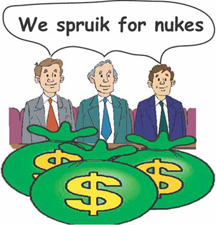 Billionaires have landed, therefore, on a new mission. As Donald Trump might say, they want to make nuclear energy great again.
“If we are serious about replacing fossil fuels, we are going to need nuclear power,” PayPal co-founder and Facebook mega-investor Peter Thiel crowed in a New York Times op-ed shortly before negotiators from 195 nations gathered in Paris to seal an international climate pact.
Thiel, who personally invests in nuclear energy, made the self-serving demand that the U.S. government forge a “plan to fund and prototype the new reactors that we badly need.”
In other words: What does a guy like me with only $2.2 billion to my name gotta do to get my corporate welfare handout?
Bill Gates is also advocating heavy public investment in novel designs that these nuclear cheerleaders swear will be safer and cheaper than the 391 reactors that now generate about one in 10 watts around the world.
As the Paris climate talks got underway, the Microsoft co-founder launched an unprecedented multibillion-dollar “clean” energy fund, backed by the U.S., Chinese, and Indian governments, as well as other billionaires and some foundations. Don’t be surprised if it’s nuclear-friendly.
The crowd of rich men with tech cred dipping their toes in these radioactive waters also includes Amazon titan Jeff Bezos and Paul Allen, Gates’ fellow Microsoft co-founder.
But there are many reasons why governments, including our own, should resist their call to pump more tax dollars into nuclear energy. Namely:
Reactors are expensive, they’re very difficult to shield from terrorist and other security threats, and they’re prone to catastrophic accidents that have created ghost towns in Japan and the former Soviet Union. Furthermore, there are still no solutions for meeting the daunting challenges of safeguarding nuclear waste and cleaning upabandoned uranium mines.
And nuclear power takes too long to crank up. Remarkably, five of the 62 reactors under construction worldwide have been in the nuclear pipeline for three decades. It’s too slow to stop the climate crisis.
Besides — to a much greater extent than solar and wind power — nuclear energy emits its own carbon pollution. Those greenhouse gas emissions come largely through the use of fossil fuels in activities like reactor construction, waste transportation, and uranium mining.
More importantly, successful businessmen ought to be able to spot an uncompetitive industry when they see one.
Here’s what Lazard, an investment bank with $180 billion under management, has to say about today’s top energy options: Utility-scale “wind and solar are much cheaper than gas and coal, and less than half the cost of nuclear.”
Renewable energy’s competitive edge makes it no surprise that generation from solar power is now growing exponentially and wind power has been expanding by more than 20 percent annually for the past seven years around the world as nukes have fumbled. The total amount of global nuclear energy remained well below 1996 levels in 2014.
A total of four new nuclear reactors in Georgia and South Carolina are at least three years behind schedule and billions of dollars over budget. That bodes badly for the save-our-nukes billionaire class because (sorry, guys) those power stations weresupposed to be models for ramping up nuclear energy quickly without cost overruns.
I wonder what they’ll choose as their next losing battle.
Emily Schwartz Greco is the managing editor of OtherWords, a non-profit national editorial service run by the Institute for Policy Studies. OtherWords.org.
Billionaires’ nuclear love affair in the ‘Breakthrough Energy Coalition’
Is Gates’s ‘Breakthrough Energy Coalition’ a nuclear spearhead?, Ecologist, Linda Pentz Gunter 6th December 2015
“……A nuclear love-affair revealed
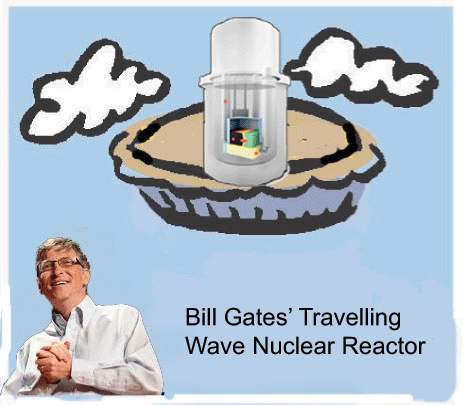 Gates is already squandering part of his wealth on Terra Power LLC, a nuclear design and engineering company seeking an elusive, expensive and futile so-called Generation IV traveling wave reactor that can never deliver electricity in time.
Mukesh Ambani is an investor in Terra Power. Amazon founder, Jeff Bezos, is betting his money on the perpetually 40 years away nuclear fusion dream, which, even if it were ever to work, will be far too expensive to apply to developing countries.
Virgin Group founder, Richard Branson, publicly touts nuclear energy and put his name on Pandora’s Promise as executive producer. “We should continue to develop advanced nuclear power to add to the mix”, he said in promoting the film via the Breakthrough Institute’s website. (See our debunk of the film’s numerous errors of fact and omission.)
Chris Hohn’s TCI hedge fund invested in J-Power, a Japanese utility company whose assets included nuclear power stations. In 2008, the Japanese government barred TCI from increasing its stake in J-Power and the hedge fund withdrew.
Vinod Khosla loves nuclear power and is on record blaming environmentalists rather than nuclear energy’s obviously disastrous economics, for its failure. “Most new power plants in this country are coal, because the environmentalists opposed nuclear”, Khosla said in a 2008 interview.
Chinese billionaire Jack Ma of Alibaba, was recently brought onto British Prime Minister David Cameron’s Business Advisory Group, probably not coincidentally one day before a state visit by the Chinese president to seal a deal involving China’s investment in the UK’s planned Hinkley-C nuclear power plant.
Ratan Tata’s eponymous corporation leapt at the chance of investing in nuclear energy in India with the passage of the nuclear non-proliferation treaty-violating US-India deal….. http://www.theecologist.org/News/news_analysis/2986571/is_gatess_breakthrough_energy_coalition_a_nuclear_spearhead.html
Britain’s nuclear power programme a cash cow for overseas companies
 Half of £24bn nuclear reactor investment will go to overseas suppliers More than £12bn of the UK government spend on two new power plants will go abroad, mainly to companies in France, a government adviser warns, Guardian, Terry Macalister, 7 Dec 15 More than half of the £24bn expected to be spent on the first British nuclear reactors for two decades could go abroad to foreign suppliers, a leading UK academic and government adviser has warned.
The issue is of extreme political sensitivity because George Osborne has already faced criticism for providing huge subsidies to Hinkley, which is being developed by EDF Energy of France.
It will be seriously tough for British manufacturers to meet the needs of EDF in line with the commitment that 60% of the value of the project will remain in this country,” said Sir Keith Burnett, who is a member of the Council of Science and Technology reporting to the prime minister, David Cameron.
Burnett, the vice-chancellor of Sheffield University, said that 40% of the total value of the work at Hinkley Point atomic plant would largely go to French firms.
At least £4bn worth of spending on items such as pipes and pumps – around 15% of the project by value – will be up for grabs for the UK but only if local companies can provide the higher specification supplies required by EDF. Burnett thinks that will be difficult to achieve…….
Part of the problem is that small and medium-sized British firms have not had the opportunity to supply equipment to a new nuclear power station since Sizewell C in Suffolk was completed in 1995.
The Hinkley Point C facility in Somerset is still awaiting the final investment decision from the largely state-owned EDF and its Chinese partners, although ground preparation is already under way………http://www.theguardian.com/business/2015/dec/06/nuclear-reactor-investment-pay-overseas-suppliers-hinkley-point
At least 50 years before nuclear fusion power might become areality
Nuclear fusion in the shadows of clean energy debate, Will Mumford, SBS, 6 Dec 15 “……..’A big mistake’ To create a fusion reaction, the 23,000-tonne ITER reactor will contain temperatures of up to 150 million degrees Celsius – hotter than the core of the sun.
The reactor, which is being built in the south of France, began site preparation in 2007 with plans to begin trials around 2019. However due to delays, reports suggest this timetable is increasingly unlikely, and ITER has pledged to release a revised schedule for the project mid-2016.
But not everyone believes governments should be investing in an unproven technology.
Greenpeace nuclear and energy campaigner, Sebastien Blavier, said the cost and uncertainty of fusion mean investing in thermonuclear reactors at the expense of other available clean energy options is risky and ignorant.

“We are opposed to this argument of fusion being the future of power for humanity, that’s totally false for us,” he said. “Today the world is facing massive challenges like poverty, like access to electricity for people, poor people, for development.”
“We now how have the solution with renewables like solar and wind – they are affordable, they are cheap. For the moment ITER is presented as being the solution for the future power of humanity and I think that’s a big mistake.”
“If you look at the costs, it’s a massive amount of money that could be invested in renewables that are already ready to take off and be competitive; so it’s not a solution to future power, it’s only research.”…..
Despite the progress being made, even the most hopeful scientists recognise that capturing and storing fusion energy for common use is likely half a century away. http://www.sbs.com.au/news/article/2015/12/06/nuclear-fusion-shadows-clean-energy-debate
Most of “Breakthrough Energy Coalition’s ” members are nuclear obsessives
perhaps the Breakthrough Billionaires Club will yet come to the realization that from a clean energy generation perspective we have already broken through. The innovations needed are not in abstract research but into deployment; and into enabling technologies led by low cost electricity storage and conversion into fuels.
The Breakthrough Energy Coalition must tear itself away from the fascination of tinkering in a laboratory and instead do something real, practical and hands-on with their money. However, the group’s assertion that “the foundation of this program must be large funding commitments for basic and applied research”, does not provide much reason for optimism.
A tennis coach I used to know would tell his team after a loss that “breakdowns come before breakthroughs.” We’ve caused the climate breakdown and we’ve made the energy breakthroughs. Now we just need to start winning
The first question that crossed my mind when reading about the latest Bill Gates investment venture was “is this a cover to divert yet more money into nuclear energy?”
Gates unveiled hisBreakthrough Energy Coalition at the start of the COP21 climate talks in Paris with much fanfare but few details, including the size of the financial commitment.
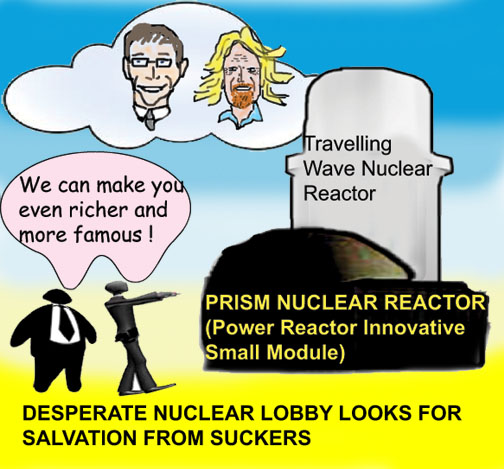
My suspicions were triggered not only by Gates’ already public commitment to nuclear energy research, but by the name selected for this collection of 28 of the world’s richest people (mainly men).
The Breakthrough Institute, after all, is the name of the pseudo-green nuclear energy front group whose people promoted and starred in the 2013 nuclear power propaganda film, Pandora’s Promise. But so far the Breakthrough Institute is lying low on the Breakthrough Energy Coalition, although I suspect not for long.
At first glance, the mission of the Breakthrough Energy Coalition, whose collective wealth is $350 billion, sounds reasonable enough, even if it takes a while to get ones head around that kind of disposable income.
Madness in the method Continue reading
Indian Parliament may fast-track nuclear projects in Winter Session
 Bill for fast-tracking nuclear power projects likely in Winter Session http://www.dnaindia.com/india/report-bill-for-fast-tracking-nuclear-power-projects-likely-in-winter-session-2152574 Sunday, 6 December 2015 A bill seeking to fast-track nuclear power projects is likely to be introduced in the Winter Session of Parliament, while another legislation for according greater autonomy to the atomic energy regulator may not be brought this time.
The Union Cabinet had last month approved amendments to the Atomic Energy Act to enable Nuclear Power Corporation of India Ltd (NPCIL) to enter into join ventures with other public sector undertakings (PSUs). The move will help secure funds for big ticket projects.
Concern over lack of financial resources has been raised by the Department of Atomic Energy (DAE) frequently. The amendment will enable NPCIL, which is one of the PSUs under the DAE, to enter into joint ventures with other government undertakings.
However, sources said, the Nuclear Safety Regulatory Authority (NSRA) Bill may not be presented before Parliament even in this session. The NSRA Bill will seek to create a more independent authority, replacing the Atomic Energy Regulatory Board (AERB)—the atomic energy sector watchdog.
The Bill, first introduced in the Lok Sabha in 2011, has lapsed and will have to be reintroduced.
Poland may ask for access to nuclear weapons
Poland considering asking for access to nuclear weapons under Nato program http://www.theguardian.com/world/2015/dec/06/poland-considering-asking-for-access-to-nuclear-weapons-under-nato-program
Deputy defence minister says Poland is discussing whether to join other European countries in hosting nuclear arms to strengthen defences. Poland’s deputy defence minister has said the ministry is considering asking for access to nuclear weapons through a Nato program in which non-nuclear states borrow the arms from the US.US and Poland in talks over weapons deployment in eastern Europe
Tomasz Szatkowski said the ministry was discussing whether to ask for access to Nato’s “nuclear sharing” program to strengthen the country’sability to defend itself.
Polish media said Szatkowski’s comments on Saturday to the private broadcaster Polsat marked the first time a Polish official has indicated the country wants to join the program.
Among Nato’s 28 members there are three nuclear powers – the US, France and Britain – but only the US has provided weapons to allies for nuclear sharing.
Belgium, Germany, Italy, the Netherlands and Turkey have hosted nuclear weapons as part of the program.
Japan’s nuclear regulatory body investigating spent nuclear fuel containers
 Regulator probes fuel container strength at Fukushima nuclear plant http://www.japantoday.com/category/national/view/regulator-probes-fuel-container-strength-at-fukushima-nuclear-plantDEC. 06, 2015 -TOKYO — Japan’s nuclear regulatory body has launched an investigation into metallic spent fuel containers at Tokyo Electric Power Co’s Fukushima Daiichi nuclear plant as they may not have sufficient strength.
Members of the Nuclear Regulation Authority raised the issue Friday at a meeting to discuss nuclear safety problems. The body will examine whether the containers made by Kobe Steel Ltd are safe for long-term use.
The nuclear regulation watchdog said it will also launch a probe at Japan Atomic Power Co’s Tokai No. 2 nuclear power plant in Ibaraki Prefecture as the same type of fuel container may be used there.
The fuel storages meet strength criteria set by the Japan Society of Mechanical Engineers. But the metal plates inside them may not be strong enough for use in storing nuclear spent fuel.
TEPCO said it believes the strength of the containers meets the NRA’s safety standards.
At Paris talks – a megaphone for corporations a muzzle for social movements
 Naomi Klein criticises protest restrictions at Paris climate talks Activist says authorities have ‘handed a megaphone to the corporations and taken the megaphone away from the social movements’, Guardian, Emma Howard , 6 Dec 15 French authorities are enforcing “unprecedented restrictions on civil society” at the UN climate change talks in Paris, the author and activist Naomi Klein has said.
Klein said the ongoing talks were a victim of austerity as the French government had failed to provide adequate state funding, leading to heavy sponsorship by corporations. Meanwhile authorities have imposed a ban on mass protests around COP21, as the conference is known, in the wake of last month’s terror attacks in Paris.
“We have got unprecedented restrictions on civil society – they’ve handed a megaphone to the corporations and taken the megaphone away from the social movements,” Klein said. “It’s a combination of the role of corporations inside the COP and the banning of protests outside.
“We always knew that this was going to be the most corporate-sponsored COP, it’s a victim of austerity … You should at least be able to have a dialogue between the corporate solutions and the popular solutions, but only one side of the debate is being given a megaphone and the other side is being hauled out or banned.”
Activists have found creative ways around the ban on mass gatherings, with 10,000 pairs of shoes laid out where a climate march should have started and a human chain running past the Bataclan concert venue where 90 people died. But police have arrested protesters who they suspect will flout the ban, and hundreds of anti-capitalist protesters were kettled by police last Sunday.
On Friday police were seen carrying protesters from the opening of Solutions 21, an exhibition for businesses to showcase their proposals for tackling climate change, according to reports by New Internationalist and Climate Hom…… http://www.theguardian.com/environment/2015/dec/06/naomi-klein-criticises-protest-restrictions-at-paris-climate-talks
Climate-saving draft – UN at Paris
 Paris climate talks: UN adopts climate-saving draft as stars add voices to call for change, ABC News 6 Dec 15 Negotiators from 195 nations have delivered a blueprint for a pact to save mankind from disastrous global warming, raising hopes that decades of arguments will finally end with a historic agreement in Paris.
Key points:
A blueprint has been been reached to curb effects of global warming
Actors Arnold Schwarzenegger and Sean Penn, Chinese tycoon Jack Ma lobbied for climate change targets
Final agreement not guaranteed despite draft deal confirmation
The planned deal would aim to break the world’s dependence on fossil fuels for energy, slashing the greenhouse gas emissions from burning oil, coal and gas that are causing temperatures to rise dangerously.
Tortuous UN negotiations dating back to the early 1990s have failed to forge unity between rich and poor nations, and the Paris talks are being described as the “last, best chance” to save mankind……….http://www.abc.net.au/news/2015-12-06/hopes-rise-as-un-adopts-climate-saving-blueprint/7004920
Paris Climate News
A lesson from Kyoto’s failure – don’t let Congress touch a climate deal.
In 1997, more than 150 countries came together in Kyoto, Japan, to negotiat e a deal to reduce the greenhouse gas emissions driving global warming. Eighteen years later, the world is still trying to agree on how to tackle climate change. But this time around, the U.S. pledge does not require congressional approval. That approach echoes an important lesson from Kyoto: A treaty’s worth is directly tied to the president’s ability to enact it.
The lesson of Kyoto was stark. “We learned the limits of what the U.S. can agree to,” said Rafe Pomerance, who went to Kyoto as deputy assistant secretary of state for environment and development. “Climate change policy is not fully dictated by negotiations,” he said. “They’re dictated by domestic political opportunities and constraints.” President Obama can pledge only wha t he can achieve through executive action, and that means that the agreement has to be a non-binding commitment that does not require congressional approval. “If the U.S. Congress won’t move, the U.S. is heavily constrained and therefore the world is constrained,” Pomerance said. Whether or not the U.S. is the largest emitter (China overtook the U.S. as the world’s biggest emitter in 2007), it’s still a major actor.
So the Paris negotiations have taken an alternative tactic. …
http://fivethirtyeight.com/features/a-lesson-from-kyotos-fai lure-dont-let-congress-touch-a-climate-deal/ & http://www.environmentalhealthnews.org/t/2960402875661446914
Paris summit by night, day and behind the scenes
Those observing the hustle and bustle of world leaders may miss the minutiae of deals being hammered out late into t he night.
http://www.smh.com.au/environment/un-climate-conference/climate-summit-paris-by-night-day-and-behind-the-scenes-20151203-glf865.html
Paris climate change talks yield first draft amid air of optimism
Country representatives and green groups say French summit is more cordial and efficient than Copenhagen five years ago
http://www.theguardian.com/environment/2015/dec/05/paris-climate-change-talks-dr aft-french-summit
1 This Month

of the week – Shut Down Drone Warfare!


Tell the Ukrainian Government to Drop Prosecution of Peace Activist Yurii Sheliazhenko

Petition to revoke the licensing of the Near Surface Nuclear Disposal Facility (NSDF) at Chalk River. https://www.ourcommons.ca/petitions/en/Petition/Details?Petition=e-7247
To see nuclear-related stories in greater depth and intensity – go to https://nuclearinformation.wordpress.com
-
Archives
- April 2026 (79)
- March 2026 (251)
- February 2026 (268)
- January 2026 (308)
- December 2025 (358)
- November 2025 (359)
- October 2025 (376)
- September 2025 (257)
- August 2025 (319)
- July 2025 (230)
- June 2025 (348)
- May 2025 (261)
-
Categories
- 1
- 1 NUCLEAR ISSUES
- business and costs
- climate change
- culture and arts
- ENERGY
- environment
- health
- history
- indigenous issues
- Legal
- marketing of nuclear
- media
- opposition to nuclear
- PERSONAL STORIES
- politics
- politics international
- Religion and ethics
- safety
- secrets,lies and civil liberties
- spinbuster
- technology
- Uranium
- wastes
- weapons and war
- Women
- 2 WORLD
- ACTION
- AFRICA
- Atrocities
- AUSTRALIA
- Christina's notes
- Christina's themes
- culture and arts
- Events
- Fuk 2022
- Fuk 2023
- Fukushima 2017
- Fukushima 2018
- fukushima 2019
- Fukushima 2020
- Fukushima 2021
- general
- global warming
- Humour (God we need it)
- Nuclear
- RARE EARTHS
- Reference
- resources – print
- Resources -audiovicual
- Weekly Newsletter
- World
- World Nuclear
- YouTube
-
RSS
Entries RSS
Comments RSS
 nuclear-news