Bill Gates’ nuclear dream doesn’t stand up to critical analysis
Germany gives rise to much optimism. With solar resources no better than Alaska, solar power has nevertheless reached nearly 6% of the total electricity mix in the country. Ten years ago, solar power essentially didn’t exist there. In the U.S., the cost of installing solar has fallen from more than $8/watt to less than $3 in the past eight years, the industry has 175,000 working in it — more than twice the number of people that mine coal — and the value of solar installations reached $18 billion last year, according to the Solar Energy Industries Association.
Thiel and Gates are using their megaphones to make different points, but they actually share much in common. Gates is an investor in TerraPower, one of the companies trying to build the kind of advanced nuclear reactor Thiel wants to see the regulatory environment pave the way for. Gates talks up far-out technologies like making fuels directly from the sun, perhaps pulling carbon from the air to do it. Like Thiel’s nuclear, it’s not remotely clear any of this is going to make economic sense and its very unlikely any of it will be useful for a decade or more……..
There are paths to 100% renewable energy using existing technologies and aggressive deployment efforts.
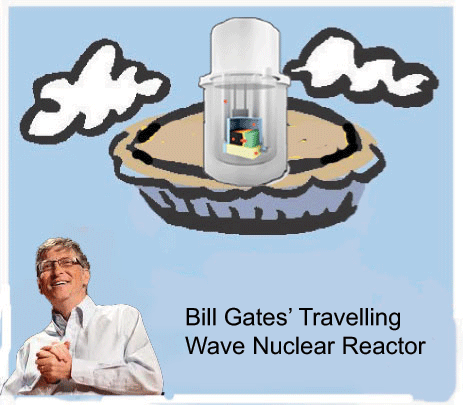 One Tech Billionaire Sees Nuclear As The Path To Clean Energy, But Is He Right?, Forbes, 30 Nov 15
Mark Rogowsky ,
The United Nations climate summit begins today in Paris and already there are headlines. The world’s richest man, Bill Gates, and a slew of his fellow billionaires have announced the Breakthrough Energy Coalition: an effort to take private money to advance promising clean-energy ideas from the lab to the marketplace. Gates suggests wind and solar have made good progress, but given the daunting scale of the challenge ahead, we need to look everywhere we can for promising ideas and develop them as quickly as possible. One thing he doesn’t talk up much is nuclear power, which just days earlier got some very positive words from another tech billionaire, number 234 on the Forbes list, Peter Thiel, who penned “The New Atomic Age We Need” for The New York Times…….
nuclear has established a safety record that argues for a rebirth, right? Perhaps if today were 1979. Unfortunately, the world has changed and nuclear hasn’t changed quickly enough……
The French, however, are set to lower the share that nuclear contributes to 50% over the coming decade. With the average French reactor now three decades old, at least part of the story is economic and technological. Thiel argues that what’s holding back nuclear is: “Designs using molten salt, alternative fuels and small modular reactors have all attracted interest not just from academics but also from entrepreneurs and venture capitalists like me ready to put money behind nuclear power… However, none of these new designs can benefit the real world without a path to regulatory approval.”
What he neglects to mention is that none of these designs are remotely ready to be put into use either. Although molten-salt reactors date back to the 1960s, the current designs haven’t left the research phase. Even in countries like China where U.S. regulatory approval isn’t a gating factor, when the scientists and engineers working on building a production reactor to make power dates like 2032 are tossed around. There are a number of other promising technologies being researched, but still the timeframes for first deployment are all between 2020-30. The U.S. regulatory regime isn’t holding these up, the slow path to development of incredibly complex systems is…..
Along with Flamanville, three other EPRs were started one in Finland and two in China. All began construction last decade, none are operational. For its part, Flamanville’s budget has ballooned to €10.5 billion and it is now slated to be finished at the end of 2018 — 3 1/2 years behind schedule. The Finnish plan isn’t doing any better, while the Chinese suggest they could be done as early as the end of next year. These EPRs are so-called “third generation” designs; the stuff for the 2020s and beyond is often called “fourth generation” technology. In other words, it’s even harder to make work because it’s more in the not-yet-invented category.
As you might imagine, when a plant costs more than three times its budget, the power it’s going to produce won’t be as inexpensive as planned either. The Watts Bar 2 plant in Tennessee recently became the first nuclear plant added to the U.S. grid in two decades, and achieving that feat required the TVA to spend a staggering $4.5 billion over the past eight years to complete a plant that was literally begun 43 years ago. (A recent report by the investment bank Lazard has nuclear running about 40-50% higher per watt than the cost of utility scale solar or wind power.)……
Germany gives rise to much optimism. With solar resources no better than Alaska, solar power has nevertheless reached nearly 6% of the total electricity mix in the country. Ten years ago, solar power essentially didn’t exist there. In the U.S., the cost of installing solar has fallen from more than $8/watt to less than $3 in the past eight years, the industry has 175,000 working in it — more than twice the number of people that mine coal — and the value of solar installations reached $18 billion last year, according to the Solar Energy Industries Association.
Thiel and Gates are using their megaphones to make different points, but they actually share much in common. Gates is an investor in TerraPower, one of the companies trying to build the kind of advanced nuclear reactor Thiel wants to see the regulatory environment pave the way for. Gates talks up far-out technologies like making fuels directly from the sun, perhaps pulling carbon from the air to do it. Like Thiel’s nuclear, it’s not remotely clear any of this is going to make economic sense and its very unlikely any of it will be useful for a decade or more……..
There are paths to 100% renewable energy using existing technologies and aggressive deployment efforts…http://www.forbes.com/sites/markrogowsky/2015/11/30/one-tech-billionaire-sees-nuclear-as-the-path-to-clean-energy-but-is-he-right/
No comments yet.
1 This Month

of the week – Shut Down Drone Warfare!


Tell the Ukrainian Government to Drop Prosecution of Peace Activist Yurii Sheliazhenko

Petition to revoke the licensing of the Near Surface Nuclear Disposal Facility (NSDF) at Chalk River. https://www.ourcommons.ca/petitions/en/Petition/Details?Petition=e-7247
To see nuclear-related stories in greater depth and intensity – go to https://nuclearinformation.wordpress.com
-
Archives
- April 2026 (91)
- March 2026 (251)
- February 2026 (268)
- January 2026 (308)
- December 2025 (358)
- November 2025 (359)
- October 2025 (376)
- September 2025 (257)
- August 2025 (319)
- July 2025 (230)
- June 2025 (348)
- May 2025 (261)
-
Categories
- 1
- 1 NUCLEAR ISSUES
- business and costs
- climate change
- culture and arts
- ENERGY
- environment
- health
- history
- indigenous issues
- Legal
- marketing of nuclear
- media
- opposition to nuclear
- PERSONAL STORIES
- politics
- politics international
- Religion and ethics
- safety
- secrets,lies and civil liberties
- spinbuster
- technology
- Uranium
- wastes
- weapons and war
- Women
- 2 WORLD
- ACTION
- AFRICA
- Atrocities
- AUSTRALIA
- Christina's notes
- Christina's themes
- culture and arts
- Events
- Fuk 2022
- Fuk 2023
- Fukushima 2017
- Fukushima 2018
- fukushima 2019
- Fukushima 2020
- Fukushima 2021
- general
- global warming
- Humour (God we need it)
- Nuclear
- RARE EARTHS
- Reference
- resources – print
- Resources -audiovicual
- Weekly Newsletter
- World
- World Nuclear
- YouTube
-
RSS
Entries RSS
Comments RSS
 nuclear-news
Leave a comment