Indonesia will block its waters to nuclear waste ship travelling to Australia
 Indon to ‘block Aust-bound nuclear waste’ http://www.couriermail.com.au/news/breaking-news/indon-to-block-aust-bound-nuclear-waste/story-fnihsg6t-1227617732008 November 21, 2015 AAP
“WE will block the ship because nuclear waste is very dangerous,” sea security coordinating agenda head Vice Admiral Desi Albert Mamahit told The Jakarta Post newspaper.
“Our ships are on standby, although the ship is still far from Indonesia. We have information about the ship.”On October 16, the Australian Nuclear Science and Technology Organisation (ANSTO) confirmed a project to repatriate radioactive waste from France, where it was sent for reprocessing in the 1990s and early 2000s, and which will now be retained at ANSTO’s Lucas Heights, Sydney, facility.”Consistent with security requirements and practice established during nine previous export operations, ANSTO will not confirm the destination port, land route, or timing,” it said on its website.The Indonesians are concerned about a ship called the MV Trader, which was close to the African coast and expected to pass through the Malacca Strait, according to reports.
Japan ramps up its evacuation rules for nuclear ship accidents
 Evacuation rules revised for nuclear vessel accidents http://www.
japantimes.co.jp/news/2015/11/20/national/science-health/evacuation-rules-revised-for-nuclear-vessel-accidents/#.Vk-NWdIrLGh KYODO The government on Friday lowered the threshold for evacuating residents during accidents on nuclear vessels, bringing it in line with accidents at atomic power plants.
Under the new rules, residents will begin evacuating when radiation exceeds 5 microsieverts per hour in areas near nuclear-powered aircraft carriers or submarines — significantly lower than the previous 100 microsieverts per hour.The government also revised its emergency manual to reflect the change, and local authorities will now order or advise residents to leave based on the new rules.
Cities hosting U.S. Marine Corps bases with nuclear vessels are Yokosuka, Kanagawa Prefecture, Sasebo, Nagasaki Prefecture, and Uruma, Okinawa Prefecture.
The Cabinet Office had been working to revise the standards after disaster management minister Taro Kono instructed it to do so last month.
The government is also eyeing further amendments since discrepancies between nuclear vessel accidents and nuclear plant accidents still exist.
For example, people within a 30-km radius of a nuclear plant are urged to stay indoors during an accident, while only those within a 3-km radius of a nuclear vessel accident are urged to do so.
The rules for power plant accidents were revised in the wake of the 2011 Fukushima disaster.
“The Third Way” – front group for new nuclear spinning hard for Paris climate Conference
 Washington think tank, has taken upon itself the unenviable task of trying to convince liberal Democrats that nuclear energy is an important part of the battle against global warming…….
“NuclearMatters” lobby group revs up its spin ahead of Paris climate conference
 Bloomberg BNA and Nuclear Matters Hosting December 3 Event in Austin on the Role of Nuclear Energy in the Region, PR Newswire
Complimentary Event Features Industry Leaders, Policy Experts and Members of Academia Discussing Challenges and Opportunities for Nuclear Energy in Texas ARLINGTON, Va., Nov. 20, 2015 /PRNewswire-USNewswire/ — Bloomberg BNA today announced that it is hosting Nuclear Energy,Texas and the EPA Clean Power Plan, an afternoon conversation exploring the future role of nuclear energy in Texas. The fourth in a series of nationwide events underwritten by Nuclear Matters, the discussion is being held in Austin on Thursday, December 3 from3:30 p.m. to 6:30 p.m. at the Driskill Hotel Austin. ……
Price Anderson Act lets nuclear companies off the hook when big accidents occur
The Atomic Age and limited liability for nuclear accidents, The Hill, 20 Nov 15 By William F. Shughart II.……….Half a century ago, the United States was the only member of the global nuclear club. After detonating atomic bombs at Hiroshima and Nagasaki, Washington’s attention turned to civilian uses of nuclear power. “Atoms for Peace” was a catchphrase of the day. The Cold War was well underway then and civilian reactors were seen as a key producer of nuclear materials destined for military use.
To jumpstart nuclear power in the United States, and to assuage fears that utilities would go bankrupt if radioactive materials were accidentally released into the atmosphere, Congress passed – and President Eisenhower signed – the Price-Anderson Nuclear Industries Indemnity Act in 1957.
-…………-the very large expected costs of a major nuclear event, unlikely as it may be, explain why private insurers are unwilling to underwrite fully any and all future accident claims.
Price-Anderson clearly is a form of corporate welfare that indemnifies the nuclear industry in a worst-case scenario. Although the law doesn’t allow the industry to get off scot-free for all injuries it may cause and it doesn’t prevent injured parties from seeking compensation, the industry’s support for its periodic reauthorization suggests that it highly values Price-Anderson protections.
From an economist’s perspective, the downside of Price-Anderson, as with insurance in general, is that it encourages behavior known as “moral hazard.” Because the nuclear industry itself will not bear the full costs of a devastating accident, such accidents are more likely to happen than otherwise. http://thehill.com/blogs/congress-blog/energy-environment/260837-the-atomic-age-and-limited-liability-for-nuclear
Christmas just “a charade” while wars continue – Pope Francis
Pope Francis calls Christmas a ‘charade’ as the ‘world continues to wage war’ http://www.washingtontimes.com/news/2015/nov/20/pope-francis-calls-christmas-a-charade-as-the-worl/ By Maria Stainer – The Washington Times – Friday, November 20, 2015
Pope Francis said Thursday in a sermon that Christmas this year will be a “charade” because the “world continues to wage war” and “we do not understand peace.”
“Today, Jesus weeps as well because we have chosen the way of war, the way of hatred, the way of enmities. We are close to Christmas. There will be lights, there will be parties, bright trees, even Nativity scenes — all decked out — while the world continues to wage war,” he said during Mass at the chapel of the Santa Marta residence in the Vatican.
Legal challenge to UK’s Hinkley nuclear plan is joined by Luxembourg
 Luxembourg joins Hinkley C nuclear challenge http://www.theecologist.org/News/news_round_up/2986352/luxembourg_joins_hinkley_c_nuclear_challenge.html Oliver Tickell 20th November 2015 Luxembourg will join Austria’s legal challenge to the UK’s support package for the Hinkley C nuclear power station. Meanwhile EDF has laid off 65 engineers working on the project in Paris, and the EU Commission has initiated proceedings against Hungary over its Paks II nuclear project with Rosatom.
The Luxembourg government will join Austria’s legal challenge to the €108 billion Hinkley C subsidy package at the European Court of Justice.
The low-key announcement was released yesterday in Austria’s Parliament, just days before the deadline for other states to join is due to expire on Monday.
“They will not make a huge fuss about it as they do not want angry phone calls from Downing Street”, commented Adam Pawloff, anti-nuclear spokesman for Greenpeace Austria, who has been working closely with Luxembourg colleagues on the issue.
But he said that the move was an important one whose significance should not be underestimated: “In terms of foreign policy and EU solidarity it is quite a statement for one member state to follow up a legal challenge against another and the fact we are seeing further member states joining shows there is a growing front against nuclear power in Europe.
“It is sending a message to all countries involved in building new nuclear power plants that nuclear is not sustainable – environmentally, economically or socially. We are talking about substantial amounts of state aid are going into this nuclear project at a time when nuclear is in normal circumstances not financeable.
“The support of the action by Luxembourg is a major setback for the nuclear lobby. And it sends an important message to governments, nuclear developers and the Commission as well which approved the package. You cannot allow this kind of heavily subsidised market-distorting nuclear development anywhere in Europe without expecting legal challenges by multiple states.”
Speaking in July after Austria launched its legal challenge, Luxembourg Environment Minister Carole Dieschbourg told the Duchy’s parliament: “Further massive sums of public money cannot put into an unsafe and unprofitable technology that will wreck the market price for renewable energy … If we take our anti-nuclear policy seriously, then we must join this lawsuit.”
Commission acts against Hungary nuclear state aid
In a simultaneous move this week, the Commission has taken the first steps in state aid and public procurement infringement proceedings against Hungary over its planned Paks II nuclear plant a little over 100km from the border with Austria.
The €12.5 billion Paks II plant is to be built by Russia’s Rosatom backed by a €10 billion loan from Russia leaving €2.5 billion invested directly by the Hungarian government. Under a deal agreed in January 2014, construction of two VVER-1200 reactors each of 1.2GW was due to begin in 2015 but this is currently scheduled for 2018.
One reason for the Commission’s action is that the project did not go to public tender, in violation of EU public procurement rules. In addition, says Pawloff, Hungary has been slow and obstructive in its dealings with the Commission, keeping it waiting for over a year before delivering key documents. “It’s a highly opaque and bizarre case”, he comments.
The Commission’s is proceedings against Hungary may also have a bearing on the Hinkley C case. The Hinkley package was approved in October 2014 in the dying days of the Barroso Commission in what was seen as a highly politicised decision which went against the advice of officials.
And one of the main points at issue in Hungary – the lack of any open and competitive tender process – also applies to Hinkley C, which was simply offered to the French parastatal EDF. And while the Paks II power plant is due to deliver power at €55 per megawatt hour, Hinkley C will cost about twice as much, £92.50 in 2012 pounds.
The move against Hungary therefore indicates that the Juncker Commission may not be unduly diligent in its defence of the Hinkley C support package when the case comes before the European Court – something that must be causing serious concern in the strongly pro-nuclear UK government.
Hinkley C prospects fade
Pawloff added that other states might also join the challenge to Hinkley C before the Monday deadline. It is no secret that Germany and Sweden, countries that are now in the process of decommissioning their nuclear power legacy and building up renewable energy, are unhappy with the European Commission’s decision to approve the UK’s state aid for Hinkley C.
Opposition to the Hinkley C deal was also voiced this week by Boris Johnson, Mayor of London and a likely future Conservative prime minister who branded the deal as “a disgrace” under questioning by Green Assembly member Jenny Jones.
“I’m totally with you on that one”, he said. “If you ask do I think the deal on nuclear power looks like good value for money at whatever it is £95 per kilowatt hour for 30 years, it just looks like an extraordinary amount of money to spend.”
And in what may have been a deliberate jibe aimed at Energy Secretary Amber Rudd and Chancellor George Osborne – who have slashed support for all forms of renewable energy and solar in particular – he added: “On renewables, which does not include nuclear because its not renewable, on other renewables, solar is very exciting and its great that the costs are coming down.”
A month ago UK Prime Minister David Cameron signed a deal with the Chinese President Xi Jinping for the China General Nuclear Power Corporation (CGN) to pay £6 billion for a 33.5% share in the troubled Hinkley C project. However EDF, which currently owns 100% of NNB Generation Company which will take the project forward, has still made no final investment decision, and indications are that it will not be taken until well into 2016.
Meanwhile works on the Hinkley C site have ground to a complete halt – and The Ecologisthas been reliably informed that a team of 65 nuclear engineers working on the project with EDF in Paris has been laid off – with the detailed technical specifications they have been working on for years left unfinished.
Only politics stands in the way of a renewable energy powered world – new report
 The World Could Run Entirely On Wind, Solar, And Hydro Power By 2050 http://www.fastcoexist.com/3053676/the-world-could-run-entirely-on-wind-solar-and-hydro-power-by-2050
We can fully get rid of fossil fuels quickly, if countries can just find the political will.
In a few decades, the world could be powered by nothing but wind, water, and sunlight. That’s the conclusion of a new study released just before world leaders head to Paris to strike a climate deal. “These are basically plans showing it’s technically and economically feasible to change the energy infrastructure of all of these different countries,” says Mark Z. Jacobson, director of the Atmosphere/Energy Program at Stanford University, who worked with University of California colleagues to analyze energy roadmaps for 139 countries [on original]
The researchers crunched numbers to see how much energy each country would need by 2050—including electricity, transportation, heating and cooling, industry, and agriculture—and then calculated how renewable energy could cover those needs, where it could go, and how much it would cost.
“People who are trying to prevent this change would argue that it’s too expensive, or there’s just not enough power, or they try to say that it’s unreliable, that it will take too much land area or resources,” Jacobson says. “What this shows is that all these claims are mythical.”
Renewable energy is already cheap and will get cheaper. Even now, Jacobson says, wind is the cheapest electricity in the U.S., costing just 3.5 cents a kilowatt-hour (unsubsidized) compared to 6 to 8 cents for natural gas. That’s not including health and climate benefits: The study estimates that shifting infrastructure would save 4 to 7 million lives a year of people who would have died from air pollution—deaths that cost the world around 3% of the global GDP.
Shifting to renewables would create 20 million more jobs than those lost in the fossil fuel industry. Energy prices would stabilize, since renewables don’t use a commodity fuel. Decentralizing power would reduce the risk of both terrorism at power plants and outages from storms. Countries could become energy independent, eliminating a major cause of global conflict. Four billion people who don’t have reliable (or, in some cases, any) access to energy today would have power.
The study lays out a timeline of how the shift could happen. By 2020, countries would stop building new coal, natural gas, or nuclear plants (or biomass, which the researchers don’t consider a good alternative). New home appliances like stoves and heaters would be electric, not gas. By 2025, new cargo ships, trains, and buses would be electrified. Cars and trucks would get there by 2030. Eventually, by 2050, the transition would be complete.
It sounds simpler than we’ve led to believe. And that’s because the catch, of course, is political: Countries will have to decide to make the shift. If they do, though, it could actually work.
A Norwegian team that slowed up Hitler’s nuclear ambitions
WWII Hero Credits Luck and Chance in Foiling Hitler’s Nuclear Ambitions, By ANDREW HIGGINS, NYT, NOV. 20, 2015 LESUND, Norway — For a man who saved the world, or at least helped ensure that Adolf Hitler never got hold of a nuclear bomb, 96-year-old Joachim Ronneberg has a surprisingly unheroic view of the forces that shape history.
“There were so many things that were just luck and chance,” he said of his 1943 sabotage mission that blew up a Norwegian plant vital to Nazi Germany’s nuclear program. “There was no plan. We were just hoping for the best,” Mr. Ronneberg, Norway’s most decorated war hero, added.
The leader and only living member of a World War II commando team that destroyed the Nazis’ only source of heavy water, a rare fluid needed to produce nuclear weapons, Mr. Ronneberg has had his exploits celebrated in a 1965 blockbuster movie, “The Heroes of Telemark,” starring Kirk Douglas, been showered with military medals and been honored, belatedly, with a statue and museum display in his hometown here on Norway’s west coast.
M.R.D. Foot, the official historian of Britain’s wartime sabotage and intelligence service, the Special Operations Executive, which organized Mr. Ronneberg’s mission, described the raid on a Norsk Hydro plant producing heavy water in Nazi-occupied Norway as a “coup” that “changed the course of the war” and deserved the “gratitude of humanity.”……..
it took years before Mr. Ronneberg came to understand the exact purpose and importance of the job. All the British told him before dropping him onto a snow-covered Norwegian mountain, he said, was that a row of pipes at the Vemork plant needed to be destroyed.
“They just said it was important and had to be blown up,” he said,…….
He added that he knew nothing at the time about nuclear physics, heavy water or the race to build a nuclear bomb. He knew that Britain had lost more than 35 men in a disastrous 1942 attempt to sabotage the Norsk Hydro plant, but he had no idea why it was so intent on disabling a remote mountain facility whose only product as far as he knew was fertilizer…….
Mr. Ronneberg’s raid slowed the Nazi’s pursuit of a bomb rather than delivering a knockout blow. The Nazis worked quickly to rebuild the plant at Vemork, prompting a series of bombing raids by the United States Air Force that infuriated even anti-Nazi Norwegians because of the civilian casualties they caused. The Germans then tried to move all their surviving heavy water in Norway to Germany, but this effort collapsed when Norwegian saboteurs, led by one of Mr. Ronneberg’s team, Knut Haukelid, blew up a ferry carrying the prized cargo.
While long celebrated by foreign, particularly British, filmmakers, the exploits of Mr. Ronneberg and nine other Norwegians involved in thwarting the Nazi nuclear project became widely known in Norway only this year, when NRK, the state broadcaster, ran “The Heavy Water War,” a six-episode mini-series that became a national sensation. The statue of Mr. Ronneberg in front of City Hall here in Alesund was put up only last year to observe his 95th birthday………http://www.nytimes.com/2015/11/21/world/europe/wwii-hero-credits-luck-and-chance-in-foiling-hitlers-nuclear-ambitions.html?_r=0
Russia Signs Deal for Nuclear Egypt

A nuclear power station in Egypt? Whatever could go wrong, besides the usual problems with nuclear power stations?
If nothing goes wrong, it will, of course, legally leak deadly radionuclides into the Mediterranean or waterways leading there. It will leak deadly radionuclides into the environment in rare green parts of Egypt. In the event of an accident it will leak more.
Most nuclear power stations provide the means to build a nuclear weapons.
“UPDATE 1-Egypt, Russia sign deal to build a nuclear power plant Posted:Thu, 19 Nov 2015 15:53:46 GMT
CAIRO, Nov 19 (Reuters) – Moscow and Cairo signed an agreement on Thursday for Russia to build a nuclear power plant in Egypt, with Russia extending a loan to Egypt to cover the cost of construction. http://feeds.reuters.com/~r/reuters/USenergyNews/~3/iRwXWBA39Qs/story01.htm
Egypt Travel Watch (UK):
“Terrorism
There is a high threat from terrorism. We believe that terrorists continue to plan attacks. Attacks…
View original post 584 more words
EU Investigation into Russian Nuclear Power Station in Hungary Needs Widening
From Greenpeace.org:
“Greenpeace calls for widening of EU investigation into Hungarian nuclear plant Press release – November 19, 2015
Brussels – The European Commission has launched a formal investigation into the construction of two nuclear reactors at the Paks nuclear power station in Hungary over a suspected breach of EU rules [1]. Greenpeace has welcomed the move, but called for an expansion of the investigation.
The Commission suspects that the Hungarian government violated EU rules on public procurement when it awarded the project to Russian state owned energy company Rosatom. Greenpeace highlighted this and other concerns in April 2014 in a formal complaint [2] calling on the Commission to also investigate possible violations of EU state aid and internal energy market rules.
Commenting on the news, Greenpeace EU legal strategist Andrea Carta said: “This is a positive move by the Commission which should lead Hungary to reassess its nuclear…
View original post 451 more words
November 20 Energy News

World:
¶ A massive solar farm the size of more than 175 football pitches is to go ahead on farmland in East Cambridgeshire, with the District council’s planning committee approval. The farm’s capacity will be nearly 39.5 MW, enough for 11,000 homes, and its energy will feed directly into the local power grid network. [Newmarket Journal]
 Solar farm approved. SUS-150325-142109001
¶ The Clean Energy Finance Commission in Australia has reported that its recently launched solar financing program has attracted a substantial amount of interest; in fact it is enough to boost the country’s large-scale PV capacity 10-fold. The CEFC program will offer loans of AU$15 million and above, for projects over 10 MW. [CleanTechnica]
¶ The world could be powered almost entirely by clean, renewable energy sources in the space of a few decades, and two US engineers say they have figured out exactly how it…
View original post 746 more words
US NRC Proposes 100% Cancer Rate; Ignores Taxpayer Funded BEIR Report; Ignores ICRP; Ignores New Study of US, UK and French Nuclear Workers: Official Deadline Tonight 11.59 PM ET (DC-NYC)
The deadline for comment to the US NRC on the 100 mSv per year exposure proposal, also known as cancer for everyone, is tonight November 19th at 11.59 pm. http://www.regulations.gov/#!docketDetail;D=NRC-2015-0057 As outlined at the bottom of today’s blog post, these high levels will also increase risk of cardiovascular disease, cataracts, and other degenerative conditions, according to the ICRP. Thus, complaint to government officials and education needs to continue after this date. In particular, the NRC should be put under investigation for even considering this petition, which is both deadly and a waste of taxpayer money.
According to the US taxpayer funded National Academy of Sciences BEIR VII, Phase 2 (2006) report, for each 100 mSv of radiation exposure there will be an estimated 1,000 out of a population of 100,000, i.e. 1 in 100, who will get cancer, above and beyond cancers which already occur. This would be the…
View original post 4,804 more words
Europe’s nuclear companies face multi $billion burden in disposing of dead nuclear reactors
Standard & Poor’s: Dismantling Europe’s old nuclear power plants will run up a €100bn bill for EDF, E.ON, RWE and others http://www.cityam.com/229161/standard-poors-dismantling-europes-old-nuclear-power-plants-will-run-up-a-eur100bn-bill-for-edf-eon-rwe-and-others 19 November 2015 by Jessica Morris Dismantling Europe’s old, uneconomic power plants will impose heavy costs on Europe’s biggest operators, something which could strain their balance sheets, and hit their credit rating.
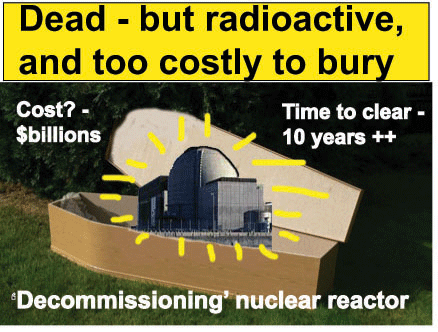
Nuclear liabilities of the largest eight nuclear plant operators in Europe totaled €100bn at the end of last year, representing around 22 per cent of their aggregate debt, according to credit rating agency Standard & Poor’s.
Operators are legally responsible for decommissioning nuclear power plants, a process which can take several decades to implement, meaning the associated costs are high. Europe’s main nuclear operators include France’s EDF, Germany’s E.ON and RWE. They are legally responsible for decommissioning nuclear power plants, a process which can take several decades to implement, meaning the associated costs are high.
While the analysis by S&P treats nuclear liabilities as debt-like obligations, it recognises that several features differentiate them from traditional debt. But given the size of the liabilities against a company’s debt, they can impact a company’s credit metrics, and their credit rating.
The report noted that a company’s nuclear provisions are difficult to quantify, as well as cross compare, because accounting methods vary between different countries. It also foresees many operational challenges ahead, including a reality check on costs and execution capabilities.
17 year delay before USA govt even starts cleanup of Hanford radioactive waste
 U.S. government proposes 17-year delay in start of Hanford nuclear tank cleanup — until 2039 http://www.latimes.com/science/la-na-hanford-delay-20151118-story.html Ralph VartabedianContact Reporter, 19 Nov 15
The Energy Department has proposed a 17-year delay in building a complex waste treatment plant at its radioactively contaminated Hanford site in Washington state, pushing back the full start-up for processing nuclear bomb waste to 2039.
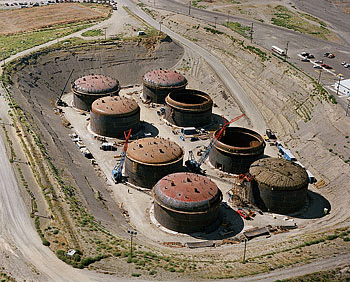
The department submitted the 29-page plan in federal court as part of a suit to amend an agreement with the state that requires the plant to start operating in 2022.
A series of serious technical questions about the plant’s design have caused one delay after another. Two of the major facilities at the cleanup site, which resembles a small industrial city, are under a construction halt ordered in 2013 by then-Energy Secretary Steven Chu.
The plant, located on a desert plateau above the Columbia River, is designed to transform 56 million gallons of radioactive sludge, currently stored in underground tanks, into solid glass that could theoretically be stored for thousands of years.
The waste was a byproduct of plutonium production, which started with the Manhattan Project during World War II.
The 586-square-mile Hanford site is widely considered the most contaminated place in the country, requiring 8,000 workers to remediate half a century of careless industrial practices that were done under strict federal secrecy. The Energy Department filing shows the extent of the problems. Continue reading
1 This Month
Chernobyl: The Lost Tapes – A good documentary on Chernobyl on SBS available On Demand for the next 3 weeks– https://www.sbs.com.au/ondemand/tv-program/chernobyl-the-lost-tapes/2352741955560

of the week–London Campaign for Nuclear Disarmament

Tell the Ukrainian Government to Drop Prosecution of Peace Activist Yurii Sheliazhenko
To see nuclear-related stories in greater depth and intensity – go to https://nuclearinformation.wordpress.com
-
Archives
- April 2026 (126)
- March 2026 (251)
- February 2026 (268)
- January 2026 (308)
- December 2025 (358)
- November 2025 (359)
- October 2025 (376)
- September 2025 (257)
- August 2025 (319)
- July 2025 (230)
- June 2025 (348)
- May 2025 (261)
-
Categories
- 1
- 1 NUCLEAR ISSUES
- business and costs
- climate change
- culture and arts
- ENERGY
- environment
- health
- history
- indigenous issues
- Legal
- marketing of nuclear
- media
- opposition to nuclear
- PERSONAL STORIES
- politics
- politics international
- Religion and ethics
- safety
- secrets,lies and civil liberties
- spinbuster
- technology
- Uranium
- wastes
- weapons and war
- Women
- 2 WORLD
- ACTION
- AFRICA
- Atrocities
- AUSTRALIA
- Christina's notes
- Christina's themes
- culture and arts
- Events
- Fuk 2022
- Fuk 2023
- Fukushima 2017
- Fukushima 2018
- fukushima 2019
- Fukushima 2020
- Fukushima 2021
- general
- global warming
- Humour (God we need it)
- Nuclear
- RARE EARTHS
- Reference
- resources – print
- Resources -audiovicual
- Weekly Newsletter
- World
- World Nuclear
- YouTube
-
RSS
Entries RSS
Comments RSS
 nuclear-news