This week – CLIMATE CHANGE is the issue
The climate is a common good, belonging to all and meant for all.
What kind of world do we want to leave to those who come after us, to children who are now growing up?
It is time to acknowledge that light- hearted superficiality has done us no good.
We need to be alert to one sad sign of the “globalization of indifference”: the fact that we are gradually growing accustomed to the suffering of others, as if it were something normal
We are confronted with a choice which cannot be ignored: either to improve or to destroy the environment. – Pope Francis
 As I write, the Paris Climate Change Summit COP21 gets underway. There is one important message about COP21 – IT’S A START – NOT A CONCLUSION. UNICEF reports that the greatest harm from climate change will be to children. Impetus for action should come from COP21, but corporations are geared up to undermine climate agreements.
I am happy to report that it looks very much as if nuclear power is off the table as an energy source to be chosen at the Paris summit – too dangerous, and more significantly, too expensive.
Melbourne kicked off the global wave of rallies with a huge climate march.
Pope and Muslim leaders in call for climate action.
Declaration of the World Nuclear Victims Forum in Hiroshima.
The unmentioned apocalyptic ISIS terror – attack on nuclear reactors. Nor do world leaders talk about the terrorism possibility regarding nuclear weapons. Increasing risk of sabotage by extremists working in the nuclear industry.
EUROPE. European Commission in-depth investigation into Hungarian investment support for Paks II nuclear power.
INDONESIA‘s fires – enormous output of greenhouse emissions.
FRANCE‘s new energy law to drastically limit electricity from nuclear power. EDF removes employees, fears radicalisation at nuclear facilities.
USA Dead nuclear reactors still leave an intractable wastes problem. USA’s nuclear operators want to extend reactor lives to 80 years! New York Opposes Big Easy Nuclear Relicensing Near New York City. USA anxious about nuclear proliferation, but keen to market nuclear technology to South Korea.
JAPAN. Fukushima: pressure of groundwater is causing underground wall around reactors to lean and crack. Japan to step up radiation protection, as worker’s leukaemia attributed to radiation
RUSSIA now plans to store nuclear wastes on Arctic islands ! Russia’s plan for a Nuclear-Powered Data Centre. Russia keen to market nuclear power to impoverished Cambodia. Sale of nuclear reactors to Egypt entails big debt to Russia.
INDIA again tests a Nuclear-Capable Missile. India opposes deal to phase out fossil fuels by 2100 at climate summit.
UK govt allout for nuclear power, discriminates against solar in tax system. Londan Mayor Boris Johnson scathing about £18bn cost of Hinkley nuclear plan. Hackers could shut down UK’s £31 billion nuclear weapon system – warns defence expert.
CHINA Did China dump nuclear trash in Northern Sudan?
Melbourne, Australia, starts the wave of global climate marches
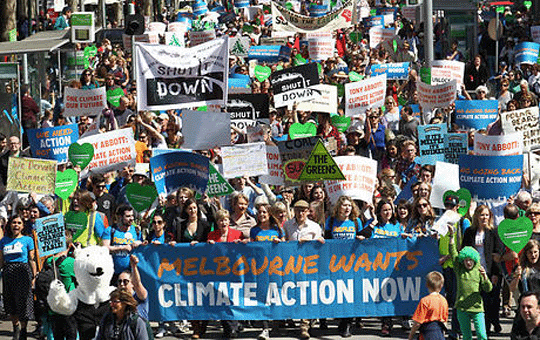 Thousands gather at Melbourne CBD rally ahead of Paris climate summit, The Age, [excellent photos and video] November 27, 2015 -Chloe Booker, Timna Jacks, With Tom Cowie and AAP
Tens of thousands of people have gathered in Melbourne’s CBD to demand world leaders take strong action to protect the planet at the Paris climate change conference.
The so-called People’s Climate March was one of hundreds of rallies being held around the world in the lead up to the crucial meeting. Members of The Cat Empire performed for the crowd, which included Opposition Leader Bill Shorten and Greens Senator Richard Di Natale.
A sea of placards stretched down Bourke Street from Spring Street to Swanston Street and along Swanston Street from Bourke Street to La Trobe Street. There was a stand-off between banked-up traffic and protesters at Exhibition Street as frustrated drivers honked their horns and the crowd erupted in cheers and shouts.
Stunned diners observed the march from outside Bourke Street cafes, and some heckled the demonstrators. Sections of the crowd were more like a party, with some dancing and clapping to a marching band dressed in green-glittered uniforms, while others swayed to the strumming of a guitar. ……..
Andy Parsons, an Environment Victoria volunteer who attended both rallies, said environmentalists supported the right of Aboriginal people to live independently.”The Aboriginal people lived sustainably for thousands of years. Us white people could learn a lot from them,” he said.
Aboriginal man Robbie Thorpe said he saw a parallel between the “genocide” of his people and what he called the “ecocide” of Australia’s natural environment. “We are the custodians of the land and the language. Only we know how to talk to our land. Without the Aboriginal people the land can’t survive and without the land, we can’t survive.” http://www.theage.com.au/victoria/thousands-expected-at-melbourne-cbd-rally-ahead-of-paris-climate-summit-20151127-gl9lz8.html
What is actually to happen at Paris climate talks?

 A Massive Climate Summit Is About to Happen in Paris. Here’s What You Need to Know. http://climatedesk.org/2015/11/a-massive-climate-summit-is-about-to-happen-in-paris-heres-what-you-need-to-know/ Tim McDonnell on Friday, November 27, 2015
 Diplomats and scientists are descending on the French capital Monday. They’ll try to save the world. On Monday, roughly 40,000 heads of state, diplomats, scientists, activists, policy experts, and journalists will descend on an airport in the northern Paris suburbs for the biggest meeting on climate change since at least 2009—or maybe ever. The summit is organized by the United Nations and is primarily aimed at producing an agreement that will serve as the world’s blueprint for reducing greenhouse gas emissions and adapting to the impacts of global warming. This is a major milestone in the climate change saga, and it has been in the works for years. Here’s what you need to know:
What’s going on at this summit, exactly? At the heart of the summit are the core negotiations, which are off-limits to the public and journalists. Like any high-stakes diplomatic summit, representatives of national governments will sit in a big room and parse through pages of text, word by word. The final document will actually be a jigsaw puzzle of two separate pieces. The most important part is the Intended Nationally Determined Contributions (INDCs). These are commitments made individually by each country about how they plan to reduce their carbon footprints. The United States, for example, has committed to cut its greenhouse gas emissions 26 to 28 percent below 2005 levels by 2025, mostly by going after carbon dioxide emissions from coal-fired power plants. Nearly every country on Earth has submitted an INDC, together covering about 95 percent of global greenhouse gas emissions. (You can explore them in detail here.)
The INDCs will be plugged in to a core agreement, the final text of which will be hammered out during the negotiations. It will likely include language about how wealthy nations should help pay for poor nations’ efforts to adapt to climate change; how countries should revise and strengthen their commitments over time; and how countries can critically evaluate each other’s commitments. While the INDCs are unlikely to be legally binding (that is, a country could change its commitment without international repercussions), certain elements of the core agreement may be binding. There’s some disagreement between the United States and Europe over what the exact legal status of this document will be. A formal treaty would need the approval of the Republican-controlled US Senate, which is almost certainly impossible. It’s more likely that President Barack Obama will sign off on the document as an “executive agreement,” which doesn’t need to go through Congress.
Meanwhile, outside the negotiating room, thousands of business leaders, state and local officials, activists, scientists, and others will carry out a dizzying array of side events, press conferences, workshops, etc. It’s basically going to be a giant party for the world’s climate nerds. Continue reading
Climate change’s biggest toll will be on children – UNICEF report
Children will bear the brunt of climate change –  http://www.un.org/apps/news/story.asp?NewsID=52637#.VljDrtIrLGg 24 November 2015 – More than half a billion children live in areas with extremely high flood occurrence and 160 million in high drought severity zones, leaving them highly exposed to the impacts of climate change, the United Nations Children’s Fund (UNICEF) said in a report released ahead of the 21st United Nations climate change conference, known as COP21.
According to the agency, of the 530 million children in the flood-prone zones, some 300 million live in countries where more than half the population lives in poverty – on less than $3.10 a day. Of those living in high drought severity areas, 50 million are in countries where more than half the population lives in poverty.
“The sheer numbers underline the urgency of acting now,” said UNICEF Executive Director Anthony Lake, in a press release. “Today’s children are the least responsible for climate change, but they, and their children, are the ones who will live with its consequences. And, as is so often the case, disadvantaged communities face the gravest threat,” he continued.
Climate change means more droughts, floods, heatwaves and other severe weather conditions. UNICEF is underlining that these events can cause death and devastation, and can also contribute to the increased spread of major killers of children, such as malnutrition, malaria and diarrhoea. This can reportedly create a vicious circle according to the agency – a child deprived of adequate water and sanitation before a crisis will be more affected by a flood, drought, or severe storm, less likely to recover quickly, and at even greater risk when faced with a subsequent crisis.
The report, Unless we act now: The impact of climate change on children, finds that the vast majority of the children living in areas at extremely high risk of floods are in Asia, and the majority of those in areas at risk of drought are in Africa.
Meanwhile, world leaders gathering in Paris for COP21 – held from November 30 to December 11 – will seek to reach agreement on cutting greenhouse gas emissions, which most experts say is critical to limiting potentially catastrophic rises in temperature.
“We know what has to be done to prevent the devastation climate change can inflict. Failing to act would be unconscionable,” said Mr. Lake. “We owe it to our children – and to the planet – to make the right decisions at COP21.”
Decision on radioactive trash dump near Great Lakes is delayed until March 2016
 Canada puts off decision on proposed nuclear waste dump near Lake Huron http://michiganradio.org/post/canada-puts-decision-proposed-nuclear-waste-dump-near-lake-huron#stream/0By STEVE CARMODY , 28 Nopv 15 The Canadian government has announced it needs more time to decide if it will OK permits for a nuclear waste storage facility near the shore of Lake Huron. Ontario Power Generation wants to bury approximately 200,000 cubic meters of low to medium level nuclear waste 680 meters – just under a half mile – below ground. The utility insists the rock formation in the area, less than a mile from Lake Huron, is geologically stable.
The Trudeau government had faced a December 2nd deadline to decide if it would approve the permits for the facility. But the agency responsible for the review announced today it is delaying the decision until March 1st.
Beverly Fernandez is with the group Stop the Great Lakes Nuclear Dump. She welcomes today’s decision.
“We are hopeful that the minister will act to protect the Great Lakes and ultimately say ‘no’ to OPG’s plan,” says Fernandez, “This really is a matter that does affect all the people in Canada and the U.S. The Great Lakes are a shared natural resource.”

Fernandez hopes the decision to delay is a sign the Trudeau government may will willing to reject the project. The proposed nuclear waste storage facility has been controversial on both sides of the border. Dozens of local governments in Michigan have passed resolutions opposing it. Environmental groups have protested against it.
Michigan’s congressional delegation has raised serious concerns about the potential consequences to the Great Lakes if the facility fails to contain the radioactive waste.
The former Conservative Canadian government appeared friendly to the planned nuclear waste storage facility. But the government of Prime Minister Stephen Harper was defeated by the Liberals in recent elections.
Corporations determined to control Paris climate agreement
 several platforms to ensure business-friendly proposals are at the heart of climate policy-making, rather than vice versa. New markets, experimental technologies, all endorsed so polluters don’t have to change their business models.
In the real world, “net-zero” gives polluters an excuse to continue with business as usual, claiming that future inventions will fix the problem.
Hundreds of thousands have already added their name to campaigns urging governments to recognise the damaging influence “big polluters” have over climate policy, and to kick them out of COP21 and all levels of government.
If enough people get behind it, Paris could mark a watershed moment: the beginning of the end for the cosy affair between politicians and polluters.
Paris climate talks: powerful business lobbies seek to undermine deal http://www.theguardian.com/sustainable-business/2015/nov/27/paris-climate-talks-un-business-lobbying-deal-governments by Pascoe Sabido
Tackling climate change means drastically transforming our economies. Our political leaders, not business, are best placed to do that.
As the UN’s climate talks in Paris begin, the lobbying and public relations push from some of the biggest corporations responsible for climate change has gone into overdrive. What are the messages they’re so keen to spread, and what will they mean for the COP21 conference – and for the climate?
A recent report from the NGO Corporate Europe Observatory reveals that what’s on offer at COP21 is nothing short of a climate catastrophe, a guaranteed recipe to cook the planet. But rather than sending the dish back, political leaders have asked for seconds, bringing the very companies responsible for the problem ever closer into the UN fold.
James Bacchus, a trade expert at the International Chamber of Commerce, says: “This issue is important for governments to address but it is far too important to leave to governments alone.”
Fortunately for Bacchus, the UN agrees. Continue reading
We don’t talk about the terrorism danger to nuclear facilities: it’s not polite
 Don’t ask, don’t tell – terrorism and the nuclear threat http://thehill.com/blogs/congress-blog/presidential-campaign/261344-dont-ask-dont-tell-terrorism-and-the-nuclear-threat By Robert Dodge, MD, 27 Nov 15 With recent tragic events in Paris the world is once again reminded that there is no safe haven from the threat of terrorism.
In a nuclear world one can only imagine what the outcome would be if the perpetrators had nuclear materials. In a world with over 15,000 nuclear weapons the potential for such a scenario is very real.
Yet with the threat posed by the existence of nuclear weapons and materials, there has been no questioning of or statements by our presidential contenders on how to address and eliminate this threat to all of humanity. As though there was a conspiracy of silence and a fear that one would somehow appear weak if advocating for the abolition of nuclear weapons.
Failing to address the existential threat posed by the continued existence of nuclear weapons while failing to deal with the causation of terrorism is ultimately a recipe for disaster.
This is particularly true now after the Paris attacks, when like after 9/11, all the world has a sense of being Parisian. As long as the ingredients for terrorism exist, no nation will be immune to the potential risk of terrorist attacks. Now is the time for nations to come together. The international leadership void that calls for a joining of efforts to address the causation allows the continued fermentation of the elements.
As per the question of nuclear weapons and their very real and growing threat to human existence, no one is speaking to the humanitarian consequences of nuclear weapons and nuclear war. Probability theorists place the threat of nuclear war by design or accident conservatively at 1 percent per year with some as high as 2-3 percent. A child born today has an unlikely chance of reaching his or her 30th birthday without a nuclear war in their world.

Studies have now confirmed that a limited regional nuclear exchange using less than ½ of 1 percent of the global nuclear arsenals would have global implications ultimately killing up to 2 billion people on the planet from the resulting climate change and devastating effects on agricultural production in the years to follow. This scenario is a very real possibility with the ongoing tensions between the nuclear armed nations of India and Pakistan.
With growing tensions in Ukraine and Syria and with the U.S. and Russia on opposing sides, either side unleashing only their nuclear weapons on hair trigger WITHOUT RETALIATION would result in massive devastation beyond that of the limited regional scenario, possibly ending human life on this planet.
With such a threat we must demand a response from our future leader to tell us what their administration will do to achieve nuclear disarmament, or under what circumstances would they propose such a suicide mission?
Yet who among the candidates for commander-in-chief, who is sworn to protect and serve the United States, has the courage to speak about this greatest threat to our country and indeed to humanity itself? And who in the media is willing to pose the questions about this grave threat? Until we address this issue we will face the possibility in the words of Albert Einstein of “unparalleled catastrophe” continuing to rely on luck as a defense strategy.
Dodge is a family physician practicing full time in Ventura, California. He serves on the National and Los Angeles boards of Physicians for Social Responsibility (www.psr.org,www.psr-la.org,). He also serves on the board of the Nuclear Age Peace Foundation (www.wagingpeace.org) and Citizens for Peaceful Resolutions (www.c-p-r.net). He writes for PeaceVoice (www.PeaceVoice.info).
Public services or nuclear weapons: it seems UK can’t afford both
 Minister Matt Hancock suggests public may have to choose
  between nuclear weapons and public services, The Independent, 27 Nov 15 He said the policy could be responsible for Labour running up debts A Cabinet minister has appeared to question whether Britain could continue to afford well-equipped schools and hospitals if it spends money on new nuclear weapons.
Matthew Hancock, the cabinet office minister, was appearing on BBC One’s Question Time programme.
He made the comments after former Mayor of London Ken Livingstone questioned whether the £40bn estimated cost of the Trident nuclear submarines could be better spent on public services.
“We have to reduce our debt but we’re still the fifth richest nation in the world and this week while we’re been told we can’t afford this, we can’t afford that – Cameron’s telling us those four nuclear submarines will cost £40bn,” the veteran Labour politician had argued.
“It’s a question of the choices you make. I’d rather our kids had a better education and that we had more hospital beds than four nuclear submarines.”…….
The Government recently announced that the estimated cost of Trident would be £40bn.
Independent estimates peg the system’s lifetime cost as being significantly higher, however. The independent Trident Commission estimated a cost of around £100bn while the Reuters news agency estimated £167bn based on other official figures.
Labour is currently split on whether to support the system’s renewal. http://www.independent.co.uk/news/uk/politics/minister-matt-hancock-questions-whether-the-britain-could-afford-schools-hospitals-and-nuclear-a6751206.html
30 November Kazakhstan: Red Cross and Red Crescent determined on banning nuclear weapons
 Kazakhstan: Round-table on the humanitarian consequences of nuclear weapons Astana (ICRC)https://www.icrc.org/en/document/kazakhstan-round-table-humanitarian-consequences-nuclear-weapons–The Kazakh Humanitarian Law University will host a round-table on 30 November on the cost in human terms of nuclear weapons. Some 30 diplomats and government officials will attend the event in Astana, Kazakhstan, organized by the foreign ministries of Japan and Kazakhstan, and the International Committee of the Red Cross (ICRC).
The round-table brings together representatives from Japan, the only country to have experienced a nuclear attack, Kazakhstan, which is still suffering from the effects of nuclear weapon testing and the ICRC, which went to help those affected immediately after the bombing of Hiroshima.
“Over seventy years have gone by since Hiroshima, but nuclear disarmament is no nearer. Unfortunately, promises have not turned into action,” said Jacques Villettaz, the head of the ICRC’s regional delegation in Central Asia. “But the humanitarian consequences of the use of such weapons have become central to any debate on nuclear disarmament.”
The ICRC and the wider International Red Cross and Red Crescent Movement are deeply concerned by the impact of nuclear weapons and, potentially, their illicitness under international humanitarian law. They are determined to focus attention on the necessity of banning nuclear weapons. For further information, please contact:
Pierre-Emmanuel Ducruet, ICRC Tashkent, tel: +7 702 768 73 35
Dead nuclear reactors still leave an intractable wastes problem
Security, storage concerns linger at closed nuclear sites US regulators still seek safe site for waste, Boston Globe, By David Abel GLOBE STAFF NOVEMBER 26, 2015 VERNON, Vt. — Across from an elementary school, a short road leads to a gate topped by barbed wire and a stark sign that warns in large letters:
“Security personnel are authorized to use deadly force.”
The Vermont Yankee nuclear plant stopped producing power last year, but rigorous security measures, including heavily armed guards in bulletproof towers, are still in place and will be for decades to protect hundreds of tons of radioactive waste that remain behind the gate. The spent fuel will stay here along a bend of the Connecticut River, just 10 miles from the Massachusetts border, until the federal government can resolve a decades-old political battle over where to store the waste from the nation’s nuclear plants.
Across the United States, there are 22 decommissioned plants that have become heavily guarded repositories of spent fuel, their owners waiting indefinitely for a federal decision on where to permanently store the radioactive waste. About 150 miles away in Plymouth, Mass., the Pilgrim Nuclear Power Station will enter the same phase after it closes sometime in the next four years and moves its waste into massive casks.
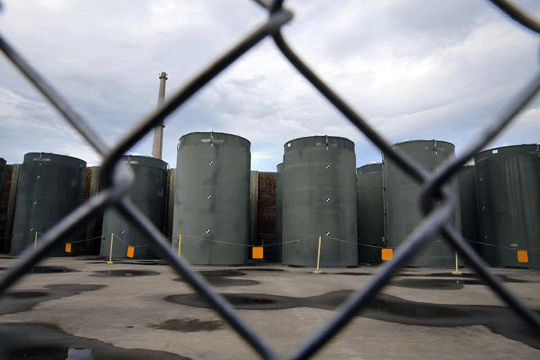
The issue of nuclear waste has long been a political quandary, one that has become increasingly urgent as more of the nation’s aging nuclear plants are shuttered…….
“We don’t think Yucca Mountain will be a viable approach,” said Secretary of Energy Ernest Moniz during a recent meeting with reporters and editors at the Globe.
Moniz said his staff is reviewing a proposal to build a temporary storage site in Andrews County, Texas, which already hosts two radioactive waste disposal facilities. The government will also have to overcome concerns and potential challenges over transporting the fuel through a variety of jurisdictions.
Until then, the waste will remain atop specially built concrete pads at the nation’s nuclear plants. That means the properties cannot be redeveloped for other uses, major security measures will remain in force at sites scattered across the country, and many of their neighbors will continue to live in fear.
“We’re talking about a colossal amount of dangerous waste,” said Deb Katz, executive director of Citizens Awareness Network, who lives 18 miles from Vermont Yankee. “The radioactive plume from an accident could travel more than 100 miles within 24 hours, depending on which way the wind blows.”
Entergy Corp., a Louisiana-based conglomerate that owns the plants in Vernon and Plymouth, plans a decommissioning process at Pilgrim similar to the one it has started at Vermont Yankee.
On its compact campus in Vernon, Vermont Yankee’s remaining 285 employees — about 600 people worked at the plant until last December — have transferred all of the remaining fuel to a 37-foot-deep pool suspended seven stories above ground in a concrete containment building. There are 2,996 spent fuel assemblies cooling in the pool.
After they’re moved into safer, dry storage, the plant will have 58 of the 18-foot-tall, 300,000-pound casks on the outdoor pad along the Connecticut River.
Activists who live near Vermont Yankee have urged the plant to move the spent fuel more quickly from the pools, which they fear could catch fire if an earthquake or other natural disaster caused a leak or cut power to the plant. They have also raised concerns about storing the casks closely together out in the open, rather than below ground or in a hardened building.
“Should someone be interested in shooting them up, they’re sitting ducks,” said Nancy Braus of the Safe and Green Campaign in Brattleboro. “They’re easy targets, very visible.”………. David Abel can be reached at dabel@globe.com. Follow him on Twitter @davabel. https://www.bostonglobe.com/metro/2015/11/26/the-long-road-decommissioning-nuclear-power-plant/k5VWUQzLKCIz2VuYs8RhoO/story.html
Russia now plans to store nuclear wastes on Arctic islands !
 Has the world gone crazy? Particularly Russia! What right do they have to impose this poisonous trash on Arctic islanders? And where radioactive pollution will further endanger the ocean? Have they not heard of climate change? Of rising sea levels? Have ANY nuclear powers ever entertained the thought of just stopping making radioactive trash for which there is no real solution?
Russia plans to build radioactive waste storage on Arctic islands of Novaya Zemlya http://tass.ru/en/economy/839293 November 25, 2015
 Until 1992, the waters off the coast of the archipelago of Novaya Zemlya had been the main area for sinking solid radioactive waste from the Soviet nuclear vessels based in the North ARKHANGELSK, November 25. /TASS/. Russia’s Rosatom state nuclear corporation intends to build a low-and medium-level radioactive waste disposal facility in the area of the Novaya Zemlya archipelago. Rosatom’s relevant request is to be considered on Wednesday by deputies of the Arkhangelsk regional assembly.
The press service of the regional assembly reported that before the session the lawmakers held a roundtable discussion to discuss the project. Deputy head of Rosatom department for work with regions Andrei Polosin said: “We do not plan to build this facility right now. We just need a permission to conduct additional studies.” “To get started, we need seven years. It’s a very big project, requiring many different approvals,” he added.
According to experts, about 50 tonnes of radioactive waste from the operation of nuclear-powered submarines in Severodvinsk have been accumulated in the Arkhangelsk region. The construction of a waste disposal facility on Novaya Zemlya would attract additional investment to the region and create new jobs.
Until 1992, the sea off the coast of the Arctic archipelago of Novaya Zemlya had been the main area for sinking solid radioactive waste from the Soviet military and civilian nuclear vessels based in the North. A total of about 17,000 containers with solid radioactive waste, as well as 16 nuclear reactors from submarines and icebreakers were sunk in the Arctic. In 1982, the K-27 emergency nuclear submarine with unloaded reactor was sunk in Stepovoi Bay. The radiation situation in these areas is regularly monitored by expeditions of the Emergency Situations Ministry and the Russian Academy of Sciences. According to their data, solid radioactive waste dumped during the Soviet years off the coast of Novaya Zemlya at present poses no threat to the environment, but requires constant monitoring
Nuclear weapons on hair-trigger alert: time to take steps towards safety


 Could U.S.-Russia Tensions Go Nuclear? Politico Believe it or not, hair-trigger launch alerts are still with us—and perhaps even more dangerous than during the Cold War. By Bruce Blair November 27, 2015 The Russian warplane recently shot down inside Turkey’s border with Syria fits a pattern of brinkmanship and inadvertence that is raising tensions and distrust between Russia and U.S.-led NATO. Low-level military encounters between Moscow and Washington are fanning escalatory sparks not witnessed since the Cold War. And there exists a small but steadily growing risk that this escalation could morph by design or inadvertence into a nuclear threat.
The backdrop for these concerns is that both the United States and Russia maintain their nuclear command posts and many hundreds of strategic nuclear warheads on hair-trigger alert. This is a long-standing practice, or habit, driven by the inertia of the Cold War. The two sides adopted the accident-prone tactic known as launch-on-warning in order to ensure that their strategic forces could be fired before incoming warheads arrived. President Barack Obama’s recent nuclear employment guidance reiterated the need to preserve this option. Our nuclear command system and forces practice it several times a week. So do the Russians.
And believe it or not, Russia has shortened the launch time from what it was during the Cold War. Today, top military command posts in the Moscow area can bypass the entire human chain of command and directly fire by remote control rockets in silos and on trucks as far away as Siberia in only 20 seconds.
Why should this concern us? History shows that crisis interactions, once triggered, take on a life of their own. Military encounters multiply; they become more decentralized, spontaneous and intense. Safeguards are loosened and unfamiliar operational environments cause accidents and unauthorized actions. Miscalculations, misinterpretations and loss of control create a fog of crisis out of which a fog of war may emerge. In short, the slope between the low-level military encounters, the outbreak of crisis and escalation to a nuclear dimension is a steep and slippery one.
Somewhere along this slope, a psychological construct known as “deterrence” is supposed to kick in to prevent the use of nuclear weapons. But deterrence can become an extreme sport during a confrontation, a game of taking and manipulating existential risk, morphing into games of chicken, bluff, coercion and blackmail. The basic idea is to instill fear in an adversary’s mind that events could spin out of control and result in a nuclear war.
That’s especially true since the public doesn’t realize just how little time exists for our leaders to make a decision to use nuclear weapons, even today—and if anything the atmosphere has become even more hair trigger with the threat of cyberwarfare. A launch order is the length of a tweet. Missile crews in turn transmit a short stream of computer signals that immediately ignite the rocket engines of many hundreds of land-based missiles. For the United States, this takes 1 minute. As a former nuclear-missile launch officer, I personally practiced it hundreds of times. We were called Minutemen. U.S. submarine crews take a little longer; they can fire their missiles in 12 minutes.
The last time the U.S. brandished nukes wholesale for the purpose of deterrence was in 1973………
Do U.S. leaders understand that the Russians may fear a decapitation threat is emerging, and that this threat may be the underlying driver raising the stakes for Russia to the level of an existential threat warranting preparations for the use of nuclear weapons? I doubt they do.
At some point one side or the other may blink and back off, or maybe not.
Tensions could continue to rise until the crisis escalates by intention or inadvertence to the threshold of nuclear use. In the case of Russia, this threshold is low. Russia’s strategy in Europe was devised by President Vladimir Putin himself in the year 2000 in response to NATO’s bombing of the Balkans. The strategy is called “de-escalatory escalation,’ which unleashes tens to hundreds of nuclear weapons in a first strike meant to shock an adversary into paralysis. And so it might, or it might just escalate into a nuclear exchange………
It is aggravated by a murky new threat—cyberwarfare. Given our poor comprehension of this cyberthreat, it seems imprudent in the extreme to keep U.S. and Russian command systems poised to launch on warning, and nuclear missiles poised to fly as soon as they receive a short stream of computer signals, whose origin may not be authorized.
Given all this risk-taking, which extends with even greater force to other nuclear weapons countries, and given that deterrence itself is nothing more or less than the manipulation of nuclear risk, we cannot reasonably expect nuclear weapons never to be used..
The obvious solution is to eliminate nuclear weapons entirely, but of course that will not happen overnight. Meanwhile, the following seven measures would help move the dial further away from nuclear midnight. They draw upon the recent report of the Global Zero Commission on Nuclear Risk Reduction……..
One. The United States and Russia could agree to eliminate launch-on-warning from their strategy………
Two. They could agree to begin taking their strategic missile forces off of hair trigger,……
Three. All the nuclear weapons countries could agree to refrain from putting any nuclear forces on high alert except under tightly controlled conditions…..
Four. The U.S. and Russia could work with other nuclear establishments to share knowledge, best practices and technologies in the area of safety and security..
Five. The U.S. and Russia, perhaps with China, could lead an effort to ban cyberwarfare…..
Six. Confidence-building measures agreed to through military-to-military dialogue ……
http://www.politico.com/magazine/story/2015/11/russia-us-tensions-nuclear-cold-war-213395#ixzz3sirbYxpC
Sudden mass kill of fish in Mississippi River due to shutdown of Monticello nuclear power plant
Sudden shutdown of Monticello nuclear power plant causes fish kill, By David Shaffer Star Tribune NOVEMBER 25, 2015 The sudden drop in temperature in the discharged cooling water resulted in a fish kill in the Mississippi River.
In a report to the U.S. Nuclear Regulatory Commission, Xcel Energy said it shut down the plant while operating at 100 percent power after a problem arose with a reactor pump. The utility said shutdown happened safely, with no release of radiation and no risk to the public.
But the sudden drop in temperature in the discharged cooling water resulted in a fish kill. Xcel said it counted 59 dead fish. The fish were crappies, sunfish, bass, catfish and carp, according to the state Department of Natural Resources, which was notified of the incident.
During unexpected shutdowns, the water temperature near the plant can drop from about 65 degrees to 40 degrees in a few hours, said Harland Hiemstra, a DNR information officer. The fish can’t cope with the sudden change in temperature, he said. “It is thermal shock,” he added…….http://www.startribune.com/sudden-shutdown-of-monticello-nuclear-power-plant-causes-fish-kill/354007091/
India again tests a Nuclear-Capable Missile
India Completes Agni-I Nuclear-Capable Missile Test, defense World, November 27, 2015 India has test fired home-made nuclear capable Agni-I missile that can hit target from a distance of 700kms.
The missile was launched from off the Odisha coast as a part of Strategic Forces Command (SF) training centre, NDTV reported today.
The surface-to-surface, single-stage missile, was powered by solid propellants. It was test-fired from a mobile launcher at 1002 hours from launch pad-4 of the Integrated Test Range (ITR) at Abdul Kalam Island (Wheeler Island)…….he missile, which has already been inducted into armed forces, weighs 12 tonnes. The 15-metre-long missile is designed to carry a payload of more than one tonne. Moreover, its strike range can be extended by reducing the payload…….http://www.defenseworld.net/news/14714/India_Completes_Agni_I_Nuclear_Capable_Missile_Test#.Vli4odIrLGg
Russia’s plan for a Nuclear-Powered Data Centre
Russia Plans Nuclear-Powered Data Centre, Sky News 27 Nov 15 A new law in Russia means that data on citizens must be held on the country’s soil, and not abroad.Russia’s largest ever data centre will cost $1bn and be rigged up to a nuclear power station.
Kalinin power station – 120 miles from Moscow – will provide the 80 megawatts needed to power the data centre’s 10,000 server racks.
The plant’s owner, Rosenergoatom, is likely hoping to take advantage of a new law in Russia which states that data on citizens must be held on the country’s soil, and not abroad.
According to Telecom Daily, more than 10% of the data centre capacity has been reserved for the state-owned company, while the rest will be available to commercial customers…….http://news.sky.com/story/1595509/russia-plans-nuclear-powered-data-centre
1 This Month

of the week – Shut Down Drone Warfare!


Tell the Ukrainian Government to Drop Prosecution of Peace Activist Yurii Sheliazhenko

Petition to revoke the licensing of the Near Surface Nuclear Disposal Facility (NSDF) at Chalk River. https://www.ourcommons.ca/petitions/en/Petition/Details?Petition=e-7247
To see nuclear-related stories in greater depth and intensity – go to https://nuclearinformation.wordpress.com
-
Archives
- April 2026 (91)
- March 2026 (251)
- February 2026 (268)
- January 2026 (308)
- December 2025 (358)
- November 2025 (359)
- October 2025 (376)
- September 2025 (257)
- August 2025 (319)
- July 2025 (230)
- June 2025 (348)
- May 2025 (261)
-
Categories
- 1
- 1 NUCLEAR ISSUES
- business and costs
- climate change
- culture and arts
- ENERGY
- environment
- health
- history
- indigenous issues
- Legal
- marketing of nuclear
- media
- opposition to nuclear
- PERSONAL STORIES
- politics
- politics international
- Religion and ethics
- safety
- secrets,lies and civil liberties
- spinbuster
- technology
- Uranium
- wastes
- weapons and war
- Women
- 2 WORLD
- ACTION
- AFRICA
- Atrocities
- AUSTRALIA
- Christina's notes
- Christina's themes
- culture and arts
- Events
- Fuk 2022
- Fuk 2023
- Fukushima 2017
- Fukushima 2018
- fukushima 2019
- Fukushima 2020
- Fukushima 2021
- general
- global warming
- Humour (God we need it)
- Nuclear
- RARE EARTHS
- Reference
- resources – print
- Resources -audiovicual
- Weekly Newsletter
- World
- World Nuclear
- YouTube
-
RSS
Entries RSS
Comments RSS
 nuclear-news