Is nuclear power competitive? Actually – NO!
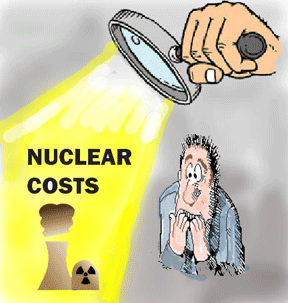 Nuclear Power Is No Fix for Climate, Energy Intelligence, M.V. Ramana, 27 Nov 15
Once actual projects were on the drawing board, however, these hypothetical numbers moved quickly north. In Europe, two French-led flagship projects were initially estimated at around $2,250-$2,475/kW in the case of the Olkiluoto-3 reactor in Finland in 2004, and around $2,600/kW in the case of the Flamanville plant in France in 2006, both higher than the figures assumed by the academic and industry studies. In the US, cost estimates by electric utilities building reactors were higher — the corresponding initial estimates for two Westinghouse AP1000 reactors under construction at the Vogtle nuclear power plant in Georgia were $4,700/kW, for just the nuclear reactor, and $6,412/kW, when the other costs associated with the project were included.
When construction actually started, those numbers were soon obsolete and costs once again rose. Today, as work on these projects continues and completion dates are extended well beyond original dates, the cost estimates keep rising. As of early 2015, Vogtle’s total cost was estimated at around $7,300/kW. Likewise, the costs of the two European projects have more than doubled. The story is similar in Russia, India and China, although the starting cost estimates were lower.
Original construction timelines now seem completely absurd. Olkiluoto-3’s construction time went from four years to 13 and Flamanville-3 from five to 11. One of the Koodankulam reactors in southern India took 12 years to be commissioned, in comparison with the initial estimate of six years; the second one is yet to start operating, and the construction period count there is upwards of 13 years. All of these experiences should serve as reminders that cost and time overruns for reactor construction, long the bugbears of the nuclear industry, have not been exorcised by modern construction and manufacturing methods.
The industry typically attempts to explain these cost and time overruns as the result of teething problems in first-of-a-kind projects and argues that as more projects get under way these problems will be sorted out. Unfortunately, historical experience belies this expectation: Nuclear construction costs have typically gone up, not down, as more reactors are built, and this trend has been extensively documented in the US, France and India. The tendency toward increased costs despite experience is being demonstrated currently, with the estimated cost of a planned French reactor at Hinkley Point in the UK higher than estimates for the same reactor at Flamanville and Olkiluoto, and with the estimated cost of the Russian reactors proposed to be constructed in Turkey and in Bangladesh being higher than the Koodankulam reactors in India.
Higher Generating Costs
For a long time now, the nuclear industry had a comforting answer to this problem of high construction costs: it may take a lot, both of time and money, to build a reactor, but once built and paid for, the reactor will generate low-cost electricity that can be sold for handsome profits. The experiences of the last few years have burst that bubble. Marginal costs associated with producing nuclear electricity have been rising, to the point that some utilities are doing the unthinkable: shutting down nuclear reactors even though their licenses would allow them to operate for a decade or more beyond the planned shutdown date.
Annual expenditures in the US averaged for the whole fleet — not counting initial construction costs, which have largely been paid off — cover fuel purchases, salaries for workers and activities like uprating generation capacity, replacing equipment and regulatory work. The total is in the vicinity of $40 to $45 per megawatt hour, which should be seen in the context of recent bids for new solar photovoltaic projects (including the cost of recouping initial construction expenditures) that are around $50/MWh, and even lower than $40/MWh in some parts of the country. These higher-than-expected nuclear generating costs and the falling costs of competing sources of electricity explain why in the past few years US utilities have decided to prematurely shut down at least eight reactors — particularly stand-alone single units that don’t enjoy the economies of scale of plants with two or more reactors.
Across the Atlantic, Vattenfall, the Swedish state-owned utility, is closing down two reactors at the Ringhals nuclear power plant earlier than planned. Another large utility, E.On, justified its decision to shut down two of the reactors at Sweden’s Oskarshamn power plant by saying that “there are no prospects of generating financial profitability either in the short or the long term.” Although there have been no shutdowns yet in France, its audit court, Cour des Comptes, estimated that production costs for EDF’s 58 reactors had risen from €49.6 to €59.8/MWh between 2010 and 2013. The company has also been selling much less electricity to its competitors than in earlier years, leading analysts to conclude that “nuclear energy is less competitive than it was in the past.” This, in France, the country most reliant on nuclear power — and which has also decided to pare back nuclear’s contribution to its overall generation from just under 80% to 50% by 2025……….. http://www.energyintel.com/pages/worldopinionarticle.aspx?DocID=906841
No comments yet.
1 This Month

of the week – Shut Down Drone Warfare!


Tell the Ukrainian Government to Drop Prosecution of Peace Activist Yurii Sheliazhenko

Petition to revoke the licensing of the Near Surface Nuclear Disposal Facility (NSDF) at Chalk River. https://www.ourcommons.ca/petitions/en/Petition/Details?Petition=e-7247
To see nuclear-related stories in greater depth and intensity – go to https://nuclearinformation.wordpress.com
-
Archives
- April 2026 (79)
- March 2026 (251)
- February 2026 (268)
- January 2026 (308)
- December 2025 (358)
- November 2025 (359)
- October 2025 (376)
- September 2025 (257)
- August 2025 (319)
- July 2025 (230)
- June 2025 (348)
- May 2025 (261)
-
Categories
- 1
- 1 NUCLEAR ISSUES
- business and costs
- climate change
- culture and arts
- ENERGY
- environment
- health
- history
- indigenous issues
- Legal
- marketing of nuclear
- media
- opposition to nuclear
- PERSONAL STORIES
- politics
- politics international
- Religion and ethics
- safety
- secrets,lies and civil liberties
- spinbuster
- technology
- Uranium
- wastes
- weapons and war
- Women
- 2 WORLD
- ACTION
- AFRICA
- Atrocities
- AUSTRALIA
- Christina's notes
- Christina's themes
- culture and arts
- Events
- Fuk 2022
- Fuk 2023
- Fukushima 2017
- Fukushima 2018
- fukushima 2019
- Fukushima 2020
- Fukushima 2021
- general
- global warming
- Humour (God we need it)
- Nuclear
- RARE EARTHS
- Reference
- resources – print
- Resources -audiovicual
- Weekly Newsletter
- World
- World Nuclear
- YouTube
-
RSS
Entries RSS
Comments RSS
 nuclear-news
Leave a comment