China steps up marketing of nuclear technology, supplies reactors to Argentina
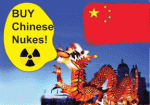 Argentina getting ‘made in China’ reactor http://asia.nikkei.com/Business/Deals/Argentina-getting-made-in-China-reactor, TETSUYA ABE, Nikkei staff writer, 17 Nov 15 BEIJING — China has clinched a deal to supply a nuclear reactor to Argentina, the fruit of an all-out effort by Beijing to ramp up infrastructure-related exports.
The deal between the state-run China National Nuclear Corp. and a state-owned Argentine nuclear power company was reached on the sidelines of the Group of 20 summit in Turkey, the Xinhua News Agency reported Tuesday. The contract totals $4.7 billion, according to Xinhua.
CNNC will supply equipment and parts for Argentina’s fourth and fifth reactors, slated for construction at the Atucha nuclear plant in Buenos Aires Province. The Hualong 1 reactor, a model that CNNC is said to have developed with China General Nuclear Power, will be adopted for the No. 5 reactor at the site. The Chinese side will cover a portion of the construction costs and offer low-interest loans. CNNC is also expected to supply the pressure vessel and steam generator for the No. 4 reactor.
At a meeting between Chinese President Xi Jinping and British Prime Minister David Cameron in October, the U.K. agreed to adopt the Hualong 1 at southeastern England’s Bradwell nuclear plant. China will also export five of the reactors to Pakistan for $15 billion in all. This type of reactor is said to cost roughly two-thirds as much to introduce as a comparable facility built in an industrialized nation.
Despite its limited track record in reactor operations and accident management, China has stepped up marketing efforts abroad by offering low prices. China General Nuclear Power recently signed a 7.2 billion euro ($7.6 billion) atomic energy deal with Romania. China’s strategy of sweetening deals by shouldering a portion of the costs for emerging nations poses a threat to established global players.
No comments yet.
1 This Month

of the week – Shut Down Drone Warfare!


Tell the Ukrainian Government to Drop Prosecution of Peace Activist Yurii Sheliazhenko

Petition to revoke the licensing of the Near Surface Nuclear Disposal Facility (NSDF) at Chalk River. https://www.ourcommons.ca/petitions/en/Petition/Details?Petition=e-7247
To see nuclear-related stories in greater depth and intensity – go to https://nuclearinformation.wordpress.com
-
Archives
- March 2026 (251)
- February 2026 (268)
- January 2026 (308)
- December 2025 (358)
- November 2025 (359)
- October 2025 (376)
- September 2025 (257)
- August 2025 (319)
- July 2025 (230)
- June 2025 (348)
- May 2025 (261)
- April 2025 (305)
-
Categories
- 1
- 1 NUCLEAR ISSUES
- business and costs
- climate change
- culture and arts
- ENERGY
- environment
- health
- history
- indigenous issues
- Legal
- marketing of nuclear
- media
- opposition to nuclear
- PERSONAL STORIES
- politics
- politics international
- Religion and ethics
- safety
- secrets,lies and civil liberties
- spinbuster
- technology
- Uranium
- wastes
- weapons and war
- Women
- 2 WORLD
- ACTION
- AFRICA
- Atrocities
- AUSTRALIA
- Christina's notes
- Christina's themes
- culture and arts
- Events
- Fuk 2022
- Fuk 2023
- Fukushima 2017
- Fukushima 2018
- fukushima 2019
- Fukushima 2020
- Fukushima 2021
- general
- global warming
- Humour (God we need it)
- Nuclear
- RARE EARTHS
- Reference
- resources – print
- Resources -audiovicual
- Weekly Newsletter
- World
- World Nuclear
- YouTube
-
RSS
Entries RSS
Comments RSS
 nuclear-news
Leave a comment