Nuclear deterrence: it’s just a house of cards
 Jeremy Corbyn’s Refusal to Launch Nuclear Weapons Shines Spotlight on Flaws of Deterrence http://fpif.org/jeremy-corbyns-refusal-to-launch-nuclear-weapons-shines-spotlight-on-flaws-of-deterrence/ When British Labour leader Jeremy Corbyn stated that, if prime minister, he would not launch nuclear weapons, the British chief of defense was predictably outraged.
By Russ Wellen, November 17, 2015. Newly elected British Labour leader Jeremy Corbyn upset the deterrence apple cart when he revealed that he wouldn’t launch nuclear weapons should he become prime minister. Chief of Defence Staff Sir Nick Houghton protested; at Huffington Post UK, Paul Waugh quoted Corbyn’s response:
“It is a matter of serious concern that the chief of the defence staff has today intervened directly in issues of political dispute. It is essential in a democracy that the military remains political neutral at all times.”
But Houghton said “the reason I say this, and it is not based on a personal thing at all, it is purely based on the credibility of deterrence.”
“The whole thing about deterrence rests on the credibility of its use.”
In other words, if a state has nuclear weapons and it’s the victim of a nuclear attack (or first strike), it feels bound to fulfill the deterrence contract and retaliate (a second strike). Otherwise, the state’s threats will never be taken seriously again.
The fallacy in that argument is that what hurts the credibility of deterrence even more is that, if nuclear war breaks out, it means that nuclear deterrence has failed. Not only that, once the world gets a load of the results of a nuclear war, nuclear programs as a whole will have lost their credibility. In other words, it doesn’t matter if the credibility of deterrence is undermined because it will likely never be used as a policy again.
Another troublesome aspect of deterrence is highlighted in an article on the precarious nature of the nuclear taboo in the new Bulletin of the Atomic Scientists by James Doyle:
Potentially lethal tension exists between nuclear deterrence and the nuclear taboo because the effectiveness of a nation’s nuclear deterrent depends on the credibility of its threat to use those weapons. If one state believes its rival will refrain from nuclear retaliation due to a desire to preserve the nuclear taboo, that state may be less deterred to initiate a nuclear attack.
“Nuclear-armed states could take steps to strengthen and formalize the nuclear taboo,” Doyle continues, “but they have not done so.”
They could all adopt a declaratory policy stating that nuclear weapons will only be used as a last resort and agree never to use them first in a conflict. … States could also configure their nuclear forces so they could not be used promptly in a crisis or to launch a disarming first strike against a potential adversary’s nuclear forces. States have failed to take these steps because they fear it will weaken deterrence. The nuclear taboo thus remains a fragile firebreak against nuclear catastrophe.
In other words, nuclear deterrence is just one big house of cards.
Japan: 6.5 earthquake, small tsunami, not far from Sendani nuclear reactors
Japan hit by 6.5 magnitude earthquake, Brock Press, November 17, 2015 Chace King On Nov. 14, a magnitude 6.5 earthquake struck Japan, hitting the coastal island of Kyushu and triggering a small tsunami, according to the U.S Geological Survey.
Initially, the earthquake was thought to be close to a 7.0, but was downgraded later Saturday.
According to the Japanese Meteorological Agency (JMA), the 30 cm tsunami registered off the island of Nakanoshima, part of the Kagoshima region. The earthquake struck 159 km south of the town Makurazaki at a depth of about 10 kilometers, prompting fear that the quake would affect a pair of reactors in Sendani owned by the Kyushu Electric Power Co.

“There was no abnormality at the No. 1 and No. 2 reactors following the quake,” stated spokesman for Kyushu Electric Naoyuki Igawa in an interview with the Japan Times……. Far from uncommon, Japan is hit by roughly 1,500 earthquakes annually. The most deadly in recent history being when in 2011, Japan was hit by an earthquake in eastern Japan, leaving more than 18,000 dead or missing and sending three nuclear reactors into meltdown. http://www.brockpress.com/2015/11/briefs-japan-hit-by-6-5-magnitude-earthquake/
China steps up marketing of nuclear technology, supplies reactors to Argentina
 Argentina getting ‘made in China’ reactor http://asia.nikkei.com/Business/Deals/Argentina-getting-made-in-China-reactor, TETSUYA ABE, Nikkei staff writer, 17 Nov 15 BEIJING — China has clinched a deal to supply a nuclear reactor to Argentina, the fruit of an all-out effort by Beijing to ramp up infrastructure-related exports.
The deal between the state-run China National Nuclear Corp. and a state-owned Argentine nuclear power company was reached on the sidelines of the Group of 20 summit in Turkey, the Xinhua News Agency reported Tuesday. The contract totals $4.7 billion, according to Xinhua.
CNNC will supply equipment and parts for Argentina’s fourth and fifth reactors, slated for construction at the Atucha nuclear plant in Buenos Aires Province. The Hualong 1 reactor, a model that CNNC is said to have developed with China General Nuclear Power, will be adopted for the No. 5 reactor at the site. The Chinese side will cover a portion of the construction costs and offer low-interest loans. CNNC is also expected to supply the pressure vessel and steam generator for the No. 4 reactor.
At a meeting between Chinese President Xi Jinping and British Prime Minister David Cameron in October, the U.K. agreed to adopt the Hualong 1 at southeastern England’s Bradwell nuclear plant. China will also export five of the reactors to Pakistan for $15 billion in all. This type of reactor is said to cost roughly two-thirds as much to introduce as a comparable facility built in an industrialized nation.
Despite its limited track record in reactor operations and accident management, China has stepped up marketing efforts abroad by offering low prices. China General Nuclear Power recently signed a 7.2 billion euro ($7.6 billion) atomic energy deal with Romania. China’s strategy of sweetening deals by shouldering a portion of the costs for emerging nations poses a threat to established global players.
USA tests non-nuclear version of B61-12 gravity bomb in Nevada
 USAF Completes Testing Of Non-nuclear Gravity Bomb, Defense World, November 17, 2015 The National Nuclear Security Administration (NNSA) and United States Air Force (USAF) have tested non-nuclear version of the B61-12 gravity bomb at Tonopah Test Range in Nevada.
The test was performed in a realistic guided flight environment, the USAF announced today.
This test is the last of three development flight tests for the B61-12 Life Extension Program (LEP). The B61-12 test asset was released by a USAF F-15E Strike Eagle and it demonstrated successful performance in a realistic guided flight environment…….
The development flight test asset contained representative non-nuclear components but no highly enriched uranium or plutonium, which is consistent with test treaty obligations, NNSA added……..The B61-12 is expected to replace earlier B61 models, including the B61-3, B61-4, B61-7, and B61-10. Development engineering of the B61-12 LEP began in February 2012 as a joint USAF-NNSA program. http://www.defenseworld.net/news/14614/USAF_Completes_Testing_Of_Non_nuclear_Gravity_Bomb#.VkwpS9IrLGg
Deep nuclear waste burial plan approved by Finland’s government
 Deep Storage Plans Approved. IEEE Spectrum By Lucas Laursen 17 Nov 2015 Finland’s government issued a construction license to nuclear disposal consortium Posiva last week, Reuters reported. The license gives the group approval to build a storage facility on Olkiluoto Island, Finland, designed to last 100,000 years.

Nuclear waste consists of metal rods composed mostly of uranium with a molecular weight of 238. Over time, the depleted uranium atoms release radioactive particles—a process called decay—that converts the uranium into lighter elements. Over billions of years, those atoms decay, too. By the end, all that is left is lead.
In the (long) meantime, however, the radioactive material can contaminate its surroundings, and therefore requires costly management. The United States and other nuclear-powered countries have thus far proven unable to agree on where to store their half-century’s worth of accumulated nuclear waste. An earthquake, volcanic activity, or even a slow leak of water could disrupt the temporary facilities in which the waste now sits.
To provide safer and more permanent storage, Posiva proposes to bury electrically-welded iron-and-copper capsules 400 meters underground. The capsules would be surrounded by clay barriers and capped with rubble and cement. The facility, which would have a 6,500 metric ton capacity, could likely hold Finland and Sweden’s projected future nuclear waste. But that capacity doesn’t come close to the volume required by larger nations such as the United States, which has over 70,000 metric tons of waste piled up, and produces an additional 2,200 tons a year.
Though tunneling has been going on for over a decade, Posiva had to wait for the Finnish government to approve its 2012 construction permit application before it could begin the trickier task of loading radioactive waste into its metal coffins. That task may begin as soon as 2023, continue for up to a century, and end when operators fill in the access tunnels with rubble and cap them off with cement. Posiva estimates that installation and operating costs for the first century will be around €3 billion (US $3.21 billion). http://spectrum.ieee.org/energywise/energy/nuclear/nuclear-waste-deep-storage-plans-approved
Finland’s nuclear waste burial plan
 Finland’s Nuclear Waste Solution. IEEE Spectrum, By Sandra Upson 30 Nov 2009 Here on Olkiluoto Island, the forest is king. Elk and deer graze near sun-dappled rivers and shimmering streams, and humans search out blueberries and chanterelle mushrooms. Weathered red farmhouses sit along sleepy dirt roads in fields abutting the woods. Far beneath the vivid green forest, deep in the bedrock, workers are digging the labyrinthine passages and chambers that they hope to someday pack with all of Finland’s spent nuclear fuel.
Posiva, the Finnish company building an underground repository here, says it knows how to imprison nuclear waste for 100 000 years. These multimillennial thinkers are confident that copper canisters of Scandinavian design, tucked into that bedrock, will isolate the waste in an underground cavern impervious to whatever the future brings: sinking permafrost, rising water, earthquakes, copper-eating microbes, or oblivious land developers in the year 25 000. If the Finnish government agrees—a decision is expected by 2012—this site will become the world’s first deep, permanent repository for spent nuclear fuel.
Of course, not everyone shares Posiva’s confidence. ”It’s deep hubris to think you can contain it,” says Charles McCombie, executive director of the Association for Regional and International Underground Storage, based in Switzerland.
There’s more at stake here than the interment of 5500 metric tons of spent Finnish fuel. More than 50 years after the first commercial nuclear power plants went operational in the United Kingdom and the United States, the world’s 270 000 metric tons of spent nuclear fuel remain in limbo. After it gets swapped out of a reactor, utilities put it in specially designed pools, where chilled, circulating water absorbs the initial heat and radioactivity. After about five or six years, the fuel has cooled considerably, enabling utilities with limited pool space to load it into huge, million-dollar steel casks that are left to sit on concrete pads within guarded compounds.
The arrangement is far from ideal. Continue reading
China to finance and build two nuclear stations in Argentina
 China to build two nuclear plants in Argentina in $15bn deal, Ft.com, Jamil Anderlini in Beijing and John-Paul Rathbone, Latin America Editor , 17 Nov 15
China will finance and build two nuclear power plants in Argentina in a deal worth up to $15bn underlining Beijing’s continued presence in Latin America despite its slowing economy.
The deal comes amid a push to export China’s homegrown atomic technology, often by offering cheap technology and generous financing. It follows China’s move last month to take a one-third stake in a French-led project to build the first in a new generation of UK nuclear plants.
Buenos Aires has been one of Beijing’s larger clients, with $19bn of lending for Chinese-led infrastructure projects since 2007, according to the Inter-American Dialogue’s China database.
Although China has started to scale back its exposure to more risky Latin American borrowers, such as Venezuela, it provided an $11bn currency swap arrangement last year to bolster Argentina’s sagging reserves.
Both reactors will be built by state-owned China National Nuclear Corp in co-operation with Argentina’s state-owned Nucleoeléctrica. When finished, they will roughly double the country’s nuclear power capacity provided by its existing three nuclear plants.
Chinese banks and companies will provide loans and investment to cover 85 per cent of the projects’ costs, with the loans to be paid back over 18 years with an annual interest rate below 6.5 per cent, according to Argentine media.
CNNC’s domestic state-owned rival, China General Nuclear Power Group (CGN), will apply to UK regulators next year for approval of its similar nuclear power technology as it seeks to build more plants in Britain.
CGN has already agreed to take a one-third stake in the French group EDF’s £18bn Hinkley Point power station, and wants to build a series of new reactors in the UK.
Analysts say success in exporting its nuclear technology to Britain will help China sell more nuclear plants around the world because of the perceived rigour of the UK’s regulatory regime.
“We have our first foot in the UK,” Zheng Dongshan, senior vice-president at CGN, told the Financial Times during a visit to the UK last month. “This could have a good effect to kick the door of other countries.”
Chinese economic planners have identified more than 60 countries between China and Europe as potential customers. They hope to provide 30 of the 200 nuclear plants they estimate will be under construction in those countries by 2030……
In recent years Beijing has stepped in to provide financing and investment to several countries locked, like Argentina, out of international credit markets or shunned by global investors because of war, sanctions or corruption.
Latin America has been an area of particular interest to China because of the ruling Communist party’s desire to expand Chinese influence into America’s traditional “backyard”.
New York State demands NRC not to relicense Indian Point nuclear station
 New York asks federal regulators not to relicense Indian Point nuclear plant http://www.cnbc.com/2015/11/16/new-york-asks-federal-regulators-not-to-relicense-indian-point-nuclear-plant.html New York state has asked federal nuclear power regulators not to relicense Entergy’s Indian Point nuclear power plant because the aging facility poses a risk to residents of New York City and the surrounding areas.
“The NRC should, on an expedited basis, deny Entergy’s application for relicensing of the Indian Point Facilities,” the administration of New York Gov. Andrew Cuomo said in a letter to the Nuclear Regulatory Commission on Monday.
European Commission calls on Hungary to halt procurements for Paks nuclear expansion
Commission to call off procurements for Hungary’s Paks nuclear expansion, Portfolio
November 17, 2015, The European Commission found that Hungarian authorities failed to comply with European Union public procurement rules when they awarded a project for the expansion of the Paks nuclear power plant to Russia’s Rosatom directly, without a tender, BruxInfo reported on Tuesday. The portal has learned that the EC will on Thursday send a letter of formal notice to Budapest, calling on the cabinet to suspend all ongoing and planned supply operations related to the Paks 2 project.
The next stage is a reasoned opinion which is sent when the country in questions does not reply or the reply is unsatisfactory. In this case the Commission states reasons why it believes the Member State has breached EU law.
Considering the seriousness of the suspected non-compliance with EU law, the Commission is expected to call on Budapest to suspend any and all ongoing procurement procedures related to the Paks 2 project and refrain from signing new contracts to this end.
The Commission did not confirm or deny the report. The EC will announce new developments ininfringement procedures on Thursday and the Paks dossier may be part of that package.
Read more about the EUR 12.5 billion NPP expansion projects and the problems it has been facing at the links below. ………http://www.portfolio.hu/en/economy/commission_to_call_off_procurements_for_hungarys_paks_nuclear_expansion.30486.html
UN Secretary-General Ban Ki-moon to visit North Korea – hope of diplomatic progress?
Hopes rise of nuclear breakthrough as UN chief visits North Korea, The Scotsman, 17 Nov 15 UN Secretary-General Ban Ki-moon is expected to visit Pyongyang this week for a possible meeting with leader Kim Jong Un.
The trip would come six months after Pyongyang at the last minute cancelled an invitation for Mr Ban to visit an inter-Korean factory park in the North Korean city of Kaesong. Mr Ban has said North Korea gave no reason for the cancellation. He had not planned to visit Pyongyang at that time.
South Korean news agency Yonhap cited an unidentified source in the UN when it reported Mr Ban’s Pyongyang trip. It gave no details on the purpose of the trip or the day it would take place.
If the trip does take place, Mr Ban would be the first UN head to visit North Korea since Boutros Boutros-Ghali in 1993. Yonhap, quoting a UN source, said Mr Ban is expected to meet Mr Kim because it is unlikely for the secretary-general to visit a UN member state without meeting the country’s leader.
South Australia: the State to become radioactively poisoned yet again?
Freydenberg said the facility would ‘only’ house low and intermediate level waste. Perhaps he is unaware of the toxicity of this LLILW. Dr Green again: ‘When the spent fuel is removed from the reactor, it is high-level nuclear waste. After some months it cools down and falls below the heat criterion so is reclassified as LLILW.’
The farmer opponents of the Kimba sites are right to be concerned. The spent fuel reprocessing waste will be hazardous for thousands of years.
 South Australia’s nuclear threat continues http://www.eurekastreet.com.au/article.aspx?aeid=45708#.VkuCE9IrLGh Michele Madigan | 17 November 2015
Last Friday 13 November, the federal government released the shortlisted sites of the proposed national radioactive waste facility. No surprise that three are in South Australia, the ‘expendable state‘: Cortlinye and Pinkawillinie near Kimba on Eyre Peninsula, and Barndioota near Hawker, north of Port Augusta.
I wonder if South Australians aren’t beginning to feel like nuclear particles themselves, bombarded on all sides by the nuclear industry. This announcement from the federal government about its nuclear repository plans comes as the state government continues to consider, through its Royal Commission, whether, when and where South Australia will offer to host the world’s high-level nuclear waste.
The six names on the federal government shortlist (the remaining three being Sallys Flat in NSW, Hale in the Northern Territory and Oman Ama in Queensland) are taken from an original list of 28 properties that were offered by their landowners. It’s disturbing to find that the owner of the Cortilinye site, at least, has been misinformed,believing ‘It’s basically only a medical waste facility.’
In reality, only 10–20 per cent of the radioactive waste is medical in origin. And nuclear medicine is in no way affected by the lack of a national repository.
Resources and energy minister Josh Freydenberg’s Friday announcement included a masterly sentence of understatement: ‘Low level waste is those gloves or those goggles or the paper or the plastic that comes into contact with nuclear medicine, and intermediate waste could be, for example, those steel rods that are used in the reactor to actually create these particular products.’
It’s interesting to notice what’s different and what stays the same from the 1998–2004 ‘dump’ campaign in SA.Former science and energy minister Nick Minchin’s ultimately unsuccessful task back then was the imposition of a national dump on a South Australian community. His favourite low-level waste examples were watches that shine in the dark.
Senator Minchin however was not quite as casual as Freydenberg about what the intermediate waste ‘could be’. While Freydenberg seems to be casting around for an arbitrary ‘example’, the ‘steel rods’ he refers to, which are still travelling by sea from France back to Australia, are in fact long-lived intermediate level radioactive waste (LLILLW). As Dr Jim Green of Friends of the Earth explains:
‘Despite the name, spent fuel is orders of magnitude more radioactive than the original uranium ore. The spent fuel reprocessing waste returning from France will be stored at Lucas Heights, south of Sydney, and is then destined for ‘interim’ above-ground storage at one of the six sites.
‘Oddly, the government is making no effort to find a final disposal site for LLILW,’ he adds, even though ‘according to international standards, it should be subject to deep underground disposal, some hundreds of metres underground.’
Freydenberg said the facility would ‘only’ house low and intermediate level waste. Perhaps he is unaware of the toxicity of this LLILW. Dr Green again: ‘When the spent fuel is removed from the reactor, it is high-level nuclear waste. After some months it cools down and falls below the heat criterion so is reclassified as LLILW.’
The farmer opponents of the Kimba sites are right to be concerned. The spent fuel reprocessing waste will be hazardous for thousands of years.
All the while, the push for welcoming the world’s most dangerous material continues within SA — despite 40 per cent of SA’s electricity currently supplied by renewable energy.
It’s interesting how ethics enters the debate on the pro-nuclear side. With uranium just .02 per cent of the nation’s export dollars, Premier Weatherill has quoted ‘some’ who saw that because SA has 70 per cent of Australia’s uranium reserves ‘we’re duty bound to play our role in storing the waste’. In a signed letter to me earlier this month he was more direct.
The environmentalist refutation is more logical. The people do not choose to export uranium, but governments and companies do. If any government imports uranium then, just as with any other product, they import the responsibility of dealing with it.
As South Australia contemplates the renewed prospect of hosting both national and international radioactive waste sites, the stakes are high, especially for local Aboriginal populations whose collective memories include both the British mainland atomic tests of the 1950s and 1960s, and the successful campaign of 1998–2004 opposing a proposed national dump.
‘We live off the land,’ one young man from Coober Pedy wrote informally to the Royal Commission. ‘We go bush, we gather our food out there. We don’t want radioactive waste to destroy our land. It’s going to contaminate everything — our creeks, our water, our family.’
‘We don’t want the nuclear waste to be on our lands,’ Mima Smart, chairperson of Yalata, told me. Yalata is the place to which the people of the Maralinga Lands were removed to in 1952, a year prior to the first mainland explosion in the British nuclear test series.
‘Long ago our people didn’t have any rights and went through the bomb,’ she says. ‘That’s why we haven’t got Old People today. But these days we have our legal rights. How many more people do they want to die like what we seen?’
“Next generation” reactors the same old failed nuclear technology
Why nuclear power is off the table in the fight against climate change, LA Times, Linda Pentz Gunter, 17 Nov 15 Robert Bryce glosses over the “many hurdles” of nuclear energy almost as an afterthought. He omits entirely the best argument against choosing nuclear energy to address climate change: time. (“Nuclear power must be a part of greener future,” Op-Ed, Nov. 12)
The “next generation reactors” are the same old — and failed — sodium-cooled and other “fast” reactor designs that have been under development for decades. The current reactor designs do not meet our needs, with most around the world mired in delays and costs overruns.
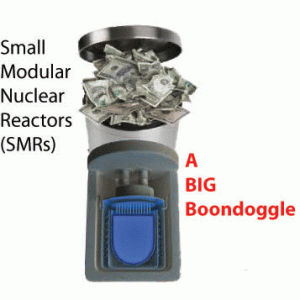 The U.S. Department of Energy has been funding a “next generation” favorite, the small modular reactor, since the 1990s. Today, there are still no such reactors in operation, and the Nuclear Regulatory Commission has yet to receive a license application.
Climate change can’t afford to wait for these last-century energy dinosaurs. On the other hand, unlike costly and dangerous nuclear power, renewables are meeting energy needs quickly and without the problem of a deadly waste legacy or risking the diversion of radioactive materials. http://www.latimes.com/opinion/readersreact/la-le-1117-tuesday-cliamte-change-nuclear-20151117-story.html
UK’s Energy Secretary Amber Rudd plans prioritising nuclear, slashing renewables
 U.K. Plans to Prioritise Nuclear, Gas Over Renewables to Cut CO2, Bloomberg, Alex Morales, 18 Nov 15 “………“In the next 10 years, it’s imperative that we get new gas-fired power stations built,” Energy Secretary Amber Rudd will say. “There are plans for a new fleet of nuclear power stations, including at Wylfa and Moorside. This huge investment could provide up to 30 percent of the low carbon electricity which we’re likely to need through the 2030s.”
The emphasis on nuclear and gas signals a further retreat from renewable energy after Rudd slashed several subsidy programs, arguing they risk exceeding Treasury spending limits. Renewables have taken a battering since Prime Minister David Cameron’s Conservatives came to power in May, with ministers announcing planned cuts to programs subsidizing solar power, onshore wind, biomass and energy efficiency.
The government has given the green light for the first new nuclear plant to be built in three decades, subsidized by consumers through their bills for 35 years. Electricite de France SA and China General Nuclear Power Corp. struck a deal last month to build by 2025 the 3.2 gigawatt-plant at Hinkley Point in southwest England.
A “little radiation” supposedly good for you – the “hormesis” argument for raising radiation safety limits
I’d never heard of hormesis until a reader alerted me to this issue on Monday. I know it’s not fair to conflate nuclear power and nuclear weapons, but the whole thing makes me think of the subtitle of Dr. Strangelove, Stanley Kubrick’s brilliant dark comedy about accidental nuclear war — How I Learned to Stop Worrying and Love the Bomb.
So a little radiation’s good for you? Hmmm … Democrat and Chronicle, Steve Orr, @SOrr111:30 November 17, 2015 “……The suggested rules are based on a scientific theory, known as radiation hormesis, which holds  that low-level radiation is not harmful to human health and may in fact be beneficial. Hormesis is the term for the circumstance where a small amount of an otherwise harmful substance is good for you in small doses. …….
current NRC regulations — that any exposure to ionizing radiation, the kind that can damage or alter human cells, is potentially unsafe. The gospel: Thou shalt fear all radiation.
With that in mind, current NRC regulations limit public exposure to radiation from power plants to 100 millirem a year. (Another measure of ionizing radiation dosage is millisieverts, or mSv. One mSv is the same as 100 millirem.) The idea is to limit radiation releases from nuclear plants to zero, of course, but very small amounts of radiation sometimes escape into the air or groundwater.
The average American is exposed to about 600 millirem a year from other sources such as radon and other naturally occurring materials, medical procedures and cosmic particles and rays.
The legal limit for nuclear power plant workers is 5,000 millirem a year, though higher doses are allowed in some circumstances…….The suggested new rules would make the limit for the general public the same as for workers — that is, 50 times higher than it is now. Fifty.
The suggested changes were advanced earlier this year in three petitions filed with the NRCby outside advocates for radiation hormesis…..You can read a great deal about this if you like. A good start would be this CounterPunch piece……
Anyone interested may submit comments online through the end of Thursday. The suggested rules are not a fait accompli; NRC spokesman Neil Sheehan said the agency will weigh the comments that are submitted, plus a great deal of other information, before deciding whether to draft actual proposed changes to the rules.
I’d never heard of hormesis until a reader alerted me to this issue on Monday. I know it’s not fair to conflate nuclear power and nuclear weapons, but the whole thing makes me think of the subtitle of Dr. Strangelove, Stanley Kubrick’s brilliant dark comedy about accidental nuclear war — How I Learned to Stop Worrying and Love the Bomb. http://www.democratandchronicle.com/story/news/local/blogs/environment/2015/11/17/more-radiation-exposure/75889896/
Travel to Mars completely stalled by reality of radiation danger
 Space Radiation Is Quietly Stopping Us From Sending Humans to Mars
In order to create a colony, we need to be able to survive a long trip through space. Neel V. Patel, November 17, 2015 Innumberable dangers threaten human astronauts traveling into deep space. Some of these, like asteroids, are obvious and avoidable with some decent LIDAR. Others aren’t. At the top of the not-so-much list is space radiation, something NASA is in no way prepared to protect explorers from while ferrying them to Mars. The radiation environment beyond the magnetosphere is not conducive to life, meaning sending astronauts out there without protection is equivalent to sending them to their doom.
While we’ve sent astronauts into space for over half a century now, the vast majority of these missions have been limited to traveling into low Earth orbit — between 99 and 1,200 miles in altitude. The Earth’s magnetic field — which extends thousands of miles into space — protects the planet from being hit head-on by high-energy solar particles traveling over one million miles per hour.
There are three big sources of space radiation, and they all pose a certain amount of risk that can’t always be anticipated or protected against. The first is trapped radiation. Some particles don’t get deflected by the Earth’s magnetic field. Instead, they’re trapped in one of the big two magnetic rings surrounding the Earth, and accumulate together as part of the Van Allen radiation belts. NASA has only had to contend with the Van Allen belts during the Apollo missions.
The second source is galactic cosmic radiation, or GCR, which originates from outside the solar system. These ionized atoms travel at basically the speed of light, although Earth’s magnetic field is also able to protect the planet and objects in low Earth orbit from GCR.
The last source is from solar particle events, which are huge injections energetic particles produced by the sun. There’s a distinction between the solar winds normally emitted by the sun, which take about a day to get to the Earth, and these higher-intensity events that hit us within 10 minutes. Besides producing a potentially lethal amount of radiation for astronauts, SPE can sometimes be wildly unpredictable, making it difficult for NASA scientists and engineers to develop protective measures against them.
NASA examines space radiation the way employers determine acceptable risks for their employees — they will not subject astronauts to an occupational risk of developing cancer beyond a certain threshold……. Continue reading
1 This Month
10 March A LIVE WEBINAR THE REAL EFFECTS OF NUCLEAR POWER
What the Industry Isn’t Telling Us
1:00 PM Mountain, 2 pm Central, 3 pm Eastern. Live on the Keepers of the Water Facebook page



18 March Webinar @ 1 PM EST: An Assessment of SMR Projects: The Case of Canada
register for the zoom:
https://us02web.zoom.us/webinar/register/WN_o8BIIOUvQ2ONJR1nta65DQ#/registration


of the week – STOP SMALL MODULAR REACTORS IN CANADA
To see nuclear-related stories in greater depth and intensity – go to https://nuclearinformation.wordpress.com
-
Archives
- March 2026 (99)
- February 2026 (268)
- January 2026 (308)
- December 2025 (358)
- November 2025 (359)
- October 2025 (376)
- September 2025 (258)
- August 2025 (319)
- July 2025 (230)
- June 2025 (348)
- May 2025 (261)
- April 2025 (305)
-
Categories
- 1
- 1 NUCLEAR ISSUES
- business and costs
- climate change
- culture and arts
- ENERGY
- environment
- health
- history
- indigenous issues
- Legal
- marketing of nuclear
- media
- opposition to nuclear
- PERSONAL STORIES
- politics
- politics international
- Religion and ethics
- safety
- secrets,lies and civil liberties
- spinbuster
- technology
- Uranium
- wastes
- weapons and war
- Women
- 2 WORLD
- ACTION
- AFRICA
- Atrocities
- AUSTRALIA
- Christina's notes
- Christina's themes
- culture and arts
- Events
- Fuk 2022
- Fuk 2023
- Fukushima 2017
- Fukushima 2018
- fukushima 2019
- Fukushima 2020
- Fukushima 2021
- general
- global warming
- Humour (God we need it)
- Nuclear
- RARE EARTHS
- Reference
- resources – print
- Resources -audiovicual
- Weekly Newsletter
- World
- World Nuclear
- YouTube
-
RSS
Entries RSS
Comments RSS
 nuclear-news