Diablo Canyon nuclear plant – the industry’s last stand in California

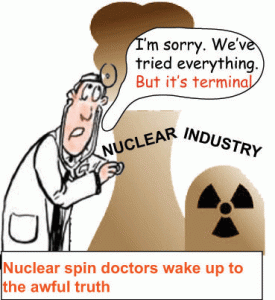 Nuclear power’s last stand in California: Will Diablo Canyon die?, SF Chronicle, By David R. Baker
The first of its two operating licenses from the federal government expires in 2024, the second a year later. Federal regulators are weighing whether to renew those licenses and keep Diablo humming through 2045. PG&E, however, appears to be having second thoughts.
And any extension will involve a fight. The plant sits within a maze of earthquake faults, all of them discovered after construction began in 1968. Seismic safety fears have dogged the nuclear industry in California for more than 50 years, forcing PG&E to abandon plans for one of its first reactors……
If Diablo closes, no nuclear plant will take its place. California law forbids building more until federal officials come up with a permanent way to deal with the waste. Thirty-nine years after the law passed, that still hasn’t happened. The state’s only other commercial reactors, at the San Onofre Nuclear Generating Station north of San Diego, closed for good in 2012 after a small leak of radioactive steam revealed defective equipment.
Many environmentalists have long dreamed of a nuclear-free California. …..They don’t trust PG&E’s claim that Diablo can withstand the worst quake likely to strike the area in 10,000 years and call the plant an American Fukushima waiting to happen.
“It should be illegal,” said Linda Seeley, 71, a retired midwife who in the 1980s was arrested twice during mass demonstrations at Diablo’s gates. “They’re playing with fire, and the people who will get burned are the people who live here.”…..
Diablo represents nuclear power’s last stand in California. But the plant’s fate may not be decided by climate change, or seismology.
It may depend on dead fish………
The San Bruno explosion only added to their suspicion of PG&E. Investigators blamed the blast, which killed eight people, on a lax attitude toward safety within the company. PG&E now faces a $1.6 billion penalty, as well as criminal obstruction-of-justice charges.
“This is the same company we’re trusting with over 2,200 metric tons of radioactive waste, sitting right there on the coastline,” said Seeley, who now lives in Los Osos, about 8 miles north of the plant. (PG&E says Diablo has 1,317 metric tons of waste.)
Nuclear energy, she insists, is a dead end. She wants the plant closed as soon as possible and replaced with renewable power.
“We have no gripes with the people who work there (at Diablo),” said Seeley, a spokeswoman for San Luis Obispo Mothers for Peace, an antinuclear group. “They work hard, and they keep us as safe as they can. It’s the corporate entity of PG&E we don’t trust.”
Fifty-five miles east of Diablo, the renewable future Seeley wants is taking shape on a quiet, dry plain.
The California Valley Solar Ranch lies on a stretch of highway so remote that, an hour before arriving, drivers pass signs warning them to check their gas. Winding through empty hills, the road finally spills onto the Carrizo Plain, a long valley coated in sparse, stubby grass.
From the highway, the Solar Ranch looks like some odd, metallic crop, row after row of flat silicon panels tilted to face the sun. Those panels, 750,000 in all, track east to west during the day, their movement almost imperceptible. Together, they can generate up to 250 megawatts of electricity, about 11 percent of Diablo’s capacity. PG&E buys the electricity.
“I’ve been in power generation all my life, and I chose to go into this — renewable power,” said Trevor Thor with SunPower Corp., the San Jose company that built the ranch. He steers his SUV slowly along the dirt roads crisscrossing the plant to avoid raising dust that could coat the panels. “It’s a no-brainer,” he said. “It’s an awesome technology. It’s clean. It’s dependable.”…….
Of course, solar isn’t the only form of renewable power.
Strong winds course over much of California at night, tapped by turbines spinning above hills and mountain passes. Their ability to supply power precisely when solar panels don’t means that the two energy sources can, to an extent, balance each other, with one kicking in when the other tapers off. ….
By constantly placing a big block of power on the grid, Diablo makes it harder to incorporate solar and wind, essentially crowding them out. California, opponents say, needs flexible energy sources that can quickly ramp up and down to meet changes in electricity supply and demand. When they want to be really mean, foes call nuclear power a 20th century technology, ill-suited to the future.
“We don’t need a minimum amount of baseload power,” said Ralph Cavanagh, co-director of the energy program at the Natural Resources Defense Council. “The idea of baseload itself is obsolete.”
Every day, Diablo’s cooling system sucks in 2.5 billion gallons of seawater. An estimated 1.5 billion fish eggs and larvae each year get swept along for the ride, churned, cooked and killed. The water then returns to the sea about 18.5 degrees warmer than it left.
Ever since the 1969 blowout of an offshore oil well near Santa Barbara, California has placed a high priority on protecting its shore. All of the state’s coastal power plants face orders to end the kind of “once-through cooling” employed at Diablo and switch to systems that kill fewer fish. For Diablo, that could mean building cooling towers — an expensive prospect. A report commissioned by PG&E found the effort could take up to 14 years and cost as much as $14 billion, in part because it would require carving a large chunk out of the nearby hills…….
The decision to push forward came from the commission, rather than PG&E. In fact the utility, so enthusiastic about extending the plant’s operating life six years ago, now seems hesitant.
That may be because PG&E faces several state-level hurdles that other nuclear plant owners don’t. The biggest concerns fish.
Every day, Diablo’s cooling system sucks in 2.5 billion gallons of seawater. An estimated 1.5 billion fish eggs and larvae each year get swept along for the ride, churned, cooked and killed. The water then returns to the sea about 18.5 degrees warmer than it left.
Ever since the 1969 blowout of an offshore oil well near Santa Barbara, California has placed a high priority on protecting its shore. All of the state’s coastal power plants face orders to end the kind of “once-through cooling” employed at Diablo and switch to systems that kill fewer fish. For Diablo, that could mean building cooling towers — an expensive prospect. A report commissioned by PG&E found the effort could take up to 14 years and cost as much as $14 billion, in part because it would require carving a large chunk out of the nearby hills.
Environmentalists consider those eye-popping estimates a bluff. PG&E, they say, is overstating the costs in hopes that the California State Water Resources Control Board will give the company a waiver from the rules. But an independent estimate still put the cost of a new cooling system at $1.6 billion, no small sum…….
David R. Baker is a San Francisco Chronicle staff writer. E-mail: dbaker@sfchronicle.com Twitter: @DavidBakerSF http://www.sfchronicle.com/business/article/Nuclear-power-s-last-stand-in-California-Will-6630933.php
No comments yet.
1 This Month


18 March Webinar @ 1 PM EST: An Assessment of SMR Projects: The Case of Canada
register for the zoom:
https://us02web.zoom.us/webinar/register/WN_o8BIIOUvQ2ONJR1nta65DQ#/registration


of the week – STOP SMALL MODULAR REACTORS IN CANADA
To see nuclear-related stories in greater depth and intensity – go to https://nuclearinformation.wordpress.com
-
Archives
- March 2026 (146)
- February 2026 (268)
- January 2026 (308)
- December 2025 (358)
- November 2025 (359)
- October 2025 (376)
- September 2025 (258)
- August 2025 (319)
- July 2025 (230)
- June 2025 (348)
- May 2025 (261)
- April 2025 (305)
-
Categories
- 1
- 1 NUCLEAR ISSUES
- business and costs
- climate change
- culture and arts
- ENERGY
- environment
- health
- history
- indigenous issues
- Legal
- marketing of nuclear
- media
- opposition to nuclear
- PERSONAL STORIES
- politics
- politics international
- Religion and ethics
- safety
- secrets,lies and civil liberties
- spinbuster
- technology
- Uranium
- wastes
- weapons and war
- Women
- 2 WORLD
- ACTION
- AFRICA
- Atrocities
- AUSTRALIA
- Christina's notes
- Christina's themes
- culture and arts
- Events
- Fuk 2022
- Fuk 2023
- Fukushima 2017
- Fukushima 2018
- fukushima 2019
- Fukushima 2020
- Fukushima 2021
- general
- global warming
- Humour (God we need it)
- Nuclear
- RARE EARTHS
- Reference
- resources – print
- Resources -audiovicual
- Weekly Newsletter
- World
- World Nuclear
- YouTube
-
RSS
Entries RSS
Comments RSS
 nuclear-news
Leave a comment