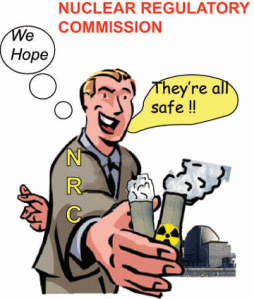
USA’s Nuclear Regulatory Commission considering 80 year licenses for nuclear reactors!
Debates may lie ahead on how aging risks should properly be measured, if a dispute involving Entergy Nuclear’s Palisades nuclear plant near South Haven, Mich., is a guide. Four citizen organizations — Beyond Nuclear, Don’t Waste Michigan, Michigan Safe Energy Future-Shoreline Chapter and the Nuclear Energy Information Service — oppose Entergy’s proposal for assessing the extent of neutron-caused embrittlement of the reactor, which could lead to critical failures…….
Aging has an economic side, too……..
 Life span of U.S. reactors is an issue for the Clean Power Plan Peter Behr, E&E reporterEnergyWire: Friday, November 6, 2015 correction appended.
The Nuclear Regulatory Commission will update by year’s end proposed guidelines for assessing the safe life span for nuclear reactors — a central issue for the nuclear industry, the nation’s future electric power supply and the Obama administration’s Clean Power Plan.
The new guidance is linked to NRC’s current judgment that there are as yet no “aging” issues with reactors’ structures and components that would prevent current plants from being licensed out to 80 years of age.
NRC’s Generic Aging Lessons Learned (GALL) Report will address four potential aging risks for reactors caused by decades of thermal shock, radiation and mechanical stress: metal embrittlement in pressure vessels, deterioration of cables, concrete and containment structures, and cracks in reactor components. The report will update inspection and assessment methods for aging issues……..
As the age increases, there will be more questions about aging management,” said Jennifer Uhle, deputy director of the NRC Office of Nuclear Reactor Regulation, speaking last month to a joint meeting of the NRC and the Federal Energy Regulatory Commission. ……
Industry experts say plant aging tends to be a case-by-case story. But if aging issues did raise unmanageable technical or economic challenges across a cluster of similar plants, the challenges of grid transitions could turn sharply in the wrong direction.
The aging issue involving “passive” plant structures will be joined when U.S. reactors must seek renewed operating licenses. In 2030, near the end of the compliance period for power plant carbon reductions set by U.S. EPA’s Clean Power Plan, the average age of the 99 currently operating reactors will be 50 years. Most of the reactors were built in the 1970s and 1980s and were granted licenses to operate for 40 years. If they continue to meet safety standards, the plants can receive license renewals in 20-year increments.
As of the middle of this year, NRC had issued a first round of 20-year renewals for 78 reactor units at 47 sites (two of the units have since shut down), Uhle said. The first relicensing applications by plants seeking to go from 60 to 80 years are expected to arrive in 2029, after most expected coal plant retirements have occurred.
Nuclear’s role in Clean Power Plan
The role of nuclear reactors in meeting the Clean Power Plan’s goals is debated by nuclear energy’s supporters and critics, with advocates for renewable energy arguing that their sources can take on a much greater share of U.S. electricity needs.
The U.S. Energy Information Administration’s CPP assessment projects that while both natural gas generation and renewables will have to take up the slack of retired coal plants, nuclear power’s share of the power supply will remain essentially unchanged through 2030…….
Measuring aging risks
Debates may lie ahead on how aging risks should properly be measured, if a dispute involving Entergy Nuclear’s Palisades nuclear plant near South Haven, Mich., is a guide. Four citizen organizations — Beyond Nuclear, Don’t Waste Michigan, Michigan Safe Energy Future-Shoreline Chapter and the Nuclear Energy Information Service — oppose Entergy’s proposal for assessing the extent of neutron-caused embrittlement of the reactor, which could lead to critical failures…….
Aging has an economic side, too……..http://www.eenews.net/stories/1060027604
No comments yet.
1 This Month

of the week – Shut Down Drone Warfare!


Tell the Ukrainian Government to Drop Prosecution of Peace Activist Yurii Sheliazhenko

Petition to revoke the licensing of the Near Surface Nuclear Disposal Facility (NSDF) at Chalk River. https://www.ourcommons.ca/petitions/en/Petition/Details?Petition=e-7247
To see nuclear-related stories in greater depth and intensity – go to https://nuclearinformation.wordpress.com
-
Archives
- April 2026 (79)
- March 2026 (251)
- February 2026 (268)
- January 2026 (308)
- December 2025 (358)
- November 2025 (359)
- October 2025 (376)
- September 2025 (257)
- August 2025 (319)
- July 2025 (230)
- June 2025 (348)
- May 2025 (261)
-
Categories
- 1
- 1 NUCLEAR ISSUES
- business and costs
- climate change
- culture and arts
- ENERGY
- environment
- health
- history
- indigenous issues
- Legal
- marketing of nuclear
- media
- opposition to nuclear
- PERSONAL STORIES
- politics
- politics international
- Religion and ethics
- safety
- secrets,lies and civil liberties
- spinbuster
- technology
- Uranium
- wastes
- weapons and war
- Women
- 2 WORLD
- ACTION
- AFRICA
- Atrocities
- AUSTRALIA
- Christina's notes
- Christina's themes
- culture and arts
- Events
- Fuk 2022
- Fuk 2023
- Fukushima 2017
- Fukushima 2018
- fukushima 2019
- Fukushima 2020
- Fukushima 2021
- general
- global warming
- Humour (God we need it)
- Nuclear
- RARE EARTHS
- Reference
- resources – print
- Resources -audiovicual
- Weekly Newsletter
- World
- World Nuclear
- YouTube
-
RSS
Entries RSS
Comments RSS
 nuclear-news
Leave a comment