Nuclear lobby convincing USA govt of its climate change credentials ?
One major consideration is convincing investors to back new nuclear…...
The Clean Air Task Force is working with other industry and environmental groups to launch the Nuclear Innovation Alliance, which aims to improve investing for advanced nuclear in the United States. A formal rollout is scheduled for later this month

White House summit boosts industry’s sagging spirits Jean Chemnick and Hannah Northey, E&E reportersE&E Daily: Friday, November 6, 2015 The nuclear industry hopes today’s White House summit is the start of a more proactive effort by the Obama administration to put reactors into the U.S. push to meet its international climate change targets.
The summit comes as the days tick down to the Nov. 30 start of the U.N. climate conference in Paris aimed at producing a post-2020 emissions agreement. President Obama has staked out a large role in helping to broker a Paris deal. Continue reading
Legal case over St Louis radioactive trash – 2700 cancer cases from nuclear radiation?
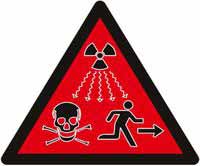
 US Government Secretly Buried Nuclear Waste Near Playground — And Thousands Now Have Cancer http://www.offthegridnews.com/current-events/us-government-secretly-buried-nuclear-waste-near-playground-and-thousands-now-have-cancer/ by: Daniel Jennings November 4, 2015 A government contractor buried tens of thousands of barrels of nuclear waste in two sites around St. Louis that may have caused more than 2,700 cases of cancer, a lawsuit and CBS News are alleging.
“Within a six-house radius, I knew four people with brain cancer, one a child, one a young professor,” resident Jenelle Wright told CBS. “And I just thought, ‘This is really odd.’”
What is truly disturbing is that Wright and others only figured out that something was wrong when they got together on Facebook to plan a school reunion. When they started reconnecting, they noticed that a lot of people they knew had developed cancer.
“If we did not have social media, if Facebook did not exist, we would never have put these pieces together,” Wright said.
Nuclear Waste on Playgrounds
Wright and other residents of North County near St. Louis think the cause of cancer was the tens of thousands of barrels of nuclear waste dumped in the area decades ago by the Mallinckrodt Chemical Company. The company had been hired by the US government agency to process uranium for America’s nuclear weapons program. Then, “under the cover of national security secrecy, the government authorized the company to dump radioactive wastes quietly in the suburbs,” according to a 1990 New York Times article.
The waste was buried in two areas near Coldwater Creek, which runs through the area. One of the sites where the waste was dumped was located near a park where Wright and her friends played as kids. The park is now locked tight and engineers are trying to clean up the mess.
What you see is an environmental health disaster unfolding slowly over decades,” St. Louis County Health Director Dr. Faisal Khan told CBS News. “… The rates of appendix cancer, for instance, which is relatively rare — we see about 800 cases across the nation per year. To find seven or eight cases in one zip code or one small geographic area is rather unusual.”
The study on the soil could take years. That frustrates Mary Oscko, a resident who has stage 4 lung cancer.
“My husband and I had to sit down at night and discuss whether I want to be cremated or buried,” she toldCBS News. “I don’t want to be buried in North County, that’s the one thing I told him — I do not want to be buried where this soil is.”
During World War II Mallinckrodt processed uranium in St. Louis for the world’s first nuclear reactor and the Manhattan Project, which created the atomic bomb.
Japan’s nuclear reprocessing boondoggle – Monju reactor still in trouble
NRA’s ‘new management’ call for Monju reactor proves divisive, Japan Times, BY ERIC JOHNSTON OSAKA, 6 Nov 15, – Two decades after a sodium leak and fire shut it down and nearly six decades after it was first conceived, the Monju prototype fast-breeder reactor in Tsuruga, Fukui Prefecture, suffered another blow Wednesday when the Nuclear Regulation Authority called for it to be turned over to another operator.
To date, over ¥1 trillion has been poured into Monju — a plant that has never produced commercial electricity. Despite remaining inactive, safety measures alone cost ¥50 million a day.
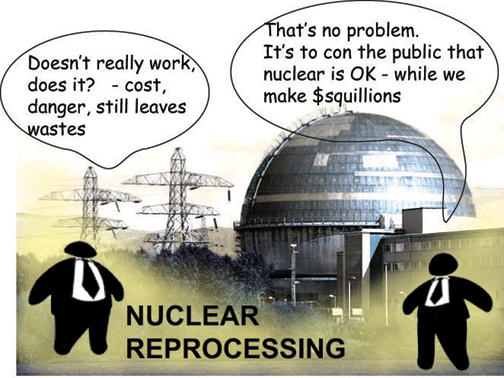
Anti-nuclear activists have hailed the NRA’s unusually critical language as an important step toward scrapping the reactor, which was supposed to burn plutonium mixed with uranium.
Fukui politicians who heavily support Monju, including the prefecture’s governor and the mayor of Tsuruga, doubt that another operator can be found. They also worry that scrapping it would create local concerns as well as safety issues.
“What does it mean when the NRA says that it can’t leave Monju’s operations to the (government-backed) Japan Atomic Energy Agency? There aren’t any other organizations it can be left to,” Tsuruga Mayor Takanobu Fuchikami told reporters after the decision…….
Monju, conceived in the 1950s, has faced nothing but technical trouble, domestic and international controversies, and scandals.
Originally slated to go live in 1970, monju did not reach criticality until 1994. It was shut down following a December 1995 leak and fire involving liquid sodium. The incident was at that time Japan’s worst nuclear-related accident.
Further delays and scandals meant that by 2005, when Monju was taken over by JAEA after its predecessor organization was disbanded, officials hoped it would be commercially viable by around 2050.
But after it was revealed in 2012 that JAEA had failed to inspect nearly 10,000 reactor components in and after 2010, the NRA ordered Monju not to engage in preparatory work until it was satisfied safety had been improved…..
Activists are urging the government to give up on the project.
“Monju should be permanently shut down. If the Japanese government is capable of immediately and permanently scrapping Monju, we can gain some trust that it intends to have a logical, functional basic energy policy,” said Aileen Mioko Smith, executive director of Kyoto-based anti-nuclear group Green Action. “If it continues the status quo by flogging a horse that has been dead for 20 years, it bodes badly for Japan’s energy future.” http://www.japantimes.co.jp/news/2015/11/05/national/nras-new-management-call-monju-reactor-proves-divisive/#.Vj0CA9IrLGj
Uncontrolled nuclear chain reactions could be underway at Fukushima

 Former Japan Ambassador: Uncontrolled nuclear chain reactions could be underway at Fukushima — “Troubling indications of recurring criticality” as Tellurium-132 detected over 100 miles from plant — ‘Recriticality’ discussed by Japan’s top nuclear official http://enenews.com/former-japan-ambassador-uncontrolled-nuclear-chain-reactions-suspected-fukushima-troubling-indications-recurring-criticality-tellurium-132-detected-100-miles-plant-recriticality-issue-discussed?utm_source=feedburner&utm_medium=email&utm_campaign=Feed%3A+ENENews+%28Energy+News%29
Japan Times, Nov 4, 2015 (emphasis added): The former Japanese ambassador to Switzerland,Mitsuhei Murata, recently suggested that Japan should stage an ‘honorable retreat’ from hosting the 2020 Olympics due to the unpredictable situation at the crippled Fukushima No. 1 nuclear power plant.
Japan Times (Hotline to Nagatacho — Brian Victoria, Kyoto), Nov 4, 2015: [F]ormer Japanese ambassador to Switzerland, Mitsuhei Murata, recently proposed… for Japan to stage an “honorable retreat” from hosting the 2020 Olympics… [I]n the September issue of Gekkan Nippon, Murata… noted the danger still posed by large numbers of spent fuel rods suspended in spent fuel pools in reactors 1, 2 and 3 [which] can’t be removed from the damaged reactor buildings due to the high levels of radioactivity surrounding these reactors… Murata’s gravest concern is a number of troubling indications of recurring criticality [ i.e. uncontrolled nuclear chain reactions] in one or more of the reactors at Fukushima No. 1. For example, he notes that in December 2014, both radioactive iodine-131 and tellurium-132 were reported as having been detected in Takasaki city, Gunma Prefecture [~130 miles SW of Fukushima Daiichi]. Given the short half-lives of these radioactive particles, their presence could not be the result of the original meltdowns at Fukushima.
Ambassador Murata to Dr. Thomas Bach (President of the International Olympic Committee), Jun 15, 2015: Allow me to send you a letter, motivated by my sense of mission to inform you of the worsening situation in Fukushima, which regrettably is being downplayed by our Government and does not seem to be well known internationally… Contrary to the assurances of the Japanese Government and [TEPCO], the situation at the site of the Fukushima Daiichi Nuclear Power Plant is not at all under control… Not only do we have a continued contamination of the groundwater and the Pacific Ocean… but the brittle structure of the damaged plant represents itself a serious threat, in particular in our earthquake prone region.
Ambassador Murata to Susana Malcorra (United Nations Chef de Cabinet), Aug 27, 2015: I am sending you my fourth message to President Bach of The IOC. I inform him of my message addressed to Prime Minister Abe. In my message… I ask for the first concrete international cooperation concerning the method of cooling spent fuel rods making use of zinc instead of water. This is crucially important. The Pacific Ocean is more and more contaminated with the daily release of more than 300 tons radioactive groundwater. I remind Prime Minister Abe that the decision to retreat from the Tokyo Olympic Games and carry out an international verification of the suspected re-criticality is urgently needed… My interview article was published in the magazine “Monthly Japan” (September). The article entitled “An honorable retreat from the Tokyo Olympic Games” is given a central place. Reactions are noteworthy and encouraging. Conscientious citizens start questioning the integrity of the IOC. Please convey my warmest greetings to Secretary-General Ban-kimoon.
Interestingly, two weeks ago the head of Japan’s Nuclear Regulation Authority addressed the recriticality issue:
Fukushima Minpo, Oct 20, 2015: Nuclear regulator chief says Fukushima Daiichi recriticality“physically impossible” — Shunichi Tanaka, chairman of the Nuclear Regulation Authority, visited the Minamisoma city government for talks with Mayor Katsunobu Sakurai on Oct. 22. Regarding Tokyo Electric Power Co.’s crippled Fukushima Daiichi nuclear power plant, Tanaka said, “We are no longer in a situation that prevents residents from returning (to their evacuated hometowns). Recriticality is physically impossible.”
India shuts down nuclear critic Greenpeace

 India orders Greenpeace to shut down http://www.heraldsun.com.au/news/breaking-news/india-orders-greenpeace-to-shut-down/news-story/81aa8e5e1c0e45927594dac4266c12fd November 7, 2015 India has cancelled Greenpeace International’s license to operate and given the group 30 days to close down, citing financial fraud and falsification of data.
Prime Minister Narendra Modi’s government has turned the spotlight on foreign charities since he took office last year, accusing some of trying to hamper projects on social and environmental grounds.
Last year, Modi government withdrew permission to Greenpeace to receive foreign funding, saying the money was used to block industrial projects.
Under the latest order issued by authorities in the southern Indian state of Tamil Nadu where Greenpeace is registered, the government said it had found the organisation had violated the provisions of law by engaging in fraudulent dealings.
A government official confirmed the closure order had been issued on Wednesday but did not elaborate.
Greenpeace India has campaigned against coal mines in forests, genetically modified crops, nuclear power and toxic waste management.
In recent months the federal government has toughened rules governing charities and cancelled the registration of nearly 9000 groups for failing to declare details of overseas donations.
Canada’s new PM Trudeau is urged by Michigan lawmakers to scrap Lake Huron nuclear waste dump plan
Michigan lawmakers urge Trudeau to reject nuclear waste disposal plan, Global News 5 Nov 15 By Staff The Associated Press “…….Doug Hunter, speaking on behalf of the Inverhuron Committee, a group of residents in opposition to the project, said residents are not satisfied that the waste won’t leak into the groundwater. DETROIT – Members of the U.S. Congress from Michigan are urging Justin Trudeau not to allow burial of nuclear waste less than two kilometres from Lake Huron.

Senators Gary Peters and Debbie Stabenow joined Democratic Rep. Dan Kildee in sending a letter Thursday to the newly elected prime minister.
It asks him to reject a plan by Ontario Power Generation to bury hundreds of thousands of cubic metres of so-called low- and intermediate-level nuclear waste 680 metres underground at a site near Kincardine, Ont……..
An advisory panel endorsed the plan in May, but a group opposed to the billion-dollar project launched a court challenge arguing the panel was biased, failed to consider Canada’s international obligations, and violated Canadian environmental rules. Federal Court won’t hear that case until next year.
Former environment minister Leona Aglukkaq had promised to make a decision by Dec. 2, ostensibly to allow for public input on any conditions that should be imposed. http://globalnews.ca/news/2322902/michigan-lawmakers-urge-trudeau-to-reject-nuclear-waste-disposal-plan/
USA’s Nuclear Regulatory Commission considering 80 year licenses for nuclear reactors!
Debates may lie ahead on how aging risks should properly be measured, if a dispute involving Entergy Nuclear’s Palisades nuclear plant near South Haven, Mich., is a guide. Four citizen organizations — Beyond Nuclear, Don’t Waste Michigan, Michigan Safe Energy Future-Shoreline Chapter and the Nuclear Energy Information Service — oppose Entergy’s proposal for assessing the extent of neutron-caused embrittlement of the reactor, which could lead to critical failures…….
Aging has an economic side, too……..
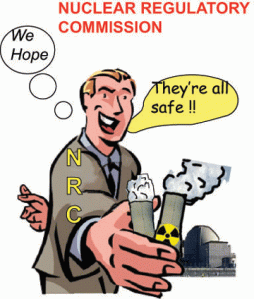 Life span of U.S. reactors is an issue for the Clean Power Plan Peter Behr, E&E reporterEnergyWire: Friday, November 6, 2015 correction appended.
The Nuclear Regulatory Commission will update by year’s end proposed guidelines for assessing the safe life span for nuclear reactors — a central issue for the nuclear industry, the nation’s future electric power supply and the Obama administration’s Clean Power Plan.
The new guidance is linked to NRC’s current judgment that there are as yet no “aging” issues with reactors’ structures and components that would prevent current plants from being licensed out to 80 years of age.
NRC’s Generic Aging Lessons Learned (GALL) Report will address four potential aging risks for reactors caused by decades of thermal shock, radiation and mechanical stress: metal embrittlement in pressure vessels, deterioration of cables, concrete and containment structures, and cracks in reactor components. The report will update inspection and assessment methods for aging issues…….. Continue reading
The ever increasing costs of new nuclear energy – Australia, USA, S Africa, China
 You’ll never guess how much this Australian nuclear power plant will cost, http://www.bizjournals.com/pittsburgh/blog/energy/2015/11/youll-never-guess-how-much-this-australian-nuclear.html Matt Stroud, energy reporter for the Pittsburgh Business Times. Nov 6, 2015 A nuclear power plant has never been built in Australia before, but Westinghouse is putting a price tag on a new one they’re hoping to build there.
The price? About $12.3 billion.
 In testimony to Australia’s Nuclear Royal Commission — a body that’s investigating whether the
Australian state of South Australia should build the nation’s first nuclear power plant — Westinghouse executive Rita Bowser said that price was all inclusive, according to The Advertiser in Adelaide, South Australia. It would include land, environmental safeguards and construction.
Australia has zero nuclear power plants — and is known for being extremely averse to nuclear energy; it won’t even allow nuclear ships into its ports.
The historical aversion won’t affect the price much, apparently; the company’s guesstimate is in line with its current Vogtle project in Georgia, which has been plagued by cost overruns. It’s less than a comparable Chinese project, set to cost $24 billion. And it’s cheap in comparison to a project proposed in Johannesburg that could cost $100 billion.
The South Australia project’s future is fluid at the moment: the Nuclear Royal Commission hasn’t even decided whether it wants to recommend a nuclear facility.
That decision is set to come in May 2016. Tokyo-based Toshiba Corp. (TYO: 6502) owns 87 percent of the Cranberry-based Westinghouse Electric Co.
Barsebäck nuclear power plant to be dismantled – good business for Westinghouse?
Westinghouse Electric to dismantle Barsebäck nuclear power plant http://cphpost.dk/news/westinghouse-electric-to-dismantle-barseback-nuclear-power-plant.html Located just 20 kilometers from Copenhagen, the plant ceased operation already in 2005 November 6th, 2015 12:10 pm| by Lucie Rychla

According to Westinghouse, the company will dismantle, segment and package the reactor pressure vessel internals for final disposal – a process that significantly reduces the radioactivity remaining in the plant since it was shut down.
No more nuclear energy
Barsebäck is a boiling water nuclear power plant with two units, which began commercial operation in May 1975 and June 1977. Barsebäck Unit One was shut down in 1999, 17 years before its planned life expectancy, and Barsebäck Unit Two ceased operation in May 2005.
In 1980, the Swedish parliament decided not to build any new nuclear power plants in the country and to phase out existing plants by 2010, following a referendum that took place after the Three Mile Island incident in Pennsylvania.
Time to anandon the fairy tale that nuclear power is affordable
It is past time for utility executives and their regulators to take a step back and reassess. An honest look at the real costs of nuclear power will show that the economics don’t add up. It is time to stop believing in impossible things
 Nuclear Power Economics Requires Believing In ‘Impossible Things‘, Energy Collective, Dennis Wamsted, 6 Nov 15 It is increasingly clear that the economics of nuclear power don’t add up. Just in the past two and a half years, for example, seven plants at six sites have been shut down due to uneconomic performance or massive equipment repair costs—and other plants are on the chopping block.
Similarly, the two ballyhooed active construction projects, in Georgia and South Carolina, are seriously behind schedule and way over budget. Nonetheless, utility executives and regulators in a number of states still have not gotten the message, notably in Florida and Virginia where executives at Juno Beach-based Florida Power & Light and Richmond-based Dominion soldier on, pushing new reactor proposals whose economics, simply put, just don’t add up and could leave ratepayers holding the bag for billions of dollars in nuclear construction costs. Continue reading
France’s effort to market nuclear technology to South Africa
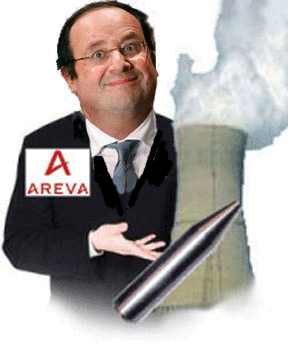 France seeks to win over SA on nuclear energy, Business Day, BY SISEKO NJOBENI, NOVEMBER 06 2015 AMID speculation about SA’s nuclear build programme, the French special envoy for the French-South African nuclear partnership Pascal Colombani is in the country punting his country for the highly anticipated programme.
During his two-day visit to the country, Mr Colombani is scheduled to have meetings “at the political level” as well with relevant public enterprises such as Eskom and the South African Nuclear Energy Co-operation (Necsa). However, he would not say who he was scheduled to meet in government.
“This is my first visit since I have been appointed by President (François) Hollande as his special envoy for the nuclear partnership with SA. Therefore, the overall purpose of my visit is to scale up our co-operation into a long-term strategic partnership in nuclear energy with SA,” Mr Colombani told Fin24.
He said France and SA shared ambitious goals for the development of nuclear energy, “which should become one key component of our strategic partnership”.
Mr Colombani said France was ready to scale up the co-operation between the two countries into a strategic long-term partnership, by supporting the development of SA’s new nuclear programme. Technology, training and safety were at the core of this partnership, he said……http://www.bdlive.co.za/business/energy/2015/11/06/france-seeks-to-win-over-sa-on-nuclear-energy
Nuclear industry sulking because Obama is not doing enough for them
Obama’s Green Push Comes At Expense Of Nuclear Power, Daily Caller 6 Nov 15 The nuclear power industry supports President Barack Obama’s plan to force coal plants to close, but a pending Supreme Court case threatens to cause huge problems for nuclear plants.
Currently the Federal Energy Regulatory Commission (FERC) is embroiled in a Supreme Court battle over a program called demand response, which seeks to cut energy use by compensating retail customers who reduce consumption during peak power grid operation. FERC is forcing energy companies to participate, a move that opponents argue exceeds their legal mandate. According to Utility Dive, demand response keeps wholesale energy prices low, cutting into profits in the nuclear and coal industry……….
The court case puts the coal and nuclear power industries on the same side……..
In the wake of these closures, the industry has been lobbying the administration to increase government assistance to nuclear power, arguing the nuclear industry holds the key to cleaner air………http://dailycaller.com/2015/11/05/obamas-green-push-comes-at-expense-of-nuclear-power/
Pitfalls and huge costs make South Africa’s nuclear programme untenable
The nuclear build is a very risky exercise with numerous potential pitfalls. And there are alternatives. The shortfall in the projected nuclear capacity can be covered by a 50% larger than planned renewable energy investment. Wind and solar energy plants have been operationalised on schedule, and solar panel prices continue falling. The intermittence of renewable energy availability is considered manageable. Finally, energy saving strategies have yet to be fully explored.
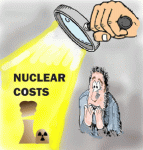
 Why SA must abandon nuclear ambitions, The nuclear build is a very risky exercise with numerous potential pitfalls. And there are alternatives. Tech Central, By Hartmut Winkler, 6 Nov 15 It has been an eventful year in South Africa, characterised by power cuts, parliamentary confrontations about wasteful expenditure and student fee protests. There has, however, been an elephant in the room that has impacted all these issues but enjoyed surprisingly scarce attention. The idea, vigorously driven by government, is for the country to build nuclear plants with an expected price tag of R1 trillion.
This equates to 4 000 times the controversial costs to upgrade President Jacob Zuma’s Nkandla residence and 400 times the shortfall the tertiary education sector will experience in 2016 because of the freeze in university fee increases. Continue reading
BHP another burst dam disaster – this time in Brazil
BHP disaster unfolds in Brazilian village 7 Nov 2015 The Weekend Australian Business MATT CHAMBERS
BHP Billiton was last night facing one of the worst disasters in its 130-year history after sludge from two burst mining dams at the Samarco iron ore joint venture in Brazil destroyed much of a nearby town, killing at least two people and leaving scores unaccounted for.
Brazilian newspapers reported local unions as saying there were 15 or 16 people killed and 45 missing after the tailings dam burst at BHP’s 50 per cent-owned Samarco operations in the state of Minas Gerais, burying houses and streets in the town of Bento Rodrigues in muddy waste.
Late last night officials were reportedly confirming two deaths but said the toll could mount.
Yesterday afternoon, BHP managing Andrew Mackenzie could not confirm how many people were killed or injured, or whether employees of Samarco, which BHP owns with Brazilian giant Vale, were missing after the disaster.
“There has been a tragic incident at the Samarco iron ore operation,” Mr Mackenzie said in a hastily arranged media conference in Melbourne………
Local reports said another dam, Santarem, which recently had its crest raised with a rubber structure to increase its capacity, had also burst, while Samarco said “dams” had been breached.
A local official said more than 50 were injured in the disaster and that the death toll could pass 40.
“That is not official,” said local fire chief Adao Severino Junior. “The situation is grim. It is dark. There is a lot of mud.”
He said rescue operations would continue through the night.
Television footage showed a torrent of industrial muck several hundred metres long that swamped houses and ripped off roofs in Minas Gerais, which is in the southeast of the country and host to a large mining industry.
BHP shares slid 58c, or 2.5 per cent, to $22.70 yesterday after news of the disaster, which Morgan Stanley estimated could result in a year of lost iron ore production……
Reuters reported last night that flooding from the mine had reached another village called Paracatu de Baixo and that villagers were being evacuated.
If the number of reported deaths from the disaster are correct, the tragedy will eclipse the Appin coalmine explosion in 1979 in the Illawarra region, in which 14 workers died.
Another great mining disaster in BHP’s history was also caused by a tailings dam failure, but not one that caused any immediate deaths.
At the OK Tedi copper mine in Papua New Guinea, a tailings dam collapse in 1984 started more than 20 years of government approved tailings discharge into local rivers, causing huge environmental damage.
Virginia nuclear power plant owner Dominium seeks 80 year lifespan for reactors !!
 Dominion plans to extend Surry nuclear reactors to 80-year lifespan BY JOHN RAMSEY Richmond Times-Dispatch, 6 Nov 15 Dominion Virginia Power today will formally seek a second license extension for its Surry nuclear power plant, becoming the first utility in the U.S. to try to push the operating range for nuclear reactors to 80 years.
If successful, the utility’s pair of reactors in Surry County would be eligible to operate past 2050.
At a White House summit on nuclear energy this afternoon, Dominion executives will deliver a letter to the federal Nuclear Regulatory Commission confirming plans to apply for the extension.
The Surry plant, located on the south bank of the James River in southeastern Virginia, saw its first reactor open in December 1972 and its second in May 1973……
As of today, no nuclear plants in the country have been granted the second 20-year extension Dominion is seeking.
1 This Month


18 March Webinar @ 1 PM EST: An Assessment of SMR Projects: The Case of Canada
register for the zoom:
https://us02web.zoom.us/webinar/register/WN_o8BIIOUvQ2ONJR1nta65DQ#/registration


of the week – STOP SMALL MODULAR REACTORS IN CANADA
To see nuclear-related stories in greater depth and intensity – go to https://nuclearinformation.wordpress.com
-
Archives
- March 2026 (146)
- February 2026 (268)
- January 2026 (308)
- December 2025 (358)
- November 2025 (359)
- October 2025 (376)
- September 2025 (258)
- August 2025 (319)
- July 2025 (230)
- June 2025 (348)
- May 2025 (261)
- April 2025 (305)
-
Categories
- 1
- 1 NUCLEAR ISSUES
- business and costs
- climate change
- culture and arts
- ENERGY
- environment
- health
- history
- indigenous issues
- Legal
- marketing of nuclear
- media
- opposition to nuclear
- PERSONAL STORIES
- politics
- politics international
- Religion and ethics
- safety
- secrets,lies and civil liberties
- spinbuster
- technology
- Uranium
- wastes
- weapons and war
- Women
- 2 WORLD
- ACTION
- AFRICA
- Atrocities
- AUSTRALIA
- Christina's notes
- Christina's themes
- culture and arts
- Events
- Fuk 2022
- Fuk 2023
- Fukushima 2017
- Fukushima 2018
- fukushima 2019
- Fukushima 2020
- Fukushima 2021
- general
- global warming
- Humour (God we need it)
- Nuclear
- RARE EARTHS
- Reference
- resources – print
- Resources -audiovicual
- Weekly Newsletter
- World
- World Nuclear
- YouTube
-
RSS
Entries RSS
Comments RSS
 nuclear-news