The nuclear dream is just slowing down REAL action on climate change
 Whether or not a commercial fusion / thorium / plutonium power industry ever emerges in the next 20 or 30 years would be irrelevant to the climate debate if not for the huge commitment of resources, expertise and time that are going into these new reactor types, and that is cash that’s not being spent on scalable, decentralised clean energy networks. Despite this, these are the technologies that are presently carving the epitaph on the headstone on the nuclear industry, the Dream that Failed.
NUCLEAR NO ANSWER , Oct 29th, 2015
 Nuclear power is the solution to a question no-one asked. Here’s why it is now known as “the dream that failed”. By Scott Ludlam The nuclear industry has been getting a fair bit of air time of late with the South Australian Royal Commission into the Nuclear Fuel Cycle and a well-credentialed new Chief Scientist throwing nuclear into the mix as part of the solution to climate change.
………. arguments against nuclear power probably still have a tinge of the 1970s about them. Particularly in the age of climate change, a new generation are querying whether opposition to the technology might be an ideological hangover that we can no longer afford.
It would be comforting if this were true, but it isn’t. The evidence shows the commercial nuclear sector is in terminal trouble, and its offers to deliver bulk, reliable ‘baseload’ energy are precisely the opposite of where global energy markets are heading.
The BP Statistical Review of World Energy released in June 2015, showed that nuclear now contributes just 4.4% of the global energy mix. Renewable energy, without the military-industrial head-start, now contributes 6% with an annual growth rate of 12%. BP concludes that “Consumption increased for all fuels, reaching record levels for every fuel type except nuclear power”.
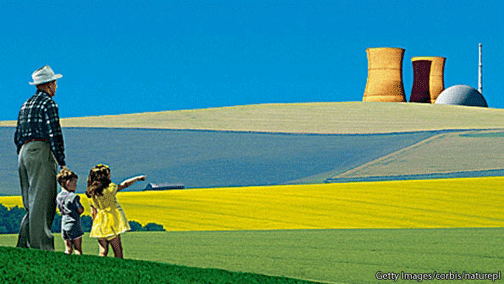
Nuclear energy globally has been in decline since well before the Fukushima nuclear disaster. With ageing reactors, and increased safety standards driving increased costs, nuclear power has been dubbed the ‘Dream that Failed’ by The Economist. Flagship projects in Finland, France and the UK are so catastrophically over budget that it is unlikely some of them will ever be switched on, so some in the industry have changed tack and are out promoting a new generation of technology types.
The Thermonuclear Experimental Reactor in the south of France was expected to cost $5 billion, but following multiple delays and management problems it is now expected to cost $21 billion. The prototype may or may not be operational by 2020. Even the proponents have stopped making confident estimates of when actual power stations might be able to begin making a contribution to decarbonising the world’s energy systems.
Thorium technology is frequently pitched as the front-runner to replace uranium fission plants, but there are sound technical reasons why nobody has ever been able to get an industry on its feet, despite a global abundance of the raw material. Almost anything is possible if you hurl enough money at it, but because the thorium fuel chain is not as intrinsically tied to nuclear weapons production as uranium technology, the technology has never benefitted from the impossibly deep pockets of the weapons developers.
Not so the plutonium sector: the dreamers of infinite energy took the reprocessing technology used to build the Nagasaki bomb and envisioned a ‘closed loop’ nuclear economy which would recycle fissionable uranium and alchemic traces of plutonium into mixed oxide fuel for feeding back into reactors. It is hard to gauge how much has been spent on this proposal for a nuclear perpetual motion machine, but we’re fortunate in that it’s been a total failure, because the environmental, public health and security consequences of a full-blown globally distributed plutonium economy are almost too hideous to contemplate.
Whether or not a commercial fusion / thorium / plutonium power industry ever emerges in the next 20 or 30 years would be irrelevant to the climate debate if not for the huge commitment of resources, expertise and time that are going into these new reactor types, and that is cash that’s not being spent on scalable, decentralised clean energy networks. Despite this, these are the technologies that are presently carving the epitaph on the headstone on the nuclear industry, the Dream that Failed. http://greens.org.au/magazine/national/nuclear-no-answer
No comments yet.
1 This Month


Tell the Ukrainian Government to Drop Prosecution of Peace Activist Yurii Sheliazhenko

Petition to revoke the licensing of the Near Surface Nuclear Disposal Facility (NSDF) at Chalk River. https://www.ourcommons.ca/petitions/en/Petition/Details?Petition=e-7247


of the week – STOP SMALL MODULAR REACTORS IN CANADA
To see nuclear-related stories in greater depth and intensity – go to https://nuclearinformation.wordpress.com
-
Archives
- March 2026 (212)
- February 2026 (268)
- January 2026 (308)
- December 2025 (358)
- November 2025 (359)
- October 2025 (376)
- September 2025 (258)
- August 2025 (319)
- July 2025 (230)
- June 2025 (348)
- May 2025 (261)
- April 2025 (305)
-
Categories
- 1
- 1 NUCLEAR ISSUES
- business and costs
- climate change
- culture and arts
- ENERGY
- environment
- health
- history
- indigenous issues
- Legal
- marketing of nuclear
- media
- opposition to nuclear
- PERSONAL STORIES
- politics
- politics international
- Religion and ethics
- safety
- secrets,lies and civil liberties
- spinbuster
- technology
- Uranium
- wastes
- weapons and war
- Women
- 2 WORLD
- ACTION
- AFRICA
- Atrocities
- AUSTRALIA
- Christina's notes
- Christina's themes
- culture and arts
- Events
- Fuk 2022
- Fuk 2023
- Fukushima 2017
- Fukushima 2018
- fukushima 2019
- Fukushima 2020
- Fukushima 2021
- general
- global warming
- Humour (God we need it)
- Nuclear
- RARE EARTHS
- Reference
- resources – print
- Resources -audiovicual
- Weekly Newsletter
- World
- World Nuclear
- YouTube
-
RSS
Entries RSS
Comments RSS
 nuclear-news
Leave a comment