There is no end to the Fukushima Daiichi Nuclear Disaster: it is just getting worse
 Fukushima Gets A Lot Uglier NOVEMBER 3, 2015 http://www.counterpunch.org/2015/11/03/fukushima-gets-a-lot-uglier/ by ROBERT HUNZIKER
As time passes, a bona fide message emerges from within the Fukushima Daiichi Nuclear Power Plant disaster scenario, and that message is that once a nuclear power plant loses it, the unraveling only gets worse and worse until it’s at its worst, and still, there’s no stopping it. Similar to opening Pandora’s box, there’s no stopping a ferocious atom-splitting insanity that knows no end.
Four years of experience with Fukushima provides considerable evidence that splitting atoms to boil water is outright unmitigated madness. After all, nuclear power plants are built to boil water; yes, to boil water; it’s as simple as that, but yet at the same time it’s also extraordinarily complex. Conversely, solar and wind do not boil water and are not complex and never deadly (Germany knows).
As it unfolds, the Fukushima story grows more convoluted and way more chilling. For example, according to The Japan Times, October 30th Edition: “Extremely high radiation levels and the inability to grasp the details about melted nuclear fuel make it impossible for the utility to chart the course of its planned decommissioning of the reactors at the plant.”
Thereby, the bitter truth behind a major nuclear meltdown shows its true colors: “Impossible for the utility to chart the course of its planned decommissioning…” is very definitive, divulging the weak underbelly of the fission-to-heat process; only one slip-up, and it’s deadly dangerous and likely out of control!
Not only that, but the entire Fukushima Daiichi Nuclear Power Plant complex is subject to recurring mishaps and setbacks, as well as various technical tribulations, something different going wrong on any given day. And, it’s always big, never small.
For example, according to The Japan Times, October 30thEdition: “Deadly 9.4 Sieverts Detected Outside Fukushima Reactor 2 Containment Vessel; Checks Stop.”
TEPCO also detected deadly radiation levels outside of reactor No. 1. According to a direct quote from the article: “People exposed to the maximum radiation dose for some 45 minutes will die.” Death in 45 minutes!
The potency contained within 9.4 Sieverts (Sv) is enormous. One Sievert, which is a measure of the health effect of radiation on the human body, is normally considered a massive dose, causing immediate radiation sickness. But, since levels beyond one Sievert are rarely, if ever, encountered in the normal course of everyday life, the industry standard uses millisieverts (mSv = 1/1000th) or microsieverts (uSv = one millionth of a Sievert) when measuring radiation.
Miserably, eight (8) Sieverts causes severe vomiting, severe headache, severe fever, incapacitation, and a 100% death rate over a period of time greater than 10 minutes within 48 hours (Radiation Survival Guide).
Chernobyl is a prime example of the potency of radiation. Immediately after the explosion (1986), radiation levels in the control room reached 300 Sv/hr, resulting in the deaths of the operators of the plant. Thirty years later, radiation levels in the same control room run approximately 8-10 mSv/hr.
It’s little wonder TEPCO finds it impossible to plan decommissioning of the Fukushima Daiichi Nuclear Power Plant, which begs the question of if, and when, decommissioning will be possible. Who knows, if ever?
Furthermore, according to The Japan Times’ article: TEPCO planned to start checking inside the containment vessel in August by use of a remote-controlled robot but “high radiation levels have stalled the examination.”
Unfortunately, not only is radiation sizzling outside of reactor No. 1, but a pipe connection at reactor No. 2 also shows extremely high radiation levels. Reactor No. 2 is where the hot melted radioactive core (corium) still has not been located. But, then again, with so much hot stuff sizzling throughout the entire Fukushima complex, how are workers expected to locate a melted nuclear core that may have already penetrated the steel-reinforced concrete containment vessel, entering the earth?
If total meltdown occurred/occurs, nobody has any idea of what to do next. There is no playbook. It’s likely impossible to do anything remedial once a melted nuclear core has burrowed into the ground because deadly isotopes uncontrollably spread erratically, ubiquitously into the surrounding underground soil and water. Then what?
In the final analysis, there is a distinct probability that Fukushima has no final analysis. . Reports out of Japan indicate that Fukushima Daiichi Nuclear Power Plant cleanup and decommissioning is severely restricted by extremely high radiation levels and the inability to grasp the details about melted nuclear fuel. What could be worse? Keep reading.
Footnote: China plans on building 400 nuclear plants “fast and cheap” over the next few decades. (Source: Oliver Tickell, Does China’s Nuclear Boom Threaten Global Catastrophe? CounterPunch, Oct. 30th.) Answer: YES!
Robert Hunziker lives in Los Angeles and can be reached at roberthunziker@icloud.com
UK’s Office for Nuclear Regulation (ONR) cosying up to the nuclear industry
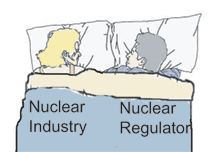 the Office for Nuclear Regulation (ONR) seemed to be dangerously edging towards the corporate financial interests of the nuclear industry rather than the public interests of ensuring national nuclear safety
Alarm over Government’s growth mandate for nuclear regulator, The Independent,
Last year, non-economic regulators were handed guidance entitled “Duty to have regard to growth” by the Department for Business, Innovation & Skills Mark Leftly Associate business editor @MLeftly Anti-nuclear campaigners fear regulators have been forced to cosy up to the industry and sacrifice some of their safety responsibilities as a result of government changes to their role.
At a meeting in Manchester last week, executives from the Office for Nuclear Regulation (ONR), which oversees civil reactors and decommissioning, told representatives from NGOs that they now have to encourage the industry’s economic growth in addition to promoting safety. Continue reading
The nuclear dream is just slowing down REAL action on climate change
 Whether or not a commercial fusion / thorium / plutonium power industry ever emerges in the next 20 or 30 years would be irrelevant to the climate debate if not for the huge commitment of resources, expertise and time that are going into these new reactor types, and that is cash that’s not being spent on scalable, decentralised clean energy networks. Despite this, these are the technologies that are presently carving the epitaph on the headstone on the nuclear industry, the Dream that Failed.
NUCLEAR NO ANSWER , Oct 29th, 2015
 Nuclear power is the solution to a question no-one asked. Here’s why it is now known as “the dream that failed”. By Scott Ludlam The nuclear industry has been getting a fair bit of air time of late with the South Australian Royal Commission into the Nuclear Fuel Cycle and a well-credentialed new Chief Scientist throwing nuclear into the mix as part of the solution to climate change.
………. arguments against nuclear power probably still have a tinge of the 1970s about them. Particularly in the age of climate change, a new generation are querying whether opposition to the technology might be an ideological hangover that we can no longer afford.
It would be comforting if this were true, but it isn’t. The evidence shows the commercial nuclear sector is in terminal trouble, and its offers to deliver bulk, reliable ‘baseload’ energy are precisely the opposite of where global energy markets are heading.

The BP Statistical Review of World Energy released in June 2015, showed that nuclear now contributes just 4.4% of the global energy mix. Renewable energy, without the military-industrial head-start, now contributes 6% with an annual growth rate of 12%. BP concludes that “Consumption increased for all fuels, reaching record levels for every fuel type except nuclear power”.
Nuclear energy globally has been in decline since well before the Fukushima nuclear disaster. With ageing reactors, and increased safety standards driving increased costs, nuclear power has been dubbed the ‘Dream that Failed’ by The Economist. Flagship projects in Finland, France and the UK are so catastrophically over budget that it is unlikely some of them will ever be switched on, so some in the industry have changed tack and are out promoting a new generation of technology types.
The Thermonuclear Experimental Reactor in the south of France was expected to cost $5 billion, but following multiple delays and management problems it is now expected to cost $21 billion. The prototype may or may not be operational by 2020. Even the proponents have stopped making confident estimates of when actual power stations might be able to begin making a contribution to decarbonising the world’s energy systems.
Thorium technology is frequently pitched as the front-runner to replace uranium fission plants, but there are sound technical reasons why nobody has ever been able to get an industry on its feet, despite a global abundance of the raw material. Almost anything is possible if you hurl enough money at it, but because the thorium fuel chain is not as intrinsically tied to nuclear weapons production as uranium technology, the technology has never benefitted from the impossibly deep pockets of the weapons developers.
Not so the plutonium sector: the dreamers of infinite energy took the reprocessing technology used to build the Nagasaki bomb and envisioned a ‘closed loop’ nuclear economy which would recycle fissionable uranium and alchemic traces of plutonium into mixed oxide fuel for feeding back into reactors. It is hard to gauge how much has been spent on this proposal for a nuclear perpetual motion machine, but we’re fortunate in that it’s been a total failure, because the environmental, public health and security consequences of a full-blown globally distributed plutonium economy are almost too hideous to contemplate.
Whether or not a commercial fusion / thorium / plutonium power industry ever emerges in the next 20 or 30 years would be irrelevant to the climate debate if not for the huge commitment of resources, expertise and time that are going into these new reactor types, and that is cash that’s not being spent on scalable, decentralised clean energy networks. Despite this, these are the technologies that are presently carving the epitaph on the headstone on the nuclear industry, the Dream that Failed. http://greens.org.au/magazine/national/nuclear-no-answer
Drastic risks to UK’s security, jobs, in the Hinkley Point C boondoggle
It is clear that this unprecedented handover of power and money to Chinese hands will prompt a justified reaction from those thousands of UK steel workers whose jobs are about to disappear due in part to the global dumping of steel by China.
Will the remnants of the steel industry and its workers see a fraction of the £76 billion to be spent by the Chancellor on his nuclear boondoggle? Not likely.
The nuclear option can and has been criticised in so many ways that the UK Government should think long and hard before proceeding with what many UK citizens will rightly consider an unpatriotic and unethical waste of money. It may even constitute a real and potent danger to our current lifestyle in Britain.
The Hinkley Point C boondoggle: a dangerous waste of money http://reneweconomy.com.au/2015/the-hinkley-point-c-boondoggle-a-dangerous-waste-of-money-57108 By Alex Russell and Peter Strachan on 2 November 2015 The UK Government’s pursuit of a new nuclear plant at Hinkley Point C represents not just a colossal waste of money, but could also be real danger to the UK’s national security, write Professors Alex Russell and Peter Strachan of Robert Gordon University. “Let us hope that the Prime Minister and Chancellor’s actions do not lead to the radicalisation of unemployed steel workers who are now being joined by unemployed renewable industry personnel.”
The Conservative government, arguably, has completely lost the plot in continuing to pursue its so called energy policy that depends so heavily on building a new fleet of nuclear power stations to keep the lights on in Britain. The government want to have 16 GW of new nuclear power stations built in the UK all using EDF’s troubled Generation-III design, of which Hinkley Point C (3.2 GW) is only the first installment.

With this project is George Osborne seeking an entry in the Guinness Book of Records as the first Chancellor of the Exchequer to commission the world’s most expensive nuclear power station? The Chancellor says the project represents good value for money. But the facts suggest otherwise. Further, and with the recent signing of a new nuclear accord as part of the State Visit of the President of China, not enough attention appears to have been given to national security issues.
Economic madness All in all, Hinkley Point C will cost an estimated £76 billion, for up to 3.2 GW of new generation capacity. Building costs are now estimated by EDF, the owner, at £24.5 billion. As a sobering thought, even offshore wind looks cheap when compared to the full commercial costs of this project.
This apparent blank cheque for new nuclear build is all the more surprising coming at a time when the Treasury has slashed support for onshore wind and solar power and other low carbon projects. Continue reading
France invites China in, to save failed nuclear corporation AREVA
 France’s nuclear-reactor maker Areva open to Chinese funds, says French President Francois Hollande, South China Morning Post, Zhen Liuzhen.liu@scmp.com 3 Nov 15 It’s natural to involve China in Areva’s planned restructuring as the two nations cooperate to build nuclear plants, says French President French President Francois Hollande said on Tuesday that France welcomed Chinese investment in its state-owned nuclear-reactor maker Areva, as he wrapped up his two-day trip to China.
“We welcome foreign capital in the Areva restructuring. It would not affect our sovereignty,” Hollande said in Beijing.
On Monday, Areva and the China National Nuclear Corporation signed a memorandum of understanding for possible partnership on nuclear-waste recycling that could be worth €20 billion (HK$171 billion).
Hollande said that as China and France had become partners building nuclear plants together in Britain and China, it was natural to have the Chinese in the Areva recapitalisation. Last month, French utility company EDF came to an agreement with Chinese nuclear company CGN to jointly build the Hinkley Point nuclear plants in Britain.
Despite the continuous nuclear cooperation, Hollande said his two-day China trip focused more on climate change issues to ensure success in the upcoming UN round of climate talks to be held in Paris next month……..http://www.scmp.com/news/china/diplomacy-defence/article/1875477/frances-nuclear-reactor-maker-areva-open-chinese-funds
USA’s budgetary tug of war between nuclear weapons and radioactive trash clean-up
The clean-up work, which includes a mixture of radioactive and chemical wastes, “is the largest environmental remediation ever undertaken by mankind and the most technically challenging”
One reason for the Energy Department’s struggles is a budgetary tug of war within the agency. One part of the department maintains the US’s atomic arsenal, and another is in charge of cleaning up the contamination from nuclear work. Funds for both come from the same pot, and in a shift from the 1990s, an increasing portion is going towards ensuring the readiness of the weapons arsenal

 Toxic remnants of US nuclear program http://www.theaustralian.com.au/business/wall-street-journal/toxic-remnants-of-us-nuclear-program/story-fnay3ubk-1227591352430m JOHN R. EMSHWILLER, GARY FIELDS THE WALL STREET JOURNAL NOVEMBER 03, 2015
About 70km southeast of San Francisco, in an 320ha mini-city built to create atomic bombs, there’s a contaminated building slated for eventual demolition.
Mark Costella, a facilities manager at the Energy Department’s Lawrence Livermore National Laboratory, would prefer to tear down the structure, but doesn’t have the tens of millions of dollars needed.
Instead, he is spending $US500,000 ($700,000) to fix the roof.
These are the kinds of contradictions at the heart of the complicated, expensive and struggling effort to clean up the US’s 70-year-old nuclear weapons program.
The Energy Department’s clean-up operation is wrestling with reduced budgets, tens of billions of dollars in ballooning cost estimates and 2700 structures on its to-do list. Officials said more than 350 additional unneeded facilities controlled by other programs in the Energy Department are probably eligible for transfer to the clean-up operation. But that office said its funds were limited and it was not accepting any more projects, no matter their significance.
That means some of the nation’s toughest threats are now on the backburner, possibly for decades, while relatively low-priority work moves forward.
Dirty and decaying structures where weapons work and other nuclear activities were carried out — some the size of several football fields and old enough to qualify for Social Security — are clustered in federal sites from South Carolina to California. Some are within easy walking distance of people’s homes. Continue reading
What’s happening? USA’s weapons program and nuclear waste clean-up funds come from the same kitty!
 Q&A: What’s Next for America’s Nuclear-Waste Clean-Up, http://blogs.wsj.com/washwire/2015/11/02/qa-whats-next-for-americas-nuclear-waste-clean-up/ WSJ, By GARY FIELDS and JOHN R. EMSHWILLER
The Senate and House are expected as early as this week to take up the defense authorization bill President Barack Obama vetoed last month and try to push a version of it through again. Buried in the bill is a proposal that could dramatically re-order nuclear-weapons clean-up activities, a decades-long effort that is costing taxpayers hundreds of billions of dollars
The proposal is five paragraphs, barely noticeable in the 1,000-plus-page document. But, if implemented, its effects could be felt in communities around the country. Here’s a Q&A:
What is the problem?
Creating America’s nuclear arsenal left thousands of structures around the U.S. tainted with radioactive and chemical contamination. Over the past quarter century, the Energy Department clean-up office has disposed of about 2,800 of them with a like number still to do. However, for various reasons some of the dirtiest and most dangerous buildings aren’t yet on that clean-up list and might not be added for decades.
How many structures are in this sort of limbo?
An Energy Department inspector general’s report this year put the number at over 350. Among them is Alpha 5 in Tennessee. Larger than ten football fields, it produced uranium for the Hiroshima bomb but is now a decaying structure of radioactive and chemical contamination where “the speed of degradation is far outpacing” maintenance funding, said an Energy Department report.
Why aren’t these places getting addressed?
The issue, as with many things, is money. The Energy Department’s money for the weapons program and the clean-up effort come from the same the same kitty. A quarter century ago, with the end of the Cold War, more money for the first time started flowing into clean-up than weapons. In recent years that situation has reversed. Plus, much of the money available to the clean-up operation is committed at various sites and there isn’t enough money to take to address some of these other buildings–even if they are more in need of attention than some of the structures being dealt with.
What are Congress and the administration doing?
The energy secretary has appointed a working group to review clean-up priorities. The provision in the vetoed defense bill would require buildings such as Alpha 5 to be added to the clean-up operation within three years—a timetable the Obama administration says isn’t possible.
Banking-industry style regulation needed for Europe’s nuclear decommissioning costs
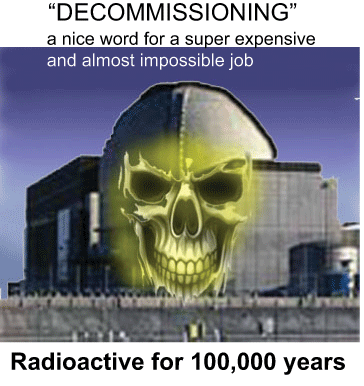 EU regulation of nuclear decommissioning costs needed -Capgemini http://www.reuters.com/article/2015/11/02/nuclear-decommissioning-idUSL8N12X22J20151102 Europe needs banking-industry style regulation to bring more transparency to the costs of nuclear reactors, consultancy Capgemini said in its annual energy market report.
Capgemini said gross provisions for decommissioning and long-term spent fuel management work out at 4.7 billion euros ($5.2 billion) per reactor in Germany, compared to just 1.2 billion in France and 3.38 billion euros in Britain.
Even if France’s nuclear fleet of 58 reactors is much bigger than Germany’s 17 reactors, economies of scale from the standardization of processes look too big to account for such a difference by themselves, according to Capgemini.
“Establishing what methodology is used to estimate the overall cost is essential, but it is never explained in annual reports, with each player relying on the estimates of their own experts in that area,” Capgemini said.
Nuclear operators like France’s EDF, Germany’s E.ON and RWE and Sweden’s Vattenfall all use different discount and inflation rates to calculate the present value of long-term liabilities and the parameters for these calculations are left to individual companies to decide, the consultancy said. “For obvious reasons to do with transparency, it is urgent that a process be instituted at European level … similar to the international regulatory framework for banks (Basel III) following the financial crisis that affected most European countries,” Capgemini said.
There are also strong disparities with regards to nuclear operators’ legal obligations in terms of covering these future costs, it said.
Only Finland’s Fortum, Vattenfall (for its Swedish activities), EDF and the Czech Republic’s CEZ have portfolios dedicated to the financing of these long-term obligations, with coverage ratios of 100, 78, 68 and 31 percent respectively, Capgemini said.
Other sector players do not have dedicated assets on their balance sheets, and German utilities currently do not cover their provisions, it added.
Last month, E.ON dropped plans to spin off its German nuclear power plants, bowing to political pressure to retain liability for billions of euros of decommissioning costs when the plants are shut down.
The International Energy Agency said late last year that almost 200 of the world’s 434 reactors in operation would be retired by 2040, and estimated the decommissioning cost at more than $100 billion, but many experts view this figure as way too low. ($1 = 0.9057 euros) (Reporting by Geert De Clercq; Editing by Susan Fenton)
Entergy closes unprofitable Fitzpatrick nuclear power plant
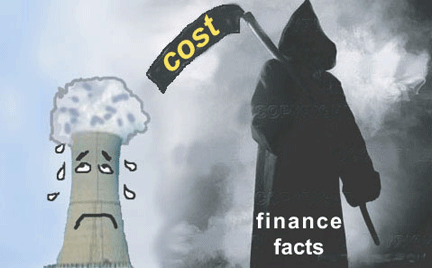 Lack of profitability forces Entergy to close Fitzpatrick nuclear power plant, Enformable, 2 Nov 15 Entergy officials have confirmed that late 2016 or early 2017 the Fitzpatrick nuclear power plant will be shut down instead of refueled and brought back online.
The plant was scheduled for refueling in September 2016 but has been losing Entergy money and can no longer be kept afloat. Wall Street analyst Julien Dumoulin-Smith of UBS Securities, recently predicted FitzPatrick would lose about $40 million in 2016 and as much as $85 million by 2018. Entergy recently told investors that the Fitzpatrick plant had lost so much money, that it was worth nearly a billion dollars less than what it was valued at……http://enformable.com/2015/11/lack-of-profitability-forces-entergy-to-close-fitzpatrick-nuclear-power-plant/
Germany’s dash for renewables has helped to create new industries
Germany’s planned nuclear switch-off drives energy innovation, Guardian, Jennifer Rankin , 3 Nov 15
While Britain visualises a nuclear future, Angela Merkel’s aim of replacing it with renewables by 2022 is well under way Hinkley Point will be the first nuclear power plant to be built in Europe since the meltdown of Japan’s Fukushima reactor in 2011. But while the British government sees nuclear energy as a safe and reliable source of power, Germany is going in a different direction.
As a result of the Fukushima, Chancellor Angela Merkel pledged to switch off all nuclear power by 2022 and fill the gap with renewables – a process known as theenergiewende (energy transition).

Germany’s push for renewables grew out of the anti-nuclear protests of the 1980s and currently more than a quarter (26%) of its electricity comes from wind, solar and other renewable sources, such as biomass, although 44% is from coal. The country’s government wants to increase the share of renewables in electricity to 40% to 45% by 2025.
No other country of Germany’s size has attempted such a radical shift in its power supply in such a short space of time. Described by Merkel as a herculean task, the transition is Germany’s most ambitious economic project since die Wende – the phrase used to describe the fall of the Berlin wall and subsequent reunification of east and west – with an estimated cost of €1tn (£742bn) over the next two decades.
However, Reinhard Bütikofer, the Green party’s spokesman for industry in the European parliament, said the really “mind-blowing” energy transition is happening in the UK, where the Hinkley Point C nuclear plant in Somerset will cost electricity customers at least £4.4bn in subsidies. “They are cutting down on solar, PV [photovoltaics], purportedly for cost reasons, while on the other hand they pledge to guarantee the nuclear industry and energy price twice the market price for the next 30 years. That’s crazy.”
The energiewende is not uncontroversial, not least due to the rising cost of subsidies paid by ordinary bill payers, which has triggered complaints that poor households are subsidising affluent dentists to put solar panels on their roofs. But the transition is not opposed by Germany’s main business lobby, the BDI, despite lingering concerns about what the transition means for the country’s manufacturing base at a time when confidence in the Made in Germany brand has been knocked by the Volkswagen scandal.
“There is broad consensus in society on the political targets – to reduce CO2 and increase energy efficiency and the share of renewables,” said Carsten Rolle, the BDI’s head of energy and climate policy………
Germany’s dash for renewables has helped to create new industries. About 370,000 Germans work in the renewable energy industry, twice the number who work in fossil fuels, according to the Heinrich Böll Foundation, a green political thinktank.
The north German port city of Bremerhaven has staged a partial revival, after decades of decline following the collapse of the shipbuilding and fishing industries in the 1970s and 1980s……..
Bütikofer said it was a myth that the push to renewables was putting German companies out of business.
“The industrial Mittelstand has always persevered, moved ahead of the curve by being more effective than others,” he said. He believed that from damaging firms, the energy law can stimulate energy efficiency. “[The energiewende] is nudging sectors of German industry towards more ambitious innovation and I think that is the name of the game for future competitiveness.” http://www.theguardian.com/environment/2015/nov/02/germanys-planned-nuclear-switch-off-drives-energy-innovation
Scientists confirm “elevated” raadioactivity levels in honey near nuclear power station
 Radioactive honey found near nuclear power station, Rt.com 2 Nov, 2015 Honey contaminated with nuclear waste has been found near a disused power station in Scotland, scientists have confirmed, with samples of the product testing positive for “elevated” radioactivity. The samples showed levels of radioactive caesium-137 that are 14 times higher than samples of honey from elsewhere in the UK, prompting scientists to call for an investigation into wider contamination at the site.
The plant, which closed in 1994, no longer produces nuclear energy. It is still in the process of being decommissioned, however.
Independent nuclear energy consultant John Large said bees are an important barometer of environmental health.“Bees are key indicators of what is happening in the environment. They forage in a three-mile radius around the hive and anything in the soil is drawn up into plants and into the nectar they collect.
“This reading is within the limit for human consumption, but caesium-137 should not be turning up in honey at all,” he added.
The results are included in the government’s Radioactivity In Food and the Environment report, published last week…….https://www.rt.com/uk/320505-nuclear-plant-honey-contamination/#.VjfDMS3IGhs.twitter
How the BBC advised Britons if there was a nuclear attack during the Cold War
Who, What, Why: What would the radio broadcast in a nuclear war?, BBC 3 Nov 15 Who, What, WhyThe Magazine answers the questions behind the news BBC newsreader Peter Donaldson, who has died aged 70, was to have been the voice of radio bulletins in the event of a nuclear attack. What would have gone out on the UK’s airwaves if the Cold War had turned hot?
“This is the Wartime Broadcasting Service. This country has been attacked with nuclear weapons. Communications have been severely disrupted, and the number of casualties and the extent of the damage are not yet known.”
So began the script, read by Peter Donaldson, which was to go out on British airwaves in the event of nuclear war.
The Wartime Broadcasting Service was run by the BBC on behalf of the government. It was intended to replace existing radio broadcasts in the event of a nuclear exchange.
According to declassified papers, the recording of Donaldson would have been broadcast from a nuclear bunker at Wood Norton in Worcestershire and transmitted from nearby Droitwich.
The script urged people to stay calm, remain in their homes, save water and make the most of tinned food supplies. It was hoped this would provide reassurance as well as information.
“If there had been a nuclear attack, people would still have heard the BBC and hopefully they would have taken heart,” Michael Hodder, who ran the Wartime Broadcasting Service, told the BBC’s The One Show in September.
The service would also be used to make official government announcements. It was intended that there would also have been regional services performing similar functions for regional seats of government.
BBC staff would have followed procedures set out in the War Book, a Cold War instruction manual that was declassified in 2009. “Engineers in charge of transmitters had it in their safes,” says BBC historian Jean Seaton.
Initially it was planned that music and light entertainment programmes including Hancock’s Half Hour, Round the Horne and Just A Minute would be broadcast too, but by the 1980s it was decided that only official announcements would be transmitted to preserve energy.
The use of a well-known presenter was considered crucial. In a June 1974 letter, Harold Greenwood from the Ministry of Posts and Telecommunications warned that an “unfamiliar voice” would lead listeners to conclude that “perhaps after all the BBC has been obliterated”.
Full script……
Southern Ocean fast becoming acidic, with abrupt effects on the marine food chain
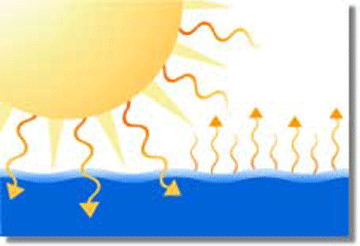 Abrupt changes in food chains predicted as Southern Ocean acidifies fast: study [excellent pictures] http://www.smh.com.au/environment/climate-change/abrupt-changes-in-food-chains-predicted-as-southern-ocean-acidifies-fast-study-20151030-gknd2g.html November 3, 2015 Peter Hannam Environment Editor, The Sydney Morning Herald The Southern Ocean is acidifying at such a rate because of rising carbon dioxide emissions that large regions may be inhospitable for key organisms in the food chain to survive as soon as 2030, new US research has found.
Tiny pteropods, snail-like creatures that play an important role in the food web, will lose their ability to form shells as oceans absorb more of the CO2 from the atmosphere, a process already observed over short periods in areas close to the Antarctic coast.
Ocean acidification is often dubbed the “evil twin” of climate change. As CO2 levels rise, more of it is absorbed by seawater, resulting in a lower pH level and reduced carbonate ion concentration. Marine organisms with skeletons and shells then struggle to develop and maintain their structures.
Using 10 Earth system models and applying a high-emissions scenario, the researchers found the relatively acidic Southern Ocean quickly becomes unsuited for shell-forming creatures such as pteropods, according to a paper published Tuesday in Nature Climate Change.
“What surprised us was really the abruptness at which this under-saturation [of calcium carbonate-based aragonite] occurs in large areas of the Southern Ocean,” Axel Timmermann, a co-author of the study and oceanography professor at the University of Hawaii told Fairfax Media. “It’s actually quite scary.”
Since the Southern Ocean is already close to the threshold for shell-formation, relatively small changes in acidity levels will likely show up there first, Professor Timmermann said: “The background state is already very close to corrosiveness.”
Below a certain pH level, shells of such creatures become more brittle, with implications for fisheries that feed off them since pteropods appear unable to evolve fast enough to cope with the rapidly changing conditions.
“For pteropods it may be very difficult because they can’t run around without a shell,” Professor Timmermann said. “It’s not they dissolve immediately but there’s a much higher energy requirement for them to form the shells.”
Given the sheer scale of the marine creatures involved, “take away this biomass, [and] you have avalanche effects for the rest of the food web”, he said.
As carbon dioxide levels rise, the impacts seen in the Southern Ocean – and its counterpart regions in the northern hemisphere – can be expected to spread closer to the equator.
Scientists anticipate that a halt in the increase in greenhouse gases will take time to have an impact on slowing the warming of the planet. However, a faster response can be expected in the oceans to any slowing in the pace of acidification.
“The corrosiveness of the water is a very strong function of the atmospheric C02 and there is not much of a delay [to any changes]”, Professor Timmermann said.
The paper’s release comes about four weeks before delegates from almost 200 nations are expected to gather in Paris, France to negotiate a new global treaty to curb carbon emissions.
Call for Hong Gong to end nuclear energy imports when contract ends
Hong Kong should end nuclear energy imports after Daya Bay contract ends in 2034, Greenpeace says, South China Morning Post Group says ‘business as usual’ approach not enough and urges greater use of renewables, 04 November, 2015, Ernest Kao ernest.kao@scmp.com
By halting nuclear energy imports after the 20-year supply contract with the Daya Bay plant ends in 2034, along with reducing electricity use by one per cent each year and boosting renewable energy use to 10 per cent, Greenpeace calculated an emissions cut of 34 per cent could be achievable…..http://www.scmp.com/news/hong-kong/health-environment/article/1875380/hong-kong-should-end-nuclear-energy-imports-after
Today’s renewable energy headlines
|
Visual Capitalist (blog) – 8 hours ago
According to the Renewable Energy Policy Network, about 22.1% of the world’s energy needs are satisfied by renewable energy. Hydro power accounts for most of this (16.4%) and the remainder (5.7%) comes from solar, wind, biomass, and other renewable …
CleanTechnica – 10 hours ago
The first era, starting in the 1990s, was characterized by deregulation, the creation of renewable energy certificates (RECs), and the development of the renewable portfolio standard (RPS). During this time period, renewable energy was purchased …
Full Fact – 7 hours ago
“We have a 20% renewables target overall across all energy, which translates into a 30% target forrenewable electricity and, I believe, there is a 12% renewable heat target, and therefore a 10%renewables target. There is no breakdown of those targets …
CleanTechnica – Nov 2, 2015
As Jordan looks to rapidly expand the renewable energy infrastructure, it is also taking measures to ensure that its transmission grid is ready for the boom in renewable energy generation. The French and Jordanian Prime Ministers recently signed an …
The Rock River Times – 1 hour ago
Our energy interests were influenced by Amory Lovins, an early advocate of energy efficiency andrenewable energy, the energy efficiency program in Osage, Iowa, visits to the solar business district in Soldiers Grove, Wisconsin, and off-grid PV powered …
Ghana Business News – 8 hours ago
Dr. Donkor said the price of solar energy in countries such as the United Arab Emirates, South Africa, Brazil and Uganda, is far below the price of electricity generated from conventional sources and government’s intent therefore, is to increase the …
Ghana Broadcasting Corporation – 4 hours ago
The three- day fair is being held at a time the country is in an energy crisis and all energy sources are being tapped to help address the situation. Opening it, the Minister of Power, Dr. Kwabena Donkor, said though renewable energy is contributing to …
|
1 This Month


Tell the Ukrainian Government to Drop Prosecution of Peace Activist Yurii Sheliazhenko

Petition to revoke the licensing of the Near Surface Nuclear Disposal Facility (NSDF) at Chalk River. https://www.ourcommons.ca/petitions/en/Petition/Details?Petition=e-7247


of the week – STOP SMALL MODULAR REACTORS IN CANADA
To see nuclear-related stories in greater depth and intensity – go to https://nuclearinformation.wordpress.com
-
Archives
- March 2026 (212)
- February 2026 (268)
- January 2026 (308)
- December 2025 (358)
- November 2025 (359)
- October 2025 (376)
- September 2025 (258)
- August 2025 (319)
- July 2025 (230)
- June 2025 (348)
- May 2025 (261)
- April 2025 (305)
-
Categories
- 1
- 1 NUCLEAR ISSUES
- business and costs
- climate change
- culture and arts
- ENERGY
- environment
- health
- history
- indigenous issues
- Legal
- marketing of nuclear
- media
- opposition to nuclear
- PERSONAL STORIES
- politics
- politics international
- Religion and ethics
- safety
- secrets,lies and civil liberties
- spinbuster
- technology
- Uranium
- wastes
- weapons and war
- Women
- 2 WORLD
- ACTION
- AFRICA
- Atrocities
- AUSTRALIA
- Christina's notes
- Christina's themes
- culture and arts
- Events
- Fuk 2022
- Fuk 2023
- Fukushima 2017
- Fukushima 2018
- fukushima 2019
- Fukushima 2020
- Fukushima 2021
- general
- global warming
- Humour (God we need it)
- Nuclear
- RARE EARTHS
- Reference
- resources – print
- Resources -audiovicual
- Weekly Newsletter
- World
- World Nuclear
- YouTube
-
RSS
Entries RSS
Comments RSS
 nuclear-news