Urgent need for transparency on South Africa’s Integrated Energy Plan (IEP)
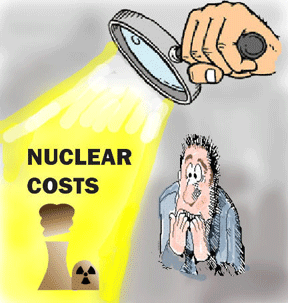 IEP 2015 must be tabled urgently: DA http://www.iol.co.za/news/politics/iep-2015-must-be-tabled-urgently-da-1.1938828#.Vjab-dIrLGg November 1 2015 By ANA Reporter Cape Town – The Democratic Alliance on Sunday urged Energy Minister Tina Joemat-Petterson to urgently table the integrated energy plan (IEP) 2015 so that it can be scrutinised in Parliament.
The IEP 2015 presently before Cabinet indicated that government planned not one but up to three R1 trillion nuclear deals by 2050, all the while acknowledging that procurement of nuclear could in fact be delayed until at least 2020, if not later, DA spokesman Gordon Mackay said in a statement.
“The DA therefore calls on Energy Minister Joemat-Petterson to table this IEP as a matter of urgency and allow Parliament to scrutinise this document and address the key issues within this plan.”
According to reports in the Sunday Times on Sunday morning, the proposed IEP nuclear-generating capacity would be expanded to between 12 and 20 times South Africa’s current installed nuclear capacity of 1830 MW, he said.
This effectively meant the energy department envisioned a series of large-scale nuclear deals over the next 20 years, despite ongoing and significant concerns on affordability by National Treasury and uncertainty as to the impact on the cost of electricity for ordinary South Africans, particularly the poor.
The purpose of the IEP was to provide a roadmap of the future energy landscape for South Africa to guide future energy infrastructure investments and policy development by providing a thorough analysis of competing technologies for the provision of sustainable and cost-effective electricity.
“Far from being a thorough assessment of competing technologies however, the IEP is nothing more than a slavish confirmation of the inevitability of the nuclear new build program and is the product of political interference by the ANC government into the terrain of energy planning,” Mackay said.
The IEP therefore failed to provide an assessment of a potential energy mix which excluded nuclear, despite the international energy landscape where major nuclear nations, such as Germany, France, and the US, were all reducing their reliance on nuclear in favour of cleaner and cheaper renewables and gas.
Further, the IEP argued for an energy mix biased towards a combination of large scale nuclear and large scale decentralised renewables, despite general international consensus that the two technologies were largely incompatible due to the variable nature of renewables electricity generation. “Furthermore, the scope for gas in the IEP has deliberately been limited in order to produce a ‘nuclear heavy’ energy roadmap. The IEP is way too conservative on the scope of gas within in the energy mix. Internationally, a number of gas producers are coming online and numerous new gas finds are being made across Africa. This will result in an increased availability of natural gas and the subsequent decrease in the price of natural gas,” he said.
Government should have used the IEP to aggressively pursue gas as an alternative energy form, which was far safer, cleaner, cheaper, and more job friendly compared to the use of the potentially politically motivated and unaffordable nuclear build programme.
“The DA remains fundamentally opposed to costly, secretive nuclear deals which have the real potential to destroy any prospects of future economic growth and job creation, and as such will not support government’s latest and unimpressive solution to the energy crisis in the form of the integrated energy plan,” Mackay said.
No comments yet.
1 This Month

of the week – Shut Down Drone Warfare!


Tell the Ukrainian Government to Drop Prosecution of Peace Activist Yurii Sheliazhenko

Petition to revoke the licensing of the Near Surface Nuclear Disposal Facility (NSDF) at Chalk River. https://www.ourcommons.ca/petitions/en/Petition/Details?Petition=e-7247
To see nuclear-related stories in greater depth and intensity – go to https://nuclearinformation.wordpress.com
-
Archives
- April 2026 (79)
- March 2026 (251)
- February 2026 (268)
- January 2026 (308)
- December 2025 (358)
- November 2025 (359)
- October 2025 (376)
- September 2025 (257)
- August 2025 (319)
- July 2025 (230)
- June 2025 (348)
- May 2025 (261)
-
Categories
- 1
- 1 NUCLEAR ISSUES
- business and costs
- climate change
- culture and arts
- ENERGY
- environment
- health
- history
- indigenous issues
- Legal
- marketing of nuclear
- media
- opposition to nuclear
- PERSONAL STORIES
- politics
- politics international
- Religion and ethics
- safety
- secrets,lies and civil liberties
- spinbuster
- technology
- Uranium
- wastes
- weapons and war
- Women
- 2 WORLD
- ACTION
- AFRICA
- Atrocities
- AUSTRALIA
- Christina's notes
- Christina's themes
- culture and arts
- Events
- Fuk 2022
- Fuk 2023
- Fukushima 2017
- Fukushima 2018
- fukushima 2019
- Fukushima 2020
- Fukushima 2021
- general
- global warming
- Humour (God we need it)
- Nuclear
- RARE EARTHS
- Reference
- resources – print
- Resources -audiovicual
- Weekly Newsletter
- World
- World Nuclear
- YouTube
-
RSS
Entries RSS
Comments RSS
 nuclear-news
Leave a comment