Germany’s slow, laborious journey from nuclear energy to renewables shows the world how to go
But here’s the thing about the Germans: They knew the energiewende was never going to be a walk in the forest, and yet they set out on it. What can we learn from them? We can’t transplant their desire to reject nuclear power. We can’t appropriate their experience of two great nation-changing projects—rebuilding their country when it seemed impossible, 70 years ago, and reunifying their country when it seemed forever divided, 25 years ago. But we can be inspired to think that the energiewende might be possible for other countries too.
In a recent essay William Nordhaus, a Yale economist who has spent decades studying the problem of addressing climate change, identified what he considers its essence: free riders. Because it’s a global problem, and doing something is costly, every country has an incentive to do nothing and hope that others will act. While most countries have been free riders, Germany has behaved differently: It has ridden out ahead. And in so doing, it has made the journey easier for the rest of us.
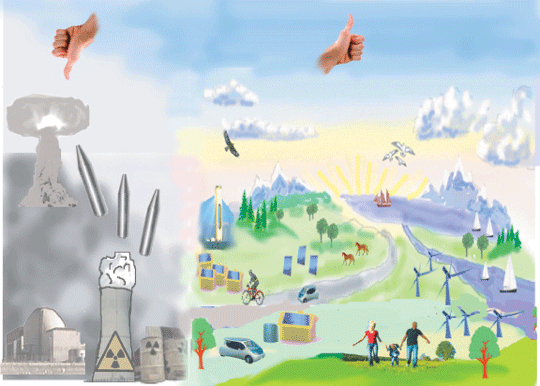
Germany Could Be a Model for How We’ll Get Power in the Future
 The European nation’s energy revolution has made it a leader in replacing nukes and fossil fuels with wind and solar technology.National Geographic, By Robert Kunzig Photographs by Luca Locatelli
OCTOBER 15, 2015 “….. Germany is pioneering an epochal transformation it calls the energiewende—an energy revolution that scientists say all nations must one day complete if a climate disaster is to be averted. Among large industrial nations, Germany is a leader. Last year about 27 percent of its electricity came from renewable sources such as wind and solar power, three times what it got a decade ago and more than twice what the United States gets today. The change accelerated after the 2011 meltdown at Japan’s Fukushima nuclear power plant, which led Chancellor Angela Merkel to declare that Germany would shut all 17 of its own reactors by 2022. Nine have been switched off so far, and renewables have more than picked up the slack.
What makes Germany so important to the world, however, is the question of whether it can lead the retreat from fossil fuels. By later this century, scientists say, planet-warming carbon emissions must fall to virtually zero. Germany, the world’s fourth largest economy, has promised some of the most aggressive emission cuts—by 2020, a 40 percent cut from 1990 levels, and by 2050, at least 80 percent……..
In a snowy clearing just uphill stood two 320-foot-tall wind turbines funded by 521 citizen investors recruited by Pesch—but we weren’t talking about the turbines yet. With an engineer named Dieter Seifried, we were talking about the nuclear reactor that never got built, near the village of Wyhl, 20 miles away on the Rhine River.
The state government had insisted that the reactor had to be built or the lights would go out in Freiburg. But beginning in 1975, local farmers and students occupied the site. In protests that lasted nearly a decade, they forced the government to abandon its plans. It was the first time a nuclear reactor had been stopped in Germany.
The lights didn’t go out, and Freiburg became a solar city. Its branch of the Fraunhofer Institute is a world leader in solar research. Its Solar Settlement, designed by local architect Rolf Disch, who’d been active in the Wyhl protests, includes 50 houses that all produce more energy than they consume. “Wyhl was the starting point,” Seifried said. In 1980 an institute that Seifried co-founded published a study called Energiewende—giving a name to a movement that hadn’t even been born yet……..
All over Germany I heard the same story. From Disch, sitting in his own cylindrical house, which rotates to follow the sun like a sunflower. From Rosenkranz in Berlin, who back in 1980 left physics graduate school for months to occupy the site of a proposed nuclear waste repository. From Luise Neumann-Cosel, who occupied the same site two decades later—and who is now leading a citizens’ initiative to buy the Berlin electric grid. And from Wendelin Einsiedler, a Bavarian dairy farmer who has helped transform his village into a green dynamo.
All of them said Germany had to get off nuclear power and fossil fuels at the same time. “You can’t drive out the devil with Beelzebub,” explained Hans-Josef Fell, a prominent Green Party politician. “Both have to go.” At the University of Applied Sciences in Berlin, energy researcher Volker Quaschning put it this way: “Nuclear power affects me personally. Climate change affects my kids. That’s the difference.”……
But here’s the thing about the Germans: They knew the energiewende was never going to be a walk in the forest, and yet they set out on it. What can we learn from them? We can’t transplant their desire to reject nuclear power. We can’t appropriate their experience of two great nation-changing projects—rebuilding their country when it seemed impossible, 70 years ago, and reunifying their country when it seemed forever divided, 25 years ago. But we can be inspired to think that the energiewende might be possible for other countries too.
In a recent essay William Nordhaus, a Yale economist who has spent decades studying the problem of addressing climate change, identified what he considers its essence: free riders. Because it’s a global problem, and doing something is costly, every country has an incentive to do nothing and hope that others will act. While most countries have been free riders, Germany has behaved differently: It has ridden out ahead. And in so doing, it has made the journey easier for the rest of us. http://ngm.nationalgeographic.com/2015/11/climate-change/germany-renewable-energy-revolution-text
No comments yet.
1 This Month

Petition to revoke the licensing of the Near Surface Nuclear Disposal Facility (NSDF) at Chalk River. https://www.ourcommons.ca/petitions/en/Petition/Details?Petition=e-7247

18 March Webinar @ 1 PM EST: An Assessment of SMR Projects: The Case of Canada
register for the zoom:
https://us02web.zoom.us/webinar/register/WN_o8BIIOUvQ2ONJR1nta65DQ#/registration


of the week – STOP SMALL MODULAR REACTORS IN CANADA
To see nuclear-related stories in greater depth and intensity – go to https://nuclearinformation.wordpress.com
-
Archives
- March 2026 (146)
- February 2026 (268)
- January 2026 (308)
- December 2025 (358)
- November 2025 (359)
- October 2025 (376)
- September 2025 (258)
- August 2025 (319)
- July 2025 (230)
- June 2025 (348)
- May 2025 (261)
- April 2025 (305)
-
Categories
- 1
- 1 NUCLEAR ISSUES
- business and costs
- climate change
- culture and arts
- ENERGY
- environment
- health
- history
- indigenous issues
- Legal
- marketing of nuclear
- media
- opposition to nuclear
- PERSONAL STORIES
- politics
- politics international
- Religion and ethics
- safety
- secrets,lies and civil liberties
- spinbuster
- technology
- Uranium
- wastes
- weapons and war
- Women
- 2 WORLD
- ACTION
- AFRICA
- Atrocities
- AUSTRALIA
- Christina's notes
- Christina's themes
- culture and arts
- Events
- Fuk 2022
- Fuk 2023
- Fukushima 2017
- Fukushima 2018
- fukushima 2019
- Fukushima 2020
- Fukushima 2021
- general
- global warming
- Humour (God we need it)
- Nuclear
- RARE EARTHS
- Reference
- resources – print
- Resources -audiovicual
- Weekly Newsletter
- World
- World Nuclear
- YouTube
-
RSS
Entries RSS
Comments RSS
 nuclear-news
Leave a comment