Solar and storage could supply as much electricity to UK, as nuclear, at half the subsidy cost

 New nuclear in the UK would require twice as much subsidy as solar – report, PV tech org news, 22 Oct 15. Solar and storage could provide as much electricity as a proposed new nuclear plant in the UK at half the subsidy cost, according to new analysis timed to coincide with expected news of a nuclear agreement between Britain and China this week……
The STA’s analysis compared the amount of subsidy required over the lifetime of Hinkley Point C with what would be needed to deliver the same amount of electricity through solar and storage over the same 35-year period.
It calculated that the subsidy needed for Hinkley C would come to £29.7 billion, compared to £14.7 billion for solar and storage – £3.8 billion for the solar element, £10.9 billion for storage.
Mike Landy, head of policy at the STA, said the association hoped the analysis would give the public cause to think about “how inexpensive solar has become” and “how competitive it is” against other forms of low-carbon generation.
“We are not saying that solar is the solution to all our energy problems, nor that it could completely replace other technologies. However the government needs to explain why it is drastically cutting support for solar energy whilst offering double the subsidy to Hinkley Point C.
“It also needs to explain why it is championing overseas state-backed utilities over British solar companies which given stable support would have considerable growth prospects,” Landy added.
The STA report comes just a day after environmental charity Greenpeace’s own analysis claimed that a fleet of three new nuclear reactors at Hinkley, Sizewell and Bradwell would add £33 per year to the average household energy bill for more than three decades. This would represent a 4.5-fold increase over the £6 cost per year associated with the solar feed-in tariff that UK’s Department of Energy and Climate Change is currently consulting on cutting for this reason.
During a hearing yesterday of the UK House of Commons’ Energy and Climate Change Select Committee with Andrea Leadsom, committee chair Angus Macneil put it to the energy minister that the government was being “miserly with renewables, but profligate with nuclear”, a claim which Leadsom rejected.
But Frank Gordon, senior policy analyst at the UK’s Renewable Energy Association, agreed with Macneil, telling PV Tech’s sister site, Solar Power Portal: “Well before Hinkley C is commissioned solar power will be generating electricity without subsidy. It will be able to produce baseload electricity as it combines with massively falling costs of energy storage.”
“Government support in its many forms is acting as an effective bridge to this future, but the proposed changes jeopardise some of the tremendous achievements of the past decade,” he added.http://www.pv-tech.org/news/new_nuclear_in_the_uk_would_require_twice_as_much_subsidy_as_solar_report
A warning to UK – the disastrous history of Finland’s Olkiluoto nuclear station
“what’s most striking at the experience of Olkiluoto — just how many different things have gone wrong.”
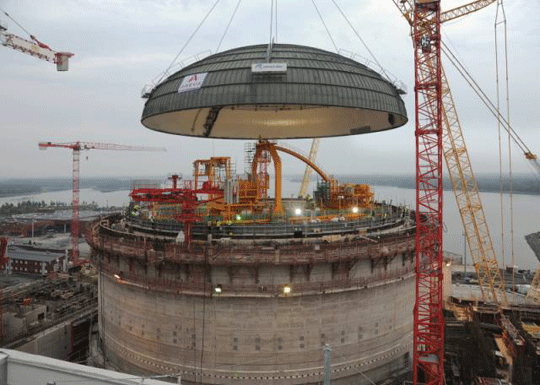 New nuclear: Finland’s cautionary tale for the UK ,Carbon Brief, 20 Oct 15,Finland has a 15-year-old problem called Olkiluoto 3. This nuclear plant was once the bright star of Finland’s energy future and Europe’s nuclear renaissance.
It was seen as a key component in Finland’s plans to reduce greenhouse gas emissionsby 80% by 2050 and end reliance on foreign imports of electricity, even during its long, dark Arctic winters. It is supposed to provide Finland with a low-carbon source of electricity for at least 60 years.
A 2006 article in the Telegraph spoke of the rebirth of Finnish love for nuclear power, describing the Olkiluoto site in phrases that could have been lifted from a pastoral poem: a “Baltic island of foraging swans”, “pine-scented” air and “unusually large salmon”.
But this source of hope has turned sour. Olkiluoto 3 — almost unpronounceable to non-Finns — is now nine years behind schedule and three times over budget. It has been subject to lawsuits, technology failure, construction errors and miscommunication. A rift between the companies behind the plant has been describedas “one of the biggest conflicts in the history of the construction sector”.
At best, it has been a turbulent lift-off to the lauded rebirth of nuclear power in western Europe. For the UK, which hopes to be a part of this renaissance, the story of Olkiluoto 3 offers a cautionary tale.
Background
The story of Olkiluoto 3 began in 2000…….
Construction problems
It is now 2015, and Finland still does not have its new nuclear plant.
The companies behind the project are at loggerheads. TVO is seeking compensation from Areva in court, the company responsible for supplying the reactor and turbine, and Areva is pursuing a counterclaim.
Herkko Plit, the deputy director of Finland’s energy department, tells Carbon Brief:
“I don’t think there’s anybody who can say they are pleased with the project.”……….
The case is being dealt with in the International Chamber of Commerce‘s arbitration court.
Nonetheless, Areva has been forced to accept losses. The company, which hasn’t turned a profit since 2010, recorded net losses of €4.8bn in 2014, largely due to Olkiluoto. It has agreed to sell a majority stake in its nuclear reactor business to EDF.
If the lawsuit turns against TVO, it could be Finland’s industry that feels the pain. The utilities company is owned by shareholders that buy the right to use the electricity produced by the power station……..
what’s most striking at the experience of Olkiluoto — just how many different things have gone wrong.” http://www.carbonbrief.org/new-nuclear-finlands-cautionary-tale-for-the-uk/
Obama and Pakistan’s President Nawaz Sharif talking about nuclear weapons

 Nuclear weapons, Taliban in focus as Obama meets Pakistan’s Sharif http://www.reuters.com/article/2015/10/22/us-usa-pakistan-idUSKCN0SG29020151022 WASHINGTON | BY DAVID BRUNNSTROM U.S. President Barack Obama met Pakistani Prime Minister Nawaz Sharif at the White House on Thursday and was expected to stress U.S. concerns over Pakistan’s expanding nuclear arsenal and to press Sharif to help bring the Taliban back to talks.
Washington has been trying to persuade Pakistan to make a declaration of “restraint” over its nuclear program but Pakistani officials said Sharif would tell Obama Islamabad will not accept limits on its use of small tactical nuclear weapons.
Analysts also question whether Sharif has sufficient influence with his own security establishment to get them to press the Taliban to return to talks on Afghanistan.
Afghan President Ashraf Ghani is pushing for a negotiated settlement to the 14-year insurgency, which has escalated since tens of thousands of U.S.-led NATO combat troops withdrew ahead of an end-2014 deadline. The two sides held inaugural talks in Pakistan in July but the process has since stalled.
While the Washington talks were expected to focus on nuclear weapons and Islamist militancy, the Obama administration is preparing to sell Pakistan eight F-16 fighter jets in an attempt to bolster the relationship, a U.S. source familiar with the matter said.
The sale, which Congress could block, would be a symbolic step given Pakistan’s already large fleet of fighters.
U.S. concerns have been growing about Pakistan’s nuclear arsenal, tensions between Islamabad and India, and the continued existence of militant sanctuaries in Pakistan used to target the U.S.-backed Afghan government and U.S. forces.
The insurgency in Afghanistan is hampering Obama’s efforts to withdraw U.S. troops, but Bruce Riedel of the Brookings Institution think tank said it was not clear Sharif had the clout with his own army to get military leaders to pressure the Taliban back into talks.
Pakistan insists smaller tactical nuclear weapons would deter a sudden attack by India, which is also a nuclear power, but Washington worries they may further destabilize an already volatile region because their smaller size makes them more tempting to use in a conventional war.
The Federation of American Scientists said this week that since 2011, Pakistan had deployed two new nuclear-capable short-range ballistic missiles and a new medium-range ballistic missile and was developing two extended-range nuclear-capable ballistic missiles and two nuclear-capable cruise missiles.
It estimated Pakistan’s stockpile had grown to 110 to 130 warheads from 90 to 110 in 2011 and could reach 220 to 250 by 2025, making it the world’s fifth-largest nuclear-weapons state.
Pakistani officials say Washington is demanding unreasonable limits on its nuclear weapons while not offering much in return apart from a hazy promise to consider Pakistan as a recognized recipient of nuclear technology.
(Reporting by David Brunnstrom; Additional reporting by Julia Edwards, Roberta Rampton, Idrees Ali and Andrea Shalal; Editing by James Dalgleish)
Touting the nuclear industry to South Carolina’s students, calling it ‘renewable’!
Engineers seek to educate about role of nuclear energy, Technican, North Carolina, October 22, 2015 Alex Kanora, Correspondent
Participating in the National Nuclear Science Week for the fifth time, NC State’s nuclear engineers are spending this week educating fellow students about the everyday presence of nuclear science, from electricity to textiles.
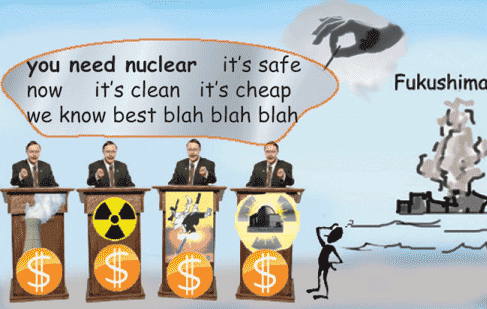
The primary goal of National Nuclear Science Week is to demystify what it means to study nuclear engineering and celebrate its role in society, according to Lisa Marshall, director of Outreach, Retention and Engagement for the department of nuclear engineering. ……..
Tuesday evening at Talley Student Union, nuclear engineering students showed “Pandora’s Promise,” a documentary that explains misconceptions and why skeptics were turned into believers in nuclear power. …..“Many people think of nuclear science as a weapons technology, which in turn keeps people from believing that nuclear energy is a great source of renewable energy,” Marshall said. …… http://www.technicianonline.com/news/article_b2d156e8-7873-11e5-8076-5ff13e669dad.html
Britain’s cost for new nuclear could buy 6 times the amount of wind energy
 For Nuclear’s Cost, U.K. Could Have Six Times the Wind Capacity, Bloomberg Reed Landberg RVLANDBERG October 21, 2015 Britain could have six times the power-generation capacity for the same money by investing in wind turbines instead of the 24.5 billion-pound ($37.9 billion) Hinkley Point nuclear reactor.
That’s the conclusion of Bloomberg New Energy Finance, a London-based researcher that estimates the cost of power from renewables in the U.K. are rivaling fossil fuels even without subsidy. Wind easily beats the more expensive nuclear plant that Electricite de France SA is building with the support of investment from China.
The findings highlights the trade-offs Prime Minister David Cameron weighed in his decision to support EDF’s bid to build the first new reactors in the U.K. in more than two decades……..
In some places, notably the U.K., wind is cheaper than nuclear. The new EDF plant at Hinkley Point will sell electricity for 92.50 pounds per megawatt-hour. That compares with lowest contract price of 79.23 pounds for supplies from onshore wind-power plants that the government awarded in February after a competitive auction.
Hinkley Point will supply 3.2 gigawatts of electricity to the grid. Spending the equivalent money on wind would give 21 gigawatts of capacity, said David Hostert, a wind energy analyst at BNEF in London.
Will Canada now oppose depleted uranium weapons?

 Will Canada’s election deliver Real Change on its depleted uranium weapons policy? http://www.bandepleteduranium.org/en/canadas-liberal-party-opposed-depleted-uranium The Liberal Party opposed depleted uranium weapons during the 2015 election, will Canada’s new government break from the stance of the Harper government on DU?
Under Harper’s government, Canada failed to join the Arms Trade Treaty and dragged its heels on the Convention on Cluster Munitions, all the while claiming leadership on disarmament issues in spite of strong evidence to the contrary. Wereviewed their position in February this year. Can we expect the situation to improve under Trudeau’s leadership?
Prior to the election Mines Action Canada (MAC) undertook informal polling of all the main parties on a range of humanitarian disarmament topics, including on DU weapons. Canada has historically abstained on UN General Assembly resolutionson DU, even though it no longer has the weapons in service – an in-depth ICBUW briefing on Canada’s position on DU is available in English and French.
MAC posed the same DU question to all the main parties – Harper’s Conservatives failed to respond to any of the questions.
“The use of depleted uranium weapons has come under international scrutiny in recent years due to significant concerns about the long term health consequences of their use. If your party forms the next government, what will Canada’s policy be on the use of depleted uranium weapons? What will be Canada’s position on providing technical and financial assistance in order to aid decontamination of affected states and reduce the risks to civilians?”
The response from the Liberal Party was short and to the point:
“The Liberal Party of Canada opposes the use of depleted uranium munitions.”
“Le Parti libéral du Canada s’oppose à l’utilisation de munitions à l’uranium appauvri.”
While the Liberal’s tone was clearly welcome, it failed to elaborate on how it would fulfil this opposition if elected. Nor did their very short answer make any mention of assistance for decontamination. Nevertheless, it could be seen as a sign that Canada’s policy may change in the coming months and ICBUW urges its Canadian supporters to seek clarification on the Liberal position once the election excitement has subsided.
The first big test of the Liberal’s position will come in October 2016, when a sixth UN General Assembly resolution on DU will be tabled. A vote in favour from Canada would be a welcome development, and would help to reinforce the norms on transparency and assistance that the resolutions have been helping to build since 2007.
The public recognition of a radiation-cancer threat may lead to high compensation payments

 Japan Acknowledges First Possible Radiation Casualty at Fukushima Nuclear Plant The public recognition of a radiation-cancer threat may lead to high compensation payments TOKYO, Oct 20 (Reuters) – Japan on Tuesday acknowledged the first possible casualty from radiation at the wrecked Fukushima nuclear power plant, a worker who was diagnosed with cancer after the crisis broke out in 2011.
The health ministry’s recognition of radiation as a possible cause may set back efforts to recover from the disaster, as the government and the nuclear industry have been at pains to say that the health effects from radiation have been minimal.
It may also add to compensation payments that had reached more than 7 trillion yen ($59 billion) by July this year…….
The male worker in his 30s, who was employed by a construction contractor, worked at Tokyo Electric Power Co’s Fukushima Daiichi plant and other nuclear facilities, a health ministry official said.
Of total radiation exposure of 19.8 millisieverts (mSv), the worker received a dose of 15.7 (mSv) between October 2012 and December 2013 working at Fukushima, said the official.
While the exposure amount was lower than the annual 50 mSv limit for nuclear industry workers, the government had decided it cannot be ruled out that the worker’s leukaemia was a result of radiation, the official said.
Tokyo Electric is also facing a string of legal cases seeking compensation over the disaster.
Inside the plant, Tepco has struggled to bring the situation under control. It is estimated removing the melted fuel from the wrecked reactors and cleaning up the site will cost tens of billions of dollars and take decades to complete. ($1 = 119.4200 yen) (Reporting by Kiyoshi Takenaka; Writing by Aaron Sheldrick; Editing by Nick Macfie) http://www.scientificamerican.com/article/japan-acknowledges-first-possible-radiation-casualty-at-fukushima-nuclear-plant/
Nuclear-Tipped Missiles very dangerous, as Russia is proving
Russia is Proving Why Nuclear-Tipped Cruise Missiles Are a Very Bad Idea, Defense One OCTOBER 19, 2015 BY TOM Z. COLLINAWILLIAM SAETREN
Those four cruise missiles that crashed in Iran could’ve been carrying nuclear warheads — which is why the US should ban them, not renew them. When Russia this month launched 26 cruise missiles from ships in the Caspian Sea into Syria, more than 900 miles away, the missiles had to pass over Iran and Iraq. Four crashed in Iran. According to reports, a number of cows were killed in the ensuing blast.
Apologies to the cows, but this could have been a lot worse.
The Russian cruise missiles, the Kalibr-NK, were armed with conventional warheads. But these missiles are also capable of carrying nuclear warheads. That’s a problem. Cruise missile attacks are inherently ambiguous and can add major risks to a crisis. Had the target been the United States, military leaders would not have known until impact if it was a nuclear attack. This kind of uncertainty can increase the risk of nuclear war and it’s why nuclear-tipped cruise missiles should banned completely.
Cruise missiles are unreliable. In the case of Moscow’s attack into Syria, if nuclear warheads had been involved and some of them crashed in Iran without detonating (which is likely), Tehran could have retrieved them. This scenario is not as far fetched as one might think. In 2007, six nuclear-armed cruise missiles were mistakenly loadedonto a B-52 bomber and flown across the United States. Because nuclear-armed cruise missiles are virtually indistinguishable from conventional ones, the error went undetected for 36 hours. If this can happen under strict American guidelines, imagine what could happen from Russia to the Middle East…
why is the U.S. Air Force planning to spend $20 billion to build approximately 1,000 new nuclear-armed Air-Launched Cruise Missiles, or ALCMs, with refreshed warheads, to replace its current fleet? It should not. Not only are they “uniquely destabilizing” but their mission has evaporated.
As Perry and Weber explain, nuclear cruise missiles were initially conceived to keep the B-52 flying until it could be replaced by the stealthier B-2 bomber. During the Vietnam War, many B-52s were lost to enemy surface-to-air defenses making it painfully obvious that the plane was no longer able to safely operate in contested airspace. But with the cruise missile, the B-52 could still strike targets deep in the heart of enemy territory. This feature was deemed necessary during the Cold War so NATO could offset the Warsaw Pact’s larger conventional forces.
That was then. As Perry and Weber write, such a Cold War posture “no longer reflects the reality of today’s U.S.conventional military dominance.”
In fact, the ALCM was supposed to be retired long ago along with the B-52 bomber when the B-2 came on line……..
President Obama can safely cancel the new nuclear cruise missile and challenge other nations, like Russia, to eliminate these destabilizing weapons. This step would save tens of billions of dollars, reduce the risk of nuclear war and provide momentum toward Obama’s goal of eliminating nuclear weapons. And, ironically, it would eliminate yet another potential pathway for Iran to get the bomb. http://www.defenseone.com/ideas/2015/10/russia-proving-why-nuclear-tipped-cruise-missiles-are-very-bad-idea/122938/
50 years later, USA will clean up site of nuclear bomb’s crash in Spain
 Palomares nuclear crash: US agrees Spanish coast clean-up http://www.bbc.com/news/world-europe-34569614 19 October 2015 Almost 50 years after four nuclear bombs fell on the Spanish coast after two US military planes collided, American officials have signed a deal to clean up contaminated land.
None of the bombs detonated in January 1966, but three fell around Palomares and a fourth was found on the sea bed.
Highly toxic plutonium was spread over a 200-hectare (490-acre) area.
On a visit to Madrid, Secretary of State John Kerry agreed to finalise a deal on disposing of contaminated soil.
Under the agreement in principle, signed by Mr Kerry and Spanish Foreign Minister Jose Manuel Garcia-Margallo, the US will remove the soil at Palomares to a site in the US.
Spanish media said the soil would be transported to a site in Nevada. The deal comes a few months before the 50th anniversary of the crash, one of the most serious nuclear incidents of the Cold War.
An earlier consignment of contaminated soil was shipped to a site in South Carolina shortly after the accident and buried in deep trenches.
But further analysis of soil in the area has been carried out in recent years, and the health of residents in the Palomares area is still being monitored.
- On 17 January 1966, a US B-52 bomber carrying four 1.5 megaton bombs collided with a refuelling tanker some 31,000 feet above Palomares on Spain’s Mediterranean coast
- The tanker crew and three people on board the bomber were killed
- One bomb equipped with a parachute landed intact
- Two bombs hit the ground at high speed, scattering plutonium
- A fourth bomb landed five miles off shore and was later recovered by USS Petrel
“I looked up and saw this huge ball of fire, falling through the sky” – Spain waits for US to finish nuclear clean-up
Rich countries put planet on course for irreversible climate change
 Unfair deal under discussion at last UN meeting before Paris negotiations http://www.foei.org/news/unfair-deal-discussion-last-un-meeting-paris-negotiations
Rich countries put planet on course for irreversible climate change
19 October, 2015 Rich countries – those most responsible for climate change – are putting us on course for irreversible and more devastating climate change instead of taking the urgently needed radical action to reduce their carbon emissions, Friends of the Earth International has warned.
The warning was issued as governments from around the world start a week-long gathering at the UN climate talks in Bonn to negotiate the text of a new global climate treaty to be agreed in Paris in December.
“Emission cut pledges made by rich countries so far are less than half of what we need to avoid runaway climate change. The draft Paris agreement being negotiated this week shows that many seem ready to accept irreversible and devastating consequences for people and the planet,” said Susann Scherbarth, climate justice and energy campaigner at Friends of the Earth Europe.
“This draft would even dismantle several key principles of the UN climate convention, such as equity. This is simply unacceptable. Richer countries must do their fair share. The new treaty must protect poorer countries and people, not let richer countries off the hook,” she added.
“Politicians are on track to fail us at their summit in Paris. Many politicians, under pressure from transnational corporate polluters profiting from fossil fuels and dirty energy, are promoting coal, fracking and nuclear energy at the UN and at national level. Instead, they should commit to drastic emission cuts and a transformation of our energy system,” said Dipti Bhatnagar, Friends of the Earth International’s climate justice coordinator.
Hundreds of thousands of people are paying with their lives for our governments’ continued inaction. But the real leaders, the people, are taking action, and showing the way with real solutions, such as community controlled renewable energy. Thousands of people from all over the world, including Friends of the Earth supporters, plan to go to Paris to make their voices heard during the United Nations climate summit and to mobilize further in 2016 and beyond.
“Our governments must stop dirty energy and urgently follow the real leaders – the people, not the polluters. More and more people are supporting the real solutions, resisting fossil fuel extraction and leading us towards climate-safe societies,” said Dipti Bhatnagar, Friends of the Earth International’s climate justice coordinator.
Climate justice organisations, social movements, faith groups, trade unions, environmental and development organisations released a new report today: ‘Fair Shares: A Civil Society Equity Review of Intended Nationally Determined Contributions (INDCs)‘.
The report shows that many developing countries are pledging to do more than their ‘fair share’ to cut emissions while rich countries are dangerously failing to pull their weight.
Based on the information governments have submitted to the UN about their INDCs, the report outlines by how much they pledge to cut their emissions.
The report argues that while ‘equity’ is a core principle in the UN process to find a global deal, countries have so far been allowed to determine their own targets on a purely national basis without reference to the scale of the global effort needed.
In the report, the fair share that each country should have in tackling climate change is measured based on their level of responsibility in causing the crisis as well as their capacity to tackle climate change at this moment in time.
Details emerge on UK’s nuclear deal with China
China to take one-third stake in £24bn Hinkley nuclear power station http://www.theguardian.com/environment/2015/oct/20/china-to-take-one-third-stake-in-24bn-hinkley-nuclear-power-station Details unveiled of deal signed between state-owned companies from China and France to build world’s most expensive plant on UK soil, Guardian, Damian Carrington, 20 Oct 15 China will take a one-third stake in a French-led project to build a new £24bn nuclear power station in the UK at Hinkley Point in Somerset, expected to be the most expensive ever built.
The deal was signed between state-owned companies from China and France just hours before the Chinese president, Xi Jinping , arrived in London for a state visit, and is due to be announced on Wednesday.
It will lead to a final investment decision – the point of no return – by the end of 2015, according to the Financial Times.
The companies – France’s EDF and China General Nuclear Power Corporation – will be the only investors, having failed to attract others. The new completion date for the two reactors at Hinkley Point is 2025, eight years later than first suggested. The deal is strongly backed by the chancellor, George Osborne. The government believes the new plant, which would deliver 7% of the UK’s electricity, represents good value for low-carbon electricity which, barring problems, is always on.
The plant has been promised £92 per megawatt hour (MWh) for 35 years, double today’s average wholesale electricity price, with any shortfall being paid by consumers via household energy bills. Hinkley Point will also be backed by up to £17bn of UK government loan guarantees.
The deal signed this week is also expected to mention Chinese involvement on additional nuclear plants at Sizewell in Suffolk and Bradwell in Essex. China hopes to build 110 nuclear power plants at home and wants to use its own designs at Bradwell as a showcase to help it sell its technology further afield.
But the nuclear push has many criticsover its cost, the time it takes to build and the possible threats to the UK’s national security of having China in control of a plant on UK soil. Osborne’s father-in-law, former energy minister Lord Howell, said the project was “one of the worst deals ever” for British consumers and industry.
Howell, and others, have warned the reactor design planned for Hinkley C has never been completed successfully, pointing to huge cost and time overruns at EDF’s projects at Flamanville in France and Olkiluoto in Finland .
EDF needs the Chinese investment as it is burdened with high levels of debt and is expected to sell €10bn of assets in the next five years, according to the Financial Times. Earlier in October, two of the world’s biggest ratings agencies warned the company it faced credit-rating downgrades if Hinkley Point goes ahead.
A Greenpeace poll this week showed 29% of the UK public supports the Hinkley project, with 34% against it.
A protest camp was set up outside the site this week and Alan Jeffery, a spokesman for the Stop Hinkley campaign said: “We remain mystified about why Osborne wants to throw good money after bad on this project. In the process, he has devastated the UK’s burgeoning renewable energy industry, threatening up to 20,000 jobs in the process. He is doing his best to kill off an innovative industry of the future in order to keep alive a technology of the past.”
However, the Institution of Mechanical Engineers have welcomed the Hinkley plan. “Nuclear is set to play a central and vital role in the UK’s energy future,” said the IME’s Jenifer Baxter. “Although the financial costs of nuclear power seem high, this power station will provide and modernise the diversification we so badly need in ensuring the UK’s lights stay on.”
Canada’s new PM Trudeau pledges action on climate change
 Incoming Canadian PM Justin Trudeau pledges new action on climate change ahead of Paris meeting, ABC News 22 Oct 15 The newly-elected Canadian leader Justin Trudeau will arrive in office with a pledge to improve the country’s battered environmental image, promising a new strategy for global climate negotiations in Paris this December.
The 43-year-old son of former prime minister Pierre Trudeau swept to victory with 39.5 percent of the popular vote, in an election that saw the highest voter turnout since 1993.
Although he has yet to say how he will achieve his goals, the Liberal Party leader faces a tough task meeting expectations.
He has less than 40 days before the Paris climate conference begins, hardly time for yet-unnamed energy and environment ministers to get up to speed, let alone to forge a common position with Canada’s 10 provinces on carbon emissions cuts.
Yet he has pledged a break from the policies of defeated prime minister Stephen Harper — a politician from Alberta’s oil patch who pulled Canada out of the Kyoto treaty and fought to shield the energy industry from global commitments to cut carbon emissions.
During the election campaign, Mr Trudeau criticised Mr Harper relentlessly for turning Canada into a “pariah” on climate change issues.
He pledged to attend the Paris conference, and then convene the country’s provincial premiers within 90 days to create national emissions targets under a framework that would allow provinces to set a price on carbon.
That party platform had almost no specifics but it raised expectations both domestically and abroad that Mr Trudeau would change Canada’s course on climate…………. http://www.abc.net.au/news/2015-10-21/canadian-leader-justin-trudeau-faces-climate-change-challenges/6872344
Political oblivion for ‘climate villains’ – Canada’s PM Harper, Australia’s PM Abbott
Canada’s Harper follows fellow “climate villain” Abbott into political oblivion, REneweconomy, By Giles  Parkinson on 20 October 2015 In less than two months, the two political leaders named by New Statesman as the“world’s worst climate change villains” have been tossed out of power: Australia’s Tony Abbott by his own party, and Canada’s Stephen Harper in a national poll.
It is good news for the upcoming Paris climate change talks. Both countries, under their former leaders, ranked at the bottom of the 34 countries in the Organisation for Economic Co-operation and Development (OECD) for their efforts on climate change. Among G20 countries, only Saudi Arabia ranked lower than them.
Since their elections – Harper in 2006, and Abbott in 2013 – they had applied the brakes on climate change and renewable energy policy, despite some strong efforts at sub-national levels (the provinces in Canada and states and territories in Australia).
During a visit to Canada last year, Abbott and Harper decided to create a “conservative alliance among ‘like-minded’ countries” to try to dismantle global efforts on climate change.
At a press conference, Harper applauded Abbott’s efforts to dump Australia’s carbon tax. Indeed, Abbott had borrowed the “axe the tax” slogan from an earlier Canadian campaign.
Now, both have gone…….http://reneweconomy.com.au/2015/canadas-harper-follows-fellow-climate-villain-abbott-into-political-oblivion-43745
UK’s China nuclear deal creates a target for terrorists
UK-China nuclear deal ‘dangerous,’ creates target for terrorists – CND Rt.com : 22 Oct, 2015 Anti-nuclear campaigners have condemned a deal signed between the UK and China on Wednesday to finance two nuclear power stations in Britain, branding the project “dangerous.”
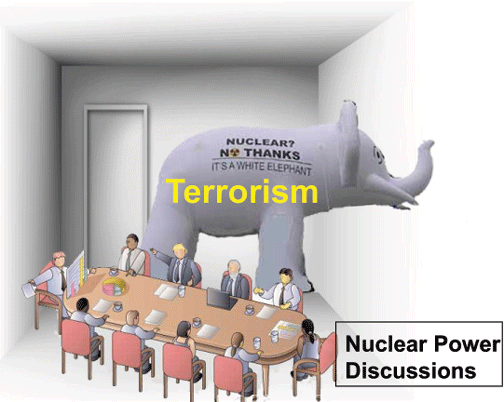
The Campaign for Nuclear Disarmament (CND) warned that the construction of new nuclear plants would create a target for terrorists and increase the likelihood of nuclear proliferation, as the uranium could be used to develop weapons.
Chinese President Xi Jinping signed the £40 billion ($62 billion) deal with Prime Minister David Cameron in Downing Street on Wednesday, crowning a four-day state visit to London which Chinese and UK officials have described as the start of a “golden era” between the two countries……
In a statement, CND General Secretary Kate Hudson said the agreements were the “wrong” deal for the 21st century.
“International agreements should promote co-operation on climate change and security – this deal does precisely the opposite,” she said.
“Nuclear power is expensive, a source of greenhouse gases, and a target for terrorism. Nuclear power also makes the proliferation of nuclear weapons far more likely. As the supply of enriched uranium increases, the possibility of using uranium to develop weapons is made easier.
“The alternative is clear. Renewable sources of energy are clean, they create more jobs, and they’re sustainable. The future for nuclear power, however, is bleak, with experts predicting that we will run out of easily accessible uranium in 50 years’ time. Investing in renewables now will provide us with sustainability and security long into the future,” Hudson said.
Intelligence sources also criticized the deal for prioritizing business over national security, expressing particular concerns that China could hide “trapdoors” in the computer systems which could allow them to gain control of the nuclear plant.
“The Treasury is in the lead and it isn’t listening to anyone – they see China as an opportunity, but we see the threat,” a security source told The Times last week. https://www.rt.com/uk/319359-china-nuclear-deal-dangerous/
Despite safety problems, South Korea obsessed with plan for massive nuclear station
South Korea’s Nuclear Obsession The fixation on nuclear power ignores Fukushima and the global trend towards renewables. The Diplomat By Daul Jang October 22, 2015 Five Greenpeace activists last week entered the security zone of the Kori Nuclear Power Plant. Arriving via a black inflatable boat, they climbed out and scampered up a rocky slope, unfurling a bright yellow banner in front of the plant’s fence. For 40 minutes they stood their ground as guards looked on, sirens blazed, and warnings from the Coast Guard were broadcast over the loud speaker.
In South Korea, the world’s fourth largest producer of nuclear power, the government is planning to expand the Kori site. With six reactors online, two waiting for operating license approval, and an additional two planned, it will bring the total number to ten reactors by 2022. Yet with 3.4 million people living within the 30 km zone, major companies such as Hyundai Motors located nearby, and popular Haeundae beach also in the vicinity, it reveals a government in denial of the threat to its people and nation.

But for the government and the industry, the argument is that Korea needs nuclear power. But the reality is that industrial economies, both established and rapidly developing nations, are investing in renewables because they are reliable, affordable, quick to install, safe, and are the best generating technology to reduce carbon emissions. In 2014, Germany, Japan, China, India, Spain, Mexico, Brazil and the Netherlands collectively generated more electricity from renewables (excluding large-scale hydro) than from nuclear power.
Even before the tragic Fukushima Daiichi nuclear accident in 2011, the global nuclear industry was in decline. ……..
The meltdown of three nuclear reactors at Fukushima dramatically exposed the reality that multiple reactors at a nuclear power plant site equal catastrophic failure. …….
The majority of South Korean people, like the people of Japan, have understood the lessons of Fukushima – that nuclear power is a technology with unacceptable risks. In contrast, both the Abe government in Japan and the administration of Park Geun-hye in South Korea are deliberately ignoring the lessons of Fukushima. It took the Fukushima Daiichi accident to change the mind of one national leader. South Korea should not have to wait for an accident at Kori to have a similar effect.
Daul Jang is the Project Leader for the Climate and Energy Campaign at Greenpeace East Asia in Seoul. http://thediplomat.com/2015/10/south-koreas-nuclear-obsession/
1 This Month
Chernobyl: The Lost Tapes – A good documentary on Chernobyl on SBS available On Demand for the next 3 weeks– https://www.sbs.com.au/ondemand/tv-program/chernobyl-the-lost-tapes/2352741955560

of the week–London Campaign for Nuclear Disarmament

Tell the Ukrainian Government to Drop Prosecution of Peace Activist Yurii Sheliazhenko
To see nuclear-related stories in greater depth and intensity – go to https://nuclearinformation.wordpress.com
-
Archives
- April 2026 (126)
- March 2026 (251)
- February 2026 (268)
- January 2026 (308)
- December 2025 (358)
- November 2025 (359)
- October 2025 (376)
- September 2025 (257)
- August 2025 (319)
- July 2025 (230)
- June 2025 (348)
- May 2025 (261)
-
Categories
- 1
- 1 NUCLEAR ISSUES
- business and costs
- climate change
- culture and arts
- ENERGY
- environment
- health
- history
- indigenous issues
- Legal
- marketing of nuclear
- media
- opposition to nuclear
- PERSONAL STORIES
- politics
- politics international
- Religion and ethics
- safety
- secrets,lies and civil liberties
- spinbuster
- technology
- Uranium
- wastes
- weapons and war
- Women
- 2 WORLD
- ACTION
- AFRICA
- Atrocities
- AUSTRALIA
- Christina's notes
- Christina's themes
- culture and arts
- Events
- Fuk 2022
- Fuk 2023
- Fukushima 2017
- Fukushima 2018
- fukushima 2019
- Fukushima 2020
- Fukushima 2021
- general
- global warming
- Humour (God we need it)
- Nuclear
- RARE EARTHS
- Reference
- resources – print
- Resources -audiovicual
- Weekly Newsletter
- World
- World Nuclear
- YouTube
-
RSS
Entries RSS
Comments RSS
 nuclear-news