St Louis residents demanding answers on underground fire near nuclear waste
“Hot spot” near nuclear waste has St. Louis residents on edge, CBS News, 27 Oct 15 There is growing fear in a suburban St. Louis community over a potential threat buried in the ground. A local landfill contains nuclear waste and just three football fields away, a “hot spot” has been burning underground in a second landfill.
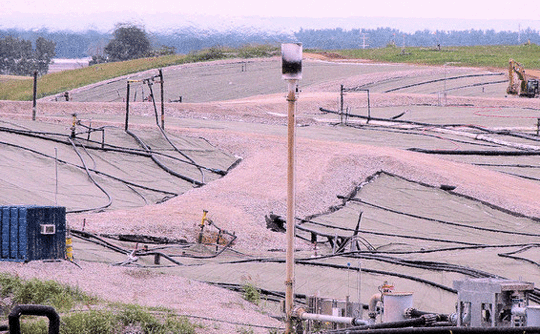 Federal officials insist the so-called “smoldering event” is contained, and not advancing towards the waste. But nearby residents have lived with both the burn and the waste for years, and they say they are fed up, reports CBS News correspondent Vinita Nair.
Hundreds of people demanded answers Monday night from federal officials.
“You can’t 100 percent guarantee that we’re okay,” said one resident.
“We don’t go outside, we don’t open our windows,” said another………
Missouri’s attorney general is now suing the landfill’s owner, Republic Services. He says the company mishandled the fire and his experts say the underground burn could conceivably hit the material in three to six months.
The Environmental Protection Agency and Republic strongly deny those reports. The company has also spent millions of dollars to contain the burn and control the odors…….
it’s not just the underground fire that is a concern – this weekend a grass fire erupted within some 75 yards of the radioactive waste. This region also sits near an earthquake fault line. http://www.cbsnews.com/news/st-louis-community-fed-up-over-dangerous-landfills-attorney-general-sues/
Vietnam: Nonproliferation and Nuclear Energy
Nonproliferation and Nuclear Energy: The Case of Vietnam Is Vietnam diverting its civilian know-how to create an indigenous nuclear weapons program? Not yet, says the CSS’ Oliver Thränert, but increased tensions or overt conflict with China could lead Hanoi to develop its own nuclear deterrent. By Oliver Thränert for Center for Security Studies (CSS) 26 October 2015
For many years, the international nuclear non-proliferation regime has been in deep crisis. This became apparent most recently when the ninth Review Conference of the Parties to the Treaty on the Non-Proliferation of Nuclear Weapons (NPT) in May 2015 ended without a common final document. At the same time, a number of threshold countries are planning to begin using nuclear energy for peaceful purposes. In a time of increasing international tensions, some of them might build on know-how acquired through their civilian programs to safeguard their national security needs through a nuclear weapons program in the near future. Vietnam is an interesting case in point. Irrespective of certain delays in the development of its peaceful nuclear program, the country has progressed quite far. At the same time, it is engaged in an increasingly precarious conflict with its main neighbor, nuclear-armed China. Currently, there are no signs of a Vietnamese nuclear weapons program. In the framework of the nuclear non-proliferation regime, the country is a model of transparency and cooperation. But it is uncertain whether this will always remain the case. On the contrary, Hanoi might change its policy if the conflict with China should come to a head while the NPT continues to be weakened…….
Vietnam’s strategic situation Vietnam’s strategic environment is rapidly changing. This is especially true for Vietnam’s relations with China. While the Communist parties of the two countries regard each other as brother parties and economic relations run deep, the two countries also have disputes over certain small islands in the South China Sea and over the mutual demarcation of exclusive economic zones in these waters. The extent of widespread anti-Chinese feeling among the general public became evident in May 2014, when a Chinese oil platform was discovered in an area claimed by Vietnam. Subsequently, there were not only skirmishes between Chinese and Vietnamese vessels, but also demonstrations in several Vietnamese cities that escalated into violence in which several people were killed.
With an increasingly aggressive China next door, Vietnam, like most of the riparian states, is seeking closer engagement with the US. Washington has become one of Vietnam’s main trading partners. Military relations, too, have been intensified. In July 2013, speaking in Washington, D.C., US President Barack Obama and Vietnamese President Truong Tan Sang announced a comprehensive bilateral partnership. One important step towards the closer development of ties was the passing in Congress of a 123 Agreement in September 2014, which paved the way for future cooperation in the peaceful use of the atom.
Despite the interest in improving cooperation with the US across the board, however, the leadership in Vietnam must be aware that issues such as the country’s single-party system, together with a human-rights situation that the US continues to regard as problematic, are certain to resurface time and again in relations with Washington. Against this background, US security guarantees such as Japan and South Korea have been given can hardly be expected by Vietnam. At the same time, there is the danger that an overly evident rapprochement with Washington might provoke reactions by China. Thus, Hanoi is forced to perform a difficult tightrope walk, balancing out its relations with China on the one hand against those with the US on the other………http://www.isn.ethz.ch/Digital-Library/Articles/Detail/?id=194337
All too many failures in nuclear power pipelines
 Nuclear Pipe Nightmares, UCS Dave Lochbaum, director, Nuclear Safety Project October 27, 2015 Disaster by Design
If you had a dollar for every foot of pipe—or even just a quarter for every three inches of pipe—used in the nation’s nuclear power plants, you would probably not be reading this post. That chore would be delegated to one or more of your many minions.
Pipes at nuclear power plants carry cooling water to the reactor vessel and spent fuel pool, transport steam to the main turbine, provide hydrogen gas to cool the main generators, supply fuel and lubricating oil to the emergency diesel generators, maintain the fire sprinklers ready to extinguish fires, and numerous other vital functions. Given so many pipes, a success rate of 99.99%—remarkably similar to a failure rate of one broken pipe out of ten thousand pipes—would result in lots of piping failures.
The Electric Power Research Institute’s report revealed lots of piping failures at U.S. nuclear power plants between 1961 and 1997 (Fig. 1). The non-leaking failures are identified by inspections indicating that safety margins had been compromised, forcing the pipes to be replaced before they leak. The leaking failures are identified by puddles on the floor or other obvious signs, again forcing pipes to be replaced.
[excellent charts on original]
The Electric Power Research Institute’s report identified numerous reasons why pipes break (Fig. 2). MIC under corrosion stands for microbiologically induced corrosion—tiny little bugs that eat metal. Pipes can be designed wrong, installed wrong, or weakened via an array of methods during use.
[article goes on to describe pipe failures at:]
Dresden Nuclear Plant
Fission Stories #65 described the January 25, 1994, …..
Browns Ferry Nuclear Plant
On August 14, 1984…..
Surry Nuclear Plant
On December 9, 1986,….
Mihama Nuclear Plant
A 22-inch diameter pipe in the condensate/feedwater system ruptured on August 9, 2004, at the Mihama nuclear plant in Japan …..
Oyster Creek and Dresden Nuclear Plants
LaSalle Nuclear Plant
On May 27, 1985…..
Oyster Creek Nuclear Plant
Fission Stories #29 described how 133,000 gallons drained from the condensate storage tank at the Oyster Creek nuclear plant in New Jersey in September 1996…..
Davis Besse Nuclear Plant
Fission Stories #131 described the March 2002 discovery by workers at the Davis-Besse nuclear plant in Ohio that a crack in a pipe allowing a control rod inside the reactor vessel to be connected to and manipulated by its electric motor outside the vessel had been leaking cooling water from the reactor for as long as six years……
Byron Nuclear Plant
On October 19, 2007, workers brushing away rust on the outer surface of a cooling water pipe at the Byron nuclear plant in Illinois poked a hole in it……
Big Rock Point Nuclear Plant
The NRC described a broken pipe at the Big Rock Point nuclear plant in their annual report to the U.S. Congress on abnormal occurrences in 1998…….
Safety by Intent
The table above from the Electric Power Research Institute indicates that 1,816 failures were identified by testing and inspection at U.S. nuclear power plants between 1961 and 1997 while 2,247 failures were found after pipes had leaked.
This data reinforce a theme too often appearing in nuclear safety posts to our All Things Nuclear blog—testing and inspection efforts are less effective than they need to be. Afederal regulation requires that plant owners have extensive testing and inspection programs that find and fix safety problems in a timely and effective manner. If compliance with this regulation were fact rather than fiction, the data should show more piping failures are found via tests and inspections than by puddles on the floor.
The NRC must figure out why testing and inspection efforts are violating federal safety regulations by failing to find and fix piping failures in a timely and effective manner. http://allthingsnuclear.org/nuclear-pipe-nightmares/
Down, down, down goes the price of uranium
 URANIUM DAILY SPOT PRICE TUMBLES $1.25 FROM A WEEK AGO TO $36.50/LB
Washington (Platts)–27 Oct 2015
The daily spot price of uranium Monday was $36.50/lb U3O8, down $1.15 from October 20, following a week when sellers accepted incrementally lower offer prices, according to price reporting company TradeTech.
The U3O8 daily spot price has declined nearly every day since TradeTech reported it at $37.75/lb October 16 and 19. The price was $37.65/lb October 20, $37.35/lb the next day, $37/lb October 22 and $36.50/lb on October 22, according to the company, which reported the spot price unchanged Monday.
In its report Friday for the week ended that day, TradeTech said, “a few sellers did attempt to draw out additional buying interest by lowering offer prices. A few buyers did step into the market to take advantage of lower prices, but most buyers remained largely disinterested.”
Overall, it reported an aggregate of 700,000 lb of U3O8 in six transactions were concluded for the week ending Friday, “with prices declining with each successive transaction.”
TradeTech on Friday reported the weekly U3O8 spot price at $36.50/lb, down $1.25 from October 16.
Price reporting company Ux Consulting on Monday also reported a $36.50/lb weekly U3O8 spot price, down $1.25 from October 19……. http://www.platts.com/latest-news/electric-power/washington/uranium-daily-spot-price-tumbles-125-from-a-week-21364472
Renewable energy headlines Oct 15 2015
Is Renewable Energy Starting to Bend the Carbon Curve?
Blog-Barron’s (blog)-14 hours ago
Toyota backs massive solar-wind hybrid energy park in north …
Energy Matters-6 hours ago
How Australia can become a renewable energy superpower
Morocco’s desert solar megaproject
Morocco poised to become a solar superpower with launch of desert mega-project
World’s largest concentrated solar power plant, powered by the Saharan sun, set to help renewables provide almost half the country’s energy by 2020, Guardian, Arthur Neslen , 26 Oct 15, “……The project is a key plank in Morocco’s ambitions to use its untapped deserts to become a global solar superpower.

When they are finished, the four plants at Ouarzazate will occupy a space as big as Morocco’s capital city, Rabat, and generate 580MW of electricity, enough to power a million homes. Noor 1 itself has a generating capacity of 160MW.
Morocco’s environment minister, Hakima el-Haite, believes that solar energy could have the same impact on the region this century that oil production had in the last. But the $9bn (£6bn) project to make her country’s deserts boom was triggered by more immediate concerns, she said.
“We are not an oil producer. We import 94% of our energy as fossil fuels from abroad and that has big consequences for our state budget,” el-Haite told the Guardian. “We also used to subsidise fossil fuels which have a heavy cost, so when we heard about the potential of solar energy, we thought; why not?”……..http://www.theguardian.com/environment/2015/oct/26/morocco-poised-to-become-a-solar-superpower-with-launch-of-desert-mega-project
Japan keen to sell nuclear reactors to Kazakhstan
 Japan to construct nuclear power plant in Kazakhstan, Tengri News, 27 Oct 15
For more information see:http://en.tengrinews.kz/politics_sub/Japan-to-construct-nuclear-power-plant-in-Kazakhstan-262718/
Use of the Tengrinews English materials must be accompanied by a hyperlink to en.Tengrinews.kz
October 23 Tengrinews.kz reported, citing the country’s Vice Minister of Energy Bakhytzhan Dzhaksaliyev, that Kazakhstan was to decide within the following 2-3 years on the location and strategic partner for its first nuclear power station.
January 23,2015 Tengrinews.kz reported that Kazakhstan had started talks with Toshiba, owner of Westinghouse, to construct its first nuclear power plant. The sides were to sign an agreement on supplying a $3.7 billion reactor capable of 1 gigawatt, according to Russia’s Kommersant daily.
Early 2014 the country’s President Nursultan Nazarbayev commissioned the Government to decide before the end of the Q1 2014 on the location, sources of investments and timing of constructing a nuclear power plant in Kazakhstan.
In his Address to the Nation at the start of 2014, President Nursultan Nazarbayev elaborated why Kazakhstan needs to construct a nuclear power plant.
He emphasized that the future lies with nuclear power……… “The actual need for a nuclear power plant will be felt around 2025 given the current power generation and consumption figures”, he elaborated.
For more information see:http://en.tengrinews.kz/politics_sub/Japan-to-construct-nuclear-power-plant-in-Kazakhstan-262718/
Abe says Japan can reap ¥3 trillion in Central Asia projects
“……Abe’s offer of support for Kazakhstan’s plan to build nuclear power plants is part of Japan’s bid to increase its presence in the resource-rich region……. http://www.japantimes.co.jp/news/2015/10/27/national/politics-diplomacy/abe-vows-support-kazakhstans-plan-introduce-nuclear-power/#.Vi_sttIrLGg
Significant Hurdles Remain for Franco-Chinese Nuclear Reactors in Britain

From Nuclear Free Local Authorities:
“NFLA Media release – for immediate release, 21st October 2015
NFLA notes only a participation agreement between China, UK and EDF is being agreed today for Hinkley Point C. Many hurdles still remain. NFLA calls instead for investment in renewables and decentralised energy.
The Nuclear Free Local Authorities (NFLA) notes with dismay the announcement to sign an initial participation agreement between the Chinese and UK Governments and EDF over the proposed construction of a new nuclear power station at Hinkley Point, and future plans for new nuclear reactors at Sizewell and Bradwell. However, it is clear that this is still not a final investment decision and many significant hurdles still remain.
NFLA note the comment published in the Financial Times that: ―senior EDF executives and a negotiating team led by China’s state-owned CGN struck an accord that will lead to a final investment decision…
View original post 993 more words
Nevada Radioactive Waste Dump Fire: 47 Pounds of Plutonium Buried at the Beatty “Low Level” Waste Site; Foreshadow of Things to Come Due to Continued Burial of Radioactive Waste in N. America and Europe
“According to American Ecology, about 47 pounds of plutonium was disposed of at the Beatty, Nevada, facility. Also, US Ecology’s December 1994 plan to stabilize and close its disposal facility for low-level radioactive wastes at Richland, Washington, states that approximately 450 pounds of plutonium was disposed of at that facility, including about 270.3 pounds of plutonium-239. Finally, about 140 pounds of plutonium was disposed of at the Kentucky facility.” GAOLRCED-98-40R Questions on Ward Valley http://pbadupws.nrc.gov/docs/ML0827/ML082760004.pdf
“Approximately 24 hours after notification of a fire at a low-level radioactive storage site near Beatty, Nevada, the State of Nevada has determined that there are no known current health risks to area residents associated with the fire. Department of Public Safety Director Jim Wright has authorized the opening of U.S. Highway 95 beginning at 5:30 p.m.” Read the rest here: http://dps.nv.gov/media/PR/2015/Update_on_the_U_S__Ecology_Industrial_Fire_in_Nye_County/ They don’t say if they tested for alpha radiation…
View original post 1,016 more words
Stern Warns Humanity Is at Climate Crossroads, Radical Action Needed in Paris #Auspol

The lead author of the 2006 Stern Review on the economics of climate change says that although there will be an agreement at the UN climate conference in Paris, COP21, in December, it’s what happens afterwards that is crucial.
Professor Nicholas Stern warns: “Whatever way we look at it, the action we need to take is immense.”
If governments delay taking decisive measures to halt greenhouse gas emissions, he is convinced that a tipping point on climate will be reached. “In Paris, we need recognition of what we need to do—and how radical that change will be.”
Awareness of Urgency
Stern, chair of the UK’s Grantham Research Institute on Climate Change and a former chief economist at the World Bank, will be involved in the Paris negotiations.
He told a packed audience at Oxford University that, on the plus side, there is now a much greater willingness to work towards…
View original post 303 more words
World Health Organisation, Dr Alice Stewart, Sr Rosalie Bertell on low Dose Radiation Exposure

 W.H.O. IPHECA report 1995… areas over 5 mSv/year were designated mandatory EVACUATION zones.
http://apps.who.int/iris/bitstream/10665/41801/1/9241561815_eng.pdf
The international standard for external exposure has been 1mSv/year. With the advent of ‘modern medicine’, the use of nuclear chemicals, xrays, dental included, of course…… it is harder for exposure to be limited in this way, but all people should be aware and consider xrays for children especially only when absolutely necessary! Dr. Alice Stewart showed that very low doses for children is far worse and causes cancers in children a few years later! Leukemia being prevalent.
Low Level radiation exposure from Sister Doctor Rosalie Bertell:
“When you are talking about constant low radiation exposure, what you are doing is introducing mistakes into the gene-pool. And those mistakes will eventually turn up by killing that line, that cell line, that species line. The amount of damage determines whether this happens in two generations or in seven generations or 10 generations. So what we are doing by introducing more mistakes into the DNA or the gene pool is we are shortening the number of generations that will be viable on the planet.
We have shortened the number of generations that will follow us. We have shortened that already. So we reduced the viability of living systems on this planet, whether it can recover or not. We don’t have any outside source to get new DNA. So we have the DNA we have, whoever will live on this planet in the future is present right now in the DNA. So if we damage it, we don’t have another place to get it.
There will be no living thing on earth in the future that is not present now in a seed, in a sperm and the ovum of all living plants and animals. So it is all here now. It is not going to come from Mars or somewhere. Living things come from living things. So we carry this very precious seed for the future. And when you damage it you do two things. You produce an organism that is less viable, less harmonized with the environment. At the same time, we are leaving toxic and radioactive waste around. So you are going to have a more hazardous environment and a less capable organism. That is a death syndrome for the species, not only for the individual. It is going to be harder to live. The body will be less able to take stress, and you are increasing the stress at the same time.
We are responsible for what we turn over to the next generation. It is amazing to me because I am the daughter of people that came from Europe, migrated to Canada and the United States for a better life for their children. And it seems that our generation does not care for the future. It is not our heritage. Our heritage was to give something better to our children than what we received. And we seem not to care. I find this very strange, and I think most of our grandparents would turn over in their graves, if they knew what we are doing.”
Dr. Rosalie Bertell 2010 Interview
http://nf2045.blogspot.fr/2014/04/2010-interview-with-rosalie-bertell.html
Petition USA Govt to Provide immediate executive action on radioactive West Lake Landfill in Missouri

 Please share.. White House petition needs 100,000 signatures by Nov 20, 2015. Please sign and IMPORTANT!! after you sign, you will be asked to go to your email account and verify your signature! Absolutely critical to get the White House to respond!
WE PETITION THE OBAMA ADMINISTRATION TO:
Provide immediate executive action regarding the radioactive West Lake Landfill in Bridgeton Missouri
The West Lake Landfill in St Louis County Missouri is a site where nearly 50,000 tons of radioactive material, left over from the Manhattan Project, was illegally dumped in the 1970’s. The site sits adjacent to a landfill owned by Republic Services Inc, where an underground fire has burned for years and is now approximately 1000 feet from the illegally dumped radioactive material. This site poses an ongoing threat to the safety and health of the region and yet has been excluded from the US Army Corps of Engineers FUSRAP program, which is specifically tasked with the containment of sites such as this. This petition calls for our commander in chief to provide a complete, detailed and responsible course of action to resolve this issue once and for all. Published Date: Oct 21, 2015
Japanese Prefecture Kyoto moves to replace nuclear with gas and renewables, in pact with Alaska
 Kyoto advances nuclear-free agenda with Alaska LNG pact, Japan Times, BY ERIC JOHNSTON KYOTO, 25 OCT 15, – The Kyoto Prefectural Government signed an agreement with Alaska last month to explore the possibility of importing liquid natural gas from the state to Maizuru, a port city on the Sea of Japan.
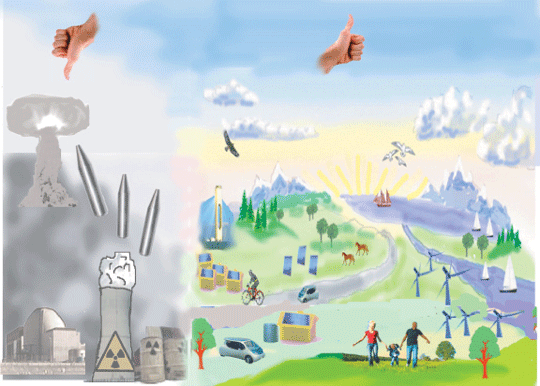
While daunting financial and bureaucratic challenges mean it will still be a while before Alaskan LNG flows to Kyoto, the agreement represents a step forward for Kyoto to achieve a larger goal: ending prefectural dependence on nuclear power by 2040.
The strategy, as outlined by Kyoto Gov. Keiji Yamada, calls for building up LNG facilities at Maizuru and installing new LNG pipelines in the Kansai region. The prefecture envisions Maizuru supplying not only Kyoto, but other prefectures in the region with gas to replace Fukui Prefecture’s nuclear power plants as a major source of electricity.
Kyoto is not alone in seeking to replace atomic power with a combination of LNG imports and renewable energy. As of the end of 2014, more than 600 local governments nationwide had declared their intent to be nuclear-free, although not all of have set specific dates like Kyoto, and many lack a strategic plan for achieving that goal.
Yamada listed several reasons why the prefecture needs to end its usage of nuclear power, which comes mostly from 11 Kansai Electric Power Co. reactors in neighboring Fukui……..
Kyoto and Hyogo, along with Osaka Gas, Kepco, and the Ministry of Economy, Trade and Industry, agreed in early September to formally research the cost of building an LNG pipeline from Maizuru to Sanda, Hyogo Prefecture, that could then supply other parts of Kansai and likely lead to other localities needing less nuclear power. http://www.japantimes.co.jp/news/2015/10/25/national/kyoto-advances-nuclear-free-agenda-alaska-lng-pact/#.Vi0_ztIrLGh
1 This Month
Chernobyl: The Lost Tapes – A good documentary on Chernobyl on SBS available On Demand for the next 3 weeks– https://www.sbs.com.au/ondemand/tv-program/chernobyl-the-lost-tapes/2352741955560

of the week–London Campaign for Nuclear Disarmament

Tell the Ukrainian Government to Drop Prosecution of Peace Activist Yurii Sheliazhenko
To see nuclear-related stories in greater depth and intensity – go to https://nuclearinformation.wordpress.com
-
Archives
- April 2026 (114)
- March 2026 (251)
- February 2026 (268)
- January 2026 (308)
- December 2025 (358)
- November 2025 (359)
- October 2025 (376)
- September 2025 (257)
- August 2025 (319)
- July 2025 (230)
- June 2025 (348)
- May 2025 (261)
-
Categories
- 1
- 1 NUCLEAR ISSUES
- business and costs
- climate change
- culture and arts
- ENERGY
- environment
- health
- history
- indigenous issues
- Legal
- marketing of nuclear
- media
- opposition to nuclear
- PERSONAL STORIES
- politics
- politics international
- Religion and ethics
- safety
- secrets,lies and civil liberties
- spinbuster
- technology
- Uranium
- wastes
- weapons and war
- Women
- 2 WORLD
- ACTION
- AFRICA
- Atrocities
- AUSTRALIA
- Christina's notes
- Christina's themes
- culture and arts
- Events
- Fuk 2022
- Fuk 2023
- Fukushima 2017
- Fukushima 2018
- fukushima 2019
- Fukushima 2020
- Fukushima 2021
- general
- global warming
- Humour (God we need it)
- Nuclear
- RARE EARTHS
- Reference
- resources – print
- Resources -audiovicual
- Weekly Newsletter
- World
- World Nuclear
- YouTube
-
RSS
Entries RSS
Comments RSS
 nuclear-news