Climate change is going to cost even more than was predicted
A cliché repeated in some scientific circles suggests that there are three possible responses to climate change: mitigation (the word wonks like to use instead of prevention), adaptation, and suffering.
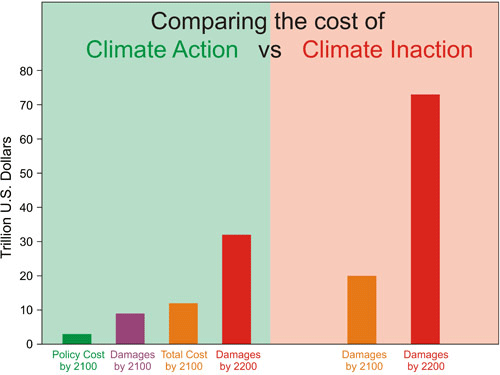
Climate change slams global economy, study from Stanford and Berkeley shows, SMH October 22, 2015 Eric Roston Climate change could cause 10 times as much damage to the global economy as previously estimated, slashing output by as much as 23 per cent by the end of the century, a new research paper from US universities Stanford and Berkeley finds.
Looking at 166 countries between 1960 and 2010, the researchers identified an optimal average annual temperature that coincides with peak productivity. It’s 13 degrees celsius, or approximately the climate of San Francisco’s bay area (Sydney’s mean temperature last year was 19.3 degrees).
Countries in the tropics, already hotter than this optimal temperature, are likely to face the most dramatic economic pain from warming, found the study, published in the latest issue of Nature. Countries at or just past the 13-degree annual average, like the US, China, and Japan, may be increasingly vulnerable to losses as the temperature warms. Northern countries well below the ideal average may see benefits as opportunities open up for agriculture and industry.
But this was the least robust finding. And even if the warming improves the lot of Scandinavia and Canada, such nations may not have many healthy trading partners left as others suffer. Also, higher temperatures in northern countries don’t take into account changes in precipitation, more extreme weather, and the many other risks in a warming world.
The authors made a clever end run around the biggest problem at the core of climate science: There’s only one Earth. Scientists usually like to run “controls,” situations that have identical conditions to the experiment except for the one thing being studied. Unfortunately for climate scientists, there’s no second Earth, filled with identical people doing identical things, where greenhouse gas emissions aren’t a problem.
So the study looks at national temperature records through time. Instead of studying a warming Nigeria and a control Nigeria, the scientists compared Nigerian economic output in average years with that in warming years………..
A dramatically higher damage function changes the cost/benefit analysis and makes potential policies that looked expensive yesterday much cheaper by comparison.
Another takeaway from the study is that over the last six decades, economies haven’t adapted well to hotter temperatures. “We’re optimistic on adaptation and its long-run potential,” Burke said. “Looking historically, we don’t see a lot of evidence that we’re good at that.”
A cliché repeated in some scientific circles suggests that there are three possible responses to climate change: mitigation (the word wonks like to use instead of prevention), adaptation, and suffering.
If the new study means our mitigation efforts are even weaker than previously thought, and we don’t have a proven track record of adaptation, are we setting ourselves up for suffering?
“That’s exactly right,” Burke said. “That’s exactly right.” http://www.smh.com.au/business/the-economy/climate-change-slams-global-economy-study-from-stanford-and-berkeley-shows-20151022-gkfl07.html#ixzz3pcaEBLtj
No comments yet.
1 This Month

of the week – Shut Down Drone Warfare!


Tell the Ukrainian Government to Drop Prosecution of Peace Activist Yurii Sheliazhenko

Petition to revoke the licensing of the Near Surface Nuclear Disposal Facility (NSDF) at Chalk River. https://www.ourcommons.ca/petitions/en/Petition/Details?Petition=e-7247
To see nuclear-related stories in greater depth and intensity – go to https://nuclearinformation.wordpress.com
-
Archives
- March 2026 (244)
- February 2026 (268)
- January 2026 (308)
- December 2025 (358)
- November 2025 (359)
- October 2025 (376)
- September 2025 (257)
- August 2025 (319)
- July 2025 (230)
- June 2025 (348)
- May 2025 (261)
- April 2025 (305)
-
Categories
- 1
- 1 NUCLEAR ISSUES
- business and costs
- climate change
- culture and arts
- ENERGY
- environment
- health
- history
- indigenous issues
- Legal
- marketing of nuclear
- media
- opposition to nuclear
- PERSONAL STORIES
- politics
- politics international
- Religion and ethics
- safety
- secrets,lies and civil liberties
- spinbuster
- technology
- Uranium
- wastes
- weapons and war
- Women
- 2 WORLD
- ACTION
- AFRICA
- Atrocities
- AUSTRALIA
- Christina's notes
- Christina's themes
- culture and arts
- Events
- Fuk 2022
- Fuk 2023
- Fukushima 2017
- Fukushima 2018
- fukushima 2019
- Fukushima 2020
- Fukushima 2021
- general
- global warming
- Humour (God we need it)
- Nuclear
- RARE EARTHS
- Reference
- resources – print
- Resources -audiovicual
- Weekly Newsletter
- World
- World Nuclear
- YouTube
-
RSS
Entries RSS
Comments RSS
 nuclear-news
Leave a comment