Radiation and cancer: to USA’s NRC it’s PR not science, that counts
Instead of treating cancer as a scientific issue, the nuclear industry treats it as a PR challenge. Frequent attempts are made to trivialize the dangers of radiation. Often this involves the Radiation- Is-Everywhere tactic complete with ludicrous examples (“It’s just like eating a banana,” or “It’s just like flying to Denver”). They like to show how little radiation is in an average X-ray but they are careful not to mention that radioactive exposure is cumulative: every dose adds.
The dirty little secret of the nuclear industry is that all NPP regularly discharge radiation into the environment. Nuclear power plants cannot operate without these discharges, and the NRC sets standards for what is allowable.
The push by the nuclear industry to block cancer research demonstrates their true colors.
 NRC Blocks Cancer Study Near San Onofre and other Nuclear Power Plants http://voiceofoc.org/2015/10/nrc-blocks-cancer-study-near-san-onofre-and-other-nuclear-power-plants/
By Roger Johnson October 14, 2015 Do the regular radioactive emissions from nuclear power plants (NPP) increase the risk of cancer? No one knows for sure whether living near a NPP can cause cancer, but on Sept. 8 the Nuclear Regulatory Commission (NRC) terminated a study designed to find out. It would have been carried out by the prestigious National Academy of Sciences which spent 5 years planning the study.
One of the six locations chosen for study was our own San Onofre. The medical records of everyone living within 31 miles of San Onofre (a circle from Huntington Beach around to Solana Beach) would have been part of the study. The research proposal is entitled Analysis of Cancer Risks in Populations near Nuclear Facilities.
The NRC logo is “Protecting People and the Environment” but many wonder if it should read “Protecting the Nuclear 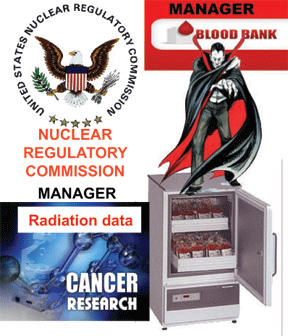 Industry and Its Profits.”
The NRC said it could not afford the $8 million, but no one swallows this since the NRC has an annual budget of over $1 billion (90 percent of which comes from the industry it is supposed to be regulating).
The NRC also said that it already knows the answer: low-level radiation coming from NPP is harmless. It continues to cite a now thoroughly discredited study by the National Cancer Institute (NCI) which examined this issue a quarter of a century ago and failed to find cancer streaks. The nuclear industry prefers this study because it likes the results.
We now know that the NCI study failed because it studied only cancer deaths, not incidence, and it studied only where people died, not where they lived or worked. It also averaged people living very near a NPP with those who lived far away. Also worrisome are recent studies in Europe which discovered that children who live near a NPP double their risk of cancer. The NAS is well-aware of this and designed part of the study to focus on children.
Instead of treating cancer as a scientific issue, the nuclear industry treats it as a PR challenge. Continue reading
Fukushima insect study shows there is no safe low level of ionising radiation
 The researchers found that caterpillars that ate radioactive leaves pupated into mutated butterflies that did not live as long, compared with caterpillars that ate non-radioactive leaves. These mutations and increased mortality were seen even in butterflies that consumed only very small doses of radioactive cesium.
Deaths and mutations spike around Fukushima; no safety threshold for radioactive cesium exposure http://theunhivedmind.com/wordpress3/deaths-and-mutations-spike-around-fukushima-no-safety-threshold-for-radioactive-cesium-exposure/October 16, 2015 theunhivedmind Deaths and mutations spike around Fukushima; October 16, 2015 by: David Gutierrez, staff writer
http://www.naturalnews.com/051581_fukushima_radiation_nuclear_power.html
Plants in the area around Fukushima, Japan are widely contaminated with radioactive cesium, which is 
producing mutation and death in local butterflies, according to a study conducted by researchers from the University of the Ryukyus, Okinawa and published in the journal Scientific Reports.
The butterflies were found to experience severe negative effects at all detectable radiation levels, even very low ones.
“We conclude that the risk of ingesting a polluted diet is realistic, at least for this butterfly, and likely for certain other organisms living in the polluted area,” the researchers wrote.
Insects hard hit
The researchers note that although the 2011 meltdown of the Fukushima Daiichi Nuclear Power Plant released “a massive amount of radioactive materials … into the environment,” few studies have looked at the biological effects of this disaster. Researchers have, however, measured elevated radiation levels in the polluted area, and have chronicled the accumulation of radioactive material in both wild and domestic plant and animal life in the region.
Studies have also suggested that insects may be particularly hard-hit by the increased radiation. One study found an increase in morphological abnormalities (physical deformities) in gall-forming aphids. Another found that insect abundance has decreased in the affected region, particularly butterfly abundance. Continue reading
1 This Month
Chernobyl: The Lost Tapes – A good documentary on Chernobyl on SBS available On Demand for the next 3 weeks– https://www.sbs.com.au/ondemand/tv-program/chernobyl-the-lost-tapes/2352741955560

of the week–London Campaign for Nuclear Disarmament

Tell the Ukrainian Government to Drop Prosecution of Peace Activist Yurii Sheliazhenko
To see nuclear-related stories in greater depth and intensity – go to https://nuclearinformation.wordpress.com
-
Archives
- April 2026 (152)
- March 2026 (251)
- February 2026 (268)
- January 2026 (308)
- December 2025 (358)
- November 2025 (359)
- October 2025 (376)
- September 2025 (257)
- August 2025 (319)
- July 2025 (230)
- June 2025 (348)
- May 2025 (261)
-
Categories
- 1
- 1 NUCLEAR ISSUES
- business and costs
- climate change
- culture and arts
- ENERGY
- environment
- health
- history
- indigenous issues
- Legal
- marketing of nuclear
- media
- opposition to nuclear
- PERSONAL STORIES
- politics
- politics international
- Religion and ethics
- safety
- secrets,lies and civil liberties
- spinbuster
- technology
- Uranium
- wastes
- weapons and war
- Women
- 2 WORLD
- ACTION
- AFRICA
- Atrocities
- AUSTRALIA
- Christina's notes
- Christina's themes
- culture and arts
- Events
- Fuk 2022
- Fuk 2023
- Fukushima 2017
- Fukushima 2018
- fukushima 2019
- Fukushima 2020
- Fukushima 2021
- general
- global warming
- Humour (God we need it)
- Nuclear
- RARE EARTHS
- Reference
- resources – print
- Resources -audiovicual
- Weekly Newsletter
- World
- World Nuclear
- YouTube
-
RSS
Entries RSS
Comments RSS
 nuclear-news