World Medical Association calls for ban and elimination of nuclear weapons
|
|
World Medical Association (WMA) Statement on Nuclear Weapons
Adopted 17 October 2015
- The WMA Declarations of Geneva, of Helsinki and of Tokyo make clear the duties and responsibilities of the medical profession to preserve and safeguard the health of the patient and to consecrate itself to the service of humanity. The WMA considers that it has a duty to work for the elimination of nuclear weapons.
- Therefore the WMA:
2.1 Condemns the development, testing, production, stockpiling, transfer, deployment, threat and use of nuclear weapons;
2.2 Requests all governments to refrain from the development, testing, production, stockpiling, transfer, deployment, threat and use of nuclear weapons and to work in good faith towards the elimination of nuclear weapons;
2.3 Advises all governments that even a limited nuclear war would bring about immense human suffering and substantial death toll together with catastrophic effects on the earth’s ecosystem, which could subsequently decrease the worlds food supply and would put a significant portion of the world’s population at risk of famine; and
2.4 Requests that all National Medical Associations join the WMA in supporting this Declaration, use available educational resources to educate the general public and to urge their respective governments to work towards the elimination of nuclear weapons.
2.5 Requests all National Medical Associations to join the WMA in supporting this Declaration and to urge their respective governments to work to ban and eliminate nuclear weapons.
The meaning of the Iran Nuclear Deal

 Adopting The Iran Nuclear Deal: What Does It Mean?, NPR, OCTOBER 18, 2015 Today marks 90 days since the United Nations Security Council endorsed the landmark nuclear accord agreed between Iran and six world powers (the U.S., Britain, France, Germany China and Russia.)
The Joint Comprehensive Plan of Action (JCPOA)will unfold in a series of steps that include nuclear cutbacks made by Iran and sanctions relief offered by the other countries. The phase that begins now is of special interest to nuclear non-proliferation experts.
Those wanting to keep Iran, or any nation, from newly acquiring nuclear weapons will be very happy to see the steps Tehran has pledged to begin taking now. They will greatly shrink the capacity and scope of the Iranian nuclear program, in ways that sharply limit its ability to produce the kind of nuclear fuel that could be used in a weapon.
Less Enrichment, Tinier Fuel Stockpile, No Plutonium
Under the JCPOA, Iran will now:
Reduce its stockpile of low enriched uranium b y some 98 percent, either shipping it out of the country or diluting it down to its natural state. (Low enriched uranium, usually less than 5 percent purity, is suitable for generating electricity. At about 20 percent, enriched uranium has uses in medical research; Iran has agreed not to enrich uranium to that level for 15 years. Weapons grade uranium is enriched to around 90 percent.)
- Explaining The Past, And Inviting Tougher Inspections This phase of the agreement should also see Iran answering long-held questions by the International Atomic Energy Agency (IAEA) about Iran’s past nuclear activities. Last week, the IAEA announced that Iran had completed responding to IAEA queries on 12 such activities that could have possible military dimensions. The agency is due to report its finding on these issues on December 15th………..
- What About Sanctions Relief?When Iran marks the nuclear deal with events on Monday, it will be focusing on the lifting of international economic sanctions that have depressed its economy, along with falling oil prices. But sanctions relief won’t come until the IAEA certifies that Iran has met all its nuclear obligations. Once that happens, there will be another milestone, known as “implementation day.”…… http://www.npr.org/sections/thetwo-way/2015/10/18/449652662/adopting-the-iran-nuclear-deal-what-does-it-mean
Precious Groundwater in Drought Areas Threatened by Uranium Mining
Why Are We Allowing Uranium Miners to Pollute Groundwater in Drought Zones?

 Uranium mining threatens aquifers that could provide the drought-stricken West with emergency water supplies. BRIAN PALMER OCT 16, 2015 Mining uranium, the fuel for nuclear reactors, is a dirty business. Following World War II, mining companies extracted millions of tons of uranium from Navajo tribal lands in the West, contaminating homes and water supplies in the process. It went on for decades, and Navajo miners developed lung cancer at very high rates.
Today, even as the United States nuclear power industry struggles to survive, uranium mining continues. The techniques are more modern, but conservationists say the threat could be just as insidious: polluting water supplies in drought-ridden parts of the country where drinking water is already alarmingly scarce.
New rules proposed by the federal government last year could help reduce the threat—although industry is fighting to weaken them, along with its Republican allies in Congress. And critics say the proposed regulations might not be strong enough anyhow. Ironically, this might all be happening to extract a resource we barely need anymore—at the risk of one that we most certainly do……..
The industry must now work with what geologists call “roll-fronts.” These are relatively thin uranium deposits that formed deep underground over the course of thousands of years. Typically just 10 to 30 feet in height—too small to be harvested by human miners—the roll-fronts can only be extracted by chemical means.
The process used today is called in situ recovery, or ISR, mining. (Opponents use the more chemically descriptive phrase “in situ leaching,” or ISL.) The mining company drills four or five holes, called injection wells, and then pumps down a mix of an oxidizing agent (often hydrogen peroxide or simple oxygen) and water. Pressure from the constant influx of fluid forces the solution to percolate through the uranium-rich layer of Earth toward another hole, called the production well, which carries it up to the surface. At this point, the company reverses the chemical reaction that dissolved the uranium, using a separate chemical to precipitate the metal out of the water. The water, now stripped of most of the uranium, heads back into the well to continue the cycle…….

In reality, ISR mining isn’t so tidy, and the few peer-reviewed studies available suggest that leaching uranium out of rocks contaminates the surrounding groundwater for decades. As Western states deal with increasing levels of drought, that’s a problem…….
Remediation is water- and time-intensive, but does it work? The answer is pretty disturbing: No one knows. There have been only a handful of major studies on the efficacy of the uranium-mining remediation process. Continue reading
A year later, uncertainty over management of Vermont Yankee’s radioactive trash
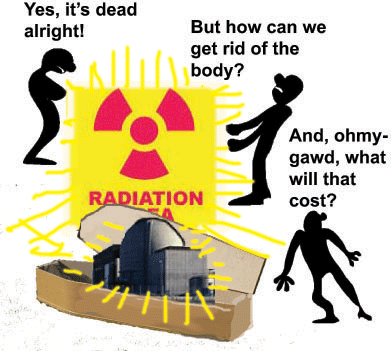 Nearly A Year After Shutdown, Vermont Yankee Continues To Spark Debate http://digital.vpr.net/post/nearly-year-after-shutdown-vermont-yankee-continues-spark-debate#stream/0By JANE LINDHOLM & SAM GALE ROSEN • OCT 12, 2015 Almost a year after its shutdown, the Vermont Yankee nuclear power plant is still sparking debate over safety, spending and the disposal of nuclear waste.
Vermont Edition spoke to Susan Smallheer, a reporter with theRutland Herald, about what’s been happening since the Vermont Yankee nuclear power plant shut down last December, as well as the back and forth between Entergy Corporation and the state of Vermont as mediated by the Nuclear Regulatory Commission.
On what’s currently happening at the plant
Entergy is putting a majority of buildings in what is called “safe and dark” mode, and demolishing minor buildings. Ultimately, they are preparing to transfer fuel from the spent pool into a facility that will begin construction in 2016.
“That will hold the spent nuclear from Vermont Yankee until the year 2052, when Entergy is expecting the Department of Energy to take away the fuel,” says Smallheer.
Uncertainties arise when discussing where this spent fuel will be held next. Vermont and Vermont Yankee have a contract with a Texas facility, owned privately by Waste Control Specialists, which holds a federal permit until 2045. According to filings that Entergy has made with the NRC, Vermont Yankee does not expect to begin deconstruction until 2068.
“Vermont Yankee has to be demolished, decommissioned and decontaminated before the waste can be shipped to Texas,” says Smallheer.
On how decommissioning funds are being spent
A point of contention for the state and Entergy is how Entergy Vermont Yankee is spending money from the decommissioning trust fund, which had reached approximately $660 million as of the shutdown.
“Now it’s down to about $600 million,” says Smallheer. “Yankee has made quite a few withdrawals with this so-called 30-day notification to the NRC, which is how the state of Vermont learns about it.”
The state claims that Entergy is not providing enough information on how these funds are being spent. “Vermont has a very vested interest in not only getting the plant decommissioned as quickly as possible, because Entergy said they’ll start decommissioning as long as there’s adequate funds in the decommissioning trust fund, but because whatever’s leftover goes back to Vermont ratepayers who started the fund,” says Smallheer.
“[The state] needs to know how [Entergy] is spending it, and if they can say it’s being spent wisely,” says Smallheer.
The planet-saving, capitalism-subverting, surprisingly lucrative investment secrets of Al Gore.
 The former vice president has led his firm to financial success. But what he really wants to do is create a whole new version of capitalism. …
The most sweeping way to describe this undertaking is as a demonstration of a new version of capitalism, one that will shift the incentives of financial and business operations to reduce the environmental, social, political, and long-term economic damage being caused by unsustainable commercial excesses.
http://www.theatlantic.com/magazine/archive/2015/11/the-planet-saving-capitalism-subverting-surprising ly-lucrative-investment-secrets-of-al-gore/407857/ & http://www.environmentalhealthnews.org/t/5035451945376812038
Video: Nuclear (a)toll? Tony de Brum, the Foreign Minister of the Marshall Islands
Video: Nuclear (a)toll? Tony de Brum, the Foreign Minister of the Marshall Islands https://www.rt.com/shows/worlds-apart-oksana-boyko/318982-nuclear-toll-disarmament-policy/Published time: 18 Oct, 2015 The tiny Pacific nation of the Marshall Islands experienced more than a decade of US nuclear testing, equivalent to 1.6 Hiroshima blasts per day, every day, for 12 years. Can the enormous nuclear, and now political fallout serve as an impetus for global nuclear disarmament? And will climate change and rising sea levels render the islands radioactive and uninhabitable before 2050? Oksana is joined by Tony de Brum, the Foreign Minister of the Marshall Islands, to take a shot at these issues.
Massachusetts opportunity to expand renewable energy, with Pilgrim nuclear to close
Mass. Mulls Future Without Nuclear, Valley News By Steve LeBlanc Associated Press Sunday, October 18, 2015 Boston — The announcement last week by the owners of the Pilgrim Nuclear Power Station that they plan to shutter the plant by June 2019 because of rising maintenance costs has thrust the state’s energy future — particularly the low-carbon variety — to the top of the policy heap on Beacon Hill…..
Gov. Charlie Baker also has waded into the debate. Even before Pilgrim made its announcement, Baker had two filed bills aimed at the state’s energy future.
One would encourage Massachusetts utilities to enter into long-term contracts with renewable energy producers. Baker said the proposal is aimed at helping the state tap into Canadian hydropower.
The second bill would raise existing caps on the state’s “net metering” program that allows homeowners, businesses and local governments to sell excess solar power they generate back to the electrical grid for credit.
The Massachusetts Senate has passed a bill to lift the net-metering caps and create a new solar incentive program when the state reaches its goal of 1,600 megawatts of installed solar capacity by 2020.
Baker said Pilgrim’s planned closing could also spur action on his push for hydropower……
Baker said the anticipated 2019 closure of Pilgrim gives the state time to make the transition.
“In the short term, I think our focus ought to be on the safety issues and on making sure that we plan accordingly for all the people who work there,” he said. http://www.vnews.com/news/state/region/19060938-95/mass-mulls-future-without-nuclear
1 This Month
Chernobyl: The Lost Tapes – A good documentary on Chernobyl on SBS available On Demand for the next 3 weeks– https://www.sbs.com.au/ondemand/tv-program/chernobyl-the-lost-tapes/2352741955560

of the week–London Campaign for Nuclear Disarmament

Tell the Ukrainian Government to Drop Prosecution of Peace Activist Yurii Sheliazhenko
To see nuclear-related stories in greater depth and intensity – go to https://nuclearinformation.wordpress.com
-
Archives
- April 2026 (152)
- March 2026 (251)
- February 2026 (268)
- January 2026 (308)
- December 2025 (358)
- November 2025 (359)
- October 2025 (376)
- September 2025 (257)
- August 2025 (319)
- July 2025 (230)
- June 2025 (348)
- May 2025 (261)
-
Categories
- 1
- 1 NUCLEAR ISSUES
- business and costs
- climate change
- culture and arts
- ENERGY
- environment
- health
- history
- indigenous issues
- Legal
- marketing of nuclear
- media
- opposition to nuclear
- PERSONAL STORIES
- politics
- politics international
- Religion and ethics
- safety
- secrets,lies and civil liberties
- spinbuster
- technology
- Uranium
- wastes
- weapons and war
- Women
- 2 WORLD
- ACTION
- AFRICA
- Atrocities
- AUSTRALIA
- Christina's notes
- Christina's themes
- culture and arts
- Events
- Fuk 2022
- Fuk 2023
- Fukushima 2017
- Fukushima 2018
- fukushima 2019
- Fukushima 2020
- Fukushima 2021
- general
- global warming
- Humour (God we need it)
- Nuclear
- RARE EARTHS
- Reference
- resources – print
- Resources -audiovicual
- Weekly Newsletter
- World
- World Nuclear
- YouTube
-
RSS
Entries RSS
Comments RSS
 nuclear-news