Closure of Pilgrim nuclear station opens a new era of costly, dangerous, radioactive trash clean-up
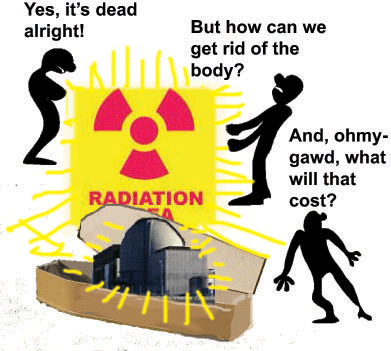 Decommissioning Pilgrim could take decades, millions Boston Globe By Nestor Ramos and David Abel GLOBE STAFF OCTOBER 13, 2015 Shutting off the power at a nuclear plant takes only a few minutes. But decommissioning one — safely removing and storing dangerous radioactive material and closing down the plant for good — can take decades.
In announcing Tuesday that it planned to close the Pilgrim Nuclear Power Station, owner Entergy Corp. revealed few details about how it plans to decommission its aging plant in Plymouth, rated among the least safe in the country. But recent history at nuclear plants in New England and beyond suggests that the process could be long, contentious and cost hundreds of millions of dollars.
Entergy has 60 years to close the plant, according to Nuclear Regulatory Commission guidelines, and that clock may not even start running until 2019, the year by which the company plans to cease operations at Pilgrim. That means it could be 2079 before radioactivity is reduced to safe levels — the ultimate goal of decommissioning.
Company officials say Pilgrim shouldn’t take that long. “We don’t intend to wait until 60 years,” said Bill Mohl, president of Entergy Wholesale Commodities, which oversees most of its nuclear plants.
Still, decommissioning any nuclear power plant takes time. Giant industrial edifices such as the reactor, where the fuel generates heat that is converted to steam, would be difficult to dismantle even if they were not brittle and dangerously radioactive. Radioactive nuclear fuel must remain in storage pools for years after the plant has ceased to generate power.
And even after the fuel is stowed in giant canisters called dry casks, deciding where to store the nuclear waste is still tied up by debate in Washington, and remains years away.
“It’s going to take years in any event,” said Geoffrey Fettus, a senior attorney at the Natural Resources Defense Council. “It’s very complicated, very expensive industrial cleanup.”
Under federal guidelines, operators have options for decommissioning a plant: They can decontaminate and remove all radioactive material as soon as possible; leave the plant largely intact as the remaining radiation dissipates; or do some combination of the strategies.
Entergy did not announce Tuesday which path it would take at Pilgrim. But work can’t begin until there’s enough money in Pilgrim’s federally mandated trust fund to ensure it can shutter the plant. Mohl said the company is trying to determine how much decommissioning Pilgrim will cost.
The decommissioning trust fund had a balance of approximately $870 million as of Sept. 30, Mohl said — $240 million more than the company is legally required to have at this time, but $380 million less than the estimated $1.25 billion cost to decommission Entergy’s Vermont Yankee plant.
At Vermont Yankee, which ceased operations last December, the company’s decommission plan largely calls for leaving the plant intact and keeping radioactive material onsite, a strategy known as SAFSTOR.
Under that plan, the company will spend about five years removing the radioactive waste from the plant’s spent-fuel pools — water-filled chambers 40 or more feet deep that contain the intense heat and high levels of radiation generated by the fuel rods. Once cool enough to be moved, the fuel will be placed in dry casks — massive, reinforced canisters weighing more than 300,000 pounds that are designed to vent amounts of radiation so small they are not considered harmful. They will be left on storage pads somewhere on the plant’s property.
And there the spent fuel will remain, until the federal government finds a suitable location to store it. That could take decades: The Obama administration ended funding for Nevada’s planned Yucca Mountain Nuclear Waste Repository in 2011, and no long-term storage site for the waste from nuclear reactors currently exists………https://www.bostonglobe.com/metro/2015/10/13/safely-decommissioning-pilgrim-nuclear-power-plant-could-take-decades/Vs8ZpFyvWFMmT7i99gA8xK/story.html
No comments yet.
1 This Month
Chernobyl: The Lost Tapes – A good documentary on Chernobyl on SBS available On Demand for the next 3 weeks– https://www.sbs.com.au/ondemand/tv-program/chernobyl-the-lost-tapes/2352741955560

of the week–London Campaign for Nuclear Disarmament

Tell the Ukrainian Government to Drop Prosecution of Peace Activist Yurii Sheliazhenko
To see nuclear-related stories in greater depth and intensity – go to https://nuclearinformation.wordpress.com
-
Archives
- April 2026 (139)
- March 2026 (251)
- February 2026 (268)
- January 2026 (308)
- December 2025 (358)
- November 2025 (359)
- October 2025 (376)
- September 2025 (257)
- August 2025 (319)
- July 2025 (230)
- June 2025 (348)
- May 2025 (261)
-
Categories
- 1
- 1 NUCLEAR ISSUES
- business and costs
- climate change
- culture and arts
- ENERGY
- environment
- health
- history
- indigenous issues
- Legal
- marketing of nuclear
- media
- opposition to nuclear
- PERSONAL STORIES
- politics
- politics international
- Religion and ethics
- safety
- secrets,lies and civil liberties
- spinbuster
- technology
- Uranium
- wastes
- weapons and war
- Women
- 2 WORLD
- ACTION
- AFRICA
- Atrocities
- AUSTRALIA
- Christina's notes
- Christina's themes
- culture and arts
- Events
- Fuk 2022
- Fuk 2023
- Fukushima 2017
- Fukushima 2018
- fukushima 2019
- Fukushima 2020
- Fukushima 2021
- general
- global warming
- Humour (God we need it)
- Nuclear
- RARE EARTHS
- Reference
- resources – print
- Resources -audiovicual
- Weekly Newsletter
- World
- World Nuclear
- YouTube
-
RSS
Entries RSS
Comments RSS
 nuclear-news
Leave a comment