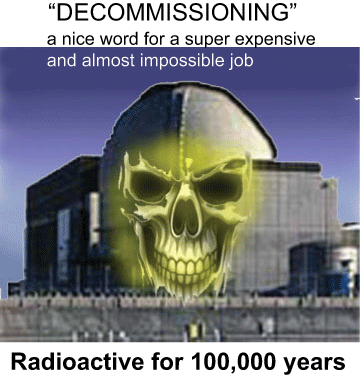
New York nuclear stations can’t afford costly shutdowns – so prolong decommissioning

 New York nuclear plants phase out, challengingly http://www.capitalnewyork.com/article/albany/2015/10/8579839/new-york-nuclear-plants-phase-out-challengingly One doesn’t have look hard in New York and throughout the region to see that the nuclear power industry has hit a rough patch.
The James FitzPatrick nuclear plant in Oswego County may be closing. The Ginna plant is on life support. Gov. Andrew Cuomo says he wants to close Indian Point.
Those closings and potential closings, combined with closure of Vermont Yankee in December and the announcement this month that Pilgrim in Massachusetts would be shuttered, herald what nuclear experts say is a denouement to the story of nuclear power in the United States.
“I would call it an organic phaseout,” said Mycle Schneider, a nuclear consultant based in Paris, during a conference at the New York Society for Ethical Culture on Thursday. “Nuclear’s position is threatened by a number of factors.”
Among those threats, he and others said, are the increasing costs of safely providing nuclear power, stagnant demand, a decrease in electricity use, and “ferocious competitors,” including natural gas and renewable power.
The question for state and federal regulators becomes how to safely and efficiently retire the nation’s nuclear fleet, a task infinitely more complex than getting rid of a typical power plant. Continue reading
Radioactive trash ship on its way to Australia, despite safety concerns
 Ship carrying nuclear waste heads to Australia, West Australian CHERBOURG, AFP October 16, 2015 A ship carrying 25 tonnes of reprocessed nuclear waste is steaming to Australia despite protests from activists about an “environmental disaster waiting to happen”.
The BBC Shanghai left the northern French port of Cherbourg after approval from local officials, who carried out an inspection on Wednesday, and is due to arrive by the end of the year in NSW. It is laden with radioactive waste from spent nuclear fuel that Australia sent to France for reprocessing in four shipments in the 1990s and early 2000s, the Australian Nuclear Science and Technology Organisation says.
The reprocessing involves removing uranium, plutonium and other materials, with the remaining substances stabilised in glass and stored in a container…….
Greenpeace, French environmental campaign group Robin des Bois (Robin Hood) and a leading Greens MP have called for the shipment, sent by Areva, to be halted. “Areva, almost bankrupt, are using a dustbin ship to carry waste, without any serious inspection!” Denis Baupin a senior MP with the French green party, tweeted.
Greenpeace Australia Pacific said the ship, owned by German firm BBC Chartering, was an “environmental disaster waiting to happen”, claiming the Shanghai was “blacklisted by the United States because of its safety record”……
But Areva’s external relations director, Bernard Monnot, said the ship was “not banned from ports in the United States but banned from transporting material for the American government”.
Nathalie Geismar from Robin des Bois said other ports had found it had a “staggering number of flaws”……
ANSTO said the material would be kept at the Lucas Heights facility in southern Sydney until a nuclear waste dump site, which has yet to be chosen, is found and constructed……https://au.news.yahoo.com/thewest/a/29834316/ship-carrying-nuclear-waste-heads-to-australia/
Nuclear power facilities not up to date with today’s cyber threats
 Unheeded cybersecurity threat leaves nuclear power stations open to attack , The Conversation, Nasser Abouzakhar October 17, 2015 There has been a rising number of security breaches at nuclear power plants over the past few years, according to a new Chatham House reportwhich highlights how important systems at plants were not properly secured or isolated from the internet.
As critical infrastructure and facilities such as power plants become increasingly complex they are, directly or indirectly, linked to the internet. This opens up a channel through which malicious hackers can launch attacks – potentially with extremely serious consequences. For example, a poorly secured steel mill in Germany was seriously damaged after being hacked, causing substantial harm to blast furnaces after the computer controls failed to shut them down. The notorious malware, theStuxnet worm, was specifically developed to target nuclear facilities.
The report also found that power plants rarely employ an “air gap” (where critical systems are entirely disconnected from networks) as the commercial and practical benefits of using the internet too often trump security…….
The problem is that the industrial communication protocols and mechanisms still commonly used in nuclear power plants were designed in an era before the internet and cyber-threats were a consideration. These are often insecure and not designed to deal with such challenges. Most of the legacy communication protocols such as Profibus, DNP3 andOPC are still vulnerable to various attacks as they lack any proper authentication techniques.
This means that all a malicious hacker might need to get inside a nuclear power station’s network is Google. Using search terms relevant to the software in use in the plant, Google can turn up direct links to websites leading into its network – with little or no security in the way…… https://theconversation.com/unheeded-cybersecurity-threat-leaves-nuclear-power-stations-open-to-attack-49258
Concerns over Japan’s huge stockpile of weapons grade nuclear material

 China calls on Japan to address world concerns on excessive nuclear stocks http://news.xinhuanet.com/english/2015-10/15/c_134717556.htm BEIJING, Oct. 15 (Xinhua) — China on Thursday called for action from Japan to defuse concerns over its excess of nuclear materials as both Chinese and U.S. think tanks expressed worry in recent reports.
“The international community has always been concerned about Japan’s stockpile of enriched uranium and the risks relating to nuclear proliferation and safety,” Foreign Ministry spokesperson Hua Chunying said.
“The reports suggest there are ways to resolve the surplus nuclear material issue,” she said at a regular news briefing, calling on Japan to be responsible and act to address the international community’s concerns.
The stockpile puts Japan, its neighbors and the world at risk, a joint study by China Arms Control and Disarmament Association and the China Institute of Nuclear Information and Economics said on Friday.
“If, in future, a different country started to stockpile — could be enriched uranium, it could be plutonium — that country could cite Japan as a precedent,” said James Acton, author of a new report on Japan’s reprocessing policy at the Carnegie Endowment for International Peace think tank.
The Chinese study suggests Japan should make a rational plan for its nuclear consumption and address the imbalance, while ensuring the safety and security of these materials.
Citing the latest data from the Japanese government submitted to the International Atomic Energy Agency (IAEA), the Chinese study found Japan has 47.8 tonnes of highly sensitive separated plutonium, 10.8 tonnes of which are stored in Japan, enough to make 1,350 nuclear warheads.
UK Labour worried that China nuclear deal could undermine national security
Nuclear deals with China could endanger UK national security, says Labour, Guardian, Rowena Mason and Frances Perraudin, 17 Oct 15 Shadow energy secretary Lisa Nandy says PM has questions to answer after concerns emerge from intelligence agencies David Cameron has serious questions to answer about whether Chinese investment in nuclear power would endanger national security, Labour’s shadow energy secretary Lisa Nandy has said.
Nandy called on the government to reassure the public after reports that the intelligence agencies have concerns that possible Chinese investments in Hinkley Point and Sizewell could pose a threat to the UK.
Osborne has held up the prospect of a new golden relationship with China ahead of Xi’s visit and was praised by Chinese state-owned media last month for not pushing the issue of human rights.
In contrast, Jeremy Corbyn, the Labour leader, is hoping to use the official state banquet at Buckingham Palace to raise China’s human rights record, after reports that more than 100 lawyers, journalists and other government critics were detained in a crackdown in early July. http://www.theguardian.com/environment/2015/oct/16/nuclear-deals-with-china-could-endanger-uk-national-security-says-labour
Hinkley deal raises fears about China’s power over Britain’s nuclear project
 Security fears over China nuclear power deal, BBC News, 17 Oct 15 Downing Street is playing down security fears about plans to give China a stake in Britain’s nuclear power industry.
A final decision on the new nuclear plant at Hinkley Point, Somerset, could be announced next week during Chinese president Xi Jinping’s state visit.
Security sources have told The Times the scheme poses a threat to national security – and a senior Tory MP has called for an inquiry.
But No 10 said it would not sign the deal if it thought security was a risk.
Chancellor George Osborne has already announced a £2bn government guarantee to secure Chinese funding for the Hinkley Point C nuclear power station, to be jointly built with French energy giant EDF at an estimated cost of £24.5bn.
The final go-ahead for the deal could be announced next week – paving the way for a second new reactor to built by the Chinese and French consortium at Sizewell, in Suffolk.
If an agreement is reached, work could then start on the first Chinese-designed and built nuclear reactor in Europe, at Bradwell, in Essex, where a previous British-built reactor is in the process of being decommissioned.
How concerned should we be?………….
Construction of the first Hualong One reactor began in May in China’s Fujian province, according to World Nuclear News.
Gaining regulatory approval from the UK authorities for the design would be a major boost to the Chinese National Nuclear Corporation’s hopes of exporting the technology around the world.
‘Trapdoors or backdoors’
But senior UK defence and security sources reportedly are concerned that the state-controlled company, which helped develop China’s nuclear weapons, poses a national security risk.
They fear “trapdoors or backdoors” could be inserted into IT systems, allowing Beijing to bypass British security measures……..
‘Fait accompli’
Bernard Jenkin, Conservative MP for Harwich and North Essex, where the Bradwell plant would be built, has called for the government to produce a “comprehensive assessment of the national security implications” of the Chinese scheme……..http://www.bbc.com/news/uk-politics-34549478
Austria’s legal action against EU approval of Hinkley nuclear project
|
InfoCuria – Case-law of the Court of Justice Action brought on 6 July 2015 — Austria v Commission
(Case T-356/15) Language of the case: German Parties Applicant: Republic of Austria (represented by: C. Pesendorfer, Agent, and H. Kristoferitsch, lawyer) Defendant: European Commission Form of order sought The applicant claims that the Court should: annul Commission Decision (EU) 2015/658 of 8 October 2014 on the aid measure SA.34947 (2013/C) (ex 2013/N) which the United Kingdom is planning to implement for support to the Hinkley Point C nuclear power station (notified under document C(2014) 7142); order the Commission to pay the costs. Pleas in law and main arguments In support of the action, the applicant relies on ten pleas in law. |
Australian Aboriginal women renew their long hard fight against nuclear waste dumping
Aboriginal women reaffirm fight against nuclear waste dump in South Australia ABC Radio National, The World Today By Natalie Whiting 16 Oct 15 The first shipment of Australia’s nuclear waste to be returned from re-processing in France has now left a French port, and will arrive on our shores by the end of the year. The return of the 25 tonnes of nuclear waste is putting renewed pressure on the Federal Government to find a location for a permanent waste dump.
The shipment began its journey just a day after senior Aboriginal women gathered in Adelaide to mark their fight against a proposed dump in South Australia in the 1990s.
The women say they will fight against any new move to put the waste on their land…..
SA Aboriginal women remember waste dump victory A Federal Government plan to build a
 nuclear waste dump in the South Australian outback in 1998 attracted fierce opposition, especially among local Aboriginal people.
An event in Adelaide last night celebrated the work of a group of women called kupa piti kungka tjuta, who campaigned against the dump. Emily Austin from Coober Pedy was one of them. (centre in picture)
The women campaigned for six years until a Federal Court challenge from the South Australian government put an end to the dump. Ms Austin said she could remember the day the court found in South Australia’s favour.
“I was out in the bush hunting and I heard it on the radio in the Toyota. We were all screaming, ‘We won’.
“All the kungkas (women) were happy.”
While the Federal Government is in the midst of a voluntary process for finding a site for a dump, South Australia’s outback is still seen as an ideal location.
The South Australian Government’s attitude to the industry has been shifting.
It has launched a royal commission to investigate possible further involvement in the nuclear fuel cycle.The royal commission is looking at everything from mining uranium, processing, waste storage and nuclear power.
The organiser of last night’s event, Karina Lester, is the granddaughter of one of the women who campaigned and her father was blinded by the British nuclear tests at Maralinga half a century ago.
She said the Aboriginal people in South Australia’s north have a long and tortured history with the nuclear industry. “Maralinga’s had a huge impact because people speak from first-hand experience,” she said.
“People like the amazing kupa piti kungka tjuta, many of those old women who are no longer with us today, they were there the day the ground shook and the black mist rolled.
“It’s an industry that doesn’t sit comfortably with Anungu community.”
Ms Lester said it was good to see the royal commission consulting with people before a decision is made.”Credit to the royal commission that they’ve made an effort to engage with a broader community of Aboriginal communities,” she said.
“But how many of those Anangu are really understanding he technicality of this royal commission and what industry really means?” Ms Austin said she was ready to fight any future attempts to set up a waste dump in the region.
“Oh yeah, I’ve still got fight yet. They might stop yet, they might listen, I dunno,” she said. http://www.abc.net.au/news/2015-10-16/aboriginal-women-fight-against-nuclear-waste-dump-in-sa/6861012
South Africa; court action to stop nuclear procurement

 Court bid to stop SA nuclear procurement http://citizen.co.za/820348/court-bid-to-stop-sa-nuclear-procurement/Paperswere lodged with the Cape High Court this week in an application against Energy Minister Tina Joemat-Pettersson and President Jacob Zuma, aimed at stopping the country’s nuclear procurement programme.
Environmental group Earthlife Africa and the South African Faith Communities Environment Institute (SAFCEI) on Thursday announced that it had lodged an application in this regard. Other respondents are the National Energy Regulator (Nersa), Chairperson of the National Council of Provinces and the Speaker of the National Assembly. No relief is sought against these three.
The applicants, however, need money for what is expected to be a long and costly fight against government. They currently have less than R1 million available for legal costs and are busy raising more funds.
The South African government is preparing for a nuclear power procurement programme based on the 2010 Integrated Resource Plan (IRP) that suggests the country will need 9 600MW nuclear generation capacity by 2030. Details about which State entity will implement the project and the structure of the procurement process are however still unknown and there is much concern about the affordability of nuclear power.
The applicants argue in their papers that Joemat-Pettersson has failed to put the necessary processes in place to ensure that the nuclear procurement is conducted lawfully and meets the requirements of the Constitution for a fair, equitable, transparent, competitive and cost-effective process.
“Notwithstanding the vast sums of money to be committed, and the potentially long-term effect on the economy and for consumers of electricity and present and future generations of South Africans, the decision to proceed with procuring these nuclear power plants (the so called nuclear fleet), and to have concluded such procurement in the next few months, has occurred without any of the necessary statutory and constitutional decisions having been lawfully taken,” the applicants argue.
They are challenging the legality of the inter-governmental agreements between South Africa and Russia, the US and Korea, respectively. These agreements were held by the Department of Energy to be done in preparation of the actual procurement.
They are asking the court to set these agreements aside and, among other things, challenge certain decisions by Joemat-Pettersson, in consultation with Nersa, prior to making the formal determination about the amount of nuclear capacity the country needs.
They maintain a fair, equitable, transparent, cost-effective and competitive procurement process cannot take place in the current circumstances and are seeking a declaratory order in this regard.
In terms of the court rules Joemat-Pettersson and President Zuma have ten days to file opposing papers.
SAFCEI spokesperson Liziwe McDaid said the organisation does not support the notion that the country needs base load energy with coal and nuclear being the only viable options. She said a mix of renewable energy technologies as well as gas, but excluding fracking, is more appropriate.
It will be a mistake to lock the country into unaffordable nuclear projects that are in actual fact outdated technology, she said. Decommissioning of the country’s older coal-fired power stations will begin in about ten years’ time. During this period huge strides may be made with regard to technological solutions for the storage of renewable energy and that will be a better replacement for the coal-fired fleet than nuclear, she said.
Brought to you by Moneyweb
Global warming could cause disappearance of vast Alpine glacier
Vast Alpine glacier could almost vanish by 2100 due to warming, Reuters, Reporting by Alister Doyle; Editing by Frances Kerry GREAT ALETSCH GLACIER, SWITZERLAND | BY DENIS BALIBOUSE One of Europe’s biggest glaciers, the Great Aletsch, coils 23 km (14 miles) through the Swiss Alps – and yet this mighty river of ice could almost vanish in the lifetimes of people born today because of climate change.
The glacier, 900 meters (2,950 feet) thick at one point, has retreated about 3 km (1.9 miles) since 1870 and that pace is quickening, as with many other glaciers around the globe.
That is feeding more water into the oceans and raising world sea levels…….
even the Great Aletsch glacier, the biggest in the Alps and visible from space, is under threat from the build-up of greenhouse gases in the atmosphere from factories, power plants and cars that are blamed for global warming.

Andreas Vieli, a professor who heads the University of Zurich’s group of glaciology experts, said the Aletsch may lose 90 percent of its ice volume by 2100, with the lower reaches melting away.
“My kids are going to see a very different scenery in the Alps,” he said.
And on the ice, Aletsch guide Richard Bortis said, “if I stay on the glacier for several days … I can even see the changes myself.”
The glacier is a vast water reserve, important for irrigation and hydroelectric power……For glaciers around the globe, from the Andes to Alaska, rising temperatures mean that the volume lost from the summer melt exceeds snows that replenish the glaciers’ ice in winter. The Aletsch flows downhill at about 180 meters (590 feet) a year.
The World Glacier Monitoring Service says “the rates of early 21st-century mass loss are without precedent on a global scale” at least since measurements began around 1850.
Representatives from almost 200 governments will meet in Paris from Nov. 30-Dec. 11 to try to agree ways to curb greenhouse gas emissions.
The United Nations’ panel of climate scientists says sea levels are set to rise by between 26 and 82 cm (10 and 31 inches) by the late 21st century, after a gain of about 20 cm (8 inches) since 1900, partly fed by water from melting glaciers. Rising oceans are a threat to places from San Francisco to Shanghai, to low-lying Pacific atolls and large parts of Bangladesh…… http://www.reuters.com/article/2015/10/15/us-climatechange-summit-earthprints-swit-idUSKCN0S914A20151015
Climate change already impacting Bangladesh coastal communities
Rising salinity threatens Bangladesh’s coastal communities – experts Source: Thomson Reuters Foundation – Tue, 13 Oct 2015 Author: Pantho Rahaman Reporting by Pantho Rahaman; editing by Jumana Farouky and Laurie Goering -the Thomson Reuters Foundation, the charitable arm of Thomson Reuters, that covers humanitarian news, climate change, women’s rights, trafficking and corruption. Visitwww.trust.org/climate
“……..Climate change-induced alterations to sea level, temperature and rainfall are affecting freshwater supplies in low-lying coastal areas around the world, scientists and environmentalists say.
With more than a quarter of its population living in 19 districts facing or near the Bay of Bengal, Bangladesh is especially vulnerable, they say.
If access to fresh water continues to decrease at current rates in Bangladesh, experts warn, the country faces worsening drinking and irrigation water scarcity in the next few decades.
“Left unattended, 2.9 million to 5.2 million poor (people) in southwest coastal Bangladesh will face serious river salinity problems by 2050,” said Susmita Dasgupta, the lead environmental economist of the World Bank’s research department, in an email interview.
A DIRE PICTURE
A study by the World Bank and Bangladesh’s Institute of Water Modelling (IWM) published last year paints a dire picture of the future of freshwater supplies for the country’s coastal communities.
In a worst case scenario, the study predicts that the area served by freshwater rivers – those whose salt levels measure less than 1 part per thousand – in the country’s 19 coastal districts will drop from 41 percent to 17 percent by 2050.
Researchers believe sea-level rise, rising temperatures, changing rainfall patterns and a reduction of water flow in the country’s rivers could add to river salinity.
Losing freshwater could mean “significant shortages of drinking water” and a lack of irrigation water for dry-season agriculture, the study said.
“The impact of the increase in salinity is already being felt by the local communities, as they now have to purchase water from water treatment plants run by commercial operators,” said Ainun Nishat, a noted Bangladeshi environmentalist and one of the researchers on the World Bank study.
A dramatic decrease in the area served by freshwater rivers would also do damage to the region’s fishing industry, which supports approximately a half million families, researchers said…..
Of Bangladesh’s 19 southwestern coastal districts, the study pinpointed nine already in danger of being unable to protect their freshwater resources.
Even in the best case, by 2050 four districts – Barguna, Jhalokoti, Khulna, and Patuakhali – may no longer have regular access to fresh water from rivers. And in a worst-case scenario, Pirojpur district could lose 100 percent of its fresh river water, while Bagerhat and Barisal could lose over 90 percent, the study said.
In addition, the study said, five districts will suffer a serious shortage of water for dry-season agriculture.
“This worrying change might lead to a migration of people from southwestern Bangladesh,” Nishat said……http://www.trust.org/item/20151013101601-r0cyw/?source=jtDontmiss
This week’s nuclear/climate news, with a focus on ionising radiation
 Try as I may, I can’t seem to make this weekly news roundup shorter. I don’t expect that people will read it all, or go to all links. However, just the 3 top links here are very much worth reading. They deal with the subject of ionising radiation. On October 7 Dr Helen Caldicott is speaking at Sydney Universityon this subject. Meanwhile the global nuclear lobby is intensifying its propaganda lie that ionising radiation is harmless.
- Three Nobel Prize winners calculated the genetic damage of nuclear energy.
- Biological Consequences of Nuclear Disasters: From Chernobyl to Fukushima.
- Film ‘The Martian” gets it really wrong about ionising radiation.
CLIMATE CHANGE. Narrow window of opportunity to prevent rapid drastic fall in Antarctic ice sheets.
IRAN. IAEA has completed its investigation of Iran’s nuclear past. Nuclear deal approved by Iran Parliament.
USA.
- ‘New Nuclear” lobby wants to weaken USA’s safety regulations.
- USA’s nuclear industry staggers to its tomb, as Pilgrim Station shuts down. Financial facts were the killer. Closure of Pilgrim nuclear station opens a new era of costly, dangerous, radioactive trash clean-up.
- Threat of out of control fire to radioactive trash site. Is the Missouri Landfill Fire a US Chernobyl or Fukushima in the Making?
- Burial of radioactive trash at San Onofre? NOT a good idea.
- The fight to preserve pure water in Nebraska from uranium mining contamination.
- Move for Grand Canyon Monument that would ban uranium mining.
- Dramatic fall in price of solar electricity.
UK. Together Against Sizewell C (TASC) plan legal action against Hinkley nuclear power project. Britain fawns over Xi Jinping – preparatory to China taking over UK’s nuclear industry . Security concern over China’s involvement in UK’s nuclear project Overwhelming costs of Britain’s Trident nuclear submarines – cannot be measured. How UK govt helped the nuclear industry hide the truth on the Fukushima catastrophe.
FRANCE. Nuclear energy falls from France’s pride and joy, to its expensive source of woe.
SWEDEN shutting down 2 nuclear reactors.
JAPAN. No evacuation plan, yet PM Abe restarts another Sendai nuclear reactor. Second nuclear reactor started at Sendai, despite public opposition. Anxious about 2020 Olympics, Tepco to hasten ice wall project at Fukushima nuclear station.
SOUTH KOREA. Expansion of South Korea’s massive Kori Nuclear Power Plant near 3.4 million people – an insane plan.
INDIA. Record low price for solar power to be sold by Indian Government.
CHINA keen to market nuclear technology overseas.
KENYA. Remote Kenya will be connected to grid with Africa’s larges wind farm.
Closure of Pilgrim nuclear station opens a new era of costly, dangerous, radioactive trash clean-up
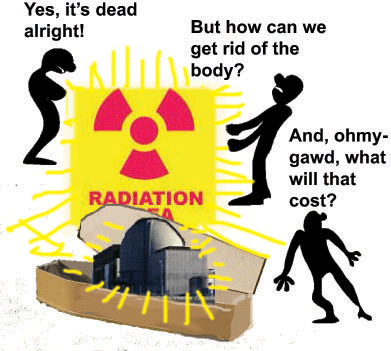 Decommissioning Pilgrim could take decades, millions Boston Globe By Nestor Ramos and David Abel GLOBE STAFF OCTOBER 13, 2015 Shutting off the power at a nuclear plant takes only a few minutes. But decommissioning one — safely removing and storing dangerous radioactive material and closing down the plant for good — can take decades.
In announcing Tuesday that it planned to close the Pilgrim Nuclear Power Station, owner Entergy Corp. revealed few details about how it plans to decommission its aging plant in Plymouth, rated among the least safe in the country. But recent history at nuclear plants in New England and beyond suggests that the process could be long, contentious and cost hundreds of millions of dollars.
Entergy has 60 years to close the plant, according to Nuclear Regulatory Commission guidelines, and that clock may not even start running until 2019, the year by which the company plans to cease operations at Pilgrim. That means it could be 2079 before radioactivity is reduced to safe levels — the ultimate goal of decommissioning.
Company officials say Pilgrim shouldn’t take that long. “We don’t intend to wait until 60 years,” said Bill Mohl, president of Entergy Wholesale Commodities, which oversees most of its nuclear plants.
Still, decommissioning any nuclear power plant takes time. Giant industrial edifices such as the reactor, where the fuel generates heat that is converted to steam, would be difficult to dismantle even if they were not brittle and dangerously radioactive. Radioactive nuclear fuel must remain in storage pools for years after the plant has ceased to generate power.
And even after the fuel is stowed in giant canisters called dry casks, deciding where to store the nuclear waste is still tied up by debate in Washington, and remains years away.
“It’s going to take years in any event,” said Geoffrey Fettus, a senior attorney at the Natural Resources Defense Council. “It’s very complicated, very expensive industrial cleanup.” Continue reading
Together Against Sizewell C (TASC) plan legal action against Hinkley nuclear power project
 Anti-nuclear group legal threat against Hinkley power plant, http://www.westernmorningnews.co.uk/Anti-nuclear-group-legal-threat-Hinkley-power/story-27984093-detail/story.html By WMN_PGoodwin October 14, 2015 Britain’s first new nuclear power station for 20 years, in Somerset, will waste billions of pounds without solving the country’s energy needs, a new report claims.
Hinkley Point C is expected to supply 7% of the UK’s electricity needs – powering around six million homes – and create thousands of jobs locally and more widely in the nuclear industry across the UK. The £20 billion scheme could get the green light next week when Chinese president Xi Jinping arrives in London on a state visit which could see a massive investment in the reactor agreed.
French state-owned energy firm EDF, who are behind the project, and the British Government have been hoping the president will visit the site which has been prepared next to the two existing nuclear power stations on the Bristol Channel.
TASC is threatening to take legal action if the Government fails to review its national policy statements for energy. Using data from the Department for Energy and Climate Change (DECC) the TASC study says every alternative to nuclear would “without exception” be an improvement, costing less, preventing power cuts, causing less pollution and meeting emissions targets.
Local campaign Stop Hinkley welcomed publication. Spokesman Roy Pumfrey added: “There are plenty of ways of providing our energy needs which are cheaper than any Government scenario for energy involving nuclear power.“The total savings to the UK economy of going for much more energy saving instead could be very large indeed and more successfully reduce greenhouse gases and provide energy security. “Nuclear power only hampers the achievement of these objectives.”
The construction came a step closer last month when Chancellor George Osborne approved an initial Government guarantee worth £2 billion for the proposed plant during a visit to China. Mr Osborne said that new nuclear power was “essential” to ensure the lights stay on as ageing nuclear and coal plants are retired.
Sweden shutting down 2 nuclear reactors
 Sweden’s Oskarshamn 1 and 2 reactor units to close World Nuclear News, 14 October 2015 German utility Eon has decided that units 1 and 2 of the Oskarshamn nuclear power plant in Sweden will be shut down permanently. Unit 3 is unaffected by the decision, which was announced today by OKG AB, of which the EOn group is the major shareholder…..The announcement followed an extraordinary shareholders’ meeting held earlier today and is in line with the “policy decision” EOn communicated in July. According to that policy, EOn said unit 1 would close between 2017 and 2019 and unit 2 by 2020……
There will be no future investments at unit 2 and the reactor will not be restarted. Operation of unit 1 will proceed in accordance with the established plan, meaning a decision on its shutdown will be made when the time schedule for the decommissioning phase has been prepared. The exact date when the unit will be permanently shut down is thus not yet established……
Earlier this month, the European Court of Justice ruled that Sweden can continue to tax nuclear power production, deciding that the levy does not fall within the scope of two European Council Directives and is therefore a national, rather than European Commission, matter. OKG AB had first contested the tax in 2009 in the Swedish courts….
1 This Month
Chernobyl: The Lost Tapes – A good documentary on Chernobyl on SBS available On Demand for the next 3 weeks– https://www.sbs.com.au/ondemand/tv-program/chernobyl-the-lost-tapes/2352741955560

of the week–London Campaign for Nuclear Disarmament

Tell the Ukrainian Government to Drop Prosecution of Peace Activist Yurii Sheliazhenko
To see nuclear-related stories in greater depth and intensity – go to https://nuclearinformation.wordpress.com
-
Archives
- April 2026 (139)
- March 2026 (251)
- February 2026 (268)
- January 2026 (308)
- December 2025 (358)
- November 2025 (359)
- October 2025 (376)
- September 2025 (257)
- August 2025 (319)
- July 2025 (230)
- June 2025 (348)
- May 2025 (261)
-
Categories
- 1
- 1 NUCLEAR ISSUES
- business and costs
- climate change
- culture and arts
- ENERGY
- environment
- health
- history
- indigenous issues
- Legal
- marketing of nuclear
- media
- opposition to nuclear
- PERSONAL STORIES
- politics
- politics international
- Religion and ethics
- safety
- secrets,lies and civil liberties
- spinbuster
- technology
- Uranium
- wastes
- weapons and war
- Women
- 2 WORLD
- ACTION
- AFRICA
- Atrocities
- AUSTRALIA
- Christina's notes
- Christina's themes
- culture and arts
- Events
- Fuk 2022
- Fuk 2023
- Fukushima 2017
- Fukushima 2018
- fukushima 2019
- Fukushima 2020
- Fukushima 2021
- general
- global warming
- Humour (God we need it)
- Nuclear
- RARE EARTHS
- Reference
- resources – print
- Resources -audiovicual
- Weekly Newsletter
- World
- World Nuclear
- YouTube
-
RSS
Entries RSS
Comments RSS
 nuclear-news