Germany says nuclear utilities can pay for decommissioning reactors
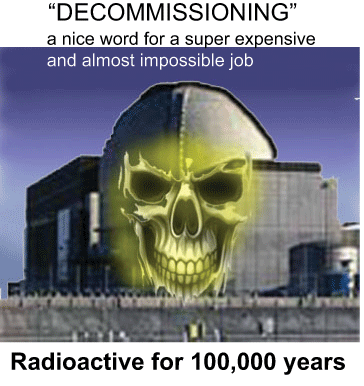 Germany Says Utilities’ Reserves Adequate for Nuclear-Power http://www.wsj.com/articles/germany-says-utilities-reserves-adequate-for-nuclear-power-exit-1444464002 Exit In wake of Fukushima, country plans to exit nuclear power by 2022 By STEFAN LANGE And MONICA HOUSTON-WAESCH Oct. 10, 2015 FRANKFURT—German utilities’ reserves for the country’s planned exit from nuclear power are adequate, the ministry for economics and energy said, citing a government-commissioned report on the matter.
“The affected companies have fully covered the costs with the designated provisions,” economics minister Sigmar Gabriel said in a statement.
The Federal Ministry of Economic Affairs and Energy had called for the stress test to determine whether utilities’ reserves are up to the task of financing nuclear waste and the decommissioning of plants. In the wake of the Fukushima disaster in 2011, Chancellor Angela Merkel said Germany would exit nuclear power by 2022, taking utilities by surprise. In the interim, politicians have voiced concern that nuclear operators could try to duck the long-term costs, leaving taxpayers with the bill.
Existing reserves for the country’s nuclear exit amount to €38.3 billion, the report said. In a worse-case scenario, costs could come to as much as €77 billion, however this assumes an average interest rate of a negative 1.6% until the year 2099, a highly unlikely event, the report noted.
Utilities have said that since the government supported the construction of nuclear facilities, it should also participate in dismantling them. Earlier this month, the economics ministry dashed those hopes.
“There will be no state assistance,” a ministry spokeswoman said on Oct. 5.
Separately, Germany’s cabinet is due to pass a draft law within days, giving utilities longer-lasting liabilities for the costs of a nuclear exit. In mid-September, shares of RWE AG and E.ON SE, the two largest utilities in the country, plummeted over 10% amid speculation that initial results of the test showed utilities’ reserves were inadequate. At the time, Mr. Gabriel said no preliminary results were available, and that the stress test was just one factor of many in determining future policy.
At the end of 2014, E.ON had earmarked €16.6 billion, while RWE set aside €10.4 billion in reserves for the nuclear exit.
“In real terms, these are the highest provisions for an asset like this on the planet,” E.ON chief executive Johannes Teyssen said in September following his company’s decision to retain its German nuclear operations. E.ON has three nuclear plants in operation and minority stakes in a number of others.
Mr. Teyssen made the comments after the company scrapped plans to shift its nuclear operations to a new company, Uniper. E.ON will proceed with plans to split, moving conventional power, trading and exploration and production to Uniper, but E.ON will keep its German nuclear operations, it said. At the time, the company also said it expected a substantial net loss for the full year.
Write to Stefan Lange at stefan.lange@wsj.com and Monica Houston-Waesch at nikki.houston@wsj.com
No comments yet.
1 This Month

of the week – Shut Down Drone Warfare!


Tell the Ukrainian Government to Drop Prosecution of Peace Activist Yurii Sheliazhenko

Petition to revoke the licensing of the Near Surface Nuclear Disposal Facility (NSDF) at Chalk River. https://www.ourcommons.ca/petitions/en/Petition/Details?Petition=e-7247
To see nuclear-related stories in greater depth and intensity – go to https://nuclearinformation.wordpress.com
-
Archives
- April 2026 (103)
- March 2026 (251)
- February 2026 (268)
- January 2026 (308)
- December 2025 (358)
- November 2025 (359)
- October 2025 (376)
- September 2025 (257)
- August 2025 (319)
- July 2025 (230)
- June 2025 (348)
- May 2025 (261)
-
Categories
- 1
- 1 NUCLEAR ISSUES
- business and costs
- climate change
- culture and arts
- ENERGY
- environment
- health
- history
- indigenous issues
- Legal
- marketing of nuclear
- media
- opposition to nuclear
- PERSONAL STORIES
- politics
- politics international
- Religion and ethics
- safety
- secrets,lies and civil liberties
- spinbuster
- technology
- Uranium
- wastes
- weapons and war
- Women
- 2 WORLD
- ACTION
- AFRICA
- Atrocities
- AUSTRALIA
- Christina's notes
- Christina's themes
- culture and arts
- Events
- Fuk 2022
- Fuk 2023
- Fukushima 2017
- Fukushima 2018
- fukushima 2019
- Fukushima 2020
- Fukushima 2021
- general
- global warming
- Humour (God we need it)
- Nuclear
- RARE EARTHS
- Reference
- resources – print
- Resources -audiovicual
- Weekly Newsletter
- World
- World Nuclear
- YouTube
-
RSS
Entries RSS
Comments RSS
 nuclear-news
Leave a comment