UK’s Hinkley C nuclear plan is not only a financial disaster: it fails on other counts too

 Hinkley C’s claimed benefits evaporate under scrutiny http://www.theecologist.org/blogs_and_comments/commentators/2985648/hinkley_cs_claimed_benefits_evaporate_under_scrutiny.html Paul Dorfman 6th October 2015 To explain their desperation to commit an estimated £76 billion of public money to the Hinkley C nuclear project, writes Paul Dorfman, the Treasury and its Chancellor, George Osborne, claim there are other benefits that justify this vast expenditure. So what exactly are they? And do the claims survive critical examination?
So much has been written about the plan to build two new EDF reactors at Hinkley Point that you might think that it’s all been said [1].
So far, the main focus has been on the cost of the thing – but money is really only just part this nuclear deadlock.
Of course, Osborne knows Hinkley is much, much too expensive. That battle has been fought, and he lost it some time ago.
But the real nuclear war has just begun – as, when pushed, Osborne, the Treasury and DECC all say that the big picture is really about a rats nest of issues facing the UK energy market.
These are: security of supply; diversity of supply; decarbonisation – all set in the context of electricity price stability and affordability. So let’s take a look at each in turn and see if any make sense – just to make sure.

Security of supply
Osborne says that we need a secure supply of nuclear baseload electricity. But Steve Holliday, CEO of National Grid, the company that operates the power transmission networks in the UK and in the northeastern US, says the idea of large nuclear power stations to be used for baseload power is outdated:
“The world is clearly moving towards much more distributed electricity production and towards microgrids. The pace of that development is uncertain. That depends on political decisions, regulatory incentives, consumer preferences, technological developments. But the direction is clear.” [2]
And unlike Germany, who are cutting consumption, Osborne’s energy policy is based on the assumption that there will be increasing energy supply demand. But is he really unaware that since 2005 overall energy use in the UK has fallen by 18%?
Just in the last year, even while GDP grew by 2.8%, energy sales fell by 6.6%. In fact, we are now using 5% less energy than 50 years ago, even though our wealth has practically tripled. So serious energy efficiency policy scenarios show that the UK economy could flourish whilst using significantly less energy.
Osborne says that Hinkley is needed to ‘stop the lights going out’ – yet any ‘generation gap’ is already forecast by Ofgem before 2020. So the real security of supply challenge happens well before Hinkley could begin generation.
Putting aside the inevitable construction cost and time over-runs, the fact is that Hinkley wont make it on-time to help with our security of supply problem – since, according to EDF, it’s not supposed to come on-line until 2024 at the very earliest, and that date is looking more and more optimistic.
And there’s a misconception that all except one of the UK’s eight nuclear power plants will be closed in 2024. Rather, EDF, the owner of most of them, say that five of their seven operating UK reactors will continue to 2027-31 and even longer.
Diversity of supply
There is good evidence to predict that UK onshore wind and PV will be at zero operational cost by 2025, and offshore wind will have a far lower operational cost than nuclear [3]. In response, Osborne says he doesn’t prefer nuclear, its just that he needs it for a balanced portfolio of power sources.
But the flip side to investment in Hinkley is low investment in renewable energy generation. This is because the government Levy Control Framework imposes a strict cap on low carbon energy financed from the public purse (from levies on the bills of energy consumers) [4].
And because the government will be contractually obliged to provide on-going State Aid for the incredibly long 35 year Hinkley contract, there will simply be very little money left over for renewables – as the Levy Control Framework budget will have been already consumed by nuclear.
So Hinkley will crowd out investment in renewables. Greedy nuclear will have ‘eaten all the pies’ before renewables get a look in, and progress towards achieving overall targets for low-carbon renewable energy will inevitably falter.
All this being so (which it is), we can see why the government has been chopping and slashing at UK renewable funding, and why there is widespread concern at the failure to consider a purposeful energy efficiency stimulus for real diversity of supply.
Decarbonisation
Ramping climate change means we need to de-carbonise quickly. Osborne has reframed nuclear as a response to climate change. But Hinkley, together with its radioactive waste stores, including spent fuel, will be sited on the coast, increasingly vulnerable to sea-level rise, flooding and storm surge from climate change.
Sorry to say that, as the UK Institute of Mechanical Engineers state: “Nuclear sites based on the coastline may need considerable investment to protect them against rising sea levels, or even abandonment or relocation in the long term.” [5]
Osborne maintains that nuclear is low-carbon. Yet serious analysis shows that, factoring in the full nuclear life-cycle from uranium mining, through transport, fuel enrichment, plant construction and operation, decommissioning and waste management, nuclear CO2 emissions have a mean value of 66g CO2e/kWh.
That’s significantly higher than for wind (2,8-7,4 g/kWhel), hydropower (17-22 g/kWhel), photovoltaic (19-59 g/kWhel), and energy efficiency measures (which are at least ten times more cost effective) [6].
Affordability and price stability
Osborne says Hinkley is good value. But it’s difficult to comprehend how Hinkley might contribute to affordability, price stability and least-cost for the UK energy consumer.
In fact, Hinkley would be the most expensive piece of nuclear kit ever built [7], and the agreed price for its electricity must inevitably lead to significantly higher prices for the UK energy consumer [8].
However, it does remain true that the deal would prove very profitable to French and Chinese nuclear corporations during the lengthy 35-year Contract period, including the very generous proposals for an inflation-indexed deal.
Essentially, all this means that the Government is willing to add £19 billion to the deficit, and will impose £2 billion/year on the energy bills of hardworking families in order to support Chinese and French state owned industries provided wholesale electricity prices do not fall, in which case the imposition on bills will be even greater.
Signed, sealed, delivered?
Osborne says he will sign a deal with the Chinese President Xi JinPing in late October 2015. But there are problems for the boyish Chancellor. The governments of Austria and Luxembourg, and six German Stadtwerke have launched a legal challenge through the EC Court of Justice [9].
They say that UK nuclear State Aid subsidies runs counter to EU Law. Whatever the outcome, based on the average time-spans of similar cases, this legal action is likely to delay Hinkley for three to four years [10]. In any event, how on earth can any real decision about Hinkley be made when it’s subject to a serious European governmental law suit?
Also, it’s become clear that EDF have been aware for some time of critical anomalies in the EPR reactor planned for Hinkley [11]. France’s nuclear safety regulator, ASN, are still carrying out critical tests on ‘serious’ flaws in the steel housing in the reactor core – and if there’s one place you don’t want any flaws it’s the reactor pressure vessel itself.
So how can Osborne come to any decision about Hinkley before these fundamentally important, critical safety tests are carried out, and the results anaysed?
This means that, for key legal and technical safety reasons, anything Osborne may or may not sign just wont be sealed or delivered. On top of this, it’s clear that Osbornes ‘big arguments’ for Hinkley just don’t stack up. It won’t make a timely contribution to UK security of supply or decarbonisation, and won’t contribute to affordability, price stability and least-cost for the UK energy consumer.
The development of diverse, sustainable and affordable low carbon energy is a growing economic sector with huge potential for job creation in the UK.
To limit this diversity for political face-saving reasons through inflexible and costly support of nuclear power, at the expense of other, more flexible, safe, productive, cost-effective and affordable technologies seems, at the very least, unwise.
Dr Paul Dorfman is Honorary Senior Research Fellow at the Energy Institute, University College London (UCL); Joseph Rowntree Charitable Trust (JRCT) Nuclear Policy Research Fellow; Founder of the Nuclear Consulting Group (NCG); Executive Board Member of the International Nuclear Risk Assessment Group (INRAG).
References
Anxious about 2020 Olympics, Tepco to hasten ice wall project at Fukushima nuclear station
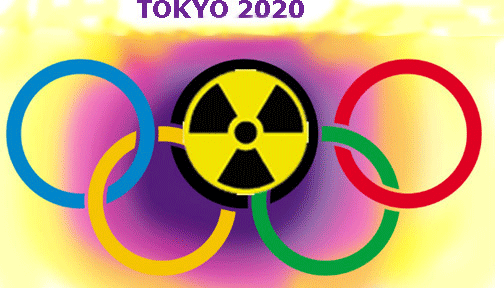 Tepco Expects to Begin Freezing Fukushima Ice Wall by Year End http://www.bloomberg.com/news/articles/2015-10-10/tepco-expects-to-begin-freezing-fukushima-ice-wall-by-year-end Stephen Stapczynski October 10, 2015
-
Aim to resolve contaminated water issue by 2020 Olympics
-
About 300 tons of water a day flow into radioactive reactor
-
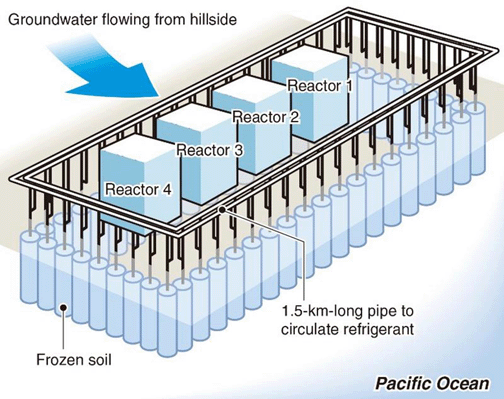
Tokyo Electric Power Co. expects to begin freezing a soil barrier by the end of the year to stop a torrent of water entering the wrecked Fukushima nuclear facility, moving a step closer to fulfilling a promise the Japanese government made to the international community more than two years ago.
“In the last half-year we have made significant progress in water treatment,” Akira Ono, chief of the Fukushima Dai-Ichi plant, said Friday during a tour of the facility north of Tokyo. The frozen wall, along with other measures, “should be able to resolve the contaminated water issues before the Olympic games.”
Solving the water management problems would be a major milestone, but Tokyo Electric is still faced with a number of challenges at the site. The company must still remove highly radioactive debris from inside three wrecked reactors, a task for which no applicable technology exists. The entire facility must eventually be dismantled.
- Currently, about 300 metric tons of water flow into the reactor building daily from the nearby hills. Tepco, as the nation’s biggest utility is called, has struggled to decommission the reactors while also grappling with the buildup of contaminated water.
Even four years after the meltdown and despite promises from policymakers, water management remains one of Tepco’s biggest challenges in coping with the fallout of Japan’s worst nuclear disaster.
The purpose of the ice wall — a barrier of soil 30 meters (98 feet) deep and 1,500 meters long which is frozen to -30 Celsius (-22 Fahrenheit) — is to prevent groundwater from flooding reactor basements and becoming contaminated.
-
Public Trust Needed
“As the radiation levels decrease via natural decay, water management becomes the main issue,” Dale Klein, an independent adviser for Tepco and a former chairman of the U.S. Nuclear Regulatory Commission, said by e-mail. “It is a very important issue for the public, and good water management is needed for Tepco to restore the public’s trust.”
- Tepco is currently testing the freezing system, aiming to have the fence fully operational by the end of December, company spokesman Yuichi Okamura said.
At the moment, the deluge of groundwater entering the reactor buildings is purified, lowering its radioactive content. The water is then stored in one of numerous barrels at the site, each of which can hold 1,000 tons of water.
To make room for the 1,000 or so barrels required to hold the water, Tepco flattened a 500 square meter (5,382 square foot) bird sanctuary on the outskirts of the facility. The company doesn’t have government approval to release the water into the ocean, and there’s no clear plan for its disposal, Tepco’s Okamura said.
- Prime Minister Shinzo Abe promised in 2013 that the government would take the lead in resolving the water management issues at the Fukushima site ahead of the 2020 Tokyo Olympics. Two years later, hundreds of tons of water continue to pour into the reactor building, while tainted water at other parts of the site overflows into the ocean.
Water Overflow
Since January, slightly tainted water has spilled from a drainage system into the ocean on nine occasions, according to company spokeswoman Yukako Handa.
The company aims to end these leaks by reconfiguring a drainage system and building a wall running 30 meters into the seabed. The drainage work will be completed next year, and the sea wall will be completed this month.
The proposed ice wall has never been done on such a scale, and there could be operational issues due to the complicated nature of the project, according to Lake Barrett, former head of the U.S. Department of Energy’s Office of Civilian Nuclear Waste Management.
“Some of these areas may have different freezing and sealing capabilities,” he said by e-mail. “These types of problems were encountered when Tepco tried and failed to seal the seawater trenches by freezing.”
How UK govt helped the nuclear industry hide the truth on the Fukushima catastrophe
 Revealed: British government’s plan to play down Fukushima Internal emails seen by Guardian show PR campaign was launched to protect UK nuclear plans after tsunami in Japan
Internal emails seen by the Guardian show how the business and energy departments worked closely behind the scenes with the multinational companiesEDF Energy, Areva and Westinghouse to try to ensure the accident did not derail their plans for a new generation of nuclear stations in the UK.
“This has the potential to set the nuclear industry back globally,” wrote one official at the Department for Business, Innovation and Skills (BIS), whose name has been redacted. “We need to ensure the anti-nuclear chaps and chapesses do not gain ground on this. We need to occupy the territory and hold it. We really need to show the safety of nuclear.”
Officials stressed the importance of preventing the incident from undermining public support for nuclear power.
The Conservative MP Zac Goldsmith, who sits on the Commons environmental audit committee, condemned the extent of co-ordination between the government and nuclear companies that the emails appear to reveal.
“The government has no business doing PR for the industry and it would be appalling if its departments have played down the impact of Fukushima,” he said.
Louise Hutchins, a spokeswoman for Greenpeace, said the emails looked like “scandalous collusion”. “This highlights the government’s blind obsession with nuclear power and shows neither they, nor the industry, can be trusted when it comes to nuclear,” she said…….
Tom Burke, a former government environmental adviser and visiting professor at Imperial College London, warned that the British government was repeating mistakes made in Japan. “They are too close to industry, concealing problems, rather than revealing and dealing with them,” he said.
“I would be much more reassured if DECC had been worrying about how the government would cope with the $200bn-$300bn of liabilities from a catastrophic nuclear accident in Britain.”……http://www.theguardian.com/environment/2011/jun/30/british-government-plan-play-down-fukushima
Outline of nuclear deal approved by Iran’s parliament
Iran’s parliament approves outline of bill on nuclear deal http://timesofindia.indiatimes.com/world/middle-east/Irans-parliament-approves-outline-of-bill-on-nuclear-deal/articleshow/49314661.cms AP | Oct 11, 2015, TEHRAN, Iran: Iran’s parliament on Sunday approved an outline of a bill that would allow the government to implement a historic nuclear deal reached with world powers, the official IRNA news agency said.
State TV meanwhile announced that Iran had successfully test-fired a new long-range ballistic missile, the first such test since the nuclear deal was reached in July.
The bill allows the government to withdraw from implementing the agreement if world powers do not lift sanctions, IRNA said. Final approval of the bill is expected later this week after further discussions. The landmark deal would curb Iran’s nuclear program in return for the lifting of international sanctions. Western nations have long suspected Iran of secretly pursuing nuclear arms, allegations denied by Tehran, which says its nuclear program is for purely peaceful purposes.
“The government should stop its voluntary cooperation in implementation of the deal if the other side fails to remain committed to lifting sanctions,” the bill says. It says the response should be the same if new sanctions are imposed or previous ones restored.
IRNA said 139 lawmakers out of 253 present voted for the bill. The chamber has 290 seats.
The session was unusually tense, with hard-liners repeatedly trying to prevent a vote on the deal. Iran’s supreme leader, Ayatollah Ali Khamenei, who makes all final decisions on key policies, has said it is up to parliament to approve or reject the deal.
Lawmaker Ruhollah Hosseinian, an opponent of the deal, said parliament needs to discuss it in detail. Until now, it has only been reviewed by a special parliamentary committee.
“Every (international) agreement must be approved and passed by the parliament. Otherwise, it won’t be legal,” Hosseinian said.
Hard-liners hope to stall approval of the deal in order to weaken President Hassan Rouhani’s moderate administration ahead of February’s parliamentary elections.
Iran’s defense minister general Hossein Dehghan meanwhile hailed the new surface-to-surface missile, saying it “will obviously boost the strategic deterrence capability of our armed forces.” He said the missile, named Emad or pillar in Farsi, was a technological achievement for Iran. He said it can be guided until the moment of impact and hit targets “with high precision.”
State TV showed footage of the huge missile being launched in a desert area, but did not elaborate on its range or the specifics of the test.
The UN resolution endorsing the nuclear deal called on Iran not to undertake any activity related to ballistic missiles capable of delivering nuclear weapons. Iran says none of its missiles are designed for that purpose.
Since 1992, Iran has boasted an indigenous military industry, producing missiles, tanks and light submarines. The government frequently announces military advances which cannot be independently verified.
The Islamic Republic already claims to have surface-to-surface missiles with a range of 2,000 kilometers (1,250 miles) that can hit Israel and US military bases in the region.
Long range missile tested by Iran
Iran Tests Long-Range Missile, Possibly Violating Nuclear Accord http://www.nytimes.com/2015/10/12/world/middleeast/iran-tests-long-range-missile-possibly-violating-nuclear-accord.html?_r=0 By THOMAS ERDBRINK OCT. 11, 2015 TEHRAN — Iran tested a new guided long-range ballistic missile on Sunday, hours before Parliament, in a rowdy session, approved the generalities of the nuclear agreement reached in July between Iran and world powers, the state news agency IRNA reported.
The missile launch may have violated the terms of the agreement, reached in Vienna with six world powers. According to some readings of the deal, it placed restrictions on Iran’s ambitious missile program.
Experts have been debating the interpretation of a United Nations Security Council resolution, adopted a few days after the accord was agreed upon, that bars Iran from developing missiles “designed to carry nuclear warheads.”
Hard-line Iranian officials had for months been demanding new missile tests, a common practice before the negotiations over the country’s nuclear program began in 2013.
The missile — named Emad, or pillar — is a step up from Iran’s Shahab-3 missiles because it can be guided toward its target, the Iranian defense minister, Hossein Dehghan, told the semiofficial Fars news agency. In recent decades, with Iran’s air force plagued by economic sanctions and other restrictions, the country has invested heavily in its nuclear program and has produced missiles that can reach as far as Europe.
“We don’t seek permission from anyone to strengthen our defense and missile capabilities,” Mr. Dehghan said.
Also on Sunday, members of Parliament voted in favor of a bill approving the generalities of the nuclear agreement, but they had been denied information on its details. State television broadcast the session using only audio and archived images of Parliament.
The head of the Atomic Energy Organization of Iran, Ali Akbar Salehi, who had gone to Parliament to defend the deal, said in a speech that a member had threatened to kill him and bury his body “in the cement of the Arak heavy-water reactor.”
Under the nuclear agreement, a heavy-water plant in Arak will be redesigned and turned into a relatively less dangerous light-water reactor. The threat, which sounded like something from an American gangster film, was made in front of witnesses by a hard-line representative, Ruhollah Hosseinian, according to reports.
Burial of radioactive trash at San Onofre? NOT a good idea
 Kelly Slater Weighs In on the State Decision to Bury Nuclear Waste at San Onofre, The Inertia,
OCTOBER 9, 2015 Kelly is pissed. And it’s with good reason. Despite widespread opposition, the California Coastal Commission approved on Tuesday the controversial plans to bury 2,700 steel castes of spent nuclear fuel in concrete bunkers 125 feet from the sea wall at San Onofre Beach. One proponent of the project claimed, “I wish that there were other options that were available now, but frankly I don’t see them.” Really? Burying them 125 feet from the water’s edge is the most viable solution? Kelly Slater thinks not:
So they’re planning on burying San-o’s nuclear waste at San-o for the next 20 years. Then what? They really gonna take it ‘away’? To where? At what point will we wake up before the fact and stop listening to people trying to sell Nuclear to the masses claiming it’s the safest and least expensive option? The endgame of this stuff is no joke. It won’t go away during our time on earth. We have the technology to move past this nowadays. Humans are a mess. What we leave in our wake is just a symptom of our ways of thinking. But now back to San onofre…thoughts?
Bill Alley, author of Too Hot to Touch, a book about the problems associated with storing nuclear waste, suggests that it would be much safer to transport the fuel to dry casks rather than leaving it in cooling ponds on site at San Onofre.
“The casks are fine for a couple of decades—certainly better than the pools,” Alley said. “But there’s no solution in the longer term, and that’s what really needs to be worked through.”
Alley and Slater touch on an important note: this is just a temporary solution to a much bigger problem. We must look beyond 20 years if we truly want to safeguard from another disastrous incident. After all, this is precisely the mentality that contributed to the most catastrophic oil and nuclear waste spills. Metal and concrete are NOT indestructible. Period……
With the daunting thought of “The Big One” looming in the minds of California residents, a quick, long-term solution is of the utmost importance. That is, unless we want a repeat of Fukishima, in which case the entire world should be concerned. Let’s do something about this and let’s do it now.

Why is Bill Gates silent on St Louis radioactive scandal ?
Saul Fein 11 Oct 15 Bill Gates is the largest stockholder of Republic Svcs! He has the power to tell Republic to put out the fire and remove the nukes! But he doesn’t, he is silent on the matter! Why?
Ticking time bomb it is without a doubt! If you want to really know what we have to live with every day, for 6 years now,
just come to shop around St Charles Rock Rd near 270/70. You will smell the toxins on any given day! Residents, workers, transients have to deal with it every day yet Republic and EPA say everything’s under control and there’s no health hazard. If that is what their scientific data tells them then I say their “scientific data” is faulty and/or those interpreting the data are idiots! Besides the toxic gases, don’t forget the 150,000 tons of nuclear weapons wastes ( according to the NRC) which has already been proven to have migrated outside the landfill onto private property and into the groundwater beneath the landfill! Please go to West Lake Landfill on Facebook!
Germany says nuclear utilities can pay for decommissioning reactors
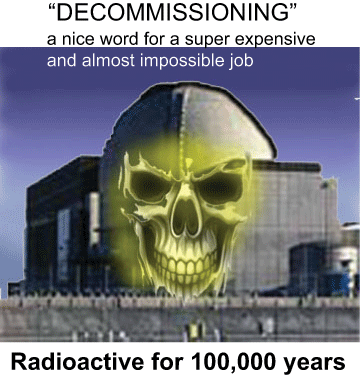 Germany Says Utilities’ Reserves Adequate for Nuclear-Power http://www.wsj.com/articles/germany-says-utilities-reserves-adequate-for-nuclear-power-exit-1444464002 Exit In wake of Fukushima, country plans to exit nuclear power by 2022 By STEFAN LANGE And MONICA HOUSTON-WAESCH Oct. 10, 2015 FRANKFURT—German utilities’ reserves for the country’s planned exit from nuclear power are adequate, the ministry for economics and energy said, citing a government-commissioned report on the matter.
“The affected companies have fully covered the costs with the designated provisions,” economics minister Sigmar Gabriel said in a statement.
The Federal Ministry of Economic Affairs and Energy had called for the stress test to determine whether utilities’ reserves are up to the task of financing nuclear waste and the decommissioning of plants. In the wake of the Fukushima disaster in 2011, Chancellor Angela Merkel said Germany would exit nuclear power by 2022, taking utilities by surprise. In the interim, politicians have voiced concern that nuclear operators could try to duck the long-term costs, leaving taxpayers with the bill.
Existing reserves for the country’s nuclear exit amount to €38.3 billion, the report said. In a worse-case scenario, costs could come to as much as €77 billion, however this assumes an average interest rate of a negative 1.6% until the year 2099, a highly unlikely event, the report noted.
Utilities have said that since the government supported the construction of nuclear facilities, it should also participate in dismantling them. Earlier this month, the economics ministry dashed those hopes.
“There will be no state assistance,” a ministry spokeswoman said on Oct. 5.
Separately, Germany’s cabinet is due to pass a draft law within days, giving utilities longer-lasting liabilities for the costs of a nuclear exit. In mid-September, shares of RWE AG and E.ON SE, the two largest utilities in the country, plummeted over 10% amid speculation that initial results of the test showed utilities’ reserves were inadequate. At the time, Mr. Gabriel said no preliminary results were available, and that the stress test was just one factor of many in determining future policy.
At the end of 2014, E.ON had earmarked €16.6 billion, while RWE set aside €10.4 billion in reserves for the nuclear exit.
“In real terms, these are the highest provisions for an asset like this on the planet,” E.ON chief executive Johannes Teyssen said in September following his company’s decision to retain its German nuclear operations. E.ON has three nuclear plants in operation and minority stakes in a number of others.
Mr. Teyssen made the comments after the company scrapped plans to shift its nuclear operations to a new company, Uniper. E.ON will proceed with plans to split, moving conventional power, trading and exploration and production to Uniper, but E.ON will keep its German nuclear operations, it said. At the time, the company also said it expected a substantial net loss for the full year.
Write to Stefan Lange at stefan.lange@wsj.com and Monica Houston-Waesch at nikki.houston@wsj.com
China keen to market nuclear technology overseas
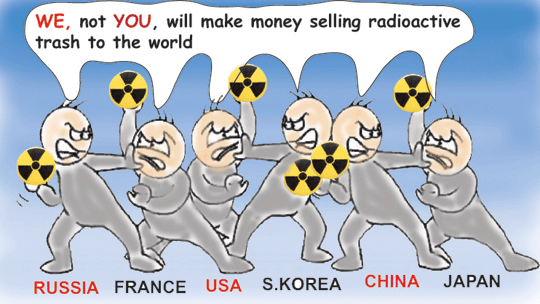
 Eyeing future exports China aims to become world’s top nuclear power producer by 2030 TETSUYA ABE, Nikkei staff writer BEIJING, 10 October 15 — Chinese President Xi Jinping’s government is poised to greatly expand the country’s nuclear power generation, with plans to build six to eight new reactors a year over the next five years.
Under its 13th five-year national development plan, which starts in 2016, China will invest 500 billion yuan ($78.7 billion) to introduce domestically developed reactors. The new five-year plan is to be formally adopted at next spring’s annual session of the National People’s Congress, China’s parliament……….
According to the China Nuclear Energy Association, there are 25 nuclear reactors operating in the country and a further 26 under construction. Under its current five-year plan, China has frozen new nuclear projects, in principle, in the wake of the 2011 nuclear disaster at Japan’s Fukushima Daiichi nuclear power plant.
In addition to unfreezing new projects, China will lift a ban on nuclear projects in inland areas and promote the introduction of domestically developed reactors under its next five-year plan. China hopes to make nuclear reactors a major infrastructure export in the future, along with high-speed trains. http://asia.nikkei.com/Politics-Economy/Policy-Politics/China-aims-to-become-world-s-top-nuclear-power-producer-by-2030
Naomi Oreskes: Exxon’s climate concealment.
Millions of Americans once wanted to smoke. Then they came to understand how deadly tobacco products were. Tragically, that understanding was long delayed because the tobacco industry worked for decades to hide the truth, promoting a message of scientific uncertainty instead.
The same thing has happened with climate change, as Inside Climate News, a nonprofit news organization, has been reporting in a series of articles based on internal documents from Exxon Mobil dating from the 1970s and interviews with former company scientists and employees.
http://www.nytimes.com/2015/10/10/opinion/exxons-climate-concealment.html & http://www.environmentalhealthnews.org/t/-5574733362346705383
New York Times Editorial: Teaching the truth about climate change.
 Misinformation about climate change is distressingly common in the United States – a 2014 Yale study found that 35 percent of Americans believe that global warming is caused mostly by natural phenomena rather than human activity, and 34 percent think there is a lot of disagreement among scientists about whether global warming is even happening…
http://www.environmentalhealthnews.org/t/3895203828349907399
Doctors plan global day of climate action

 Doctors urge climate action http://www.sbs.com.au/news/article/2015/10/11/doctors-urge-climate-action One of Australia’s peak medical bodies says political leaders must act on climate change to reduce serious health impacts. AAP
The Royal Australasian College of Physicians will hold a Global Day of Climate Action to put pressure on leaders at the coming United Nations climate talks in Paris in December.
Infectious diseases physician and senior lecturer at the Australian National University medical school, Dr Ashwin Swaminathan, said doctors are trying to raise awareness of serious health impacts caused by climate change. “Doctors want the community and our government representatives to know that health is at stake with climate change,” Dr Swaminathan said.
“The college recognises that climate change poses a risk to the health of all Australians across all regions.”
Health professionals have seen a spike in ambulance call-outs, hospital admissions and deaths during heatwaves, which are projected to increase further without checks on global emissions.
Dr Swaminathan said there will also be increases in water-borne and mosquito-borne diseases, with Australian disease specialists worried in particular about diarrhoea-causing bacteria and disease-carrying mosquitoes. Higher temperatures expand the areas in which these disease carriers can thrive.
Dr Swaminathan said the species of mosquitoes that can carry dengue fever, Ross River fever and Barmah Forest virus will be able to move further south in Australia under changed climate conditions.
Disease and climate change is attracting more attention from doctors. “It’s something that is becoming more discussed at infectious diseases forums,” Dr Swaminathan said.
The Royal Australasian College of Physicians has begun a Doctors for Climate Action campaign which, with the support of 50 medical organisations, is calling on world leaders to commit to meaningful targets for emissions reduction at the United Nations COP 21 Climate Change Conference in Paris.
Big El Nino weather period now on its way
As monster El Niño looms, the world rushes to get ready, New Scientist By Michael Slezak The world is preparing for a massive El Niño that could be the strongest since 1998. That event led to the deaths of an estimated 20,000 people and caused almost $100 billion of damage. The economic and human cost of this year’s event is already starting to mount.
El Niño emerges when winds blowing west across the Pacific weaken, and warm water spreads out east towards South America, dragging rainfall with it. As a result, chunks of Asia and Australia dry out, and rain is dumped on much of the Americas. The effects are felt further afield too, especially in Africa. El Niños are irregular, developing at intervals of two to seven years and lasting between nine months and two years……..
California, which is currently burning with the worst wildfire season in the state’s history, is expected to see more rain as El Niño develops, but it could go too far and cause floods, as it did in 1998.
The El Niño will intensify in the coming months and probably peak around February. The rains are yet to hit Africa and South America; marine impacts such as coral bleaching are expected to begin around December. https://www.newscientist.com/article/dn28296-as-monster-el-nino-looms-countries-around-the-world-rush-to-get-ready/
Extra $29bn pledged by World Bank to help poor nations adapt to climate change
 World Bank pledges extra $29bn to poorer nations for climate change fight http://www.theguardian.com/environment/2015/oct/10/world-bank-pledges-extra-29bn-to-poorer-nations-for-climate-change-fight
Jim Yong Kim, president of the World Bank Group, said it could boost funding by a third in response to client demand Dan Collyns The World Bank has pledged to boost by up to $29bn the financial assistance pledged to poorer nations to cope with climate change, bringing closer the possibility of reaching a target of $100bn a year by 2020.
Jim Yong Kim, the president of the World Bank Group, said it could boost funding by a third, from 21% to 28%, in response to client demand. He spoke at a meeting of the World Bank and the IMF in Lima, Peru.
“As we move closer to Paris countries have identified trillions of dollars of climate-related needs. The bank, with the support of our members, will respond ambitiously to this great challenge,” Kim said.
In 2014 rich countries and businesses provided close to two-thirds, nearly $62bn, of the “climate finance” which is part of the global climate change negotiations, before the Paris conference this December, according to the OECD.
Rachel Kyte, the World Bank’s special envoy for climate change, said the bank’s pledge coupled with commitments from Germany, France and the UK to double their climate finance and similar pledges from multilateral development banks in Asia, Europe and Africa meant the total pledges were “well on the way to $100bn”.
“It’s a global investment plan for moving the world towards [limiting temperature rises to] two degrees which represent trillions of dollars of investment opportunity,” she told the Guardian.
But Oxfam estimates only $2 billion of the total is going to the countries hardest hit by extreme weather caused by climate change, in the form of adaptation grants.
The charity’s climate change policy expert Isabel Kreisler said finance ministers should agree at least half of “public funding going towards the $100bn goal should be for adaptation”.
Most of the money is going to green energy investments such as climate-smart transport solutions, renewable energy and enhanced water security.
“We should now see climate finance as investment in the low carbon transition,” said Laurence Tubiana, the French ambassador for the COP21.
Finance ministers from the 20 countries most vulnerable to climate change, the V20, who held their inaugural meeting on Thursday, echoed calls to boost adaptation funding.
The countries range from Tuvalu, a Pacific island of 10,000 people, to Bangladesh and the Philippines.
USA worries about Pakistan’s nuclear agendas
India, Pakistan’s Nuclear Agendas Concern U.S., Value Walk, Brinda Banerjee October 10, 2015 A high-ranking official from within the Obama administration has recently likened India and Pakistan to North Korea and Iran in a conversation regarding the countries’ nuclear capabilities. The comment was made in a discussion about countries that are actively pursuing nuclear development and growth even as the international community remains apprehensive about weapons proliferation and the potential fallout of the same.
Addressing a seminar at Oslo, Norway, U.S. official Frank Rose recently said, “India and Pakistan are adding to their arsenals; North Korea’s nuclear and missile programs remain a concern to all; and Iran, despite the landmark nuclear deal, continues its ballistic missile programs”. Mr. Rose currently serves as the Assistant Secretary of State at the Bureau of Arms Control, Verification and Compliance of the United States Department of State.
At present, India possesses between 80 and 100 nuclear warheads while Pakistan’s stockpile is estimated at between 100 and 120 nuclear warheads. Assessments based on Pakistan’s nuclear development goals reveal that the country is poised to own the third-largest supply of nuclear weapons within the next ten years.
At present, Russia and the United States have the biggest nuclear weapons supplies in the world, with both Moscow and Washington totaling in at approximately 1,600 each. China, France and the United Kingdom follow suit with 250, 300 and 225 nuclear warheads respectively.
Security experts interpret Pakistan’s ever-expanding nuclear arsenal as a cause for concern given the country’s history of proliferation. Talk of Pakistan and the nuclear issue is incomplete without mention of Pakistani scientist Abdul Qadeer Khan who was found guilty of selling nuclear weapons technology and information on the black-market to bidders in Iran, Libya and North Korea. The country’s record with nuclear technology, its experiences with internal security challenges and extremism and the historic rivalry with India have all caused the international community to worry about regional security and international fallout should nuclear growth in the region be allowed to continue unchecked.
Comprehensive Nuclear-Test-Ban Treaty And Proliferation Concerns
While the Comprehensive Nuclear-Test-Ban Treaty (CTBT) is the overarching international regulation by way of which the global community aims to prevent nuclear proliferation, the agreement has not been fully effected. This is, due in part to the reluctance of some states to fully agree to the covenant.
The United States and Iran are amongst the countries that have signed the CTBT but are yet to ratify it. Other states that have signed the treaty but not ratified it include China, Egypt and Israel. India, North Korea and Pakistan are the three countries that have not signed the agreement. Signing began in the year 1996; since then, only three countries have been conclusively known to have carried out nuclear testing: India, North Korea and Pakistan. India and Pakistan both conducted two rounds of nuclear tests in 1998 while North Korea organized its tests in 2006, 2009 and 2013……….
U.S. Considers Nuclear Accord With Pakistan, India Objects
The United States is reportedly exploring options for a nuclear arrangement with Pakistan. The deal, if it were to be realized, would witness a definite capping of Pakistan’s nuclear stockpile in return for a greater supply of nuclear material. The deal will allow the U.S. access to Pakistan’s nuclear production facilities and raw materials. For Pakistan, the tradeoff will include the U.S.’ assistance in purchasing nuclear materials and necessary capabilities from the Nuclear Suppliers Group, which at present does not transact with countries that have not signed the Non Proliferation Treaty.
While Pakistan has demanded a “non-discriminatory approach on nuclear issues” in its pursuit of a nuclear agreement like the one India enjoys with the United States, Islamabad has not been as successful in realizing its ambitions.
However, The Washington Post has reported that Pakistan’s wishes may soon be realized and while the White House is yet to lend credence to these allusions, Pakistani Prime Minister Nawaz Sharif’s upcoming trip to the United States may indeed spell a new era for Pak-U.S. strategic ties. http://www.valuewalk.com/2015/10/india-pakistans-nuclear-agendas-concern-u-s/
1 This Month

of the week – Shut Down Drone Warfare!


Tell the Ukrainian Government to Drop Prosecution of Peace Activist Yurii Sheliazhenko

Petition to revoke the licensing of the Near Surface Nuclear Disposal Facility (NSDF) at Chalk River. https://www.ourcommons.ca/petitions/en/Petition/Details?Petition=e-7247
To see nuclear-related stories in greater depth and intensity – go to https://nuclearinformation.wordpress.com
-
Archives
- April 2026 (103)
- March 2026 (251)
- February 2026 (268)
- January 2026 (308)
- December 2025 (358)
- November 2025 (359)
- October 2025 (376)
- September 2025 (257)
- August 2025 (319)
- July 2025 (230)
- June 2025 (348)
- May 2025 (261)
-
Categories
- 1
- 1 NUCLEAR ISSUES
- business and costs
- climate change
- culture and arts
- ENERGY
- environment
- health
- history
- indigenous issues
- Legal
- marketing of nuclear
- media
- opposition to nuclear
- PERSONAL STORIES
- politics
- politics international
- Religion and ethics
- safety
- secrets,lies and civil liberties
- spinbuster
- technology
- Uranium
- wastes
- weapons and war
- Women
- 2 WORLD
- ACTION
- AFRICA
- Atrocities
- AUSTRALIA
- Christina's notes
- Christina's themes
- culture and arts
- Events
- Fuk 2022
- Fuk 2023
- Fukushima 2017
- Fukushima 2018
- fukushima 2019
- Fukushima 2020
- Fukushima 2021
- general
- global warming
- Humour (God we need it)
- Nuclear
- RARE EARTHS
- Reference
- resources – print
- Resources -audiovicual
- Weekly Newsletter
- World
- World Nuclear
- YouTube
-
RSS
Entries RSS
Comments RSS
 nuclear-news