Impossible to fund South Africa’s nuclear power plan
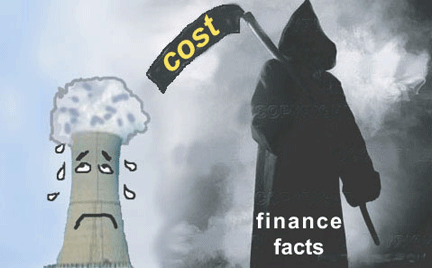
 Greenpeace boss says plan for nuclear power stations is impossible to fund http://www.bdlive.co.za/ business/energy/2015/10/08/ greenpeace-boss-says-plan-for- nuclear-power-stations-is- impossible-to-fund BY WYNDHAM HARTLEY, 08 OCTOBER 2015, SOUTH Africa’s planned nuclear build programme would never get off the ground because it would be impossible to fund, Greenpeace executive director Kumi Naidoo said on Thursday.
Mr Naidoo, on visit to the land of his birth, was a guest of the Cape Town Press Club at which he spoke on global warming and environmental matters.
Responding to questions, Mr Naidoo said the plan for nuclear power stations “is crazy because it is too expensive and too dangerous”.
“It won’t come off because no-one will be able to fund it,” he said, adding that when government first started talking about a nuclear build the price tag was R1-trillion but that was when the exchange rate was R8 to the US dollar and not the current R14.
He said that the main concern about the obsession with nuclear was that it softened the concentration on renewable energy sources like sun and wind which created more jobs than nuclear.
Chairman of the African National Congress’s (ANC) policy sub-committee Jeff Radebe is on record as saying the energy challenge is a top priority in a discussion document for its national general council.
The ANC has said that nuclear energy plan will be discussed at the council, but has also said it would go ahead unless there were affordability assessments.
Mr Naidoo expressed concern that there was no safe way of disposing of nuclear waste which could last anything between 200 and 1,000 years.
On his main topic of whether the earth could survive global warming, he said: “There is a small window of opportunity to change things, but it is closing fast.”
The CIA and the Pentagon in the US were right, he said, when they said that the threat to global peace and security was the effects of climate change which placed people in competition for water and other natural resources which they were prepared to fight for.
“There are no jobs on a dead planet”.
Mr Naidoo said however he was optimistic about the future “because we don’t have any choice”. Responding to a question about climate change sceptics, he described the view they held as denialism — “like the view in South Africa that HIV did not cause AIDS”.
Favourites for Nobel Peace Prize – Pope Francis and International Campaign to Abolish Nuclear Weapons (ICAN)
Pope Francis, Anti-Nuclear Activists Among Nobel Peace Prize Contenders, NewsWeek BY REUTERS 10/8/15 Pope Francis and a line-up of anti-nuclear campaigners headed lists of favorites to win the 2015 Nobel Peace Prize on the eve of Friday’s announcement.
The Geneva-based International Campaign to Abolish Nuclear Weapons (ICAN) was named as a leading contender for the $972,000 prize by Norway’s state broadcaster NRK and by Nobeliana, a website run by historians who specialize in tracking the award.
NRK said Pope Francis’ opposition to nuclear weapons boosted his chances, alongside his help in brokering a deal between the United States and Cuba, and his encyclical on climate change. Nobeliana mentioned his calls for social justice.
Both organizations also highlighted Setsuko Thurlow, a survivor of the nuclear bombing of Hiroshima, while Nobeliana picked out Sumitero Taniguchi, a survivor of the atomic attack on Nagasaki………http://www.newsweek.com/pope-francis-anti-nuclear-activists-among-nobel-peace-prize-contenders-381307
The work of Russia’s anti nuclear NGO “Planet of Hope”

 Our NGO, based in Ozersk, had three programs. We educated citizens about their rights, in particular those who were victims of radioactive contamination. We did sociological research on the inhabitants. And we gave training to representatives of other NGOs in the Ozersk region.
Today, we have no way to be certain that releases into the Techa have been stopped. The factory states that the reservoirs are secure……. http://nf2045.blogspot.jp/2015/10/a-russian-antinuclear-activist-asks-for.html
Displacement Solutions advocates on behalf of climate refugees
 UN drops plan to help move climate-change affected people, Guardian, Oliver Milman, 7 Oct 15 “…….Advocates for displaced people argue that a new international framework needs to be created to help them, given that the UN refugee convention does not cover them because they are not fleeing persecution.
“I’d hope the UN would put a new apparatus in place. At the moment this is being dabbled in – there’s nothing systemic,” said academic Scott Leckie, founder of Displacement Solutions, an NGO that facilitates moving people displaced by climate change within their countries.
Leckie’s organisation focuses its work in five countries – Bangladesh, Colombia, Fiji, Panama and the Solomon Islands – but said climate displacement was a global problem, even in wealthy nations such as the US where people in Alaskahave had to move and Boston faces a future of being a “city of canals” because of sea level rises.
“Successful relocation is very complicated and there’s a real gap in how governments do this internally,” he said. “It may seem simple to move 30,000 people within Panama, for example, but when you get into it there is a variety of land and ethnic tensions.
 “The question for people on small islands is whether to stay or go, which is almost impossible to answer because the stakes are so high. Once you have people leave, you get a brain drain, investment dries up and you get into a vicious cycle of despair and poverty.
“This is solvable with political will and resources. There needs to be a coordinated human rights approach. Just as Australia takes in 12,000 Syrian refugees, there’s nothing stopping a further 1,000 places earmarked for people who have nowhere else to go in the Pacific islands.
“I think every country in the world responsible for CO2 emissions have some measure of responsibility for the predicament they’ve caused. Top of that list is Australia, given it is the worst per capita emitter in the world.” http://www.theguardian.com/environment/2015/oct/07/un-drops-plan-to-create-group-to-relocate-climate-change-affected-people
Turkey warns Russia it may not get its nuclear technology from Russia
Turkey’s Erdogan warns Russia on nuclear project, natural gas: papers http://news.yahoo.com/turkeys-erdogan-warns-russia-nuclear-project-natural-gas-090830083.html ISTANBUL (Reuters), 8 Oct 15 – Turkish President Tayyip Erdogan told Russia there were other places Turkey could get natural gas and other countries that could build its first nuclear plant, in the wake of Russian incursions into Turkish air space during its air campaign in Syria.
Russian aircraft twice entered Turkish air space at the weekend. Turkish F-16 jets have also been harassed by Syrian-based missile systems and unidentified planes since then.
“We can’t accept the current situation. Russia’s explanations on the air space violations are not convincing,” the Turkish daily Sabah and others quoted Erdogan as telling reporters as he flew to Japan for an official visit. He said he was resentful over what had happened but did not currently plan to speak to Russian President Vladimir Putin.
“These are matters for Russia to think about. If the Russians don’t build the Akkuyu (nuclear plant in southern Turkey) another will come and build it,” he said.
Turkey in 2013 commissioned Russia’s state-owned Rosatom to build four 1,200-megawatt reactors, but a start date for what is Turkey’s first nuclear power plant project has not yet been set.
“We are Russia’s number one natural gas consumer. Losing Turkey would be a serious loss for Russia. If necessary, Turkey can get its natural gas from many different places,” he said.
Around 28-30 billion cubic meters (bcm) of Turkey’s 50 bcm annual natural gas needs are met by Russia.
(Additional reporting by Orhan Coskun; Writing by Daren Butler; Editing by Hugh Lawson)
How Russia repressed anti nuclear Non Government Organisation Planet of Hope [Planeta Nadezhd]
 A Russian antinuclear activist asks for asylum in France Mediapart , October 2, 2015, by Amélie Poinssot and Michel de Pracontal, “………..You have been in France since July, in Paris, and on October 2nd you are applying for asylum. Why did you leave Russia?
See also:
Chris Harris, “Charity boss flees with young kids after Russia’s NGO crackdown,” Euronews, September 9, 2015. http://nf2045.blogspot.jp/2015/10/a-russian-antinuclear-activist-asks-for.html
International Monetary Fund chief Christine Lagarde says now is the time for carbon tax
 Now ‘right moment’ for carbon tax, IMF chief Christine Lagarde says http://www.abc.net.au/news/2015-10-08/now-right-moment-for-carbon-tax-imf-chief-lagarde-says/6836532 The time is right for governments to introduce taxes on carbon emissions, which would help fight global warming and raise badly needed revenue, IMF chief Christine Lagarde says.
“It is just the right moment to introduce carbon taxes,” Ms Lagarde said at the annual meetings of the International Monetary Fund and World Bank in Lima, Peru.
The issue is in the spotlight two months from a key United Nations conference in Paris tasked with delivering a comprehensive carbon-cutting pact.
Besides discouraging pollution, Ms Lagarde said, taxing greenhouse gas emissions would have the added bonus of helping governments boost their revenues at a time when many countries have dipped heavily into their “fiscal buffers” to get through a prolonged rough patch for the global economy.
“Finance ministers are looking for revenues. That’s the fate of finance ministers,” she said.
“But it’s particularly the case at the moment because many have already used a lot of their fiscal buffers… and are always in need of some fiscal buffers in order to fight the next crisis.”
Ms Lagarde urged governments to tax carbon emissions rather than rely on emissions trading, a competing system already in place in Europe in which governments essentially issue permits to pollute that can then be traded on an open market. I know that a lot of people would rather do emissions trading systems, but we believe that carbon taxation would be a lot better,” she said.
Australia scrapped its carbon tax in July last year. The Government has a target of generating 23.5 per cent of the country’s electricity from renewable sources by 2020.
Ms Lagarde said revenues from carbon taxes could contribute to rich nations’ funding target of $US100 billion ($139 billion) a year by 2020 to help poorer nations fight the impacts of climate change.
The world was still $US38 billion short of that target last year, the Organisation for Economic Cooperation and Development said in a new report.
Ms Lagarde said it was also the “right moment” to eliminate energy subsidies, which the IMF says will cost the world $US5.3 trillion this year — 6.5 per cent of the global economy.
Australia manages to get help for climate refugees OFF the UN climate action draft!
 UN drops plan to help move climate-change affected people, Guardian, Oliver Milman, 7 Oct 15
Australia opposed the plan for a group to assist migration, and it has been left off the draft agreement for UN climate talks in Paris Australia’s opposition to the creation of a body to help people escaping the ravages of climate change appears to have paid off, with the idea dropped from the draft agreement for the crucial UN climate talks in Paris.
A previous draft of the deal to be thrashed out by nations included a “climate change displacement coordination facility” that would provide “organised migration and planned relocation”, as well as compensation, to people fleeing rising sea levels, extreme weather and ruined agriculture.
However, this reference has been removed in a revised text ahead of the December climate conference negotiations. Australia opposed the facility, although Guardian Australia understands the prime minister, Malcolm Turnbull, has shown interest in the issue of displacement.
“Australia does not see the creation of the climate change displacement coordination facility as the most effective or efficient way to progress meaningful international action to address the impacts of climate change,” a Department of Foreign Affairs and Trade spokesman said. “Australia is already working closely with our Pacific partners on these important issues.”
Australia had spent more than $50m in climate resilience projects in the Pacific and contributed another $200m to the Green Climate Fund.
Opposition to the coordination facility is not shared by Australia’s traditional allies, with representatives from the US, British and French governments indicating they were open to the idea……..
The impact of climate change is anticipated to displace up to 250 million people worldwide by 2050, including many in low-lying Pacific islands such as Tuvalu, the Solomon Islands and Kiribati.
In areas of the Pacific, sea level is rising by 1.2cm a year, four times faster than the global average. For coral-based islands two to three metres above sea level this has resulted in communities being relocated, and drinking water and crops are threatened by salt water inundation. Recent research suggests islands will not be submerged but will change shape and height, posing difficulties for fixed infrastructure.
“Why on earth would Australia not support a coordination facility?” said Phil Glendenning, president of the Refugee Council. “We are talking about the most vulnerable people on the planet who are facing threats to their food security, seeing their water supplies diminish and their entire cultures at risk.
“The world is going to have to deal with this displacement. We need to get on the front foot. Australia can’t say we are doing enough. People in Kiribati and Tuvalu are the canaries in the coalmine and they are looking to Australia.”
Last year the Kiribati government bought 20 sq km of land on Vanua Levu, one of the Fiji islands, in case its people cannot be moved internally. It has a policy called “migration with dignity” if its cluster of 33 coral atolls becomes inhabitable…….
Relocation of people is occurring across the Pacific region. Dozens of villages in Fiji will be moved, and 2,000 people from the Carteret atoll of Papua New Guinea will be transferred to mainland Bougainville, a three-hour trip on a wooden boat, because of salt intrusion and destructive tides……. http://www.theguardian.com/environment/2015/oct/07/un-drops-plan-to-create-group-to-relocate-climate-change-affected-people
Secretive Trans Pacific Partnership copyright details leaked
Trans-Pacific Partnership accord’s copyright details leaked As suspected, Pacific Rim trade deal mimics US on copyright term: life plus 70 years. http://arstechnica.com/tech-policy/2015/10/trans-pacific-partnership-accords-copyright-details-leaked/ by David Kravets – Oct 7, 2015 A day after 11 Pacific Rim nations and the US agreed to the wording of the secret Trans-Pacific Partnership trade deal, New Zealand revealed Tuesday that the section on intellectual property lines up with how copyright terms are treated in the US.
The deal, which now needs approval from the pact’s member nations, makes copyrights last for the life of the creator plus 70 years after death, according to the New Zealand government (PDF). That’sbasically the same as in the US.
The New Zealand government wrote:
TPP requires New Zealand to move to 70 years as well, but allows for a transition to do this over time.
This change could benefit New Zealand artists in some cases, but the benefits are likely to be modest. Extending the copyright period also means New Zealand consumers and businesses will forego savings they otherwise would have made from books, music and films coming off copyright earlier. The net cost of extending New Zealand’s copyright term from 50 to 70 years will be small to begin with and increases gradually over 20 years, reaching a relatively constant level after that. Over the very long term, including the initial 20-year period, the average annual cost is estimated to be around $55 million.
New Zealand also said the accord would not require Internet service providers “to terminate accounts for Internet copyright infringements.” In the US, many of the top ISPs have a six-strikes consumer infringement program.
The nations included in the accord, which took more than five years to negotiate, include the US, Japan, Australia, Peru, Malaysia, Vietnam, New Zealand, Chile, Singapore, Canada, Mexico, and Brunei. They represent about 40 percent of the global economy.
The text of the deal still remains secret and is expected to become public by year’s end.
Even routine sirens from nuclear station can cause social panic
RANDOM SIRENS ALARM NUCLEAR PLANT NEIGHBORS abc 13 eyewwitness News, , October 08, 2015 NEW HILL, NC — Annual maintenance. That’s Duke Energy’s explanation for warning sirens around the Harris Nuclear Power plant going off at seemingly random times over the past week. But no one seemed to know about it.
The first reports started popping up on social media last week.
Local police started getting calls. So did the Town of Apex. But no one could explain why the sirens were going on and off……”You can put a lot of people in panic if that siren goes off and there’s not really nothing going on at the nuclear plant,” Conley said. “People can go a little bananas when they don’t know what it’s meant for.” “It sounds like it’s in your back yard,” said Laura Taylor. “It’s really loud.”
Taylor lives in Apex, one of the surrounding towns and communities that has nuclear warning sirens scattered about. She says she heard the siren go off three times last week.
“It is concerning because you wonder what’s going on,” said Taylor. “Is it just some kind of malfunction or should we be more concerned?” As it turns out, it was neither………http://abc13.com/news/random-sirens-alarm-nuclear-plant-neighbors/1023278/
1 This Month

of the week – Shut Down Drone Warfare!


Tell the Ukrainian Government to Drop Prosecution of Peace Activist Yurii Sheliazhenko

Petition to revoke the licensing of the Near Surface Nuclear Disposal Facility (NSDF) at Chalk River. https://www.ourcommons.ca/petitions/en/Petition/Details?Petition=e-7247
To see nuclear-related stories in greater depth and intensity – go to https://nuclearinformation.wordpress.com
-
Archives
- April 2026 (91)
- March 2026 (251)
- February 2026 (268)
- January 2026 (308)
- December 2025 (358)
- November 2025 (359)
- October 2025 (376)
- September 2025 (257)
- August 2025 (319)
- July 2025 (230)
- June 2025 (348)
- May 2025 (261)
-
Categories
- 1
- 1 NUCLEAR ISSUES
- business and costs
- climate change
- culture and arts
- ENERGY
- environment
- health
- history
- indigenous issues
- Legal
- marketing of nuclear
- media
- opposition to nuclear
- PERSONAL STORIES
- politics
- politics international
- Religion and ethics
- safety
- secrets,lies and civil liberties
- spinbuster
- technology
- Uranium
- wastes
- weapons and war
- Women
- 2 WORLD
- ACTION
- AFRICA
- Atrocities
- AUSTRALIA
- Christina's notes
- Christina's themes
- culture and arts
- Events
- Fuk 2022
- Fuk 2023
- Fukushima 2017
- Fukushima 2018
- fukushima 2019
- Fukushima 2020
- Fukushima 2021
- general
- global warming
- Humour (God we need it)
- Nuclear
- RARE EARTHS
- Reference
- resources – print
- Resources -audiovicual
- Weekly Newsletter
- World
- World Nuclear
- YouTube
-
RSS
Entries RSS
Comments RSS
 nuclear-news