Record rain overwhelming Fukushima’s nuclear station’s drainage pumps
Japan’s torrential downpour overwhelmed Fukushima’s drainage pumps sending hundreds of tonnes of contaminated water flowing into the Pacific! Japanese flooding update, The Big Wobble , 10 Sept 15
Rainfall reached 600 millimetres in the area around Joso, with weather officials expecting at least 200mm more in parts of eastern Japan, including Fukushima, the site of the nuclear reactor crippled in 2011, before the downpour stops on Friday.
Report Says Floods May Pose Threat To Radiation Under Fukushima
The torrential downpour has exacerbated a contaminated water problem at the Fukushima nuclear plant as it overwhelmed the site’s drainage pumps, sending hundreds of tonnes of contaminated water flowing into the ocean, a spokesman for operator Tokyo Electric Power (TEPCO) said.
The continuous torrent of rain water is complicating the already difficult situation in Fukushima where, according to an operator of the Tokyo Electric Power (Tepco), the drainage pumps are not able to evacuate all the water that is pouring into the plant, becoming contaminated and damaging the ‘surrounding environment.
Since 2011, the Tempco has been in charge of storing tons of radioactive water used to cool the reactors at the plant, destroyed by the tsunami……..TEPCO is storing huge volumes of water used to cool reactors that were sent into meltdown when a tsunami hit Japan in 2011……..
“This is a scale of downpour that we have not experienced before.
Grave danger could be imminent,” forecaster Takuya Deshimaru told an emergency press conference. Etau, which smashed into Japan on Wednesday, moved out into the Sea of Japan (East Sea) by the end of the day, but a wall of rain continued to lash the country……http://www.thebigwobble.org/2015/09/japans-torrential-downpour-overwhelmed.html
‘Climate Change Fix” chosen as 2015 theme by World Nuclear Association

Christina Macpherson’s websites & blogs
Australia’s nuclear propagandist Ben Heard is over in London, attending the World Nuclear Association’s Symposium. Heard has been advising them on how to spin the pro nuclear. message to the public.
It seems that the big message of the nuclear lobby is that lie that “Nuclear can solve climate change”

World Nuclear Association urges industry growth to 25%, WNA 10 September 2015 The global nuclear industry should aim to achieve a 25% share of world electricity production by 2050, Agneta Rising, director general of the World Nuclear Association said today. To do that it will need to add 1000 gigawatts of new generation capacity.
In her opening remarks to delegates at the association’s annual Symposium, being held in London this week, Rising said there are political and regulatory barriers to overcome in achieving this target, and the industry could find more ways to reduce its own costs. “But we have a goal,” she said.
That goal is the focus of the association’s new Harmony initiative. To achieve it, Rising stressed the industry was capable of adding 50 GWe of capacity in 2015-2020, 125 GWe in 2020-2025 and 825 GWe in 2025-2050……
To achieve the 1000 GWe target, the World Nuclear Association has outlined three objectives in its Harmony initiative – a level playing field for nuclear among sources of electricity generation, a harmonised regulatory process, and an effective safety paradigm. To achieve them, the industry must manage the challenges with deregulated markets and nuclear energy taxes, high capital investments, grid system costs and subsidies for alternative sources of electricity. It must also seek to gain recognition for nuclear power for its low-carbon generation.……….. http://www.world-nuclear-news.org/WNN-World-Nuclear-Association-urges-industry-growth-to-25-10091501.html
Kazakhstan’s disaster of dead animals near Semipalatinsk Nuclear Test Site
“Rapid, stunning and complete” die-off of animals near nuclear site — 150,000+ antelopes bleeding from internal organs, pits brimming with corpses — Experts completely baffled: “It’s really unheard of… 100% mortality, I know of no example in history like it… Doesn’t make any sense” (PHOTOS)http://enenews.com/rapid-stunning-complete-crash-animal-population-nuclear-site-150000-antelopes-dead-after-bleeding-internal-organs-experts-100-mortality-example-history-like-really-unheard-doesnt-make-sense-infe?utm_source=feedburner&utm_medium=email&utm_campaign=Feed%3A+ENENews+%28Energy+News%29
NBC News, Sep 3, 2015 (emphasis added): Now, the researchers have found clues as to how more than half of the [Kazakhstan saiga antelope] herd, counted at 257,000 as of 2014, died so rapidly. Bacteria clearly played a role in the saigas’ demise. But exactly how these normally harmless microbes could take such a toll is still a mystery, [Steffen Zuther, with the Altyn Dala Conservation Initiative] said. “The extent of this die-off, and the speed it had, by spreading throughout the whole calving herd and killing all the animals, this has not been observed for any other species,” Zuther said. “It’s really unheard of.”… Tissue samples revealed that toxins, produced by Pasteurella and possibly Clostridia bacteria, caused extensive bleeding in most of the animals’ organs. But Pasteurella is found normally [and] usually doesn’t cause harm unless the animals have weakened immune systems. (Below: Semipalatinsk nuclear test wasteland, Kazakhstan)

Live Science, Sep 2, 2015: [In] four days, the entire herd — about 60,000 saigas — had died off. Workers struggled to keep up with the mass dying, quickly burying the animals that died in heaps. Scientists were completely baffled… necropsies revealed that bacterial toxins from a few species of pathogen had caused bleeding in all of the animals’ internal organs… [Pasteurella] rarely causes harm unless their immune system has already been weakened by something else. And genetic analysis suggested this was a garden-variety pathogenic form of the microbe, which has never caused such a rapid, stunning and complete crash in a population before. All told, more than 150,000 saiga have died [which]may be an underestimate, as that number only counts saiga who have been buried…
New York Times, May 29, 2015: The numbers and images that describe a mass dying of the critically endangered saiga… in the Betpak-dala region of Kazakhstan are stunning. Hastily bulldozed pits brim with corpses… The enormous new saiga die-off is particularly devastating… there had been previous die-offs… in 1955, 1956, 1958, 1967, 1969, 1974, 1981 and 1988.
Richard Kock, Royal Veterinary College: “It’s very dramatic and traumatic, with 100-percent mortality…. I know of no example in history with this level of mortality.”
BBC, Jun 1, 2015: An unknown environmental trigger is thought to have caused two types of normally benign bacteria found in the antelopes’ gut to turn deadly… “Over two days (in the herd I was studying) 80% of the calving population died,” [Zuther] told the BBC. The whole herd then died within two weeks… Two different bacteria, pasteurelosis and clostridia, have been found in every dead animal studied. These bacteria are naturally found in the animals… so something must have reduced the immunity of the animals… “There’s no infectious disease that can work like this,” said Prof Kock… losing 100% percent of some populations within two weeks “doesn’t make any sense” from a biological or evolutionary perspective, Prof Kock said… all individuals affected by the sudden die-off are from the largest remaining Betpak-dala population…
U.S. National Research Council, 2001:Radionuclide Contamination at Kazakhstan’s Semipalatinsk Test Site — 498 nuclear tests were conducted [and] vented underground detonations occurred through 1989… some Kazakh scientists opine that residual radioactivity is responsible for ongoing health impacts… Pathologies in cohorts born after the atmospheric tests appeared to be significantly higher… [Prof. Saim Balmukhanov, the prominent director of the Institute of Oncology] made a particular case that various pathways of exposure to plutonium particles from the soil may be a causative agent… There is little doubt that people living in the STS region suffer from a range of adverse health effects, includinghigh rates of infectious and noninfectious diseases, cancer, and hematological disorders… The STS is located in the plains of the dry Eurasian steppe… Steppe fauna includes… the migratory saiga antelope… [I]nformation exists suggesting that plants at the test site can hyperaccumlate radionuclides… During meetings with ecologists from Kazakhstan State National University a claim was made that in the past, there were 100 species of higher plants at the STS, now there are fewer than 40. Many animal species have disappeared
Outrageous decision of USA’s Nuclear Regulatory Commission (NRC) to cancel research on cancer-nuclear links
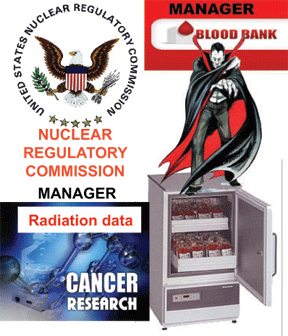 Vital cancer study canceled: NRC will hide the truth about nuclear reactor risks Beyond Nuclear today decried the outrageous decision by the U.S. Nuclear Regulatory Commission (NRC) to cancel a study that would have examined cancer incidence and mortalities and the connection to U.S. nuclear facilities.
“Study after study in Europe has shown a clear rise in childhood leukemia around operating nuclear power facilities, yet the NRC has decided to hide this vital information from the American public,” said Cindy Folkers, radiation and health specialist at Beyond Nuclear.
The study, initiated in 2009 and carried out under the auspices of the National Academy of Sciences (NAS), had completed Phase 1 and was looking at seven pilot nuclear sites around the country, a project that was estimated to cost $8 million.
“An $8 million price tag for the next phase of this study is a drop in the bucket for an agency with a $1 billion annual operating budget,” added Folkers. The NRC identified the “significant amount of time and resources needed and the agency’s current budget constraints” as its excuse for terminating the study.
Folkers noted that, in reality, nuclear industry manipulation, rather than budget constraints, could be behind the NRC’s sudden decision to abandon the NAS study.
In documents obtained by Beyond Nuclear it was revealed that NRC staff had been approached by the president of U.S. National Council on Radiation Protection and Measurements (NCRP), John Boice, offering a cheaper, faster and less sensitive study design to replace the NAS study, although the NRC has not yet agreed to accept the NCRP bid.
Read the full press release and feel free to circulate. http://www.beyondnuclear.org/home/2015/9/8/vital-cancer-study-canceled-nrc-will-hide-the-truth-about-nu.html
Fukushima nuclear plant under threat from epic flooding
 ABC: “Epic flooding in Japan threatening Fukushima… Serious concerns about nuclear power plant in flood zone” — Hundreds of tons of contaminated water have already flowed into ocean — Torrential downpours overwhelm site — Worst rains to hit area in past 50 years (VIDEO)http://enenews.com/abc-epic-flooding-japan-threatening-fukushima-serious-concerns-about-nuclear-power-plant-flood-zone-hundreds-tons-contaminated-water-flowed-ocean-torrential-downpours-overwhelm-site-video
Mainichi: Typhoon causes injuries, cancelled trains and flights, radioactive water leak… [TEPCO] announced on Sept. 9 that rainwater contaminated with radioactive materials had leaked from the plant’s drainage system into the ocean. The heavy rains brought on by Typhoon Etau exceeded the capacity of a transfer pump… This is the seventh time of possible or confirmed leaks of radiation-contaminated water since the utility began transferring the water from canal to canal in April… TEPCO says it does not know how much contaminated water leaked into the ocean, and is currently analyzing the concentration of the radioactive matter in the leaked water.
ABC News transcript: Epic flooding in Japan threatening the Fukushima plant… Serious concern this morning about a nuclear power plant in the flood zone… Torrential downpours [are] raising concerns about the Fukushima power plant… Reports that these heavy rains may overwhelm the site’s drainage pumps.
Reuters: A spokesman for operator Tokyo Electric Power (TEPCO) told the Guardian hundreds of tonnes of contaminated water have flowed into the ocean from the Fukushima nuclear plant… Rainfall reached 500 mm around Joso, NHK said, with weather officials expecting at least 200 mm more in parts of eastern Japan, including Fukushima, the site of the nuclear reactor crippled in 2011, before the downpour stops on Friday.
AFP: Japan flags grave danger from floods and water tainted by Fukushima nuke plant radiation— Tens of thousands of people were ordered to evacuate across Japan today as heavy rain pounded the country, sending radiation-tainted waters into the ocean at the crippled Fukushima nuclear plant… The torrential downpour has also exacerbated a contaminated water problem at the Fukushima nuclear plant as it overwhelmed the site’s drainage pumps, a spokesman for operator Tokyo Electric Power said.
Weather Channel: JMA issued landslide warnings parts of Miyagi and Fukushima prefectures, including areas near the Fukushima Daiichi nuclear power plant that suffered a catastrophic meltdown after the 2011 Tohoku earthquake and tsunami. According to the Mainichi Shimbun, a national newspaper, the heavy rain caused contaminated water from the site to run off into the Pacific Ocean for several hours early Wednesday.
UPI: More radioactive water has leaked out from the Fukushima Daiichi nuclear power plant… The heavy rain has caused additional leaks at the damaged Fukushima Daiichi nuclear power plant, where the site’s drainage pumps were overwhelmed — causing radioactive water to leak into the Pacific Ocean.
Telegraph: The huge rains also exacerbated a contaminated water problem at the crippled Fukushima nuclear plant as it overwhelmed the site’s drainage pumps, sending radiation-tainted water into the ocean.
Guardian: The heavy rain, which is expected to spread north on Friday, has also caused additional leaks of radioactive water at the stricken Fukushima Daiichi nuclear power plant… The meteorological agency warned that heavy rain would continue in the northeast, including Fukushima prefecture, until early Friday morning.
Bloomberg: The storm caused contaminated water from the wrecked Fukushima nuclear plant to leak into the ocean… Contaminated water at Tokyo Electric Power Co.’s Fukushima Dai-Ichi facility leaked into the Pacific Ocean at about 12:30 a.m. on Wednesday, company spokesman Tatsuhiro Yamagishi said by phone, adding that company is still investigating the leak.
ABC Australia: Fukushima tainted water flows into ocean… weather officials [are] expecting at least 200mm more in parts of eastern Japan, including Fukushima, the site of the nuclear reactor crippled in 2011, before the downpour stops on Friday. The torrential downpour has exacerbated a contaminated water problem at the Fukushima nuclear plant as it overwhelmed the site’s drainage pumps, sending hundreds of tonnes of contaminated water flowing into the ocean, a spokesman for operator Tokyo Electric Power (TEPCO) said.
ABC News: In addition to the clear danger facing residents, Japanese authorities are particularly concerned about the flooding, given its proximity to one of the country’s biggest nuclear power plants, Fukushima — damaged by the 2011 earthquake and subsequent tsunami… “The torrential downpour is threatening safety at the Fukushima nuclear plant, closed since the 2011 disaster, as it has overwhelmed drainage pumps at the site’s contaminated water treatment facility,” a Japanese government official told ABC News.
NPR: Floodwaters also “overwhelmed the drainage pumps at the Fukushima nuclear plant,” Japan Times reports, citing a Tokyo Electric Power Co. spokesman who said the flooding sent “hundreds of tons of contaminated water” into the ocean.
Prensa Latina, Sep 10, 2015: Typhoon Etau Causes Leak of Radioactive Water in Fukushima — Typhoon Etau originated leaks of radioactive water from the Fukushima plant in Japan… Leaks occurred in dams located around the tanks storing liquid used to cool the reactors. With this leak, there have been seven detected since last April when a pumping system was implemented to prevent radioactive waste emanating from the reactor to flow in a place away from the plant.
EFE: Contaminated water from Fukushima leaks into sea due to typhoon Etau — The Fukushima plant… has been found to be leaking contaminated water into the sea following heavy rainfall in the region caused by typhoon Etau, a spokesperson of Fukushima’s operator confirmed to EFE Thursday… The leaks have been caused in the embankments around the tanks where highly radioactive water is stored after they are used to cool the reactors…
USA Today: Tens of thousands of people are ordered to flee homes across Japan as heavy rain pounded the country, sending radiation-tainted waters into the ocean at the crippled Fukushima nuclear plant.
Kyodo: Heavy rains whose severity was described as occurring once in 50 years were observed in… Fukushima Prefecture.
CNN: Fukushima prefecture, which was devastated by the 2011 tsunami, saw more than 30 centimeters (1 foot) of rain in 48 hours — the heaviest downpour there in 50 years, NHK said.
UK nuclear lobby is seeking a blank cheque from the governmnet
So where is the British flight into ‘nuclear power is cheap somewhere’ fantasy leading us? Well, to nationalisation, of course
 What the pro-nuclear lobby now wants is for limitless sums of money to be siphoned off from public spending on education, health and whatever else and spent on building nuclear power stations. The money will be notionally borrowed, a contract that will be concocted that will claim that the electricity consumer will pay the money back at a later date, and the balance will be paid for by, well, less schools, hospitals etc. Meanwhile a story will be manufactured about how all of this is cheap.
The state will end up giving the whole project a blank cheque so that the disastrous construction process can be bankrolled entirely from a bottomless pit of state finances.
 The notion that nuclear is cheaper somewhere else is a myth http://realfeed-intariffs.blogspot.co.uk/2015/09/the-notion-that-nuclear-is-cheaper.html by Dr David Toke The British attitude to the notion that nuclear power is not cheap after all is a bit like a child who first hears that Father Christmas does not, after all, exist. Disbelief, and in this case a belief that if only Father Christmas is nationalised, then it will still be true. The psychologists call this cognitive dissonance, in other words if a fact is uncomfortable to you, you believe that the fact is wrong.
Scrutinising Japan’s government PR about The Reopening Of Nahara Fukushima
 The Reopening Of Nahara Fukushima, What The Press Failed To Mention, Simply Info September 9th, 2015 The press has widely reported the reopening of Nahara as the government uses it as a PR tool. Much of the reporting focused on issues such as the lack of stores, services or schools. This is a distraction from the very real pressing concern of the radiation levels and uncertain status of the town’s decontamination efforts.
Nahara has been plagued with problems and high radiation levels yet the government has characterized the town as being “safe”. Nahara was the site of Fukushima Daiichi debris findings in 2013. ……..
Asahi Shimbun discovered illegal practices were being used in the decontamination work being done in Nahara in 2013. Nahara currently houses large stockpiles of radioactive soil and debris as seen in this photo. The town is part of the long term consolidated storage plan where contaminated soil from around Japan is being collected and stored near Fukushima Daiichi.
Nahara’s city water supply was found to have 18,700 bq/kg of cesium in the soil in the bottom of the reservoir. In May of 2014 Nahara officials demanded that the central government decontaminate Nahara to pre-disaster levels. Nothing further was reported on this to show any response to these requests………
Recent soil sampling done by Iwaki Radiation Measuring Center with the help of a former Fukushima Daiichi worker who collected the samples found alarmingly high radiation.
Soil samples in Nahara were found as high as:
52500 bq/kg cesium 137 & 134 combined
34790 bq/kg cesium 137 & 134 combined
26480 bq/kg cesium 137 & 134 combined……..http://www.fukuleaks.org/web/?p=15023
USA Senator Markey scathing about NRC decision to stop Cancer Risk Pilot Study
Senator Markey Statement on NRC Decision to End Cancer Risk Pilot Study http://www.markey.senate.gov/news/press-releases/senator-markey-statement-on-nrc-decision-to-end-cancer-risk-pilot-study September 8, 2015
Washington (September 8, 2015) – Statement from Senator Edward J. Markey (D-Mass.), a member of the Environment and Public Works Committee, on the announcement this morning from the Nuclear Regulatory Commission (NRC) that it is ending the pilot study of cancer risks in populations near U.S. nuclear power facilities being conducted by the National Academy of Sciences.
“We need a thorough, accurate accounting of the health risks associated with living near nuclear facilities so residents can know if there are any adverse health impacts associated with living close to nuclear reactors. But the NRC has decided to take a ‘Don’t Ask, Don’t Tell’ approach to this public health concern by ceasing work on what could be a life-saving cancer risk research study. The NRC blames budgetary constraints for ending the study, but what price do residents pay for living near operating nuclear facilities? We should know that answer, and the NRC should prioritize the resources to continue and complete this study.”
In 2013, Senator Markey praised NRC’s decision to start the study, having originally called on the NRC in 2009 to perform the independent research.
France heading towards a nuclear industry phaseout?
 France tilting toward nuclear phase-out, DW 10 Sep 15 As the traditionally strong French nuclear power industry continues to be plagued by technical and financial difficulties, the government has sought to cut nuclear power in favor of renewables. French Environment Minister Segolene Royal sparked rebuke Tuesday (08.09.2015) by tying shutdown of the country’s oldest nuclear plant to the opening of an EPR reactor that has been delayed for six years already………last year, Areva recorded a loss of 5 billion euros. The group hasn’t sold a single power plant in the last seven years, and the Fukushima disaster looks to have had further impacts on demand for new reactors.
Third-generation nuclear reactors – so-called European Pressurized Reactors (EPR) – were initially considered a secure technology for the future and the flagship of the French nuclear industry. But even they have been fraught with problems.
Despite Royal’s recent statement, recently passed legislation on renewable energy in France may be the most telling sign that the winds of change appear to be blowing – toward a nuclear phase-out.
Technology of the future turns sour
Operational start of the Olkiluoto 3 EPR in Finland has been delayed from 2009 to 2018, and the Flamanville 3 reactor in France from 2012 to 2018. Construction costs for Flamanville 3 have exploded, from 3.3 to more than 10 billion euros. Two EPR reactors at the Hinkley Point nuclear facility in England have also been the focus of controversy, as construction costs are much higher than initially projected. Financing for completing the project has still not been secured.
There is also the prospect of major safety issues. In mid-April it became known that there were weak points in the steel vessel that surrounds the reactor at the French Flamanville plant, which could lead to cracking under pressure.
The French Nuclear Safety Agency (ASN) called the situation “very serious,” and has demanded a comprehensive report by October.
If the regulating authority judges the vessel unsafe, it would be a disaster for Areva. Replacing it would take several years and result in additional costs in the hundreds of millions of euros, experts say.
Yannick Rousselet, a nuclear energy expert at Greenpeace, says further delays would deal a death blow to the EPR project. Aside from the two European reactors, no EPR installation has been successfully completed – there are just two projects in China.
“Only a few years ago, Areva told us that worldwide it would be finalizing two to three reactors per year,” Rousselet said. “The reality today is that the EPR as an industrial project is dead.”
EDF steps in to save AREVA. The French state owns 86.5 percent of Areva and 84.5 percent of EPR, which is the world’s second-largest electricity provider and a major nuclear power producer.
In an emergency meeting with President Francois Holland in June, it was agreed that EDF should buy in to Areva’s reactor business.
“Without these measures, Areva wouldn’t survive the year,” said Mycle Schneider, editor of the World Nuclear Industry status report.
And according to Schneider, help for Areva doesn’t spell an end French nuclear power’s problems.
EDF is considerably larger than Areva, and has an annual turnover of 70 billion euros. But Schneider points out its also has 37.5 billion euros of debt. Schneider sees this mountain of debt as a central problem.
According to the Paris audit office, the company faces an additional 50 billion euros in costs for dismantling and disposal of nuclear waste.
From nuclear to renewables?
As nuclear energy faces these problems, winds of change appear to be blowing through the French energy system.
Marc Bussieras, head of EDF’s economic strategy department, is open to energy production without nuclear. EDF’s priority is a cost-effective strategy, he told DW.
“Today in France, there are economic reasons in favor of installing renewable energy capacity,” Bussieras said.
Marc Bussieras, head of strategy at EDF, said at a DW panel renewables make economic sense
The French government is seeking to promote an energy transition through new legislation, which is also hoped to create jobs. The law, adopted in July 2015, states that the share of nuclear power in France’s energy mix should be reduced from 75 percent today to 50 percent by 2025. The shortfall in power supply should primarily be covered by wind and solar.
According to a study commissioned by the national environmental agency (ADEME), a complete phase-out of nuclear power and switch to 100 percent renewable energy should be possibly – and economically viable – by 2050…….
Schneider sees other opportunities for the nuclear industry. “The future lies in the huge market for demolition and nuclear waste management,” Schneider said. “New constructions will remain the exception.” http://www.dw.com/en/france-tilting-toward-nuclear-phase-out/a-18692209
Anxieties in China over the safety of the nation’s nuclear power programme

 China resumes nuclear power plant construction after a four-year freeze By Zhang Yu Source:Global Times Published: 2015-6-15“…China recently ended its pause for approvals of nuclear power plants put into place after the 2011 nuclear accident in Japan. This year, as many as eight nuclear power plants may be launched in China. Some experts are warning that this is going too fast with controversial technology…….
Since 2004, China has been approving projects using advanced nuclear power reactors, including US-based Westinghouse’s AP1000 and France-based Areva’s EPR (Evolutionary Power Reactor), many of which are now under construction. Dubbed generation III reactors, they are designed to withstand the crisis that damaged the Japanese nuclear plant.
Construction of these projects has not been smooth. Sanmen Nuclear Power Station in Zhejiang Province was expected to be the first nuclear power plant in the world that uses AP1000 technology. The first of the two reactors was scheduled to finish construction and start operation in November 2013, but construction is now over 18 months behind schedule. The plant won’t start operation until 2016 at the earliest, an official from China’s State Nuclear Power Technology, the company building the power plant, said in January.
The company has struggled to keep its schedule because of constant changes in design and new problems that emerged during tests, previous reports said.
In a statement by the economic planner of Zhejiang Province in 2013, its energy department said the delay has slowed down the province’s nuclear development and affected the power supply plan in Zhejiang. It has also undermined China’s overall plan to make AP1000 its major technology in new nuclear plants……..
She said hydroelectricity and other new energy means should be developed in inland areas. “Nuclear shouldn’t play an important role in China’s energy structure,” she said.
“The rapid speed of China’s nuclear expansion, and the direction it is expanding – to the most populous inland areas – is unprecedented…Besides, China’s nuclear industry has a tendency to exaggerate its achievements to the central government, so as to gain more funding,” He told the Global Times.
He also warns of a nuclear accident when the total number of nuclear power plants reaches 50 – the total number of nuclear plants built and under construction in China.
“According to past experiences, the likelihood of a disaster rises sharply after a country runs over 50 nuclear power plants, as is the case in the US and Japan,” he said……..http://www.globaltimes.cn/content/927146.shtml
No accountability for the $billions being spent on Oak Ridge Uranium Processing Facility.
 BUSTED! UPF bomb plant to break the bank at $11 Billion, UPF Update. Orepa.org 10 Sep 15
Nuclear Regulatory Commission prevents hearing on Fermi nuclear plant
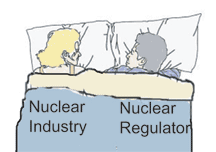 Nuclear regulators halt plans for Fermi 2 hearing BY TOM HENRY BLADE STAFF WRITER
http://www.toledoblade.com/Energy/2015/09/09/Nuclear-regulators-halt-plans-for-Fermi-2-hearing.html#Ge8j5KJYItT4iPTj.99 NEWPORT, Mich. — Anti-nuclear activists trying to stop DTE Energy’s Fermi 2 nuclear plant from getting a 20-year license extension were dealt a setback Tuesday when the U.S. Nuclear Regulatory Commission killed their plans for a special hearing about the plant’s continued operation.
The agency’s commissioners overruled a decision by the NRC’s Atomic Safety and Licensing Board to grant a hearing on three issues, or contentions, as regulators call them.
The plant’s operating license expires March 20, 2025.
Three environmental groups — Don’t Waste Michigan, Citizens Environment Alliance of Southwestern Ontario, and Beyond Nuclear — filed a request for a hearing with four proposed contentions challenging DTE’s application.Another environmental group, Citizens Resistance at Fermi 2, also known as CRAFT, filed a separate hearing request with fourteen proposed contentions.
Requests for the hearing were opposed by DTE and the NRC’s staff.
The NRC said its rules for allowing hearings on such contentions “are designed to ensure that only focused, well-supported issues are admitted for hearing.”
The coalition of groups said it plans to appeal the NRC’s decision in federal court.
The agency’s licensing board had granted a hearing on safety and environmental contentions regarding the common transmission line corridor shared by Fermi 2 and the proposed new Fermi 3 reactor.
Activists warned of a “domino effect” if either of those reactors or their high-level radioactive waste storage pools released radiation. Contact Tom Henry at: thenry@theblade.com, 419-724-6079, or via Twitter @ecowriterohio.
In brief – solar energy and climate news
Why solar energy is poised for yet another record year.
The growth boom is being fueled by a combination of declining costs, low interest rates, and a federal solar investment tax credit, a new report suggests.
http://www.washingtonpost.com/news/energy-environment/wp/2015/09/09/why-solar-energy-is-poised-for-yet-another-record-year/ & http://www.dailyclimate.org/t/3864796633753627934
Energy boss tips solar explosion
One of the sector’s most experienced leaders has predicted a major investment in ‘utility scale’ solar power.
http://www.theaustralian.com.au/national-affairs/climate/energy-boss-grant-king-tips-solar-explosion/story-e6frg6xf-1227520102456
Sophie Lewis: Sure, winter felt chilly, but Australia is setting new heat records at 12 times the rate of cold ones
Melbourne, Canberra and much of southern Australia have shivered through a cold winter. But on a longer view, record cold snaps are disappearing, while Australian heat records continue to be broken.
https://theconversation.com/sure-winter-felt-chilly-but-australia-is-setting-new-heat-records-at-12-times-the-rate-of-cold-ones-35607
Forest fires in Alaska: A ticking climate time bomb
As US President Barack Obama visits Alaska to focus attention on climate change, scientists warn that this very bad wildfire year is part of a vicious cycle caused by – and accelerating – climate change.
http://www.dw.com/en/forest-fires-in-alaska-a-ticking-climate-time-bomb/a-18684423
Nuclear whistleblower Mordechai Vanunu again under house arrest in Israel
 Israeli nuclear whisteblower Vanunu under house arrest over TV interview, DW, 10 Sept 15
More than a decade since completing his 18-year jail-term for exposing details of Israel’s nuclear weapons, Mordechai Vanunu has been put under house arrest. His detention follows a TV interview regarding the disclosure. Army radio reported on Thursday that Vanunu had been arrested in the early hours of September 5, hours after privately owned Channel 2 broadcast an interview which authorities said violated the terms of his 2004 release.
The 60-year-old reportedly appeared in a Jerusalem court before he was confined to his home for seven days. The court also imposed a ban on Vanunu using the Internet.
A senior Israeli security official later confirmed Vanunu’s detention, telling DPA news agency that he was forbidden from sharing any classified information which he learned while working at the Israeli nuclear plant in Dimona, “even if he already published that information in the past.”
Nucelar whistleblower
Vanunu was first imprisoned in 1986 for exposing details behind Israel’s nuclear weapons plan to British newspaper “The Sunday Times.”
He spent more than 10 years of his sentence in solitary confinement.
In 2010, Vanunu was imprisoned for a second time after a court ruled that he had broken the terms of his release by talking to a foreigner……
Police have demanded to see last week’s interview in its entirety. Channel 2 has refused to hand over the unedited footage, however, on the grounds of the journalistic principle of the protection of sources. The television station is now taking the case to court.
Israel has neither confirmed nor denied that it owns nuclear weapons – the only Middle East country to do so.
It has also refused to sign the nuclear Non-Proliferation Treaty – which aims to prevent the spread of nuclear weapons – or to allow international surveillance of the Dimona plant in the country’s south east. http://www.dw.com/en/israeli-nuclear-whisteblower-vanunu-under-house-arrest-over-tv-interview/a-18707561
UN says a global nuclear test ban is an urgent necessity

 Global nuclear-test ban urgently needed for safer, more secure world – UN officials, United Nations, 10 September 2015 – Top United Nations officials today highlighted the existential threat posed by nuclear testing, and called for all States that have not yet done so to sign and ratify the international treaty that seeks to achieve a ban on such testing.
Addressing a meeting to mark the International Day against Nuclear Tests, observed annually on 29 August, Secretary-General Ban Ki-moon noted the devastation caused by nuclear testing.
“I have witnessed the lasting societal, environmental and economic damage nuclear tests have caused,” he told the gathering. “Since the first test in New Mexico 70 years ago, the world has endured over 2,000 nuclear tests. Those tests devastated pristine environments and local populations around the world.
“Many have never recovered from the legacies of nuclear testing – including poisoned groundwater, cancer, birth defects and radioactive fallout,” Mr. Ban continued. “Today let us also send a strong signal that the international community stands united to take action that will lead us to a safer and more secure world – a world free of nuclear weapons.”
The Secretary-General said that the Comprehensive Nuclear-Test-Ban Treaty (CTBT), which was adopted in 1996, was an essential building block for achieving this goal as a legally-binding, verifiable means by which to constrain the quantitative and qualitative development of nuclear weapons.
Stressing that the Treaty must enter into force in order to be truly effective, Mr. Ban called on all remaining States to sign and ratify the instrument, including China, the Democratic People’s Republic of Korea, Egypt, India, Iran, Israel, Pakistan, and the United States.
The importance of the CTBT was also highlighted by the President of the General Assembly, Sam Kutesa, who underscored the need for a world free of nuclear testing……. http://www.un.org/apps/news/story.asp?NewsID=51843#.VfHx1tKqpHw
1 This Month
Chernobyl: The Lost Tapes – A good documentary on Chernobyl on SBS available On Demand for the next 3 weeks– https://www.sbs.com.au/ondemand/tv-program/chernobyl-the-lost-tapes/2352741955560

of the week–London Campaign for Nuclear Disarmament

Tell the Ukrainian Government to Drop Prosecution of Peace Activist Yurii Sheliazhenko
To see nuclear-related stories in greater depth and intensity – go to https://nuclearinformation.wordpress.com
-
Archives
- April 2026 (139)
- March 2026 (251)
- February 2026 (268)
- January 2026 (308)
- December 2025 (358)
- November 2025 (359)
- October 2025 (376)
- September 2025 (257)
- August 2025 (319)
- July 2025 (230)
- June 2025 (348)
- May 2025 (261)
-
Categories
- 1
- 1 NUCLEAR ISSUES
- business and costs
- climate change
- culture and arts
- ENERGY
- environment
- health
- history
- indigenous issues
- Legal
- marketing of nuclear
- media
- opposition to nuclear
- PERSONAL STORIES
- politics
- politics international
- Religion and ethics
- safety
- secrets,lies and civil liberties
- spinbuster
- technology
- Uranium
- wastes
- weapons and war
- Women
- 2 WORLD
- ACTION
- AFRICA
- Atrocities
- AUSTRALIA
- Christina's notes
- Christina's themes
- culture and arts
- Events
- Fuk 2022
- Fuk 2023
- Fukushima 2017
- Fukushima 2018
- fukushima 2019
- Fukushima 2020
- Fukushima 2021
- general
- global warming
- Humour (God we need it)
- Nuclear
- RARE EARTHS
- Reference
- resources – print
- Resources -audiovicual
- Weekly Newsletter
- World
- World Nuclear
- YouTube
-
RSS
Entries RSS
Comments RSS
 nuclear-news