UK: Tories slashing and buring solar industry
Ah, you say, but surely new nuclear is the answer? No chance. The new nuclear reactor at Hinkley Point in Somerset was supposed to open in 2017. Now that has been pushed back to 2024 while its estimated cost is skyrocketing to £24bn and beyond.
If it is ever built, Hinkley will be by far the most expensive nuclear plant ever. And they are planning more. Future generations will not thank this government for loading them with high and ever-rising electricity prices to pay for their ridiculous new toys.
Undeterred by their nonsensical energy policy, the Conservatives now want to slash the support mechanism for roof-top solar, known as the feed-in tariff, by up to 87%.
Solar industry is being slashed and burned by the Tories http://www.theguardian.com/business/economics-blog/2015/sep/09/solar-industry-is-being-slashed-and-burned-by-the-tories
Ashley Seager The government’s claim to be leading a solar revolution is a bad joke when it is instead pursuing ideological warfare against ‘green crap’ The government wasted no time after the election in killing the country’s onshore wind power sector and is now taking its wrecking ball to the solar industry, despite the call from the energy and climate change secretary, Amber Rudd, only months ago for a “solar revolution”.
 Her claim, repeated this week, that this is the greenest government ever, is a bad joke. The problem is that the Tories’ actions, far from pushing down electricity prices, will push them up. They are playing politics with our money. Why? Because they are culling cheap forms of renewable power, the costs of which are falling rapidly, in favour of ruinously expensive nuclear power, never-likely-to-happen fracking and schemes like the overpriced Swansea tidal lagoon, all of which will suck more money out of our wallets than onshore wind or solar ever could.
The reasons are purely political. The Conservatives perceive they lost rural votes to Ukip in the election because of the latter’s opposition to wind and solar farms.
Rudd and George Osborne have developed a narrative of expensive renewables requiring subsidies that are no longer affordable. Nonsense – the support going to solar and onshore wind has been in sharp decline for years, as the sectors have slashed costs to a competitive level. By contrast, the government’s preferred choices, particularly nuclear power, are horribly expensive and require far higher subsidies than wind or solar. Continue reading
Pacific Ocean radioactive isotopes from Atomic Testing compared with from Fukushima nuclear disaster
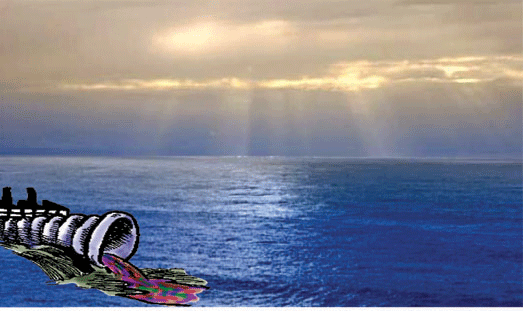 History of Bomb Strontium and Cesium Isotopes in Pacific Compared to Fukushima Sources http://www.dailykos.com/story/2014/01/16/1269942/-History-of-Bomb-Strontium-and-Cesium-Isotopes-in-Pacific-Compared-to-Fukushima-Sources# (EXCELLENT GRAPHS) by MarineChemist
The purpose of this diary is to compare the concentrations of Sr-90 and Cs-137 in the North Pacific Ocean over the last 50 years to the concentrations predicted to arrive on the west coast associated with waters affected by release of radionculides from the Fukushima-Daiichi Nuclear Power Plant. Given present levels that are being measured in the eastern Pacific and barring release rates that significantly exceed past rates in March-April 2011 the impact on marine organisms and the marine environment is going to be very minimal. What follows below the fold is a comparison of the concentrations measured and predicted over much of the Pacific owing to Fukushima to the concentrations that were present in the mid-1960s from the fallout of atmospheric weapons testing that is free from any discussion of safe doses or models of radiation exposure to organisms. Continue reading
North Korea – same old nuclear weapons threats – and how to break them

 Why North Korea’s Latest Nuclear Threats Are Like Groundhog Day All Over Again An expert explains why we’ve been here before, and how to break the cycle. Charlotte Alfred World Reporter, The Huffington Post , 19 Sept 15 North Korean officials sent a defiant message to the world over their nuclear and missile programs this week, as the reclusive regime gears up to celebrate the ruling party’s 70th anniversary.
The head of Pyongyang’s space agency said on Monday it was preparing to send a new earth observation satellite into space on a long-range rocket. The U.S. has warned this would violate United Nations resolutions against Pyongyang conducting ballistic missile tests, because of the similarity of the technology involved. Meanwhile, analysts and South Korean officials are skeptical of the announcement, saying there is little sign that Pyongyang is readying a satellite launch.
A day later, the director of North Korea’s Atomic Energy Institute announced that the country’s main Nyongbyon nuclear complex was fully operational again and reiterated threats to use nuclear weapons against the U.S. The complex was closed in 2007 during six-party talks with the U.S., China, Russia, Japan and South Korea. But the talks collapsed, and North Korea said in 2013 that it would resume nuclear enrichment. Tuesday’s announcement accords with recent analysis by 38 North, a project of the U.S.-Korea Institute at John Hopkins University, which concluded, based on satellite imagery, that North Korea is “expanding its capacity to mine and mill natural uranium.”
The WorldPost spoke to Chad O’Carroll, the founder of specialist news and media service NK News, about what’s behind the latest warning signs from Pyongyang.
Did North Korea’s announcements this week about the rocket launches and nuclear reactivation come out of the blue?
The statement about the satellite launch did not come out of the blue. North Korea has made at least two or three announcements this year about upcoming satellite launches, leading many analysts to suggest that there will likely be a satellite launch to coincide with the 70th anniversary of the ruling party. This has been a narrative building up to those events.
The nuclear announcement did not necessarily come out of the blue either. Pyongyang had already announced that they would reactivate the nuclear processing plant, and that’s been underway for a while. This week’s statement was potentially triggered by 38 North recently publishing satellite imagery that shows activity at the Nyongbyon nuclear complex. The North Korean media may be responding to that, amid the general build-up to the Oct. 10 anniversary.
What do we know about the current state of North Korea’s nuclear and missile programs, and how concerned should the world be about them?
The technology for long-range ballistic missiles has not been fully mastered yet. It takes North Korea several weeks, if not months, to set up a satellite launch. So this is not much of a military threat because that’s a long window of time for the U.S. to take that threat out.
The real threat is two-fold: usage of short-range to medium-range ballistic missiles — which North Korea has a lot of and have been proven to work — and low-end applications of nuclear technology. The problem is that as long as the status quo continues, the better North Korea’s technology becomes. Five or six years ago, no one would have thought that in 2015 North Korea would be showcasing submarine technology to launch ballistic missiles………
We have seen that the way that world leaders are currently responding to North Korea leads to Groundhog Day: complaints to the U.N., limited sanctions on North Korea, complaints from Pyongyang that it has been unfairly singled out, followed by further tensions and a new nuclear test, and then we’re back where we started.
Understandably, democratically elected leaders need to be seen to be responding to things, but having seen the cycle repeat itself so many times, it seems that there does need to be some fresh thinking. And there are only really two options on the table: one is military — and there doesn’t seem to be much appetite for that — and the other is of a different diplomatic response.
If you want to reduce the threat that North Korea’s weapons pose, the best solution is some kind of settlement and diplomatic agreement. Unfortunately, everything seems very far away in that regard right now. http://www.huffingtonpost.com.au/entry/north-korea-nuclear-weapons_55facf48e4b0fde8b0cd2596?section=australia&adsSiteOverride=au
South Africa’s govt keeping nuclear costs secret from the public

 Business Day denied nuclear cost reports http://www.bdlive.co.za/business/energy/2015/09/18/business-day-denied-nuclear-cost-reports BY CAROL PATON, 18 SEPTEMBER 2015, THREE reports by top international consultancies which explore the cost of building 9,600MW of nuclear power in SA have been classified as secret and will not be made available to the public, the Department of Energy has said.
The reports were commissioned in the past year by the department from KPMG, Ingerop and Deloitte to provide information on nuclear-procurement models, the cost of nuclear plants and financing models.
The Open Democracy Advice Centre requested the documents on behalf of Business Day under the Promotion of Access to Information Act last month.
In a reply received this week, deputy director-general of the department Zizamele Mbambo said “the records contain information to be used in the procurement process. The disclosure of such information will compromise the negotiations or prejudice the commercial competition as far as third parties are concerned”.
These were the same grounds used to maintain the secrecy of the intergovernmental agreements on nuclear co-operation. But when the agreements were tabled in Parliament in June, they contained no proprietary or commercial information. The letter also states that the documents are classified. Mr Mbambo has said the department’s studies show that the nuclear build “is affordable” without giving details.
Business Day editor Songezo Zibi said the application was made as “we have reason to believe that the cost studies the department does not want the public to see until it is too late in the process, show that 9,600MW of nuclear will be unaffordable”.
The Open Democracy Advice Centre is to appeal against the refusal.
Spokesman for the Right 2 Know Campaign Murray Hunter said the affordability study for SA’s strategic arms procurement in 1999 was classified until last year. “When this was unclassified, it was clear that there had been enormous financial risks. Governments often overclassify documents to shield themselves from accountability and end up making the wrong decisions. The fact that these documents are being withheld makes it impossible for SA to have the conversation about nuclear energy.”
Energy Minister Tina Joemat-Pettersson recently claimed that she had never advocated nuclear build of 9,600MW.
Mr Zibi said it “was also curious how a cost study can be conducted if, as the minister claimed, the size of the procurement was yet to be determined. What, then, would be the benchmark number if not the 9,600MW already mentioned by the president and ministers of energy including Ms Joemat-Pettersson?”
Salem nuclear plant cooling-water affecting the Delaware River

 New round of debate over Salem nuke’s water intake http://enviropoliticsblog.blogspot.com.au/2015/09/new-round-of-debate-over-salem-nukes.html#.Vf9Nq9KqpHw A regional environmental group set the stage Friday for a new round in the decades long battle over Salem nuclear plant cooling-water demands, submitting the most-detailed critique yet of the site’s 3-billion-gallon-per-day draw from the Delaware River. Jeff Montgomery reports for the The News Journal:
Delaware Riverkeeper, a multi-state environmental and conservation group, said New Jersey’s renewal of a federally required permit for the twin reactors’ intakes would be “irresponsible,” based on newly submitted and past economic and ecological studies.
The Global Climate Leadership Review 2015
New Climate Institute report: The Global Climate Leadership Review 2015: What the Paris negotiations mean for Australia and our economy September 18, 2015. The Global Climate Leadership Review 2015: What the Paris negotiations mean for Australia and our economy summarises global climate developments in the lead up to the Paris climate negotiations in late 2015. It explores what success in Paris would look like and also the impact of the agreement on the global and Australian economies.
The report is accompanied by a short video animation addressing the same issues.
The report is also part of the broader project, Focus on Paris & Beyond, that The Climate Institute has conducted throughout 2015. Reports, factsheets, infographics and other content can be accessed here on the project page.
Download the 5-page report at: http://www.climateinstitute.org.au/articles/publications/global-climate-leadership-review-2015.html
(And check out other recent Climate Institute reports and projects, media releases and briefs and multimedia available at:http://www.climateinstitute.org.au/)
Pilgrim nuclear plant just too costly to keep running
 Costs cited in possible closure of Pilgrim nuclear plant, Cape Cod Times, Christine Legere @chrislegereCCT 20 Sep 15 Entergy Corp. will announce some time this winter whether it will move forward with costly repairs and upgrades to the beleaguered Pilgrim Nuclear Power Station or simply decide the 43-year-old plant is no longer a moneymaker and close it down.
The Nuclear Regulatory Commission downgraded Pilgrim to the bottom of the performance list for the nation’s 99 operating reactors two weeks ago, based on the frequency of forced shutdowns and equipment failures there since 2013.
The so-called Column 4 category is just one step above mandatory shutdown by federal regulators. Only two other reactors in the country are in that performance category, both at Arkansas Nuclear I and both owned by Entergy.
Spokeswoman Lauren Burm said Entergy is now faced with a big decision. “If the corporation finds the cost of making improvements exceeds the value of the plant, it may consider shutting Pilgrim down,” Burm said.
Burm also noted the challenges of the current energy market. “The wholesale market has dropped and natural gas is hard to compete with,” she said.
Entergy must produce a performance improvement plan for federal regulators within six months, but a decision on Entergy’s future should be made long before then.
David Noyes, Pilgrim’s director of regulatory and performance improvement, said the scope of required work — along with cost figures he anticipates will be in the millions — is nearly ready for review by Entergy’s corporate leaders.
“They will work out the business models in terms of profitability,” Noyes said. Whether the plant continues to be financially viable will then be determined.
Costs will include necessary equipment, experts to monitor and analyze plant data, and workers to make required changes and upgrades, since the 600 current employees of the plant are needed for day-to-day operation.
Entergy just recently spent $70 million on Pilgrim, on equipment and additional staff, during its April refueling, yet the plant has been forced to power down twice since then.
Entergy must also pay the NRC for inspections, which have been frequent due to the plant’s performance.
Neil Sheehan, spokesman for the NRC, said last year’s inspections cost the company $1.8 million. Inspectors spent 6,500 hours at the plant, at a rate of $279 per hour.
The frequency of inspections will increase, Sheehan said, now that Pilgrim has been downgraded.
Meanwhile state Sen. Daniel Wolf, a Democrat from Harwich and longtime Pilgrim critic, has filed two bills that would add about $58 million to Entergy’s yearly expenses. The bills are expected to be considered this fall, Wolf said.
The first would impose a $10,000 annual charge for each spent fuel bundle that remains in pools at nuclear plants. Pilgrim has more than 3,000 bundles in its pool, making the charge $33 million. Wolf’s second bill would institute a requirement that $25 million be paid annually by nuclear plants into a decommissioning fund, so enough money would be available to cover closure.
“If those bills were to pass, that would be part of our evaluation of future viability,” Noyes said.
Wolf said he would like to see Pilgrim shut down. “This is a nuclear plant that federal officials have designated as a Category 4, a low to moderate safety risk; that’s just not acceptable,” Wolf said…….
Entergy closed Vermont Yankee, a boiling-water reactor similar to Pilgrim, in 2014, saying it was no longer economically viable. The corporation has secured federal approval to keep the Vermont plant in SafStor, which means fuel is removed from the reactor and stored in the spent fuel pools, but the reactor itself and all its components can remain onsite for 60 years.
Earlier this month, Entergy informed its investors that it will decide before the end of this calendar year whether to close the New York-based FitzPatrick Nuclear Power Plant, also similar to Pilgrim in size and type. “The decision will be based on the market,” Burm said……http://www.capecodtimes.com/article/20150920/NEWS/150929946
USA’s Republicans now pretend to support action on climate change
Republicans go from embracing junk science to junk policy on climate change https://www.washingtonpost.com/opinions/republicans-go-from-embracing-junk-science-to-junk-policy-on-climate-change/2015/09/17/ae717fea-5d77-11e5-9757-e49273f05f65_story.html By Editorial Board September 17
WHAT’S A larger lapse in leadership, refusing to admit that the country has a problem, or acknowledging the problem and refusing to tackle it? That question emerges from Wednesday’s GOP debate, in which Sen. Marco Rubio (Fla.) took offense at the notion that he is a climate “denier” but nevertheless led his fellow Republicans in condemning “left-wing” plans to address climate change.
“We’re not going to destroy our economy the way the left-wing government that we are under now wants to do,” Mr. Rubio declared. New Jersey Gov. Chris Christie piled on, warning against the “wild left-wing idea that somehow us by ourselves is going to fix the climate.” Wisconsin Gov. Scott Walker attacked the Environmental Protection Agency for allegedly endangering tens of thousands of jobs in its quest to reduce greenhouse gas emissions.
Not everyone on stage followed this script. Sen. Rand Paul (Ky.) tried to break into the conversation: “If you want a skeptic, Jake, I will happily jump into that briar patch.” Thankfully, the moderators shut him down for speaking out of turn, and others on stage who might have attacked scientists weren’t called on.
But the resulting conversation wasn’t much better. The message of the evening was: Climate change may be happening, but shame on those trying to address it.
In fact, the EPA estimates its carbon dioxide rules would cost $5.1 billion to $8.4 billion in 2030. Even if they are off somewhat, numbers of that size do not threaten a $17 trillion national economy. Mr. Rubio also argued that the country will reap no benefits from acting because the United States can’t solve climate change by itself. But the United States isn’t acting alone; its leadership is prompting action from other countries, which will meet in Paristhis year to pledge specific carbon-reduction goals. As with free trade, the way to coax other nations to move is for the United States to show willingness to move. Mr. Rubio condemns U.S. politicians who would fail to lead other nations, but he excuses himself from that responsibility on this issue.
If the candidates had any good alternatives to President Obama’s climate agenda, they didn’t let on. Mr. Christie bragged about one of his worst decisions as governor of New Jersey, pulling the state out of the Regional Greenhouse Gas Initiative, a market-based agreement among states in the Northeast and Mid-Atlantic to reduce carbon dioxide emissions. He claimed that his state still kept emissions down by using nuclear power and burning natural gas. But nuclear power is expensive and the nuclear fleet is aging. Natural gas, meanwhile, has been a success story but still produces significant greenhouse emissions and can be only a bridge to newer and cleaner energy technologies.
True conservatives would recoil from picking winners and losers in the energy debate and instead embrace the policies Mr. Christie attacked — market-based, technology-neutral plans that cut emissions while maximizing individual choice and minimizing costs.
Should we be grateful that some Republicans have moved from junk science to junk policy? Sadly, they remain on the reckless fringes of the debate, which is not where any credible candidate for president can be.
Unexpected shutdown at Pickering nuclear plant
System ‘trip’ at Pickering nuclear plant prompts scramble for energy http://toronto.ctvnews.ca/system-trip-at-pickering-nuclear-plant-prompts-scramble-for-energy-1.2571689 TVNews.ca Staff September 19, 2015
A “trip” in the system at the Pickering Power Plant caused an unexpected shutdown earlier this week, leaving the province scrambling to find alternative sources of energy, CTV News has learned.
The shutdown, caused by a “trip” in the system that is designed to ensure safe operations, forced Ontario to import power to keep electricity flowing in the province. The “trip” was caused by a turbine valve problem in the non-nuclear side of the reactor.
The sudden shutdown had a serious impact on the Ontario power grid. At the time, four reactors at the facility in Darlington, Ont. were already down for planned maintenance, along with two units at another nuclear facility.
Combined with the unexpected outage, the province was short 40 per cent of the nuclear supply.
The reactor in Pickering has since come back online and has been reconnected with the power grid.
With a report from CTV’s Paul Bliss.
Japan Crushes Resistance to Restart Nuclear Power Plants

From JapanFocus.org:
“Japan Crushes Resistance to Restart Nuclear Power Plants
The Asia-Pacific Journal, Vol. 13, Issue. 38, No. 1, September 21, 2015,
by Thierry Ribault
Summary: This article reviews the Abe administration’s moves to crush opposition to nuclear power and restart the first nuclear reactors since the closure of all 54 nuclear power plants following the triple meltdown of March 11, 2011. The author punctures official claims of an economic crisis resulting from post-3.11 import of fossil fuels, the basis for the Abe restart program. Likewise, claims that preserving a share of the energy mix to nuclear power is essential and inescapable in order to avert or alleviate climate crisis. Finally, the author considers the implications of government policies for the possible creation of a Japanese nuclear weapons arsenal.
On August 11, 2015, the n°1 reactor at Sendai nuclear power plant, located in Kagoshima Prefecture in south-west Japan…
View original post 5,581 more words
California Governor Warns of Coming Climate Refugee Crisis

Governor Brown of California states the obvious. A climate refugee crisis is waiting to happen in North America. Joe Romm at Climate Progress: The Syria conflict has triggered the largest humanitarian crisis since World War II,” explains the European Commission. As Climate Progress has been reporting for years, and as a major 2015 study confirmed, […]
http://climatecrocks.com/2015/09/16/california-governor-warns-of-coming-climate-refugee-crisis/
September 20 Energy News

Opinion:
¶ “Governor Shumlin: A model for getting energy right” Powerful fossil fuel interests and their climate-denier allies in Congress prevent meaningful action and work to preserve the status quo. Here in Vermont, however, we are showing that progress can be made and that there is a model for energy that is good for our economy and our environment. [Vermont Biz]
 A solar array at the Vermont Law School. Photo by SayCheeeeeese. Public domain, CC0.
¶ “Recent hearings were the last gasps of the Yucca Mountain road show” The federal government’s long-winded campaign to mollify the nuclear power industry by adopting Yucca Mountain as the burial grounds for spent, highly radioactive fuel rods is running on fumes. The NRC conducted hearings, but only because of a court order. [Las Vegas Sun]
Science and Technology:
¶ It is not clear where the idea of a “global warming…
View original post 499 more words
Migrant Crisis: ‘If We Don’t Stop Climate Change…What We See Right Now Is Just the Beginning’
A Q&A with Frank Biermann, a Dutch researcher who led a controversial 2010 study on climate refugees, who fears crises like Europe’s will only get worse.
By Phil McKenna
Sep 14, 2015
The surge of people fleeing to Europe from the Middle East highlights how quickly mass migrations can occur. It may also offer a glimpse of what’s to come as climate change makes some regions around the world unlivable, according to a leading researcher on the human effects of climate change.
Frank Biermann, a professor of political science and environmental policy sciences at VU University Amsterdam, led researchers in the Netherlands five years ago in a study that warned there may be as many as 200 million climate refugees by 2050. That staggering number first arose out of research in 1995, and it has always been controversial. The study Biermann led in 2010 recommended the creation of an international…
View original post 976 more words
Stand With Pope Francis#Auspol Be part of the #Climate solution.
Ahead of Pope Francis’s first visit to the U.S., NextGen Climate today launched a national campaign calling on our leaders to stand with Pope Francis and embrace clean energy solutions that protect our common home and secure our children’s future.
In the coming weeks, NextGen Climate will run TV, print and digital ads highlighting the diverse coalition of Americans who are answering the Pope’s moral call to action on climate change. NextGen Climate will also partner with Nuns on the Bus, a campaign of NETWORK, a National Catholic School Social Justice Lobby, to host rallies and events in Columbus, Ohio and Washington, DC urging our leaders to join the fight to build a clean energy future.
“Pope Francis’ visit to the United States has the power to shift the conversation about climate change in a very real way,” said NextGen Climate President Tom Steyer. “His may be the most important…
View original post 113 more words
Philippine Biodiversity Documentary by The Suicide Squad (ENVN01A- Clip #1)

https://www.youtube.com/v/fhu9vAkqRM4?fs=1&hl=fr_FRSourced through Scoop.it from: www.youtube.com
Most of us would be delighted to see more efforts such as this.
1 This Month
Chernobyl: The Lost Tapes – A good documentary on Chernobyl on SBS available On Demand for the next 3 weeks– https://www.sbs.com.au/ondemand/tv-program/chernobyl-the-lost-tapes/2352741955560

of the week–London Campaign for Nuclear Disarmament

Tell the Ukrainian Government to Drop Prosecution of Peace Activist Yurii Sheliazhenko
To see nuclear-related stories in greater depth and intensity – go to https://nuclearinformation.wordpress.com
-
Archives
- April 2026 (126)
- March 2026 (251)
- February 2026 (268)
- January 2026 (308)
- December 2025 (358)
- November 2025 (359)
- October 2025 (376)
- September 2025 (257)
- August 2025 (319)
- July 2025 (230)
- June 2025 (348)
- May 2025 (261)
-
Categories
- 1
- 1 NUCLEAR ISSUES
- business and costs
- climate change
- culture and arts
- ENERGY
- environment
- health
- history
- indigenous issues
- Legal
- marketing of nuclear
- media
- opposition to nuclear
- PERSONAL STORIES
- politics
- politics international
- Religion and ethics
- safety
- secrets,lies and civil liberties
- spinbuster
- technology
- Uranium
- wastes
- weapons and war
- Women
- 2 WORLD
- ACTION
- AFRICA
- Atrocities
- AUSTRALIA
- Christina's notes
- Christina's themes
- culture and arts
- Events
- Fuk 2022
- Fuk 2023
- Fukushima 2017
- Fukushima 2018
- fukushima 2019
- Fukushima 2020
- Fukushima 2021
- general
- global warming
- Humour (God we need it)
- Nuclear
- RARE EARTHS
- Reference
- resources – print
- Resources -audiovicual
- Weekly Newsletter
- World
- World Nuclear
- YouTube
-
RSS
Entries RSS
Comments RSS
 nuclear-news