Should Entergy’s profitability be our primary concern? Or might it be our grandchildren’s health?
 Cape Codders care not for Pilgrim’s profitability http://www.capecodtimes.com/article/20150927/OPINION/150929636 Paul Rifkin Sep. 27, 2015 Your paper covers the issue of the Pilgrim Nuclear Power Station in Plymouth several times a week. The same names keep appearing in your stories.
Spokesmen for Entergy, the owner of the Pilgrim facility, such as Lauren Burm, speak of the cost of making improvements to the plant exceeding the value of the plant. David Noyes, Pilgrim’s director of regulatory and performance improvement, says that Entergy “will work out the business models in terms of profitability.”
Value, profitability … is that what Cape Cod residents should be concerned about?
If there is an accident at Pilgrim, radioactive poison blowing in our direction … the bridges close … we are trapped … .
Should Entergy’s profitability be our primary concern? Or might it be our grandchildren’s health, our glorious loss of living on Cape Cod in perpetuity? As frequently quoted activist Diane Turco suggests, “Public safety should have no price tag.”
Turco’s voice is the voice of reason and sanity here. Let’s shutter Pilgrim before the sirens of toxicity sound and we come to realize that Turco was right. She and other anti-Pilgrim activists speak for us. Pay attention to that voice of sanity and reason. The possible consequences of honoring Entergy’s bottom line might be catastrophic.
Can Nuclear Plants Actually Operate Safely?
Cancer, Coverups and Contamination: The Real Cost of Nuclear Energy 27th September 2015
Andreas Toupadakis Ph.D Contributing Writer for Wake Up World
“…..If we assume that more nuclear power plants are constructed around the world, can anyone guarantee that the nuclear accidents will disappear? No, that is impossible. Not only will the risks not disappear, but logic dictates they will also increase if there are more plants in operation, as will the volume of unmanageable radioactive waste. And let us not forget the unpredictability of earthquakes. Nuclear accidents will always happen just like any other accidents do, which may affect both power plants and waste storage facitilities.
Reliance on nuclear energy not only results in building new nuclear power plants but also relicensing existing ones. The peril of tragic accidents within the industry will inevitably be higher, especially while maintaining plants that are decades old — as we have already witnessed with the ongoing disaster at Fukushima, as well as the overheated reactor at Miami’s Turkey Point facility in 2014. Other nuclear power plant disasters include:
- 1952 Chalk River, near Ottawa, Canada: a partial meltdown of the reactor’s uranium fuel core resulted after the accidental removal of four control rods.
- 1957 Windscale Pile No. 1, north of Liverpool, England: fire in a graphite-cooled reactor spewed radiation over the countryside, contaminating a 200-sq-mile area.
- 1957 South Ural Mountains, Soviet Union: an explosion of radioactive wastes at a Soviet nuclear weapons factory 12 miles from the city of Kyshtym forced the evacuation of over 10,000 people from a contaminated area.
- 1959, Santa Susana, USA: A reactor at the Atomics International field laboratory in the Santa Susana Mountains, California, experienced a power surge and subsequently spewed radioactive gases into the atmosphere. According to a 2009 report from the Los Angeles Times, residents blame the facility for their health issues and say the site remains contaminated.
- 1976, near Greifswald, East Germany: the radioactive core of a reactor in the Lubmin nuclear power plant nearly narrowly avoided meltdown following the failure of safety systems during a fire.
- 1979, Three-Mile Island, near Harrisburg, Pennsylvania: Following a combination of equipment malfunctions, design-related problems and worker error, one of two reactors lost its coolant which caused overheating and partial meltdown of its uranium core, releasing radioactive water and gases.
- 1986, Chernobyl, near Kiev, Ukraine: an explosion and fire in the graphite core of one of four reactors released radioactive material that spread over parts of the Soviet Union, Europe and Scandinavia.
- 1987, Rocky Flats Plant, near Denver, Colorado, USA: Following insider reports of unsafe conditions, investigation found numerous violations of federal anti-pollution laws, including discharging of pollutants, hazardous materials and radioactive matter into nearby creeks and water supplies. A subsequent grand jury report criticized the Department of Energy and Rocky Flats contractors for “engaging in a continuing campaign of distraction, deception and dishonesty”.
- 1999, Tokaimura, Japan: An uncontrolled chain reaction in a uranium-processing nuclear fuel plant spewed high levels of radioactive gas into the air, exposing 69 people, killing one worker, and seriously injuring two others.
- 2011, Fukushima Prefecture, Japan: The troubled Fukishima Daiichi nuclear plant in Japan has experienced a number of ‘incidents’ since its construction in 1971, culminating in total reactor failure when the plant was hit by a tsunami following an earthquake. At the time of the disaster, the plant began releasing substantial amounts of radioactive materials and, more than four years after the incident, the plant is still leaking radioactive water into the Pacific Ocean.
The extent of this recent disaster at Fukushima should not be taken lightly. The water leaking from the ailing plant contains plutonium 239 and its release into the world’s ocean system has global repercussions. Explains chemist John A. Jaksich for DecodedScience.com:
“Certain isotopes of radioactive plutonium are known as some of the deadliest poisons on the face of the Earth. A mere microgram (a speck of darkness on a pinhead) of Plutonium-239, if inhaled, can cause death, and if ingested… can be harmful, causing leukemia and other bone cancers.
“In the days following the 2011 earthquake and nuclear plant explosions, seawater meant to cool the nuclear power plants instead carried radioactive elements back to the Pacific ocean. Radioactive Plutonium was one of the elements streamed back to sea.”
As history has shown us, assurances on safety from nuclear operators and regulators are nothing but preposterous. That is something that the public understands — because it is common sense. No matter how much uncaring, financially invested scientists will try to convince the public of the safety of the nuclear industry, the public does not have a salary from working on nuclear business and so, unlike those working on behalf of the industry, can maintain integrity and common sense……….….http://wakeup-world.com/2015/09/27/cancer-coverups-and-contamination-the-real-cost-of-nuclear-energ
South Africa’s Treasury exposed on nuclear financing – annual report
Annual report exposes Treasury on nuclear says DA, Times Live, Fin24 | 27 September, 2015 A National Treasury official received training in nuclear finance, sponsored by South Korea, at an estimated cost of R500 000 in the 2014/15 financial year. This information listed among others in the National Treasury’s 2014/15 annual report contradicts claims by Finance Minister Nhlanhla Nene and Energy Minister Tina Joemat-Pettersson that the Treasury had only recently been invited into the decision-making process on the financing of the nuclear build programme, the DA said on Sunday.
South Africa has signed five international nuclear agreements with Russia (which is seen as the preferred bidder), France, China, South Korea and the US as it moves ahead with the procurement for its nuclear energy programme. A decision is due in March 2016.
The DA said in a statement the annual report shows that the National Treasury had clearly done more work on the feasibility, financing and assessment of alternative energy options, including nuclear energy, than the minister has been prepared to disclose; and much of the work was completed before the end of the 2014/15 financial year.
The DA said the 2014/15 annual report shows the Treasury:
• conducted and completed extensive work on nuclear energy during the 2014/15 financial year;
• some of the work was included in the decision-making process and submitted to the Department of Energy during the 2014/15 financial year; and
• an official, or officials, from the National Treasury, received training, at an estimated cost of R500 000, in nuclear finance, which was sponsored by South Korea.
“We cannot sit back and allow the nuclear build programme to go ahead in secret given the massive financial implications for South Africa,” the DA said……..
According to annual report, the Treasury’s National Capital Projects Unit, also completed “several in-depth studies on short and long-term energy generation options for South Africa”.
The DA said on Sunday although there is no explicit mention of nuclear energy, the National Capital Projects Unit’s in-depth studies “almost certainly include nuclear energy as a possible energy generation option for South Africa”.
It said Joemat-Pettersson “is walking a political tightrope because the National Treasury has more than likely raised serious questions about the feasibility of the nuclear build programme”.
The DA said it will request the chairperson of the Standing Committee on Finance, Yunus Carrim, to schedule a briefing by the National Treasury on the work conducted and completed on the nuclear build programme by the National Treasury; and the economic and financial implications of the proposed nuclear build programme for South Africa. http://www.timeslive.co.za/politics/2015/09/27/Annual-report-exposes-Treasury-on-nuclear-says-DA
Even nuclear supporters say that the UK govt should kill the Hinkley C Project
Even Nuclear Supporters Think Hinkley C Needs To Be Canceled, Clean Technica September 27th, 2015 by James Ayre
Even many of the supporters of nuclear energy in the “environmentalist” camp — such as George Monbiot, Mark Lynas, and Chris Goodall — are now advocating for the cancellation of the Hinkley C project in the UK, as evidenced by an article recently published by the three mentioned above.
When even supporters of the broader cause begin to question a specific project, it’s probably worth taking note. Is the Hinkley C project really such a boondoggle that even support from otherwise erstwhile supporters is nearing its end?
In the recent article from the above authors, the argument is made that the project possesses “all the distinguishing features of a white elephant: (it’s) overpriced, overcomplicated and overdue” — and also that the most recent delay should be used to sound the death knell for the project.
The exact words used in the article are pretty blunt: “The government should kill the project.”
The authors’ article in the Guardian provides more:……….http://cleantechnica.com/2015/09/27/even-nuclear-supporters-think-hinkley-c-needs-canceled/
The health toll of ionising radiation at all stages of the nuclear fuel chain
Cancer, Coverups and Contamination: The Real Cost of Nuclear Energy 27th September 2015
Andreas Toupadakis Ph.D Contributing Writer for Wake Up World “……Uranium mining has also cost many lives and great suffering, not just on the workers but on all the communities around these mines. These problems, and the lack of a solution or accountability from the nuclear industry, is described in detail in the ECRR report:
“In response to a challenge to the ethical foundation of civilian nuclear power and the cancers caused by licensed emissions, nuclear industry apologists have offered comparisons between the number of miners killed as part of the lifecycle of energy production in coal-fired power stations with the number of citizens killed by cancers consequent on nuclear releases. However, this is an ethically flawed position. The miners are well informed about the risky nature of their employment and accept it in return for direct pecuniary gain. Their situation is not the same as that of the adult or child who breathes in radioactive particles released from Sellafield without knowing they are in the air, or without benefiting directly from their production. Such people are in effect bystanders and thus have a morally distinct status from those who are engaged in producing the pollutants…
“If the nuclear industry and the military are to continue within a sound ethical framework serious questions need to be addressed and those who will suffer its health consequences need to be informed and consulted to a far greater extent than they ever have been… while children will inevitably die from leukemia as a result of radioactive discharges, causality will be denied and… [their numbers deemed] not worthy of consideration. The moral bankruptcy of such a justification is intuitively apparent…
“The Committee concludes that releases of radioactivity without consent can not be justified ethically since [even] the smallest dose has a finite, if small, probability of fatal harm.”
And how about many other locations, beside power plants, where radiation pollution exists? How about the hundreds of thousands of people that have died and suffered from the whole nuclear cycle? How about future generations who will similarly suffer from long-term contamination?
Nuclear power plants are just one point of the nuclear waste cycle. To this day, the disposal and storage of high-level nuclear waste remains a major unresolved issue. Now 15 years later, only 70 years into a million-year long waste cycle, we are no closer to solving the problem of mounting nuclear waste generated by these continuing programs. The populations in regions where radioactive waste is stored, such as Savannah River and Yucca Mountain (at which millions of gallons of high-level nuclear waste is stored in 49 leaking tanks), are equally as susceptible to disease as those communities near active power plants.
Furthermore, in 2000, the National Academy of Sciences released a report commissioned by the Department of Energy that states that most of the sites where the US federal government built nuclear bombs will never be cleaned up enough to allow public access to the land. The report also noted that the plan for guarding sites that are permanently contaminated is inadequate:
“Nearly 150 sites around the country are contaminated, a nagging reminder of the nuclear arms race. DOE has concluded that even after planned remediation activities are completed — or found to be infeasible — at these so-called “legacy” waste sites, 109 of them will never be clean enough for unrestricted use… [These sites] are located in 27 states, Puerto Rico, and territorial islands in the Pacific…
“There is no convincing evidence that institutional controls — such as surveillance of radioactive and other hazardous wastes left at sites, security fences, and deeds restricting land use — will prove reliable over the long run…
“Because the long-term behavior of contaminants in the environment is unpredictable and physical barriers may break down at some point, the committee urged DOE to develop its stewardship plans under the assumption that contaminant isolation eventually will fail… Today’s scientific knowledge and institutional capabilities do not provide much confidence that containment of sites with residual risks will function as expected indefinitely.”
And how about the places where nuclear material is processed into forms of nuclear fuel? From “nuclear rocks” into nuclear fuel, thousands of people die in agonizing death, families are destroyed, deformed children are born, and many others are born dead. These are very well established facts around the world, in every place that nuclear material is present in one form or another. In fact a 2003 review by the ECRR, headed by an adviser to the British Government, examined research results and concluded that that pollution from nuclear energy and weapons programs will account for as many as 65 million deaths, also asserting that previously accepted figures massively underestimated the nuclear industry’s impact on human life……….http://wakeup-world.com/2015/09/27/cancer-coverups-and-contamination-the-real-cost-of-nuclear-energy/
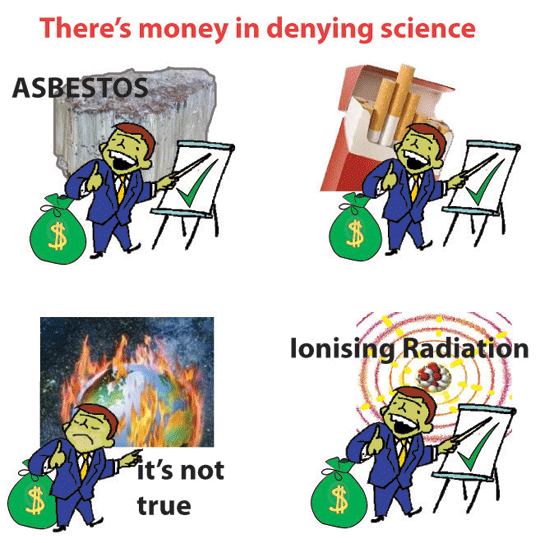
Radiation & science denial- theme for October 2015
Denial of the health effects of ionising radiation is the latest and the most sinister, of the lies against science. That lie is now being used as part of the campaign to get nuclear recognised at the UN December Paris Climate Conference as a “clean” technology – worthy of tax-payer funded incentives.
Denial of science is not new – goes back to Flat Earth and beyond. It does have to do with complex psychological issues. These include resentment and jealousy of the respected position of scientists, fear of change, and a kind of helplessness in the face of challenging circumstances.
There are other motivations – such as the desire to be famous and important – as being someone “brave enough to oppose the mainstream”
Then there’s the “libertarian idea” – so strongly believed by Rupert Murdoch, that government must not interfere with personal freedom. This idea would include – the freedom to promote smoking to young people, to get a job as an asbestos miner, to refuse to vaccinate children against fatal diseases, to accept that low level irradiation of one’s children is OK.
But none of these motivations would get “air play”, would prevail, if it were not for the Money Motive – the good old “What’s In It For Whom?” That’s the impetus behind public relations people, “consultants” , journalists, commentators, TV producers, film-makers etc who are paid by think tanks that are fronts for polluting industries, and for corporate giants like the Koch brothers. And – don’t let’s forget, – the scientists and science media who are paid by governments that are trapped – financially beholden to polluting corporations, and to the military industrial complex
1 This Month

of the week – Shut Down Drone Warfare!


Tell the Ukrainian Government to Drop Prosecution of Peace Activist Yurii Sheliazhenko

Petition to revoke the licensing of the Near Surface Nuclear Disposal Facility (NSDF) at Chalk River. https://www.ourcommons.ca/petitions/en/Petition/Details?Petition=e-7247
To see nuclear-related stories in greater depth and intensity – go to https://nuclearinformation.wordpress.com
-
Archives
- April 2026 (91)
- March 2026 (251)
- February 2026 (268)
- January 2026 (308)
- December 2025 (358)
- November 2025 (359)
- October 2025 (376)
- September 2025 (257)
- August 2025 (319)
- July 2025 (230)
- June 2025 (348)
- May 2025 (261)
-
Categories
- 1
- 1 NUCLEAR ISSUES
- business and costs
- climate change
- culture and arts
- ENERGY
- environment
- health
- history
- indigenous issues
- Legal
- marketing of nuclear
- media
- opposition to nuclear
- PERSONAL STORIES
- politics
- politics international
- Religion and ethics
- safety
- secrets,lies and civil liberties
- spinbuster
- technology
- Uranium
- wastes
- weapons and war
- Women
- 2 WORLD
- ACTION
- AFRICA
- Atrocities
- AUSTRALIA
- Christina's notes
- Christina's themes
- culture and arts
- Events
- Fuk 2022
- Fuk 2023
- Fukushima 2017
- Fukushima 2018
- fukushima 2019
- Fukushima 2020
- Fukushima 2021
- general
- global warming
- Humour (God we need it)
- Nuclear
- RARE EARTHS
- Reference
- resources – print
- Resources -audiovicual
- Weekly Newsletter
- World
- World Nuclear
- YouTube
-
RSS
Entries RSS
Comments RSS
 nuclear-news