San Onofre High radiation levels endangered employees
 Explosive report on radioactive waste handling at San Onofre High radiation levels endangered employees San Diego’s NBC affiliate is unleashing a story on nuclear waste deposited by Southern California Edison Corporation that may explain why the pristine State Beach is referred to in internal memos as
“Jap Mesa.”
Apparently the Geiger counter readings at some locations are so high that the site is reminiscent of Ground Zero at Hiroshima andNagasaki.
Key findings include…
– Attempts to keep documents on toxic radiation a secret.
According to the NBC report, SCE is attempting to keep radioactive
pollution a secret by forcing parties who are involved in negotiations
about the future of the property to sign non-disclosure agreements.
– Radioactive debris left on Beach and “Jap Mesa.”
“Hundreds of pieces” of contaminated radioactive equipment was
stored on both sides of the I-5, the heavily traveled freeway that
bisects the San Onofre Nuclear Waste Dump that is currently
under construction,
– Radiation levels at the beach-front property so alarming,
that in places inspectors from the Nuclear Regulatory Commission
refused to to perform routine radiation surveys.
– Southern California Edison controlled NRC radiation inspections
According to a former SCE Safety Officer, Edison’s cozy relationship
with inspectors from the Nuclear Regulatory Commission prevented
proper inspections. The former employee revealed that NRC inspectors
rarely conducted inspections outside areas that were identified by SEC.
– Trailers housing SCE employees had elevated readings
In an apparently rare incident where an NRC inspector conducted
radioactive testing without SCE’s supervision, a trailer housing
security guards had elevated readings.
– Calls for Third-Party Investigations
Former San Onofre employee and Safety Officer Vinod Arora is
calling on an independent third-party to thoroughly inspect the
tainted 25-acre parcel at San Onofre.
Get the full report and the confidential documents here.
Russia rattled by USA adding to its nuclear weapons stockpile in Germanay
 US Nuclear Weapons In Germany: Russia Concerned By American Plans To Add To Stockpile http://www.ibtimes.com/us-nuclear-weapons-germany-russia-concerned-american-plans-add-stockpile-2108265 By Christopher Harress @Charress c.harress@ibtimes.com on September 22 2015 Russia is concerned about U.S. plans to modernize and station additional nuclear weapons in Germany, according to Russian Foreign Ministry spokeswoman Maria Zakharova, who spoke with a German TV channel Tuesday. The channel had reported earlier in the day that the U.S. planned to station 20 nuclear weapons in the European country, as per a line in the 2015 U.S. defense budget.
“We are concerned that these states actually have nuclear weapons as part of the framework of NATO’s nuclear sharing program,” said Zakharova in an interview with Germany’s ZDF television, according to Russian news site Sputnik. Zakharova also said that the move would contravene the Treaty of Nonproliferation of Nuclear Weapons, which was ratified by 191 nations in 1970 to stop the spread of nuclear weapons.
“At the same time in Europe — not just in Germany, but also in Belgium, the Netherlands, Italy and Turkey — U.S. tactical nuclear armaments remain deployed,” said Zakharova, who also claimed that Russia had reduced its own stockpiles fourfold since the 1990s, despite the U.S. keeping its arsenal at strength. “The Americans are modernizing their aerial bombs, and the NATO European members are modernizing their aircraft that carry these weapons,” he said.
The U.S. continues to maintain nuclear carrying facilities in the countries mentioned by Zakharova through a NATO sharing program. As part of nuclear sharing, host countries carry out consultations, make decisions on weapons policy and maintain equipment required for the use of nuclear weapons, including warplanes capable of delivering them. The United Kingdom and France are the only countries in Europe that maintain state-owned nuclear arsenals.
As part of the renewed hostilities between the U.S.-led NATO and Russia, who are clashing over Moscow’s military actions in Ukraine, Russia has threatened to place short- to medium-range nuclear capable missiles in Kaliningrad, an enclave on the Baltic coast controlled by Russia, according to a BBC report. The missiles would have the ability to reach nearly all areas of Europe.
Anti-radiation pills coming in the mail to residents near Pickering nuclear plant
 Residents near Pickering nuclear plant to receive anti-radiation pills by mail http://toronto.ctvnews.ca/residents-near-pickering-nuclear-plant-to-receive-anti-radiation-pills-by-mail-1.2574427 TV Toronto , September 22, 2015 Residents living near the nuclear power plant in Pickering, Ont., will soon start receiving anti-radiation pills in the mail to protect them in the event of a radiation leak at the facility.
Starting in October, anyone living within a 10-kilometre radius of the Pickering Nuclear Plant will receive a pack of potassium iodide (KI) pills that help prevent thyroid cancer caused by exposure to radioactivity.
“It fills up your thyroid with iodine and therefore, if you ever get exposed to radioactive iodine, it can’t get into your thyroid and it prevents thyroid cancer,” said Ken Gorman, Durham region’s director of environmental health. More than 200,000 homes and businesses near the plant will receive kits containing the pills and a brochure explaining how to administer the treatment. Each package contains enough pills for one family.
Until now, potassium iodide pills have been available at local pharmacies to anyone who wanted to stock up. But in October 2014, the Canadian Nuclear Safety Commission ordered that the pill be distributed to all Canadians living or working within 10 kilometres of a nuclear facility.
In the event of a leak at a nuclear plant, residents are asked to evacuate the area as quickly as possible. If this isn’t possible, the provincial emergency authority recommends that people stay indoors and wait for instruction from authorities. With a report from CTV Toronto’s Austin Delaney
Clusters of Cancer – the shameful nuclear secret of Santa Susana Field Lab’s “Area Four,”

 LA’s Nuclear Secret: Part 1 Tucked away in the hills above the San Fernando and Simi valleys was a 2,800-acre laboratory with a mission that was a mystery to the thousands of people who lived in its shadow 4 Southern California By Joel Grover and Matthew Glasser, 22 Sep 15
“………..Researchers inside and out of government have contended that the radiation and toxic chemicals from Santa Susana might have caused many cancer cases. “The radiation that was released in 1959 and thereafter from Santa Susana is still a danger today,” Dr.Dodge said. “There is absolutely a link between radiation and cancer.”
The I-Team tracked down dozens of people diagnosed with cancer and other illnesses who grew up in the shadow of Santa Susana — in Canoga Park, West Hills, Chatsworth, Thousand Oaks, Simi Valley. Many of them believeh their cancers were caused by radiation and chemicals from the field lab.
Kathryn Seltzer Carlson, 56, and her sisters, Judy and Jennifer, all grew up in Canoga Park around the time of the nuclear meltdown and for years after, and all have battled cancer. “I played in the water, I swam in the water, I drank the water” that ran off the Santa Susana Field Lab, said Carlson, who finished treatment for ovarian cancer earlier this year and is now undergoing chemotherapy for lymphoma. “I’ve had, I don’t know how many cancers.”
Bonnie Klea, a former Santa Susana employee who has lived in West Hills since the 60s, also battled bladder cancer, which is frequently linked to radiation exposure. “Every single house on my street had cancer,” Klea said. A 2007 Centers for Disease Control study found that people living within two miles of the Santa Susana site had a 60 percent higher rate of some cancers.
“There’s some provocative evidence,” said Dr. Hal Morgenstern, an epidemiologist who oversaw the study. “It’s like circumstantial evidence, suggesting there’s a link” between the contamination from Santa Susana and the higher cancer rates.
Silence From the Government
For more than two months, the I-Team asked to speak with someone from the U.S. Department of Energy (DOE), the federal agency that’s responsible for all nuclear testing, to ask why workers were ordered to release dangerous radiation over Los Angeles, why the DOE has never publicly admitted this happened, and what it plans to do to help get the site cleaned up.
The DOE emailed the I-Team, “We will not have anyone available for this segment.”
So the I-Team showed up at a public meeting this month about Santa Susana and asked the DOE’s project manager for the site, Jon Jones, to speak with us. He walked away and wouldn’t speak.
Will the Contamination Ever Be Cleaned Up?
Community residents, many stricken with cancer and other radiation-related illnesses, have been fighting for years to get the government and the private owners of the Santa Susana Field Lab to clean up the contamination that remains on the site.
But efforts in the state legislature and state agencies that oversee toxic sites have, so far, stalled. But residents, with the support of some lawmakers, continue to fight for a full cleanup. “People are continuing to breathe that (radiation) in and to die,” Chatsworth resident Arline Mathews said.”See that this is done immediately, before more lives are lost.” http://www.nbclosangeles.com/investigations/LA-Nuclear-Secret-327896591.html
Privatisation of USA’s nuclear arsenal – wasteful, inefficient, irresponsible
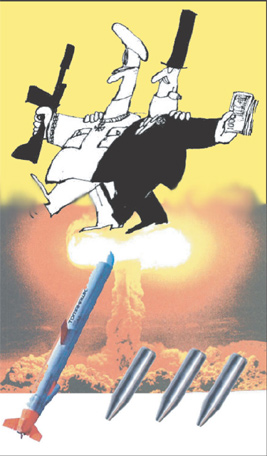 the production, maintenance, and modernization of nuclear weapons are sources of super profits for what is, in essence, a cartel.
Many Americans are unaware that much of the responsibility for nuclear weapons development, production, and maintenance lies not with the Pentagon but the Department of Energy (DOE), which spends more on nuclear weapons than it does on developing sustainable energy sources.
Through contracts with URS, Babcock & Wilcox, the University of California, and Bechtel, the nuclear weapons labs are to a significant extent privatized. The LANL contract alone is on the order of $14 billion. Similarly, the Savannah River Nuclear Facility, in Aiken, South Carolina, where nuclear warheads are manufactured, is jointly run by Flour, Honeywell International, and Huntington Ingalls Industries.
One of the reasons nuclear weapons profitability is extremely high is that the National Nuclear Security Administration (NNSA) of the Department of Energy, responsible for the development and operations of the DOE’s nuclear weapons facilities, does not monitor subcontractors, which makes it difficult to monitor prime contractors as well.
Meet the Private Corporations Building Our Nuclear Arsenal, Privatizing our nuclear arsenal development is not only dangerous, but incredibly inefficient, The Nation By Richard Krushnic andJonathan Alan King, 22 Sept 15
Imagine for a moment a genuine absurdity: Somewhere in the United States, the highly profitable operations of a set of corporations were based on the possibility that sooner or later your neighborhood would be destroyed and you and all your neighbors annihilated. And not just you and your neighbors, but others and their neighbors across the planet. What would we think of such companies, of such a project, of the mega-profits made off it?
In fact, such companies do exist. They service the American nuclear weapons industry and the Pentagon’s vast arsenal of potentially world-destroying weaponry. They make massive profits doing so, live comfortable lives in our neighborhoods, and play an active role in Washington politics. Most Americans know little or nothing about their activities and the media seldom bother to report on them or their profits, even though the work they do is in the service of an apocalyptic future almost beyond imagining.
No major reason why we can’t shift to 100 per cent renewable energy by 2050
 World could go 100% renewable by 2050 for net economic gain REneweconomy By Sophie Vorrath on 21 September 2015 [excellent graphs and tables ] Whether or not last week’s unceremonious changing of the guard in Canberra will shift Australia’s political debate on renewables from bickering over costs, to developing sensible policy for growth, remains to be seen.
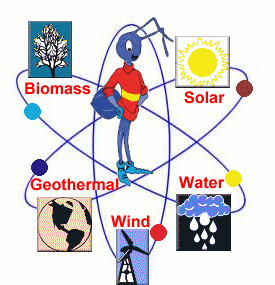
But a new report released by Greenpeace International on Monday has reinforced the view that there are no major economic or technical barriers to shifting the world to 100 per cent renewable energy by 2050; nor to the complete phase-out of fossil fuels. All we need now is the political will to do it.
Greenpeace’s Energy [R]evolution scenario 2015 phases out coal, oil, gas and nuclear energy as fast as technically and economically possible, by expanding the renewable energy share to 42 per cent in 2030, 72 per cent in 2040 and 100 per cent in 2050.
The only remaining use for fossil fuels, says the report, would be in the non-energy sector, such as petrochemicals and steel making.
Of course, the transition will not come cheaply. As you can see in the chart below, [on original] there is a lot to be done, and according to, the costs will be “huge” at around $US1 trillion a year. But the analysis also shows that the savings are even bigger.
“The investment costs for the switch to 100% renewables by 2050 is about $US1 trillion a year,” the report says.
“But because renewable energies don’t need fuel, the average fuel cost savings are $US1.07 trillion a year. So the investment over the period is met in full (107 per cent) by fuel cost savings, with the cross-over happening between 2025 and 2030.
Beyond 2050, there are no further fuel costs in renewable energy, thus stabilising energy costs for socities, as well as reducing energy sector emissions to near zero.
So it is not only achievable by 2050, according to Greenpeace’s analysis, but affordable, cost competitive, a net job creator and would bring a huge cut in global emissions. You can see in the table below[on original] how this plays out under Greenpeace’s scenario, as compared to the International Energy Agency’s “Current Policies” scenario.
A large part of the report focuses on the global power generation sector, which it notes has been the most dynamic, with a renewables comprising 60 per cent of new generation world wide in 2014, despite energy subsidies still being “weighted heavily in favour of fossil fuels.”
According to the report, the transformation to a carbon free 100% renewable energy system in the Advanced Energy [R]evolution scenario – Greenpeace’s optimum scenario – will increase global electricity demand in 2050
to more than 40,000 TWh/a from about 18,860 TWh/a in 2012.
“Electricity will become the major renewable ‘primary’ energy, not only for direct use for various purposes but also for the generation of synthetic fuels for fossil fuels substitution,” says the report……………http://reneweconomy.com.au/2015/world-could-go-100-renewable-by-2050-for-net-economic-gain-90746
Sloppy management of San Onofre’ s nuclear waste
Documents Detail How Nuclear Material Was Handled at San Onofre Nuclear Generating Station, Expert tells NBC 7 Investigates handling of nuclear material was “sloppy” NBC, By JW August and Lynn Walsh Documents newly obtained by NBC 7 Investigates during secret talks about the condition of the land where the San Onofre Nuclear Generating Station (SONGS) sits detail how nuclear material was handled at the plant since the 1980s.
The documents were released to individuals involved with the secret negotiations about the current condition and future handling of the 25-acre property. According to a source familiar with the negotiations, the secret meetings have been going on for about 20 months and involve all the players with a stake in the prime coastal property.
Those players include the U.S. Navy, which owns the property; the U.S. Marines, whose base surrounds the property; and Southern California Edison (SCE) and San Diego Gas and Electric (SDG&E), both of which hold the lease to the property.
The current lease was signed on April 2011, and according to the agreement, ends on May 12, 2023.
A source close to the lease negotiations told NBC 7 Investigates that SCE and SDG&E want out of the lease as soon as possible. According to the source, the team representing the utilities has told all involved they want nondisclosure agreements signed so no one can go public with any information disclosed during the negotiations.
So far, one or more of the parties involved in the talks are refusing to sign the nondisclosure agreements. Continue reading
Questions raised about China’s funding and management of UK’s nuclear power project
Nuclear venture raises questions about UK-China relationship George Osborne says Britain wants to be China’s best partner in the west, but open-door approach raises security issues, Guardian Julian Borger and Emma Graham-Harrison, 23 Sept 15, Britain’s open-door policy towards Chinese nuclear investment has raised fresh questions about relations with Beijing: is it an adversary, a partner or a bit of both?
For years, intelligence officials – in particular the electronic surveillance centre GCHQ – have warned that Chinese hacking attacks are one of the most substantial threats to Britain’s cybersecurity. When the Foreign Office announced in 2011 that it had repelled an attack on its internal communications from “a hostile state intelligence agency”, officials briefed that China was the culprit.
Now George Osborne says Britain wants to be “China’s best partner in the west”, and to that end Chinese companies will be permitted to build a nuclear power station in Bradwell, Essex, possibly the first of several such ventures. The dissonance has not gone unnoticed.
“All western countries are torn between their desire to cash in on China’s rise and their fears about China’s longer-term intentions,” said Mark Leonard, the director of the European Council on Foreign Relations. “The United States goes to great lengths to try to protect their critical infrastructure from China – from stoppingChina from investing in oil companies and windfarms to placing limits on telecoms companies like Huawei. Americans are slightly horrified by the open-door approach of the UK government, which welcomed Huawei to protect the London tube and to run its nuclear power stations.”
China already owns a significant slice of the UK’s strategic infrastructure. …….
Prof Steve Tsang, a senior fellow of the China policy institute at Nottingham University, said: “It clearly shows that the UK’s China policy and energy policy are now made by the Treasury, not by the Foreign Office and energy department.” http://www.theguardian.com/politics/2015/sep/22/nuclear-venture-questions-uk-china-relationship-security
Melting Arctic permafrost adds to the $300 trillion economic costs of climate change
Emissions from melting permafrost could cost $43 trillion, Science Daily September 21, Source: University of Cambridge
- Summary:
- New analysis of the effects of melting permafrost in the Arctic points to $43 trillion in extra economic damage by the end of the next century, on top of the more than the $300 trillion economic damage already predicted.
- New analysis of the effects of melting permafrost in the Arctic points to $43 trillion in extra economic damage by the end of the next century, on top of the more than the $300 trillion economic damage already predicted.Increased greenhouse gas emissions from the release of carbon dioxide and methane contained in the Arctic permafrost could result in $43 trillion in additional economic damage by the end of the next century, according to researchers from the University of Cambridge and the University of Colorado.
In a letter published today (21 September) in the journal Nature Climate Change, the researchers have for the first time modelled the economic impact caused by melting permafrost in the Arctic to the end of the twenty-second century, on top of the damage already predicted by climate and economic models.
The Arctic is warming at a rate which is twice the global average, due to anthropogenic, or human-caused, greenhouse gas emissions. If emissions continue to rise at their current rates, Arctic warming will lead to the widespread thawing of permafrost and the release of hundreds of billions of tonnes of methane and CO2 — about 1,700 gigatonnes of carbon are held in permafrost soils in the form of frozen organic matter.
Rising emissions will result in both economic and non-economic impacts, as well as a higher chance of catastrophic events, such as the melting of the Greenland and West Antarctic ice sheets, increased flooding and extreme weather. Economic impacts directly affect a country’s gross domestic product (GDP), such as the loss of agricultural output and the additional cost of air conditioning, while non-economic impacts include effects on human health and ecosystems.
The researchers’ models predict $43 trillion in economic damage could be caused by the release of these greenhouse gases, an amount equivalent to more than half the current annual output of the global economy. This brings the total predicted impact of climate change by 2200 to $369 trillion, up from $326 trillion — an increase of 13 percent……..http://www.sciencedaily.com/releases/2015/09/150921112731.htm
Radiation risks to interventional cardiologists
 Interventionalists Receive 4.7 Times the Radiation Exposure to Left Side of Head Than Right Side During Invasive Cardiovascular Procedures Published study reveals exposure at 16 times the ambient radiation level WASHINGTON, Sept. 22, 2015 /PRNewswire/ — The results of a research study indicate that interventional cardiologists receive “very high” radiation exposure levels to the left side of the head specifically when performing fluoroscopically guided invasive cardiovascular (CV) procedures. Even with modern imaging equipment and shielding, a significant exposure difference was seen between the two sides of the head. The study was published in JACC: Cardiovascular Interventions, a peer-reviewed journal of the American College of Cardiology. Dr. Ehtisham Mahmud, MD, FACC, FSCAI, chief of Cardiovascular Medicine, director of Sulpizio Cardiovascular Center Medicine and director, Interventional Cardiology at UC San Diego, authored the study.
According to the study, interventionalists received 16 times the ambient radiation level to the left side of the head during an invasive CV procedure. Also, radiation exposure on the left side of the head was 4.7 times higher than exposure on the right side of the head. Interventional cardiologists typically stand anteriorly to the patient, with the left side of their body closest to the patient’s chest and most proximate to the radiation source.
“The implications of this study are significant when considering the subsequent impact ongoing exposure to even low levels of radiation can have on the health of the practitioner over the course of their career,” said Dr. Mahmud………..http://www.prnewswire.com/news-releases/interventionalists-receive-47-times-the-radiation-exposure-to-left-side-of-head-than-right-side-during-invasive-cardiovascular-procedures-300146945.html
Nevada test site videos on nuclear bomb testing
 Building the atom bomb – Nevada test site videos, Guardian By Laurence Topham , Alok Jha and Will Franklin 22 September 2015 From 1951, over four decades, the US government carried out almost a thousand nuclear tests at this test site, earning it the nickname of the “most bombed place on Earth”. Here, they took the crude nuclear weapons that had been dropped over Hiroshima and Nagasaki in 1945 and honed their destructive power.
A hundred of these tests, known as atmospheric shots, took place above ground, creating the characteristic mushroom clouds that have become synonymous with nuclear detonations.
The government still carries out classified work on the site, and access is limited to a small number of carefully vetted visitors each year, who are not allowed to take photographs. The Guardian was given extremely rare access to film at the site……..
In nearby towns such as St George in Utah, which were downwind of the Nevada Test Site, people found the nuclear programme more troubling.
After decades of campaigns by the so-called Downwinders, Congress passed the Radiation Exposure Compensation Act in 1990 to make payments to some of those who claimed to have been affected by fallout from nuclear tests at the Nevada Test Site.
So far, $2bn (£1.3bn) has been paid out to more than 32,000 claimants. The compensation is only available to a limited number of those who claim to have been affected and for a limited set of conditions…..http://www.theguardian.com/us-news/ng-interactive/2015/sep/21/building-the-atom-bomb-the-full-story-of-the-nevada-test-site
Department of Transportation rules violated in shipment of Y-12 uranium
Y-12 uranium shipment reportedly violated DOT rules, Knoxville News Sentinel, Frank Munger, Sep 22, 2015 OAK RIDGE — A federal spokesman at the Y-12 nuclear weapons plant confirmed that a July shipment did not comply with some Department of Transportation regulations for transporting hazardous materials, and he said Y-12 officials have been in contact with DOT and “are cooperating with their findings.”
Steven Wyatt of the National Nuclear Security Administration also confirmed that the “special nuclear material” shipped from Y-12 to a commercial facility was uranium, although he refused to say if it was highly enriched or weapons-grade uranium and would not specify how much uranium was sent to the unnamed facility.
The NNSA, a semi-independent part of the U.S. Department of Energy that oversees the nuclear weapons complex, last week said Y-12 inadvertently shipped more nuclear material than intended to a private facility. After the mistake was discovered, a special team from Y-12 reportedly went to the site and secured the material for return to Oak Ridge…….http://www.knoxnews.com/news/local-news/y12-uranium-shipment-reportedly-violated-dot-rules_22839052
South Carolina to review law that allows nuclear utilities to charge rate-payers in advance
| South Carolina to conduct analysis of Base Load Review Act |
Enformatble 22 Sep 15 Officials from the South Carolina Office of Regulatory Staff will conduct a review of the Base Load Review Act, the legal mechanism which allowed South Carolina Electric & Gas (SCE&G) to increase rate-payers bills by 27.7% through a series of annual rate increases to collect funds to pay for the construction of two new nuclear reactors at the V.C. Summer nuclear power plant. The construction of the new reactors has been continually hindered by cost overruns and construction delays and is currently at least three years behind the original construction schedule.
The review will consider whether the Base Load Review Act is the best method for utilities to collect funds for large projects like the construction of nuclear power plants. The Base Load Review Act allows utilities to charge ratepayers for certain costs while the project is under construction, as opposed to the utilities using their own resources or loans to pay for construction costs and recovering fees from consumers only after the facility is producing power.
As a part of the review, the Office of Regulatory Staff will compare the costs of building the new nuclear reactors under the Base Load Review Act against the costs of building them under traditional financing methods. When completed the review will be presented to the Public Service Commission, but no timetable for its completion has been released yet.
Consumers and organizations like the AARP and the South Carolina Small Business Chamber of Commerce have been calling for a review saying that the rate increases are putting an unfair burden on rate payers with the greatest impacts being on the low-income families and the elderly. Critics of the Base Load Review Act say that it shifts the risk for the project onto consumers, who are forced to pay for a facility even if it never is put into operation….. http://enformable.com/2015/09/south-carolina-to-conduct-analysis-of-base-load-review-act/?utm_source=feedburner&utm_medium=email&utm_campaign=Feed%3A+Enformable+%28Enformable%29
1 This Month

of the week – Shut Down Drone Warfare!


Tell the Ukrainian Government to Drop Prosecution of Peace Activist Yurii Sheliazhenko

Petition to revoke the licensing of the Near Surface Nuclear Disposal Facility (NSDF) at Chalk River. https://www.ourcommons.ca/petitions/en/Petition/Details?Petition=e-7247
To see nuclear-related stories in greater depth and intensity – go to https://nuclearinformation.wordpress.com
-
Archives
- March 2026 (251)
- February 2026 (268)
- January 2026 (308)
- December 2025 (358)
- November 2025 (359)
- October 2025 (376)
- September 2025 (257)
- August 2025 (319)
- July 2025 (230)
- June 2025 (348)
- May 2025 (261)
- April 2025 (305)
-
Categories
- 1
- 1 NUCLEAR ISSUES
- business and costs
- climate change
- culture and arts
- ENERGY
- environment
- health
- history
- indigenous issues
- Legal
- marketing of nuclear
- media
- opposition to nuclear
- PERSONAL STORIES
- politics
- politics international
- Religion and ethics
- safety
- secrets,lies and civil liberties
- spinbuster
- technology
- Uranium
- wastes
- weapons and war
- Women
- 2 WORLD
- ACTION
- AFRICA
- Atrocities
- AUSTRALIA
- Christina's notes
- Christina's themes
- culture and arts
- Events
- Fuk 2022
- Fuk 2023
- Fukushima 2017
- Fukushima 2018
- fukushima 2019
- Fukushima 2020
- Fukushima 2021
- general
- global warming
- Humour (God we need it)
- Nuclear
- RARE EARTHS
- Reference
- resources – print
- Resources -audiovicual
- Weekly Newsletter
- World
- World Nuclear
- YouTube
-
RSS
Entries RSS
Comments RSS
 nuclear-news