No major reason why we can’t shift to 100 per cent renewable energy by 2050
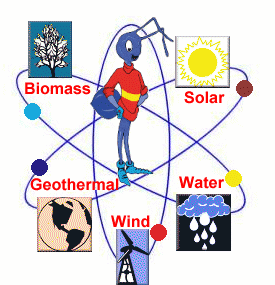 World could go 100% renewable by 2050 for net economic gain REneweconomy By Sophie Vorrath on 21 September 2015 [excellent graphs and tables ] Whether or not last week’s unceremonious changing of the guard in Canberra will shift Australia’s political debate on renewables from bickering over costs, to developing sensible policy for growth, remains to be seen.
But a new report released by Greenpeace International on Monday has reinforced the view that there are no major economic or technical barriers to shifting the world to 100 per cent renewable energy by 2050; nor to the complete phase-out of fossil fuels. All we need now is the political will to do it.
Greenpeace’s Energy [R]evolution scenario 2015 phases out coal, oil, gas and nuclear energy as fast as technically and economically possible, by expanding the renewable energy share to 42 per cent in 2030, 72 per cent in 2040 and 100 per cent in 2050.
The only remaining use for fossil fuels, says the report, would be in the non-energy sector, such as petrochemicals and steel making.
Of course, the transition will not come cheaply. As you can see in the chart below, [on original] there is a lot to be done, and according to, the costs will be “huge” at around $US1 trillion a year. But the analysis also shows that the savings are even bigger.
“The investment costs for the switch to 100% renewables by 2050 is about $US1 trillion a year,” the report says.
“But because renewable energies don’t need fuel, the average fuel cost savings are $US1.07 trillion a year. So the investment over the period is met in full (107 per cent) by fuel cost savings, with the cross-over happening between 2025 and 2030.
Beyond 2050, there are no further fuel costs in renewable energy, thus stabilising energy costs for socities, as well as reducing energy sector emissions to near zero.
So it is not only achievable by 2050, according to Greenpeace’s analysis, but affordable, cost competitive, a net job creator and would bring a huge cut in global emissions. You can see in the table below[on original] how this plays out under Greenpeace’s scenario, as compared to the International Energy Agency’s “Current Policies” scenario.
A large part of the report focuses on the global power generation sector, which it notes has been the most dynamic, with a renewables comprising 60 per cent of new generation world wide in 2014, despite energy subsidies still being “weighted heavily in favour of fossil fuels.”
According to the report, the transformation to a carbon free 100% renewable energy system in the Advanced Energy [R]evolution scenario – Greenpeace’s optimum scenario – will increase global electricity demand in 2050
to more than 40,000 TWh/a from about 18,860 TWh/a in 2012.
“Electricity will become the major renewable ‘primary’ energy, not only for direct use for various purposes but also for the generation of synthetic fuels for fossil fuels substitution,” says the report……………http://reneweconomy.com.au/2015/world-could-go-100-renewable-by-2050-for-net-economic-gain-90746
No comments yet.
1 This Month


Tell the Ukrainian Government to Drop Prosecution of Peace Activist Yurii Sheliazhenko

Petition to revoke the licensing of the Near Surface Nuclear Disposal Facility (NSDF) at Chalk River. https://www.ourcommons.ca/petitions/en/Petition/Details?Petition=e-7247


of the week – STOP SMALL MODULAR REACTORS IN CANADA
To see nuclear-related stories in greater depth and intensity – go to https://nuclearinformation.wordpress.com
-
Archives
- March 2026 (176)
- February 2026 (268)
- January 2026 (308)
- December 2025 (358)
- November 2025 (359)
- October 2025 (376)
- September 2025 (258)
- August 2025 (319)
- July 2025 (230)
- June 2025 (348)
- May 2025 (261)
- April 2025 (305)
-
Categories
- 1
- 1 NUCLEAR ISSUES
- business and costs
- climate change
- culture and arts
- ENERGY
- environment
- health
- history
- indigenous issues
- Legal
- marketing of nuclear
- media
- opposition to nuclear
- PERSONAL STORIES
- politics
- politics international
- Religion and ethics
- safety
- secrets,lies and civil liberties
- spinbuster
- technology
- Uranium
- wastes
- weapons and war
- Women
- 2 WORLD
- ACTION
- AFRICA
- Atrocities
- AUSTRALIA
- Christina's notes
- Christina's themes
- culture and arts
- Events
- Fuk 2022
- Fuk 2023
- Fukushima 2017
- Fukushima 2018
- fukushima 2019
- Fukushima 2020
- Fukushima 2021
- general
- global warming
- Humour (God we need it)
- Nuclear
- RARE EARTHS
- Reference
- resources – print
- Resources -audiovicual
- Weekly Newsletter
- World
- World Nuclear
- YouTube
-
RSS
Entries RSS
Comments RSS
 nuclear-news
Leave a comment