Sustainable infrastructure needed – there’s no Planet B
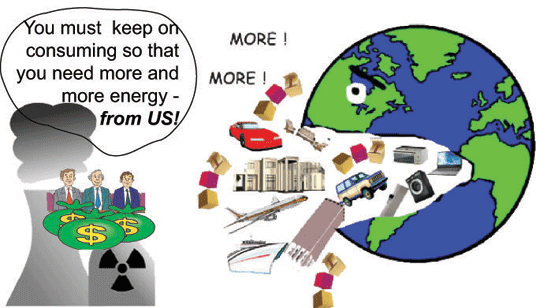 We Have Just One Planet (Not Four), Huffington Post , Denise Nelson Vice President for Public Education at the Institute for Sustainable Infrastructure 15 Sept 15 The United Nations estimates the world population to reach 9.6 billion by 2050 and 10.9 billion by 2100. These billions of new people will need infrastructure to provide clean water, sanitary-waste removal, energy, transportation systems, data systems, and more. This infrastructure is the foundation necessary to achieve other global goals: promoting good health, clean water, and sanitation; providing access to quality education and jobs in a thriving economy; and supporting sustainable cities and economies.
Immense resources are required to expand infrastructure systems, and our business-as-usual approach cannot continue indefinitely. The Global Footprint Networkreports that, world-wide, we are operating on our one planet as if we have 1.4 planets worth of resources at our disposal. The United States operates as if we have four planets to work with, and Europe operates as if they have two to three planets. If allowed to continue, this overuse of natural resources and reduction of ecosystem services will have devastating consequences worldwide. It’s critical that the worst offenders develop new practices and that the current practices from these countries are not adopted by developing nations.
A new paradigm is necessary to support this growth and development in a sustainable manner. Sustainable-infrastructure development is about building stronger, more resilient communities, as well as providing safe and reliable services in a way that preserves what people value: the quality of their community, their environment, and their future. Sustainable infrastructure means many things: regional and trans-border inclusivity and collaboration, affordable infrastructure with equitable access for all, infrastructure that supports economic growth and development, resource efficiency, use of clean and environmentally sound technologies, and promotion of research and innovation.
Community planners, architects, engineers, and other infrastructure professionals have the opportunity to implement sustainable practices with each individual infrastructure project in order to build sustainable communities. However, the task of evaluating every type of sustainable technology, product, or process, and comparing those options, can be quite overwhelming. There are guidance and project-assessment systems available for specific types of infrastructure, such as buildings, roads, and landscaping (Leadership in Energy and Environmental Design, GreenRoads, andSITES, respectively) among others. There are also systems available for specific geographies (CEEQUAL in the United Kingdom and IS in Australia). While these are great resources, the not-for-profit Institute for Sustainable Infrastructure (ISI) in collaboration with the Harvard Zofnass Program for Sustainable Infrastructureidentified the need for clear, concise guidance on sustainable practices for all types of infrastructure projects worldwide.
Together, they developed Envision, a guidance manual and project-assessment tool to promote sustainable-infrastructure best practices………http://www.huffingtonpost.com/denise-nelson/we-have-just-one-planet-not-four_b_8124624.html?utm_hp_ref=politics&ir=Politics
No comments yet.
1 This Month

of the week – Shut Down Drone Warfare!


Tell the Ukrainian Government to Drop Prosecution of Peace Activist Yurii Sheliazhenko

Petition to revoke the licensing of the Near Surface Nuclear Disposal Facility (NSDF) at Chalk River. https://www.ourcommons.ca/petitions/en/Petition/Details?Petition=e-7247
To see nuclear-related stories in greater depth and intensity – go to https://nuclearinformation.wordpress.com
-
Archives
- March 2026 (251)
- February 2026 (268)
- January 2026 (308)
- December 2025 (358)
- November 2025 (359)
- October 2025 (376)
- September 2025 (257)
- August 2025 (319)
- July 2025 (230)
- June 2025 (348)
- May 2025 (261)
- April 2025 (305)
-
Categories
- 1
- 1 NUCLEAR ISSUES
- business and costs
- climate change
- culture and arts
- ENERGY
- environment
- health
- history
- indigenous issues
- Legal
- marketing of nuclear
- media
- opposition to nuclear
- PERSONAL STORIES
- politics
- politics international
- Religion and ethics
- safety
- secrets,lies and civil liberties
- spinbuster
- technology
- Uranium
- wastes
- weapons and war
- Women
- 2 WORLD
- ACTION
- AFRICA
- Atrocities
- AUSTRALIA
- Christina's notes
- Christina's themes
- culture and arts
- Events
- Fuk 2022
- Fuk 2023
- Fukushima 2017
- Fukushima 2018
- fukushima 2019
- Fukushima 2020
- Fukushima 2021
- general
- global warming
- Humour (God we need it)
- Nuclear
- RARE EARTHS
- Reference
- resources – print
- Resources -audiovicual
- Weekly Newsletter
- World
- World Nuclear
- YouTube
-
RSS
Entries RSS
Comments RSS
 nuclear-news
Leave a comment