UK nuclear lobby is seeking a blank cheque from the governmnet
So where is the British flight into ‘nuclear power is cheap somewhere’ fantasy leading us? Well, to nationalisation, of course
 What the pro-nuclear lobby now wants is for limitless sums of money to be siphoned off from public spending on education, health and whatever else and spent on building nuclear power stations. The money will be notionally borrowed, a contract that will be concocted that will claim that the electricity consumer will pay the money back at a later date, and the balance will be paid for by, well, less schools, hospitals etc. Meanwhile a story will be manufactured about how all of this is cheap.
The state will end up giving the whole project a blank cheque so that the disastrous construction process can be bankrolled entirely from a bottomless pit of state finances.
 The notion that nuclear is cheaper somewhere else is a myth http://realfeed-intariffs.blogspot.co.uk/2015/09/the-notion-that-nuclear-is-cheaper.html by Dr David Toke The British attitude to the notion that nuclear power is not cheap after all is a bit like a child who first hears that Father Christmas does not, after all, exist. Disbelief, and in this case a belief that if only Father Christmas is nationalised, then it will still be true. The psychologists call this cognitive dissonance, in other words if a fact is uncomfortable to you, you believe that the fact is wrong.
Scrutinising Japan’s government PR about The Reopening Of Nahara Fukushima
 The Reopening Of Nahara Fukushima, What The Press Failed To Mention, Simply Info September 9th, 2015 The press has widely reported the reopening of Nahara as the government uses it as a PR tool. Much of the reporting focused on issues such as the lack of stores, services or schools. This is a distraction from the very real pressing concern of the radiation levels and uncertain status of the town’s decontamination efforts.
Nahara has been plagued with problems and high radiation levels yet the government has characterized the town as being “safe”. Nahara was the site of Fukushima Daiichi debris findings in 2013. ……..
Asahi Shimbun discovered illegal practices were being used in the decontamination work being done in Nahara in 2013. Nahara currently houses large stockpiles of radioactive soil and debris as seen in this photo. The town is part of the long term consolidated storage plan where contaminated soil from around Japan is being collected and stored near Fukushima Daiichi.
Nahara’s city water supply was found to have 18,700 bq/kg of cesium in the soil in the bottom of the reservoir. In May of 2014 Nahara officials demanded that the central government decontaminate Nahara to pre-disaster levels. Nothing further was reported on this to show any response to these requests………
Recent soil sampling done by Iwaki Radiation Measuring Center with the help of a former Fukushima Daiichi worker who collected the samples found alarmingly high radiation.
Soil samples in Nahara were found as high as:
52500 bq/kg cesium 137 & 134 combined
34790 bq/kg cesium 137 & 134 combined
26480 bq/kg cesium 137 & 134 combined……..http://www.fukuleaks.org/web/?p=15023
USA Senator Markey scathing about NRC decision to stop Cancer Risk Pilot Study
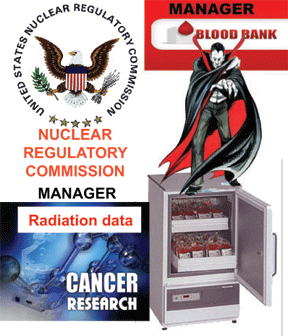 Senator Markey Statement on NRC Decision to End Cancer Risk Pilot Study http://www.markey.senate.gov/news/press-releases/senator-markey-statement-on-nrc-decision-to-end-cancer-risk-pilot-study September 8, 2015
Washington (September 8, 2015) – Statement from Senator Edward J. Markey (D-Mass.), a member of the Environment and Public Works Committee, on the announcement this morning from the Nuclear Regulatory Commission (NRC) that it is ending the pilot study of cancer risks in populations near U.S. nuclear power facilities being conducted by the National Academy of Sciences.
“We need a thorough, accurate accounting of the health risks associated with living near nuclear facilities so residents can know if there are any adverse health impacts associated with living close to nuclear reactors. But the NRC has decided to take a ‘Don’t Ask, Don’t Tell’ approach to this public health concern by ceasing work on what could be a life-saving cancer risk research study. The NRC blames budgetary constraints for ending the study, but what price do residents pay for living near operating nuclear facilities? We should know that answer, and the NRC should prioritize the resources to continue and complete this study.”
In 2013, Senator Markey praised NRC’s decision to start the study, having originally called on the NRC in 2009 to perform the independent research.
France heading towards a nuclear industry phaseout?
 France tilting toward nuclear phase-out, DW 10 Sep 15 As the traditionally strong French nuclear power industry continues to be plagued by technical and financial difficulties, the government has sought to cut nuclear power in favor of renewables. French Environment Minister Segolene Royal sparked rebuke Tuesday (08.09.2015) by tying shutdown of the country’s oldest nuclear plant to the opening of an EPR reactor that has been delayed for six years already………last year, Areva recorded a loss of 5 billion euros. The group hasn’t sold a single power plant in the last seven years, and the Fukushima disaster looks to have had further impacts on demand for new reactors.
Third-generation nuclear reactors – so-called European Pressurized Reactors (EPR) – were initially considered a secure technology for the future and the flagship of the French nuclear industry. But even they have been fraught with problems.
Despite Royal’s recent statement, recently passed legislation on renewable energy in France may be the most telling sign that the winds of change appear to be blowing – toward a nuclear phase-out.
Technology of the future turns sour
Operational start of the Olkiluoto 3 EPR in Finland has been delayed from 2009 to 2018, and the Flamanville 3 reactor in France from 2012 to 2018. Construction costs for Flamanville 3 have exploded, from 3.3 to more than 10 billion euros. Two EPR reactors at the Hinkley Point nuclear facility in England have also been the focus of controversy, as construction costs are much higher than initially projected. Financing for completing the project has still not been secured.
There is also the prospect of major safety issues. In mid-April it became known that there were weak points in the steel vessel that surrounds the reactor at the French Flamanville plant, which could lead to cracking under pressure.
The French Nuclear Safety Agency (ASN) called the situation “very serious,” and has demanded a comprehensive report by October.
If the regulating authority judges the vessel unsafe, it would be a disaster for Areva. Replacing it would take several years and result in additional costs in the hundreds of millions of euros, experts say.
Yannick Rousselet, a nuclear energy expert at Greenpeace, says further delays would deal a death blow to the EPR project. Aside from the two European reactors, no EPR installation has been successfully completed – there are just two projects in China.
“Only a few years ago, Areva told us that worldwide it would be finalizing two to three reactors per year,” Rousselet said. “The reality today is that the EPR as an industrial project is dead.”
EDF steps in to save AREVA. The French state owns 86.5 percent of Areva and 84.5 percent of EPR, which is the world’s second-largest electricity provider and a major nuclear power producer.
In an emergency meeting with President Francois Holland in June, it was agreed that EDF should buy in to Areva’s reactor business.
“Without these measures, Areva wouldn’t survive the year,” said Mycle Schneider, editor of the World Nuclear Industry status report.
And according to Schneider, help for Areva doesn’t spell an end French nuclear power’s problems.
EDF is considerably larger than Areva, and has an annual turnover of 70 billion euros. But Schneider points out its also has 37.5 billion euros of debt. Schneider sees this mountain of debt as a central problem.
According to the Paris audit office, the company faces an additional 50 billion euros in costs for dismantling and disposal of nuclear waste.
From nuclear to renewables?
As nuclear energy faces these problems, winds of change appear to be blowing through the French energy system.
Marc Bussieras, head of EDF’s economic strategy department, is open to energy production without nuclear. EDF’s priority is a cost-effective strategy, he told DW.
“Today in France, there are economic reasons in favor of installing renewable energy capacity,” Bussieras said.
Marc Bussieras, head of strategy at EDF, said at a DW panel renewables make economic sense
The French government is seeking to promote an energy transition through new legislation, which is also hoped to create jobs. The law, adopted in July 2015, states that the share of nuclear power in France’s energy mix should be reduced from 75 percent today to 50 percent by 2025. The shortfall in power supply should primarily be covered by wind and solar.
According to a study commissioned by the national environmental agency (ADEME), a complete phase-out of nuclear power and switch to 100 percent renewable energy should be possibly – and economically viable – by 2050…….
Schneider sees other opportunities for the nuclear industry. “The future lies in the huge market for demolition and nuclear waste management,” Schneider said. “New constructions will remain the exception.” http://www.dw.com/en/france-tilting-toward-nuclear-phase-out/a-18692209
Anxieties in China over the safety of the nation’s nuclear power programme

 China resumes nuclear power plant construction after a four-year freeze By Zhang Yu Source:Global Times Published: 2015-6-15“…China recently ended its pause for approvals of nuclear power plants put into place after the 2011 nuclear accident in Japan. This year, as many as eight nuclear power plants may be launched in China. Some experts are warning that this is going too fast with controversial technology…….
Since 2004, China has been approving projects using advanced nuclear power reactors, including US-based Westinghouse’s AP1000 and France-based Areva’s EPR (Evolutionary Power Reactor), many of which are now under construction. Dubbed generation III reactors, they are designed to withstand the crisis that damaged the Japanese nuclear plant.
Construction of these projects has not been smooth. Sanmen Nuclear Power Station in Zhejiang Province was expected to be the first nuclear power plant in the world that uses AP1000 technology. The first of the two reactors was scheduled to finish construction and start operation in November 2013, but construction is now over 18 months behind schedule. The plant won’t start operation until 2016 at the earliest, an official from China’s State Nuclear Power Technology, the company building the power plant, said in January.
The company has struggled to keep its schedule because of constant changes in design and new problems that emerged during tests, previous reports said.
In a statement by the economic planner of Zhejiang Province in 2013, its energy department said the delay has slowed down the province’s nuclear development and affected the power supply plan in Zhejiang. It has also undermined China’s overall plan to make AP1000 its major technology in new nuclear plants……..
She said hydroelectricity and other new energy means should be developed in inland areas. “Nuclear shouldn’t play an important role in China’s energy structure,” she said.
“The rapid speed of China’s nuclear expansion, and the direction it is expanding – to the most populous inland areas – is unprecedented…Besides, China’s nuclear industry has a tendency to exaggerate its achievements to the central government, so as to gain more funding,” He told the Global Times.
He also warns of a nuclear accident when the total number of nuclear power plants reaches 50 – the total number of nuclear plants built and under construction in China.
“According to past experiences, the likelihood of a disaster rises sharply after a country runs over 50 nuclear power plants, as is the case in the US and Japan,” he said……..http://www.globaltimes.cn/content/927146.shtml
No accountability for the $billions being spent on Oak Ridge Uranium Processing Facility.
 BUSTED! UPF bomb plant to break the bank at $11 Billion, UPF Update. Orepa.org 10 Sep 15
Nuclear Regulatory Commission prevents hearing on Fermi nuclear plant
 Nuclear regulators halt plans for Fermi 2 hearing BY TOM HENRY BLADE STAFF WRITER
http://www.toledoblade.com/Energy/2015/09/09/Nuclear-regulators-halt-plans-for-Fermi-2-hearing.html#Ge8j5KJYItT4iPTj.99 NEWPORT, Mich. — Anti-nuclear activists trying to stop DTE Energy’s Fermi 2 nuclear plant from getting a 20-year license extension were dealt a setback Tuesday when the U.S. Nuclear Regulatory Commission killed their plans for a special hearing about the plant’s continued operation.
The agency’s commissioners overruled a decision by the NRC’s Atomic Safety and Licensing Board to grant a hearing on three issues, or contentions, as regulators call them.
The plant’s operating license expires March 20, 2025.
Three environmental groups — Don’t Waste Michigan, Citizens Environment Alliance of Southwestern Ontario, and Beyond Nuclear — filed a request for a hearing with four proposed contentions challenging DTE’s application.Another environmental group, Citizens Resistance at Fermi 2, also known as CRAFT, filed a separate hearing request with fourteen proposed contentions.
Requests for the hearing were opposed by DTE and the NRC’s staff.
The NRC said its rules for allowing hearings on such contentions “are designed to ensure that only focused, well-supported issues are admitted for hearing.”
The coalition of groups said it plans to appeal the NRC’s decision in federal court.
The agency’s licensing board had granted a hearing on safety and environmental contentions regarding the common transmission line corridor shared by Fermi 2 and the proposed new Fermi 3 reactor.
Activists warned of a “domino effect” if either of those reactors or their high-level radioactive waste storage pools released radiation. Contact Tom Henry at: thenry@theblade.com, 419-724-6079, or via Twitter @ecowriterohio.
In brief – solar energy and climate news
Why solar energy is poised for yet another record year.
The growth boom is being fueled by a combination of declining costs, low interest rates, and a federal solar investment tax credit, a new report suggests.
http://www.washingtonpost.com/news/energy-environment/wp/2015/09/09/why-solar-energy-is-poised-for-yet-another-record-year/ & http://www.dailyclimate.org/t/3864796633753627934
Energy boss tips solar explosion
One of the sector’s most experienced leaders has predicted a major investment in ‘utility scale’ solar power.
http://www.theaustralian.com.au/national-affairs/climate/energy-boss-grant-king-tips-solar-explosion/story-e6frg6xf-1227520102456
Sophie Lewis: Sure, winter felt chilly, but Australia is setting new heat records at 12 times the rate of cold ones
Melbourne, Canberra and much of southern Australia have shivered through a cold winter. But on a longer view, record cold snaps are disappearing, while Australian heat records continue to be broken.
https://theconversation.com/sure-winter-felt-chilly-but-australia-is-setting-new-heat-records-at-12-times-the-rate-of-cold-ones-35607
Forest fires in Alaska: A ticking climate time bomb
As US President Barack Obama visits Alaska to focus attention on climate change, scientists warn that this very bad wildfire year is part of a vicious cycle caused by – and accelerating – climate change.
http://www.dw.com/en/forest-fires-in-alaska-a-ticking-climate-time-bomb/a-18684423
Nuclear whistleblower Mordechai Vanunu again under house arrest in Israel
 Israeli nuclear whisteblower Vanunu under house arrest over TV interview, DW, 10 Sept 15
More than a decade since completing his 18-year jail-term for exposing details of Israel’s nuclear weapons, Mordechai Vanunu has been put under house arrest. His detention follows a TV interview regarding the disclosure. Army radio reported on Thursday that Vanunu had been arrested in the early hours of September 5, hours after privately owned Channel 2 broadcast an interview which authorities said violated the terms of his 2004 release.
The 60-year-old reportedly appeared in a Jerusalem court before he was confined to his home for seven days. The court also imposed a ban on Vanunu using the Internet.
A senior Israeli security official later confirmed Vanunu’s detention, telling DPA news agency that he was forbidden from sharing any classified information which he learned while working at the Israeli nuclear plant in Dimona, “even if he already published that information in the past.”
Nucelar whistleblower
Vanunu was first imprisoned in 1986 for exposing details behind Israel’s nuclear weapons plan to British newspaper “The Sunday Times.”
He spent more than 10 years of his sentence in solitary confinement.
In 2010, Vanunu was imprisoned for a second time after a court ruled that he had broken the terms of his release by talking to a foreigner……
Police have demanded to see last week’s interview in its entirety. Channel 2 has refused to hand over the unedited footage, however, on the grounds of the journalistic principle of the protection of sources. The television station is now taking the case to court.
Israel has neither confirmed nor denied that it owns nuclear weapons – the only Middle East country to do so.
It has also refused to sign the nuclear Non-Proliferation Treaty – which aims to prevent the spread of nuclear weapons – or to allow international surveillance of the Dimona plant in the country’s south east. http://www.dw.com/en/israeli-nuclear-whisteblower-vanunu-under-house-arrest-over-tv-interview/a-18707561
UN says a global nuclear test ban is an urgent necessity

 Global nuclear-test ban urgently needed for safer, more secure world – UN officials, United Nations, 10 September 2015 – Top United Nations officials today highlighted the existential threat posed by nuclear testing, and called for all States that have not yet done so to sign and ratify the international treaty that seeks to achieve a ban on such testing.
Addressing a meeting to mark the International Day against Nuclear Tests, observed annually on 29 August, Secretary-General Ban Ki-moon noted the devastation caused by nuclear testing.
“I have witnessed the lasting societal, environmental and economic damage nuclear tests have caused,” he told the gathering. “Since the first test in New Mexico 70 years ago, the world has endured over 2,000 nuclear tests. Those tests devastated pristine environments and local populations around the world.
“Many have never recovered from the legacies of nuclear testing – including poisoned groundwater, cancer, birth defects and radioactive fallout,” Mr. Ban continued. “Today let us also send a strong signal that the international community stands united to take action that will lead us to a safer and more secure world – a world free of nuclear weapons.”
The Secretary-General said that the Comprehensive Nuclear-Test-Ban Treaty (CTBT), which was adopted in 1996, was an essential building block for achieving this goal as a legally-binding, verifiable means by which to constrain the quantitative and qualitative development of nuclear weapons.
Stressing that the Treaty must enter into force in order to be truly effective, Mr. Ban called on all remaining States to sign and ratify the instrument, including China, the Democratic People’s Republic of Korea, Egypt, India, Iran, Israel, Pakistan, and the United States.
The importance of the CTBT was also highlighted by the President of the General Assembly, Sam Kutesa, who underscored the need for a world free of nuclear testing……. http://www.un.org/apps/news/story.asp?NewsID=51843#.VfHx1tKqpHw
Exelon dithers about closing uneconomic nuclear power plants in Illinois
EXELON DELAYS CLOSURE DECISION ON 2 ILLINOIS NUCLEAR PLANTS http://abc7chicago.com/business/exelon-delays-closure-decision-on-2-illinois-nuclear-plants/977661/ September 10, 2015 Exelon Corp. says it is delaying for one year its decision about whether to close nuclear plants in the Quad Cities and Byron.
Chicago-based Exelon owns Illinois’ 11 nuclear reactors. It has previously said its generating stations in the Quad Cities, Byron and Clinton were in danger of closing.
Exelon said Thursday that it plans to continue operating its Quad Cities nuclear power plant through at least May 2018 and the Byron plant will operate through May 2019. The company said the Clinton station remains “economically challenged” and could be closed if conditions don’t improve.
Exelon president and CEO Chris Crane called the decision a “short-term-reprieve.” He said policy reforms are needed to level the clean energy playing field and position Illinois to meet EPA carbon reduction rules.
Nuclear power just isn’t the answer to climate change
 http://www.gazettetimes.com/news/opinion/as-i-see-it/as-i-see-it-nuclear-power-isn-t-the-answer/article_e1344eb7-11a0-584c-ae40-5b3135957709.html September 09, 2015 DEBRA HIGBEE-SUDYKA
However, there are real concerns about the resurgence of nuclear power, and how this energy source will impact the environment and our economy. We need a comprehensive clean energy policy that supports the most efficient, economical and environmentally safe energy sources. These sources must not only reduce greenhouse gases but also do so in the cleanest, fastest, and safest way possible.
The Sierra Club does not see how new nuclear power, including small modular reactors, meets the criteria necessary for a safe and secure energy future. We wish to call attention to some of the reasons why Sierra Club believes nuclear is the wrong choice:
• Nuclear energy does not address climate change: Building a fleet of new reactors will take decades, not nearly fast enough to address climate change. And nuclear energy is not carbon-free, especially if you factor into the equation of the construction of the plant, the sourcing of uranium, the transportation and ultimately the long-term storage of its waste. Climate change and energy independence can be achieved much cheaper and faster through efficiency measures as well as readily available clean renewable resources.
• It’s too expensive for consumers and taxpayers: Nuclear power is not just expensive; it is becoming the most cost-prohibitive energy source. The estimated costs of new nuclear power plants have tripled since 2000. Cost comparisons show that building a new fleet of nuclear power plants (especially small modular reactors, which lack economies of scale) will far exceed the costs of other, better energy options.
The Congressional Budget Office estimates the likelihood of default for loans made to nuclear reactor developers to be “well above 50 percent.” The signal coming from the market place is clear: the nuclear industry, even after high levels of cradle-to-grave subsidies, handouts, and incentives provided by the federal government, is too expensive and risky. Overall, electricity produced by new reactors would cost two to three times more than renewable energy and efficiency measures.
• Nuclear power is not “homegrown”: Virtually every part of the nuclear chain is dependent on foreign corporations, governments, or nationalized companies. In 2013, more than 83 percent of the uranium used for U.S. nuclear power plants was imported from other countries. The United States’ high-priced uranium resources, subject to world uranium price volatility, mean that our dependence on foreign uranium is not likely to change significantly in the future.
Nuclear power is an ineffective and risky choice for addressing the global challenge of climate change. The Sierra Club believes in options that will not only be cheaper, cleaner and faster to bring on-line, but also will create more jobs, stimulate our economy, be truly homegrown and will not contribute to the risk of terrorism or require centuries of waste management.
Debra Higbee-Sudyka, of Corvallis is a Conservation Committee member of the Oregon Chapter of the Sierra Club and is active with the Sierra Club Nuclear Free Campaign.
German utility E.ON gives up plan to set up anew nuclear company, in view of new liability law proposed
E.ON Faces Massive Loss After Scrapping German Nuclear Spinoff
Utility said it would post a hefty net loss this year after booking billions of euros in impairments, WSJ, MONICA HOUSTON-WAESCH and FRIEDRICH GEIGER Sept. 10, 2015 BERLIN—E.ON SE will post a massive loss this year after ditching plans to unload its German nuclear operations into a new company, in a nod to government proposals to saddle utilities with liabilities related to nuclear energy.
E.ON expects to book impairment costs this quarter of as much as €9 billion ($10 billion), triggering a multibillion-euro loss. Its shares plunged to an all-time low on Thursday, dropping 6% to €9.09.
The German utility had planned to move its nuclear operations into Uniper, a company being established to operate conventional power, trading, exploration and production. The spinoff will proceed but without German nuclear activities, said E.ON, which also has Swedish nuclear operations……..
E.ON’s decision was prompted by government proposals for legal changes that would make utilities permanently liable for the costs of nuclear waste and plant decommissioning……..
E.ON now plans to bundle its German nuclear operations into an independent unit within E.ON. Its Swedish nuclear operations will be spun off into Uniper as planned……http://www.wsj.com/articles/e-on-drops-plan-to-spin-off-german-nuclear-plants-1441865094
-
Archives
- February 2026 (228)
- January 2026 (308)
- December 2025 (358)
- November 2025 (359)
- October 2025 (376)
- September 2025 (258)
- August 2025 (319)
- July 2025 (230)
- June 2025 (348)
- May 2025 (261)
- April 2025 (305)
- March 2025 (319)
-
Categories
- 1
- 1 NUCLEAR ISSUES
- business and costs
- climate change
- culture and arts
- ENERGY
- environment
- health
- history
- indigenous issues
- Legal
- marketing of nuclear
- media
- opposition to nuclear
- PERSONAL STORIES
- politics
- politics international
- Religion and ethics
- safety
- secrets,lies and civil liberties
- spinbuster
- technology
- Uranium
- wastes
- weapons and war
- Women
- 2 WORLD
- ACTION
- AFRICA
- Atrocities
- AUSTRALIA
- Christina's notes
- Christina's themes
- culture and arts
- Events
- Fuk 2022
- Fuk 2023
- Fukushima 2017
- Fukushima 2018
- fukushima 2019
- Fukushima 2020
- Fukushima 2021
- general
- global warming
- Humour (God we need it)
- Nuclear
- RARE EARTHS
- Reference
- resources – print
- Resources -audiovicual
- Weekly Newsletter
- World
- World Nuclear
- YouTube
-
RSS
Entries RSS
Comments RSS
 nuclear-news