Nuclear Regulatory Commission scraps public rulemaking on weak GE containments,
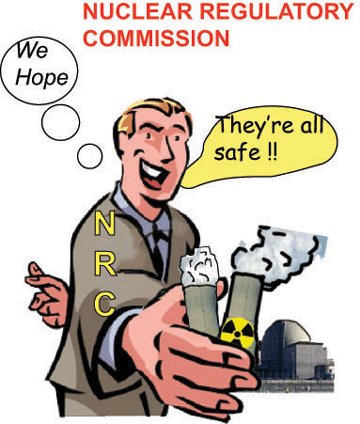 A Fukushima Lesson Unlearned: NRC scraps public rulemaking on weak GE containments, Enformable Paul Gunter 4 Sept 15 The United States Nuclear Regulatory Commission (NRC) typically begins its narrative on the “lessons learned” from the Fukushima Daiichi nuclear catastrophe with Japan’s March 11, 2011 accident. Not surprisingly, the agency has avoided addressing the most critical lesson recognized in the accident’s official investigative report by Japan’s National Diet. In their finding, the unfolding radiological catastrophe is “manmade” and the result of “willful negligence” of government, regulator and industry colluding to protect Tokyo Electric Power Company’s financial interests. Likewise, here in the US, addressing identical reactor vulnerabilities remain subject to a convoluted corporate-government strategy of “keep away” with public safety as the “monkey in the middle” going back more than four decades and, for now, three nuclear meltdowns later.
In the latest development, by a 3-1 vote issued on August 19, 2015, the majority of the four sitting Commissioners with NRC ruled not to proceed with their own proposed rulemaking and bar public comment and independent expert analyses on the installation of “enhanced” hardened containment vents on 30 U.S. reactors. In the event of a severe nuclear accident, roughly one-third of U.S. atomic power plants currently rely upon a flawed radiation protection barrier system at General Electric (GE) Mark I and Mark II boiling water reactors that are essentially identical to the destroyed and permanently closed units at Fukushima Daiichi. The nuclear catastrophe has resulted in widespread radioactive contamination, massive population relocation, severe economic dislocation and mounting costs projected into the hundreds of billions of dollars.
Fundamentally at fault, the GE Mark I and Mark II boiling water reactor “pressure suppression containment system” designed for internalizing such a nuclear accident is roughly one-sixth the volumetric size of pressurized water reactor containment designs like Three Mile Island. Under accident conditions, the reactor pressure vessel and the operation of the emergency core cooling system is depressurized into the “drywell” containment component which in turn routes steam, heat, combustible gases and radioactivity into the “wetwell” component where it is supposed to be quenched and scrubbed in a million gallons of water. The GE design was first identified as too small to contain potential accident conditions in 1972 by Atomic Energy Commission memos. The internal communications would eventually be released years later under the Freedom of Information Act after more GE reactors were granted operating licenses. The memos revealed that the undersized containment system is highly vulnerable to catastrophic failure from over-pressurization in the event of a severe accident. This long recognized chink in GE’s “defense-in-depth” armor was graphically confirmed with the global broadcast of the Fukushima explosions.
Fukushima further demonstrated that “voluntary” GE containment modifications requested by NRC in the early 1990’s are not reliable under real accident conditions. Most U.S. Mark I operators voluntarily installed a hardened vent on the “wetwell” or “torus” containment component. The same modification was installed in Japanese reactors including Fukushima Daiichi. The voluntary containment modifications in the U.S. were carried out under a NRC regulation (10 CFR 50.59) that avoids licensee disclosures in the public hearing process, claiming that the design changes did not raise significant safety issues. Other than the paper trail, even the NRC inspectors were not aware of the final as-built containment modifications…………
The Commission’s August 19th majority vote is effectively a gag order on the American public’s opportunity for formal input to fortify the continued operation of GE Mark I and Mark II reactors against the next nuclear catastrophe. Ironically, the international nuclear industry is simultaneously cashing in on the effort to restart Japan’s nuclear power plants where their Nuclear Regulation Authority has ordered state-of-the-art engineered external filters on severe accident capable hardened containment vents as a prerequisite to resume operation. On August 17, 2015, AREVA issued a press release announcing that it had just delivered it fourteenth filtered containment vent system to the Hamaoka Unit 4 reactor operated by Chubu Electric Power Company where 70% of the Japanese public no longer trust the industry and its regulator and remain opposed to any further nuclear power operations. http://enformable.com/2015/09/a-fukushima-lesson-unlearned-nrc-scraps-public-rulemaking-on-weak-ge-containments/
No comments yet.
1 This Month



Tell the Ukrainian Government to Drop Prosecution of Peace Activist Yurii Sheliazhenko

Petition to revoke the licensing of the Near Surface Nuclear Disposal Facility (NSDF) at Chalk River. https://www.ourcommons.ca/petitions/en/Petition/Details?Petition=e-7247


of the week – STOP SMALL MODULAR REACTORS IN CANADA
To see nuclear-related stories in greater depth and intensity – go to https://nuclearinformation.wordpress.com
-
Archives
- March 2026 (222)
- February 2026 (268)
- January 2026 (308)
- December 2025 (358)
- November 2025 (359)
- October 2025 (376)
- September 2025 (258)
- August 2025 (319)
- July 2025 (230)
- June 2025 (348)
- May 2025 (261)
- April 2025 (305)
-
Categories
- 1
- 1 NUCLEAR ISSUES
- business and costs
- climate change
- culture and arts
- ENERGY
- environment
- health
- history
- indigenous issues
- Legal
- marketing of nuclear
- media
- opposition to nuclear
- PERSONAL STORIES
- politics
- politics international
- Religion and ethics
- safety
- secrets,lies and civil liberties
- spinbuster
- technology
- Uranium
- wastes
- weapons and war
- Women
- 2 WORLD
- ACTION
- AFRICA
- Atrocities
- AUSTRALIA
- Christina's notes
- Christina's themes
- culture and arts
- Events
- Fuk 2022
- Fuk 2023
- Fukushima 2017
- Fukushima 2018
- fukushima 2019
- Fukushima 2020
- Fukushima 2021
- general
- global warming
- Humour (God we need it)
- Nuclear
- RARE EARTHS
- Reference
- resources – print
- Resources -audiovicual
- Weekly Newsletter
- World
- World Nuclear
- YouTube
-
RSS
Entries RSS
Comments RSS
 nuclear-news
Leave a comment