German govt to change nuclear liability law – to make utilities pay up for nuclear exit costs
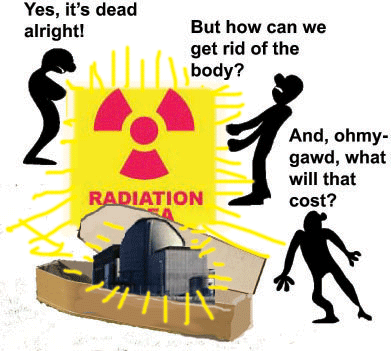 Germany proposes changes to nuclear liability law- draft law http://www.reuters.com/article/2015/09/02/germany-nuclear-idUSB4N10101R20150902 BERLIN, SEPT 2 The German government has proposed changes to a law to prevent German utilities from evading the payment of billions of euros needed to fund the country’s nuclear exit, according to a copy of the draft law seen by Reuters.
The document says that utilities will be liable for the costs of shutting down power plants and disposing of nuclear waste even if they give up control of subsidiary companies or spin-offs.
A spokesperson for the economy ministry said the draft law was currently being discussed by government departments.
Under current corporate laws, companies are liable for spun off units for five years, but there has been concern utilities might break up to avoid paying for the dismantling of Germany’s nuclear plants, the last of which will be shut for good in 2022. (Reporting byGernot Heller; Writing by Caroline Copley; Editing by Madeline Chambers)
#Nuclear submarines bring increasing danger to Indo-Pacific region
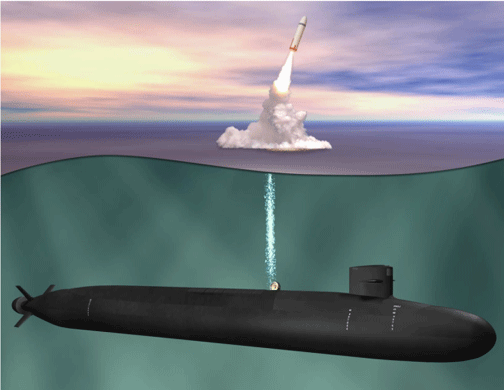 the more submarines you put in the same body of water, the higher the probability they might collide’.
Indo-Pacific nuclear sub threat to rival Cold WarAFR, by John Kerin, 3 Sept 15 The Indian and Pacific Oceans are becoming increasingly crowded with nuclear armed and conventional submarines increasing the risk of collision and nuclear conflict.
The warning is contained in a new Lowy Institute of International Affairs paper to be released on Friday which argues the region faces the greatest threat of a miscalculation involving nuclear armed submarines since the Cold War era.
“The regional contests for influence between the United States and China and China and India do not yet have the existential or ideological ‘life or death character’ of the Cold War,” the paper by Professor Rory Medcalf of the ANU based National Security College and Brendan-Thomas Noone from the Lowy International Security Program says.
“But quite literally below the surface a new and dangerous competition is emerging as China and India in particular start deploying nuclear weapons at sea……….
The paper says during the Cold War there were estimated to have been between 20 and 40 submarine collisions at sea.
“Dangerous submarine incidents can occur even among allies in the post Cold War world, as shown by a potentially disastrous clash between British and French nuclear armed boats in 2009,” the paper says.
“With the number of submarines operating in the Indo Pacific growing, particularly around choke points, the chances are such encounters will increase.
The paper says the risk of triggering a nuclear conflict remains low but could occur as countries such as China and India field long range nuclear weapons aboard their submarines for the first time – but crews lack sufficient experience with training and nuclear doctrine.
“There will likely be a long phase of initial instability as China and India start deploying nuclear submarines without the full command and communications systems and the training and doctrine so vital to a credible and secure deterrent,” the paper says.
“Unless these systems are in place nuclear submarines could be a strategic liability, rather than a stabilising presence, particularly during conflict or crisis situations,” it says……….
The first Australia-India naval exercise will be held later this month and the countries are also expected their first joint airforce exercises.: http://www.afr.com/news/policy/indopacific-nuclear-sub-threat-to-rival-cold-war-20150903-gjerpm#ixzz3kiBWLtw1
South Carolina electricity customers slugged for Over-Budget Nuclear Project
SCE&G Customers Paying for Over-Budget Nuclear Project Savannah Levins, WLTX September 2, 2015 COLUMBIA, SC (WLTX)– South Carolina Electric and Gas was approved to build two nuclear reactors back in 2009. The mission of the new devices: provide cleaner energy
The legislature, under the Baseload Review Act, agreed the company can increase customer bills every year to help pay for it. But now that the company is about a billion dollars over budget and years behind schedule, customers like environmental activist Tom Clements are getting frustrated.
“The rate payer, the customer, is saddled with 100% of the costs and all the risk of the project, and at the end of the day we don’t own anything,” he said. “We’ve paid for everything, we’ve taken all the risk, and we don’t own anything. But that;s courtesy of the legislature that passed what i think is an unjust law.”
On Wednesday, the Public Service Commission approved SCE&G’s request for an additional one billion in today’s dollars, and a four year extension to complete the project.
SCE&G Spokesperson Eric Boomhower says another customer rate increase of 2.8% is set to take effect in the end of October, and will continue to increase each year until the project is complete……..
Company representatives predict customers will continue to see annual increases averaging 2.2% until the project is completed.
That completion date, originally set at 2016, was pushed back on Wednesday to 2020. http://www.wltx.com/story/news/local/2015/09/02/sceg-customers-paying-over-budget-nuclear-project/71608720/
Security gaps persist in Nuclear Weapons Complex That Couldn’t Keep Out 82-Year-Old Nun
Nuclear Weapons Complex That Couldn’t Keep Out 82-Year-Old Nun Is Still Unsafe, Mother Jones, 3 Sept 15 Audit shows security gaps persist in a $50 million security system at the Y-12 nuclear complex that stores enough fissile material for 10,000 nuclear bombs. By Patrick Malone and Center for Public Integrity Thu Sep. 3, 2015 A good security system would seem essential for the federal repository holding virtually all of the nation’s highly enriched uranium, a key ingredient of nuclear weapons, just outside Knoxville,Tenn.
But the high-tech system installed at a cost of roughly $50 million over the past decade at the Department of Energy’s Y-12 complex is still riddled with flaws that impede its operation, according to a newly released report by the department’s top auditor. Moreover, no one knows how much the government will have to spend to fix it or when that task might be accomplished, the report says.
Flaws in the site’s security system first came into national view in July 2012, when an 82-year-old nun and two other anti-nuclear activists cut through fences and walked through a field of motion detectors to deface the exterior of Y-12’s Highly Enriched Uranium Materials Facility, which holds enough explosives to make 10,000 nuclear bombs. Subsequent investigations concluded that those monitoring the few critical sensors that were operating that day had been trained to ignore them by persistent false alarms, including many triggered by wildlife.
But not much has changed since that break-in, according to the report by Inspector General Gregory H. Friedman, even though the department spent more than a million dollars in 2012 to get a consultant’s advice about how to make the system work better, and then millions more completing the installation of high-tech sensors in 2013. The report says that the so-called Argus security system, which was developed by DOE’s Lawrence Livermore National Laboratory and named optimistically after the fabled 100-eyed monster of Greek mythology, “did not fully meet the site’s security needs” and was not installed the way it was designed to be used. It’s still prone to frequent false alarms and falls short of the Energy Department’s requirements…….. http://www.motherjones.com/politics/2015/09/audit-shows-security-gaps-persist-nuclear-weapons-complex
Yet more delay for New Hinkley Point nuclear power station
New Hinkley Point nuclear power station may be further delayed, Guardian, Terry Macalister, 4 Sept 15
France’s EDF gives no definite schedule for construction of £24.5bn plant, which still awaits firm’s final investment decision The planned new nuclear power station at Hinkley Point in Somerset has been hit by another setback, with its developer EDF admitting the project may be further delayed.
The news came as the French energy group said a more advanced sister project at Flamanville in Normandy would now not start operating until 2018, at a cost of €10bn (£7.3bn). It was originally slated to open in 2005 and cost €3bn.
No definite schedule has been given for power to be switched on at Hinkley, but it means the £24.5bn facility, which still awaits EDF’s formal go-ahead, may not be ready by 2023 – a date that has already been put back several times…….
The latest problem follows continued speculation that China General Nuclear Power Corp and China National Nuclear Corp were pushing the UK government for concessions before committing to a cash investment at Hinkley.
Critics have repeatedly told the government that it was foolish to rely on a new generation of nuclear power stations to meet Britain’s energy crunch, because such huge projects have a record of coming in late and over budget. http://www.theguardian.com/business/2015/sep/03/new-hinkley-point-nuclear-power-station-may-be-further-delayed
1 This Month



Tell the Ukrainian Government to Drop Prosecution of Peace Activist Yurii Sheliazhenko

Petition to revoke the licensing of the Near Surface Nuclear Disposal Facility (NSDF) at Chalk River. https://www.ourcommons.ca/petitions/en/Petition/Details?Petition=e-7247


of the week – STOP SMALL MODULAR REACTORS IN CANADA
To see nuclear-related stories in greater depth and intensity – go to https://nuclearinformation.wordpress.com
-
Archives
- March 2026 (212)
- February 2026 (268)
- January 2026 (308)
- December 2025 (358)
- November 2025 (359)
- October 2025 (376)
- September 2025 (258)
- August 2025 (319)
- July 2025 (230)
- June 2025 (348)
- May 2025 (261)
- April 2025 (305)
-
Categories
- 1
- 1 NUCLEAR ISSUES
- business and costs
- climate change
- culture and arts
- ENERGY
- environment
- health
- history
- indigenous issues
- Legal
- marketing of nuclear
- media
- opposition to nuclear
- PERSONAL STORIES
- politics
- politics international
- Religion and ethics
- safety
- secrets,lies and civil liberties
- spinbuster
- technology
- Uranium
- wastes
- weapons and war
- Women
- 2 WORLD
- ACTION
- AFRICA
- Atrocities
- AUSTRALIA
- Christina's notes
- Christina's themes
- culture and arts
- Events
- Fuk 2022
- Fuk 2023
- Fukushima 2017
- Fukushima 2018
- fukushima 2019
- Fukushima 2020
- Fukushima 2021
- general
- global warming
- Humour (God we need it)
- Nuclear
- RARE EARTHS
- Reference
- resources – print
- Resources -audiovicual
- Weekly Newsletter
- World
- World Nuclear
- YouTube
-
RSS
Entries RSS
Comments RSS
 nuclear-news