Ken Buesseler, Jay Cullen, lead independent research into radiation in the Pacific Ocean

Christina Macpherson’s websites & blogs
Great article. As an anti nuclear activist myself, I think that it is most important that we keep our concerns in proportion. The nuclear industry has so many bad effects, that we don’t ned to exaggerate ones that are not clear. Thankfully, despite government inertia, Buesseler and co are working to establish the facts on the effect if the Fukuhsima disaster on the ocean.
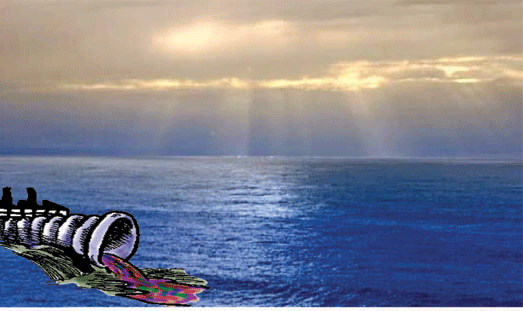
 Radiation in the Ocean http://www.huffingtonpost.com/peter-neill/radiation-in-the-ocean_b_8072914.html?ir=Australia Peter Neill Director, World Ocean Observatory The West Coast of the United States seems under siege by negative environmental news: earthquake predictions, oil spills, drought, critically diminished water supply, wildfires, and numerous accounts of unusual coastal events: algae blooms, whale strandings, cancer in seals, collapse of fish stocks, and more.
How to explain? Well, much of this can be attributed to climate factors where rising temperatures have resulted in multiple inter-related consequences: limited glacial melt, increased evaporation, no water, dry land, and the inevitable fire darkening that pristine Pacific air with smoke and ash the length of the coast.
The ocean phenomena may be different. The warming of the ocean surely has an impact on changing growth patterns of marine plants and animals, just as the changing pH or acidity of the ocean has been shown to modify habitat and migrations. But what else?
One argument has been the effect of radiation leaking from the three nuclear power plant reactors shut down by the earthquake and resultant tsunami tidal wave that inundated Fukushima, Japan in 2011, and has been thereafter distributed by ocean currents; indeed there is evidence of a plume of increased concentration of Cesium-134, and other radioactive elements that have been observed at unprecedented levels, spreading out some 5,000 miles into the Pacific toward North and South America. In April of this year, there were headlines declaring that “Fukushima radiation has reached the North American Shore” and concerns were raised, spread through the Internet and press, that this was surely the cause of these otherwise inexplicable anomalous natural events.
There is no Federal agency that funds monitoring of radiation in coastal water, and the present effort, conducted since 2004 by Ken Buesseler, a marine chemist at theWoods Hole Oceanographic Institution, has been underwritten by crowd-funding and the efforts of volunteers taking samples to provide data on cesium isotopes along the west coast of Alaska, the U.S. mainland coast, and Hawaii, the information that has been used to model potential distribution and concentration of any contamination. A comparable effort has been launched in Canada, led by Jay Cullen of the University of Victoria in collaboration with government, academic, and NGO partners.
The radioactivity has been decreased by time, the natural half-life of the isotopes, and by dilution in a very large and deep body of water. In their samples, Buesseler and his “citizen scientists” did detect cesium-137 already in the waters as a result of atmospheric nuclear weapons testing in the 1950s and 60s, and cesium-134 which does not otherwise occur naturally in the ocean and can only be attributed to Fukushima, to serve as a first baseline for subsequent collection, analysis, modeling, and conclusion.
Buesseler channels his research through the Center for Marine and Environmental Radioactivity at the Woods Hole Institute, where he offers a preliminary conclusion that “the amount of cesium-134 reported in these new offshore data is less that 2 Becquerels (a radioactive measure) per cubic meter (the number of decay events per second per 260 gallons of water.) This Fukushima-derived cesium is far below where one might expect any measurable risk to human health or marine life, according to international health agencies. And it is more than 1,000 times lower than acceptable limits in drinking water set by the U.S. Environmental Protection Agency.”
Buesseler continues, “We emphasize that cesium-134 has not been detected YET as it has been detected offshore of North America by Canadian oceanographers… The uncertainty in the predictions by these ocean models only emphasizes the importance of collecting samples from along the shores. Remember too that those models predict interacting levels of both cesium isotopes for the next 2 or 3 years, the highest published prediction is for 20 to 30 Becquerels per cubic meter, or well below what is thought to be of human health and fisheries concerns.”
So, yes, and no. No definitive conclusion, no clear argument that radiation is the cause of those coastal events which distress us so. There is no solace in uncertainty, just as there is no certainty without evidence. The question is immensely important and thanks to Ken Buesseler and all those volunteers alongshore and in research vessels who are working to provide the substance for a real answer.
3 Comments »
Leave a comment
1 This Month


Tell the Ukrainian Government to Drop Prosecution of Peace Activist Yurii Sheliazhenko

Petition to revoke the licensing of the Near Surface Nuclear Disposal Facility (NSDF) at Chalk River. https://www.ourcommons.ca/petitions/en/Petition/Details?Petition=e-7247


of the week – STOP SMALL MODULAR REACTORS IN CANADA
To see nuclear-related stories in greater depth and intensity – go to https://nuclearinformation.wordpress.com
-
Archives
- March 2026 (212)
- February 2026 (268)
- January 2026 (308)
- December 2025 (358)
- November 2025 (359)
- October 2025 (376)
- September 2025 (258)
- August 2025 (319)
- July 2025 (230)
- June 2025 (348)
- May 2025 (261)
- April 2025 (305)
-
Categories
- 1
- 1 NUCLEAR ISSUES
- business and costs
- climate change
- culture and arts
- ENERGY
- environment
- health
- history
- indigenous issues
- Legal
- marketing of nuclear
- media
- opposition to nuclear
- PERSONAL STORIES
- politics
- politics international
- Religion and ethics
- safety
- secrets,lies and civil liberties
- spinbuster
- technology
- Uranium
- wastes
- weapons and war
- Women
- 2 WORLD
- ACTION
- AFRICA
- Atrocities
- AUSTRALIA
- Christina's notes
- Christina's themes
- culture and arts
- Events
- Fuk 2022
- Fuk 2023
- Fukushima 2017
- Fukushima 2018
- fukushima 2019
- Fukushima 2020
- Fukushima 2021
- general
- global warming
- Humour (God we need it)
- Nuclear
- RARE EARTHS
- Reference
- resources – print
- Resources -audiovicual
- Weekly Newsletter
- World
- World Nuclear
- YouTube
-
RSS
Entries RSS
Comments RSS
 nuclear-news
Guess that has nothing to do with the marine life found dead along the California coast being taken away in truck loads, reported to appear malnourished and starving has nothing to do with Fukishima. The fish in WA state have multiple sores on their sides and fishing and selling fish from WA state prohibited. That the green goo coming into the nets of Alaska fishermen, reminiscent of the stuff in Ghost Busters, dying seaweed, and the non existent sock eye salmon expected to be a record number this year have nothing to do with Fukishima. You must be a government spokes person. Obama has forbidden that any reports be give about the radiation coming into North America. Found a good web site that had tons of really tangible events you should review and then reconsider your non informational article about radiation along the shore of the coast of the United States.
Thanks for your comment.
Having studied the reports, the work of Ken Buesseler, I will agree with you that he is cautious about attributing marine illness conditions to the Fukushima radiation disaster. However, I am very much in favour of caution in this matter.
Buesseler and Cullen are , I believe credible and careful scientists, and that’s what we need.
The nuclear lobby will pounce on any reports that they can use to destroy the credibility of anti nuclear opinion.
I believe that Buesseler and Cullen will com eup with the facts, and independently of government.
The nuclear industry is promoting quack science. Let us not do the same!
Early US Atomic Energy Commission-WHOI research is found below, indicating that Ken Buessler (WHOI) and Jay Cullen’s testing is not thorough enough. Their research is clearly inadequate to evaluate the impact of the ongoing Fukushima nuclear disaster on life in the Pacific. Given their funding-ties to the nuclear-military industrial complex, should one be surprised? They are getting a lot of governmental funding, and in the case of WHOI, foreign partnerships-funding, including the University of Tokyo! Of course, Jay Cullen’s funding source frequently “partners” with Cameco, which co-owns a major, newly opened, uranium mine with TEPCO at Cigar Lake. (See details at bottom of page). Remember TEPCO? TEPCO is owner-operator of the Fukushima Daiichi Nuclear Power Station. It is worth noting that Ken Buesseler’s dissertation focused on plutonium testing. And, yet, his current focus appears to be on Cesium 134, half-life of 2 years in seawater and sometimes fish. https://miningawareness.wordpress.com/2015/11/08/radionuclides-in-sediment-vs-seawater-and-in-plankton-marine-invertebrates-e-g-sea-stars/