Radioactive trash mounting in South Korea, with no solution in sight
At all of the sites visited, the author found local opinion leaders making clear their concerns about the safety of spent fuel management in addition to their concerns about the overall safety of nuclear power plant operations
As they grapple with safety concerns regarding nearby nuclear facilities, local residents typically lack unbiased information on the issues involved
 The Search for Interim Spent Nuclear Fuel Storage in South Korea, Nautilus, By Jungmin
  Kang 31 August 2015
I. Introduction
Plans call for a continued expansion in South Korea’s fleet of nuclear reactors, but at the same time, facilities for the temporary storage of spent fuel, mostly in at-reactor pools, continue to fill up. Negotiations between the nuclear industry and central government agencies on one side, and local host communities on the other, for siting of interim spent fuel storage facilities, let alone permanent waste disposal facilities, have been largely ineffective to date, due in large part to a combination of the tactics used by authorities in approaching local communities, and a lack of unbiased information about nuclear facilities on the part of local stakeholders. In the last few years, a new effort to engage host communities has been undertaken, and shows some promise, though much work remains before agreements on facility siting can be reached.
Nuclear Spent Fuel is Accumulating at Reactor Sites in South Korea
As of 2015 about 760 metric tons of spent fuel is discharged annually from 23 reactors in South Korea.[1] About half of this total comes from four CANDU heavy water reactors (HWRs) and the other half from 19 pressurized light-water reactors (PWRs).[2] As of the end of 2013, 6,541 tHM (tonnes heavy metal) in spent PWR fuel and 7,258 tHM in spent HWR fuel were stored in the spent fuel storage facilities at four different nuclear power plants clustered into four coastal sites: Hanul (Ulchin), Wolsong and Kori along the East coast and Hanbit (Yonggwang) on the West coast.
By 2035, the government plans to have 16 more reactors online, bringing the country’s total nuclear generating capacity to 42.7 gigawatts (GW).[3] It is estimated that approximately 51,400 metric tons of spent PWR fuel and 19,400 metric tons of spent HWR fuel will be generated over the extended lifetimes of the 35 pressurized water reactors and 4 heavy water reactors units that are currently operating and are to be deployed by 2035. These projections are based on an assumed thermal to electric power conversion efficiency of 33%, an average 90% capacity factor, and average fuel burn-ups at the time of spent fuel discharge for PWR and HWR fuel of 50 and 7.1 GWd/tHM, respectively.
As the existing at-reactor storage pools fill up, spent fuel management has become a hot-button issue in South Korea. Korea Hydro & Nuclear Power Co., Ltd. (KHNP), South Korea’s electric-power utility, argued in 2008 that the saturation dates for the current spent fuel storage capacity at the three PWR sites—Kori, Hanbit and Hanul—and at the Wolsong HWR site, would be 2016, 2021, 2018 and 2017, respectively.[4] KHNP did not fully consider intra-site trans-shipment of spent fuel, however, or the potential for dense-racking arrangement of spent fuel assemblies in pools—“re-racking” was assumed in the spent fuel pools of some reactors but not in others.
In 2011, the Korea Radioactive Waste Agency (KORAD, previously KRMC) published a reassessment performed by an expert group composed of members of the South Korea’s nuclear establishment, which found that the storage pools at Kori, Hanbit, Hanul and Wolsong will be full by 2028, 2024, 2028 and 2025, respectively.[5]
When re-racking and transfers between pools on the same site are considered, Kori will be full in 2031 and Hanul and Hanbit in 2028 and 2023, respectively, based on the author’s calculation using recent KHNP data.[6] Taking into account additional planned MACSTOR/KN-400 dry-storage modules at Wolsong facilities, the storage capacity at Wolsong will be full in 2027. These results are not very different from those obtained by the KORAD group.
Compared with the PWR sites, the spent-fuel storage situation at Wolsong is more complex. According to a 2005 law, the “Special Act on Support for Areas Hosting the Low and Intermediate Level Radioactive Waste (LILW) Disposal Facility,” spent fuel-related facilities cannot be built in the locality that hosts the national LILW site. That site is in the same local jurisdiction as the Wolsong site. Some South Korean nuclear experts interpret the law as follows: no more dry storage facilities can be built at Wolsong after 2017 when the current dry storage facilities there will be full. However, KORAD claims that the dry storage facilities at Wolsong are “tentative,” not the “interim” storage that is banned by the 2005 Special Act of LILW. KORAD understands the term “tentative” storage to mean storage of spent fuel on-site under the control of KHNP, whereas “interim” storage is understood to mean storage of spent fuel on a reactor site or at an away-from-reactor (AFR) site under the control of KORAD.
Legal Basis for Spent Fuel Management in South Korea……….
Public Engagement Commission on Spent Nuclear Fuel Management
In October 2013, given the increasing urgency to develop measures to address long-term radioactive waste management, South Korea’s government launched a Public Engagement Commission on Spent Nuclear Fuel Management (PECOS) to consult with a variety of sectors and make recommendations on options of resolving spent fuel problem by the end of 2014.[9] PECOS has 13 members, including specialists on energy, social sciences and conflict management, non-governmental organizations (NGOs), and representatives of the nuclear power plant host regions. The launch of PECOS may be a critical turning point in what has been four decades of impasse for the South Korean SNF management program.
Thus far, PECOS has emphasized the importance of interim spent fuel storage. It has made little progress, however, in engaging the local communities that host South Korea’s nuclear power plants. Instead, the commission has been focusing on its media strategy. When it became evident that PECOS had failed to produce any specific recommendation by the end of 2014, its end date was postponed to the end of June, 2015.
Despite PECOS’ efforts to ease their concerns about the problem of filling on-site storage capacity, civic groups and the local public alike have offered quite a frosty response thus far, in part due to popular discontent with the government’s requirement that PECOS find a quick solution (within a year) to the spent fuel management problem.
Increasing popular apprehension about the safety of nuclear power plants will naturally affect residents’ concerns about spent fuel management issues. The author confirms this concern as a result of his visits to each of the nuclear power plant sites in South Korea. At all of the sites visited, the author found local opinion leaders making clear their concerns about the safety of spent fuel management in addition to their concerns about the overall safety of nuclear power plant operations. Opinion leaders made clear that any decision to address spent fuel storage problem should include measures to assure that spent fuel storage arrangements are safe……….
As they grapple with safety concerns regarding nearby nuclear facilities, local residents typically lack unbiased information on the issues involved…….http://us4.campaign-archive1.com/?u=0de7e0e84dc3aff619f936a70&id=70900dcf63&e=ae85b3aafb
No comments yet.
1 This Month
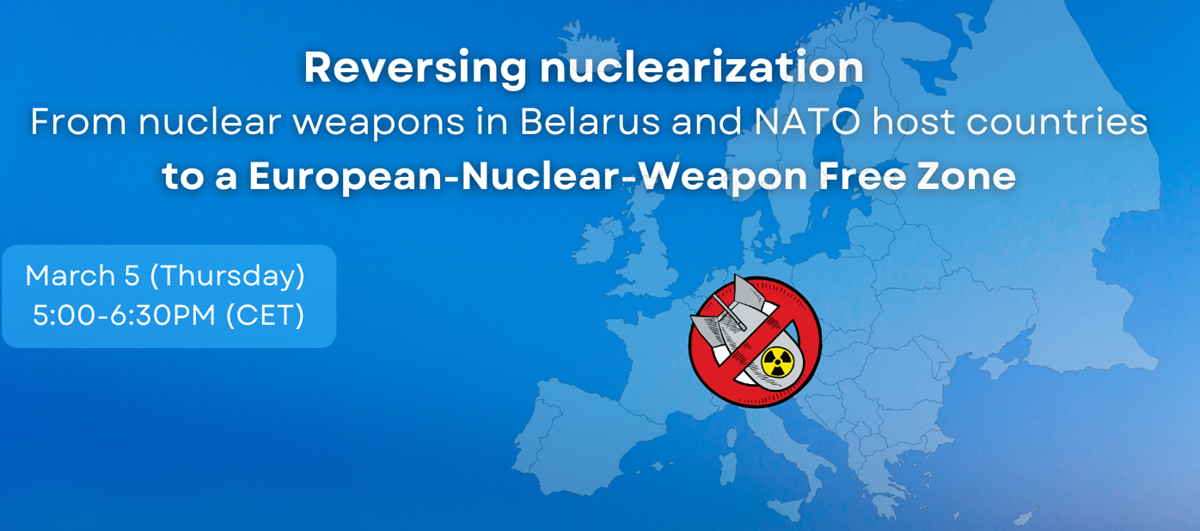
5 March -Online – Reversing nuclearization:
From nuclear weapons in Belarus and NATO host countries to a European-Nuclear-Weapon Free Zone
11am-12:30pm Eastern Time USA / 5pm-6:30pm CET

of the week – Advocating for a
nuclear free beach – https://www.samuellawrencefoundation.org/
The Samuel Lawrence Foundation advocates for a Nuclear Waste Free Beach at San Onofre, join us and take action!
10 March A LIVE WEBINAR THE REAL EFFECTS OF NUCLEAR POWER
What the Industry Isn’t Telling Us
1:00 PM Mountain, 2 pm Central, 3 pm Eastern. Live on the Keepers of the Water Facebook page

18 March Webinar @ 1 PM EST: An Assessment of SMR Projects: The Case of Canada
register for the zoom:
https://us02web.zoom.us/webinar/register/WN_o8BIIOUvQ2ONJR1nta65DQ#/registration

of the week – STOP SMALL MODULAR REACTORS IN CANADA
To see nuclear-related stories in greater depth and intensity – go to https://nuclearinformation.wordpress.com
-
Archives
- March 2026 (51)
- February 2026 (268)
- January 2026 (308)
- December 2025 (358)
- November 2025 (359)
- October 2025 (376)
- September 2025 (258)
- August 2025 (319)
- July 2025 (230)
- June 2025 (348)
- May 2025 (261)
- April 2025 (305)
-
Categories
- 1
- 1 NUCLEAR ISSUES
- business and costs
- climate change
- culture and arts
- ENERGY
- environment
- health
- history
- indigenous issues
- Legal
- marketing of nuclear
- media
- opposition to nuclear
- PERSONAL STORIES
- politics
- politics international
- Religion and ethics
- safety
- secrets,lies and civil liberties
- spinbuster
- technology
- Uranium
- wastes
- weapons and war
- Women
- 2 WORLD
- ACTION
- AFRICA
- Atrocities
- AUSTRALIA
- Christina's notes
- Christina's themes
- culture and arts
- Events
- Fuk 2022
- Fuk 2023
- Fukushima 2017
- Fukushima 2018
- fukushima 2019
- Fukushima 2020
- Fukushima 2021
- general
- global warming
- Humour (God we need it)
- Nuclear
- RARE EARTHS
- Reference
- resources – print
- Resources -audiovicual
- Weekly Newsletter
- World
- World Nuclear
- YouTube
-
RSS
Entries RSS
Comments RSS
 nuclear-news
Leave a comment