Bristol Nuclear Protestors Fined…instead…shouldn’t they be awarded Medals?!

 Hinkley Blockade
April 1st 2015
Three nuclear safety campaigners from Somerset have each been fined £300 for their ‘criminal’ actions in highlighting the far greater nuclear crimes by the industry.
The Morning Star has this report:
MAGISTRATES imposed £300 fines yesterday against three Bristol women for blockading the road to nearby high-risk nuclear power station Hinkley Point.
Care worker Ornella Saibene, grandmother Caroline Hope and retired nurse Marian Connolly appeared at Taunton Magistrates’ Court where they chose to plead guilty to avoid much larger penalties and costs.
The court refused to set repayments any lower than £10 a week even after they heard the trio were on low incomes, they told the Star. They are considering whether to lodge an appeal over the convictions.
The women, who are members of South West Against Nuclear, Nuclear Free Bristol and Bristol CND, chained themselves together across the road to Hinkley B station in Somerset…
View original post 255 more words
Official Volcano Evacuation Warning Near Re-opened Nuclear Reactors in Japan; Volcanic Ashfall Could Lead to Meltdown; Spent Fuel Pool Collapse

The dangerous Sakurajima volcano is located approximately 50 km (30 mi) from the Sendai Nuclear Power Station, which just re-opened a few days ago. Japan has issued a prepare to evacuate warning for the areas around the volcano. 
Volcano locations exported from: https://en.wikipedia.org/wiki/List_of_volcanoes_in_Japan
“Japan raises warning level on volcano not far from nuclear plant Posted:Sat, 15 Aug 2015 10:59:15 GMT
TOKYO (Reuters) – Japan warned on Saturday that a volcano 50 km (31 miles) from a just-restarted nuclear reactor is showing signs of increased activity, and said nearby residents should prepare to evacuate.”
http://feeds.reuters.com/~r/reuters/environment/~3/_SQxBY0RtZY/story01.htm
“It is the first time that the Level 4 alert has been issued for Sakurajima since the volcanic eruption alert system was introduced in 2007.” (“Volcanic alert raised for Sakurajima in Kagoshima“, 8:38 pm, August 15, 2015 Jiji Press: http://the-japan-news.com/news/article/0002359146)
“The analysis reveals that Kyushu Electric has underestimated the…
View original post 1,525 more words
Insider View of What’s Wrong with US DOE’s Contractors, in particular Bechtel; Risk of Hydrogen Explosion; Risk of Criticality Event at Hanford
“When I first arrived in April 2003 I was asked the bus ticket question by several employees: “Do you have your bus ticket?” I said “no” and asked “why?” Their response was: “Bechtel Engineering is building the plant so poorly that everyone in Engineering has a bus ticket to get out of town before they push the start button. You don’t want to be left behind.” (Walter Tamosaitis, 2013)
Hanford Waste Treatment Plant STILL under construction
“The issues I raised relate to hydrogen gas explosions, uncontrolled nuclear reactions (a criticality), environmental releases, and plant pluggages that could render the plant non-operable.” (Walter Tamosaitis, 2013). He’s talking nuclear radiation here!
“Ending years of legal wrangling, a whistleblower who raised safety concerns regarding operations at the Hanford nuclear waste site in Washington has won a $4.1 million settlement, his lawyer announced Wednesday. Walter Tamosaitis, an engineer, worked…
View original post 1,608 more words
August 16 Energy News

Science and Technology:
¶ Climate change makes some organisms go extinct, but increases others. According to the author of a newly released study, “it is not so easy to determine the number of wild boars in Europe.” However, in the recent decades, more and more boars have wound up as road kill and in hunting bags – a strong indication that local populations are growing and gaining ground. [Nature World News]
 A possible beneficiary of climate change. Photo: pixabay
¶ According to the Taskforce on Extreme Weather and Global Food System Resilience, worldwide food shortages, dramatic price increases, and volatile market conditions may take place every 30 years in about 25 years from now, instead of taking place once a century. To cover this and population increase, food production may need to improve by over 60%. [Modern Readers]
World:
¶ Kuwait has approved the construction of a…
View original post 599 more words
Thousands March against TPP Trade Agreement

August 15 2015
www.stuff.co.nz
LAWRENCE SMITH

Up to 10,000 people march down Auckland’s Queen Street marching in protest at the Government’s controversial Trans-Pacific Partnership agreement.
Thousands of people have marched against the Government’s controversial Trans-Pacific Partnership (TPP) agreement in rallies around the country.
Trade ministers from 12 nations including New Zealand have been negotiating the trade deal, which would stretch from Japan to Chile and cover 40 per cent of the world economy.
Talks had stalled however, with New Zealand digging in over dairy trade and Japan and the United States disagreeing over the auto industry.

Organizers estimated 10,000 protesters had gathered in Auckland; 5000 in Wellington;
4000 in Christchurch and 2000 in both Dunedin and Hamilton. They put the crowds at 800 in Nelson, 500 in Napier,
300 in New Plymouth, 200 in Tauranga, 250 in Golden Bay and 50 in Featherson .
In Auckland the gathered masses ranged…
View original post 886 more words
July’s stupefying heat indexes in southwest Iran. #Auspol #ClimateChange


Stepping outside during the summer often leads to an immediate groan, as if you suddenly found yourself stuck in a sauna. But for people living in southwest Iran along the Persian Gulf, conditions in late July went beyond the level of usual summer whining: on July 30-31, staying outside for a prolonged period could have led to heat stroke and death.
Summer temperatures in Iran can routinely top 100°F, but 100°+ temperatures were not what made this event so remarkable and so potentially dangerous. The event was not the “dry heat” that people in the United States associate with the desert Southwest. Instead, the scorching temperatures were accompanied by extremely humid conditions, which give the human body even less ability to cool itself off.
In the coastal city of Bandar Mahshahr on July 30 at 2:30pm and 4:30pm local time, the temperature reached 113°F and 111°F. The dew point temperatures…
View original post 81 more words
August 15 Energy News
Science and Technology:
¶ Twenty-five years ago, the Passive House certification system raised the bar for energy efficiency by introducing a rigorous performance-based standard. Now, the Passive House Institute has raised the bar higher with certification of two residential projects under a new category, “Passive House Plus,” that incorporates evaluation of on-site renewable energy. [Architectural Record]
 A 16-unit apartment building in Innsbruck, Austria, is the first of its kind to be certified under Passive House Plus. Passive House Institute photo.
World:
¶ Fears are growing in South Africa that agreements to build nuclear power plants will made behind closed doors, without the necessary public scrutiny. Among those voicing concern, two government sources say the Treasury is not being included in procurement discussions, despite the massive budgetary implications of a project that may cost as much as $100 billion. [Daily Times]
¶ According to the IEA, almost…
View original post 537 more words
Nuclear nations raise “allowable” limits of ionising radiation – knowing that this is unsafe
 damchodronma, 15 Aug 15, This is why the policy of nuclear nations is to raise ‘allowable’ limits for nuclear workers and the population generally when there are accidents… and since Atomic Age began. Contamination gets worse, it is worse for all life, but nothing about it is really safe or acceptable. It’s propaganda.
“The evidence from the Chernobyl affected territories reveals the real-world consequences of a simple and terrible new discovery: that the effects of low dose internal irradiation cause subtle changes in the genome that result in an increase in the general mutation rate. … first seen in cells in the laboratory. The Chernobyl evidence, shows that this seems to be true for all species, for plants and
animals and humans. It has profound implications that go beyond radiation protection and risk models.
“Krysanov …find that mice living in the high irradiation zone, 22 generations after the initial exposure, are MORE radiosensitive than mice living in lower exposure areas. The same effect is reported for plants by Grodzhinsky who wryly points out that plants cannot exhibit the ‘radiophobia’ that many of the Chernobyl effects have been blamed on. This flies in the face of current ideas about genetic selection.
“The effects of genomic instability are apparent in the evidence of massive harm to the organs and systems of living creatures at low doses of internal exposure, resulting in a kind of radiation ageing associated with random mutations in all cells. At the higher doses in the ‘liquidators’, after some years, their bodies seem to simply fall apart. In an astonishing statement we hear from Yablokov that in Moscow 100% of the liquidators are sick, in Leningrad 85%. These are men that ran like hares into the radiation fields with improvised lead waistcoats cut from roofs and who, by stabilising the situation at the reactor, saved Europe from a nuclear explosion equivalent to 50 Hiroshima Bombs – an outcome that would have made most of it uninhabitable. They are forgotten.
[THEY SIMPLY FALL APART]
“WHOLE BIOLOGICAL SYSTEMS COLLAPSE; at the cell level, at the tissue level and at the population level. Burlakova and Nazarov describe these subtle effects at lower doses of internal irradiation in laboratory cell systems and also people, Grodzhinsky shows the effects in plants, – higher for internal exposures than external, Krysanov shows the effects in wild animals and Yablokov and the Nesterenkos in the children and adults living and continuing to live in the contaminated territories. The effects clearly operate at what are presently thought to be vanishingly low doses.”
“ECRR Chernobyl: 20 Years On” (2006) pg 2
ECRR = European Committee on Radiation Risk
Dr. Chris Busby, Scientific Secretary wrote Introduction.
co-edited with Dr. Alexey Yablokov
http://life-upgrade.com/DATA/chernobylebook.pdf
Spanish http://ciaramc.org/ciar/boletines/cr_bol226.htm
Earthquake M5.0 offshore of Fukushima prefecture
 M5.0 hit Fukushima offshore / No announcement on plant status from Tepco http://fukushima-diary.com/2015/08/m5-0-hit-fukushima-offshore-no-announcement-on-plant-status-from-tepco/ by Mochizuki , August 14, 2015 According to JMA (Japan Meteorological Agency), M5.0 occurred offshore of Fukushima prefecture at 5:13 of 8/14/2015 (JST).
The depth of epicenter was 40km. They observed 4 of seismic intensity in Iwaki city.
The earthquake affected the large area from Shizuoka to Aomori prefecture.
The latest status of Fukushima plant has not been announced by Tepco http://www.jma.go.jp/en/quake/20150814051743395-140513.htm

Questions on the causes and effects of the Tianjin explosion
Tianjin explosions ignite barrage of questions, The Age, Philip Wen China correspondent for Fairfax Media, August 14, 2015 Tianjin: As fatalities continue to mount, so too have questions around the cause, response and potential health effects of the terrifying explosions at a toxic chemicals warehouse that tore through the port city of Tianjin, China, on Wednesday night.
Chinese authorities have dispatched more than 200 military nuclear and biochemical materials specialists to the site of the blast, as well as a team from the International Atomic Energy Agency’s Beijing environmental emergency response centre.
But some 36 hours after the explosions, municipal and environmental officials said they were still unable to determine the specific substances held in the warehouse which likely triggered the blast which killed dozens, injured hundreds, and ignited a fireball so large it was captured by orbiting satellites.
The owner of the warehouse, Ruihai International Logistics, is a firm which specialises in handling hazardous cargo, state news agency Xinhua said. It is licensed to handle dangerous and toxic chemicals including sodium cyanide, compressed natural gas, phosphoric acid, potassium nitrate and butanone – an explosive industrial solvent.
“So far, we are not able to provide the detail of type and amount of these dangerous items,” Gao Huaiyou, the deputy director of Tianjin’s work safety administration bureau, said on Thursday. “There is quite a big inconsistency with information provided by the company’s management and their customs declaration.”
Though a pungent smell and visible smog hung in the vicinity of the blast, officials said 17 emergency air monitoring stations indicated air quality in the city remained within a normal range, aided by easterly winds which blew toxic plumes from the fires out to sea.
Readings of cyanide and chemical oxygen demand – a measure of water quality – some three to eight times normal levels were detected near two underground discharge pipes, though officials said the pipes had been sealed off and posed no danger to health or the environment of the surrounding area.
Xinhua said 1000 firefighters and more than 140 fire trucks were struggling to contain the blaze in a warehouse which stored “dangerous goods”.
“The volatility of the goods means the fire is especially unpredictable and dangerous to approach,” it said….http://www.theage.com.au/world/tianjin-explosions-ignite-barrage-of-questions-20150814-gizjw9.html#ixzz3ir0wfaMy
Nuclear bomb testing has resulted in radioactive polonium in seafoods
Kiwis exposed to radiation in seafood – study http://www.3news.co.nz/nznews/kiwis-exposed-to-radiation-in-seafood—study-2015081507#axzz3ipQ2JViV Saturday 15 Aug 2015 New Zealanders who eat a lot of seafood may be exposing themselves to radiation and putting their health at risk, a study suggests.

Researchers found seafood such as mussels, paua and oysters contained concentrated levels of radiation.
Those at particular risk were sub-populations for whom fish consumption was culturally important and those relying of fishing and shellfish collection to feed their families, the study’s authors said in an article released on Friday.
“Seafood has importance to the New Zealand population as a source of nutrition consumed in considerable amounts by some sectors of the community,” they said.
“Chemical contaminants in seafood can therefore lead to significant health burdens to the population and it is an important public health function to identify the contaminants of concern and characterise their exposure.”
Researchers measured levels of radioactive caesium and polonium in 36 kinds of seafood.
Levels of caesium were of minimal dietary concern, but levels of polonium could “contribute significantly to the dietary does of ionising radiation for high seafood consumers, although the magnitude varies considerably depending on the composition of seafood species consumed,” the researchers said.
They found levels in New Zealand were the same as found in other countries, which suggested the radiation was a worldwide result of global nuclear testing rather than the 2011 Fukushima incident.
Radiation levels were higher in seafood than other foods, they said.
The study by Andrew Pearson, Sally Gaw, Nikolaus Hermanspahn and Chris Glover was published in the Journal of Environmental Radioactivity earlier this year.
SEAFOOD WITH HIGHER CONCENTRATED RADIATION LEVELS:
- Slapjack tuna
- greenshell mussels
- paua
- queen scallop
- rock lobster
- Bluff oyster
- littleneck clams
Judge’s ruling prioritises uranium industry over Grand Canyon’s health and environment
TAKE ACTION: Tell President Obama to protect the Grand Canyon from mining and share the message on Facebook
This uranium project could haunt the Grand Canyon region for decades to come,” said Katie Davis with the Center for Biological Diversity. “Uranium mining leaves a highly toxic legacy that endangers human health, wildlife and the streams and aquifers that feed the Grand Canyon. It’s disappointing to see the Forest Service prioritizing the extraction industry over the long-term protection of a place as iconic as the Grand Canyon.”
‘Beyond Unacceptable’: Judge OKs Uranium Mine at Grand Canyon s underground aquifers. Slamming ruling, conservationists warn of irreversible contamination of the canyon’s underground aquifers.By Reynard Loki / AlterNet August 12, 2015 In June, the Grand Canyon was named one of the “Most Endangered Places” in America by the National Trust for Historic Preservation. But the designation came just two months too late to possibly influence U.S. District Court Judge David Campbell. In April, he denied a request by the Havasupai tribe and a coalition of conservation groups to halt new uranium mining next to Grand Canyon National Park, just six miles from the Grand Canyon’s South Rim.
“We are very disappointed with the ruling by Judge Campbell in the Canyon Mine case,” said Havasupai Chairman Rex Tilousi. “We believe that the National Historic Preservation Act requires the Forest Service to consult with us and the other affiliated tribes before they let the mining company damage Red Butte, one of our most sacred traditional cultural properties.” He said that the Havasupai Tribal Council would appeal the decision.
Cleaning Up Contamination? Next to Impossible Continue reading
Japan exposing hundreds of young men to radiation – in the cause of promoting the nuclear industry
the level of radiation is so high that my biggest humanitarian concern is that – if the Japanese push to get these plants dismantled quickly – they will burn out hundreds and hundreds of young men. It’s usually young men because that’s how the construction trade is, needlessly. My point is, walk away for a hundred years, then come back in a hundred. By waiting a hundred years you’re reducing the radiation exposure to a significant, young virile gene pool that in my opinion doesn’t deserve to be exposed right now.
There’s a very real human cost to thousands of construction workers who are being exposed and will be exposed. But they have to show the Japanese that they’re dismantling that site because if the Japanese don’t believe it can be cleaned up they won’t let the other plants start back up.
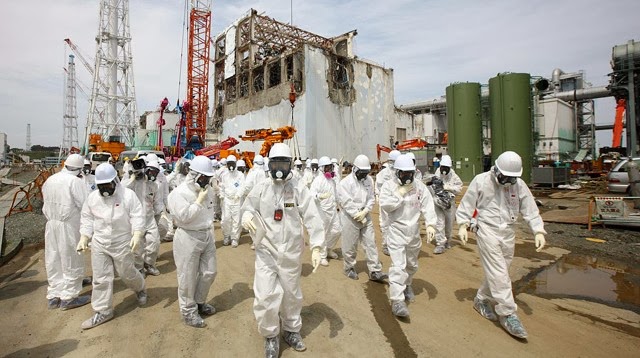
It’s a show. This is all about showing the Japanese that it’s not too bad, and we can run our other forty or so plants fine, trust us. It’s definitely symbolic for the Japanese, but the real reason is the banks want their money back.
This Expert Claims the Japanese Government’s Fukushima Clean Up Is Just “a Show” http://linkis.com/www.vice.com/en_uk/r/5UnqS August 12, 2015 by Thomas Marsh The past couple of weeks have seen two stories draw our attention back to the Fukushima Daiichi nuclear disaster of March 2011, in which three nuclear reactors melted down after the plant was hit by a tsunami. Radioactive material was released in what was the biggest and most disastrous nuclear incident since Chernobyl in 1986.
One story concerned some pictures of deformed daisies near the Fukushima Daiichi site, which trended online for a while and got everyone all hot under the collar about radiation, until it was established that they occur all the time in nature. So no need to worry about that.
The other was a video released by Arnie Gundersen, a former nuclear industry executive and engineer who’s declared Fukushima “the biggest industrial catastrophe in the history of mankind”. In it, he claimed that 23,000-tankers of water contaminated with radioactive isotopes have leaked into the Pacific from the Fukushima Daiichi site since 2011 and will continue to do so for decades – at a rate of three hundred tonnes a day. So maybe start worrying again.
Sure enough, a recent report by the Tokyo Electric Power Company (TEPCO) claimed that concentrations of radioactive isotope Strontium-90 have reached record highs in certain areas of the Pacific Ocean around Fukushima, with levels spiking by about 1,000 percent in three months. Continue reading
Secrecy and graft in South Africa’s multi $billion nuclear power plan?
 Nuclear power plan stirs fears of secrecy and graft Project could cost as much as $100 bn – experts., Money Web Joe Brock, Reuters | 14 August 2015 Fears are growing in South Africa that agreements to build nuclear power plants that could be the most expensive procurement in the country’s history will be made behind closed doors, without the necessary public scrutiny.
Among those voicing concern, two government sources say the Treasury is not being included in procurement discussions, despite the massive budgetary implications of a project that experts say may cost as much as $100 billion.
Construction on the first plant is due to start next year, breakneck speed compared with the years of regulatory and environmental checks for nuclear projects in countries such as Britain and the United States.
The Democratic Alliance, the main opposition party, believes the pace of the deal will prevent proper analysis before contracts are signed and huge sums of money change hands.
“The whole deal has been veiled in secrecy. We have no details on what we’re buying, how much it’s going to cost or how we’re going to pay for it,” shadow energy minister Gordon Mackay told Reuters.
The Department of Energy (DoE) did not respond to requests for comment. It has said several times the procurement process will be transparent and follow procedure.
Finance Minister Nhlanhla Nene was forced this week to deny reports of tensions with the DoE over the plans and said the Treasury was playing a supporting role in the procurement process.
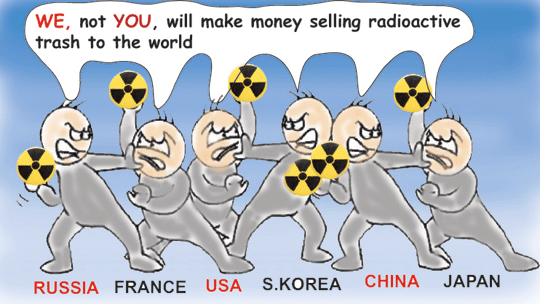 Pretoria has already signed non-binding inter-government agreements for nuclear power support from several countries including France, China and South Korea.
South Africa’s President Jacob Zuma said this week the nuclear plan was at an “advanced stage” and the procurement process should be completed by March.
Following meetings between Zuma and Russian President Vladimir Putin last year, the Russian atomic agency Rosatom said it had agreed a $10 billion contract to build power stations.
However, the DoE denied an agreement had been reached, raising public suspicion in South Africa of backroom dealmaking – an accusation often levelled against the ruling African National Congress under Zuma’s tenure.
The nuclear deal is of huge concern given South Africa’s history of endemic corruption,” said Andrew Feinstein, a former ANC lawmaker and now executive director of Corruption Watch UK.
Feinstein is the author of a book about alleged widespread graft in a $4.8 billion arms deal during the late-1990s.
“I fear that the corruption in this deal might dwarf the arms deal,” he said.
Chronic shortages, mounting debt…….A 2013 study by the University of Cape Town’s Energy Research Centre found more nuclear power was not needed and would not be cost-effective, based on an estimated installed cost of $7 000 per kilowatt.
The DoE has estimated the build would cost $4 200 per kilowatt. Energy experts say this is optimistic and the calculations are based on out-of-date assumptions……..http://www.moneyweb.co.za/news/south-africa/nuclear-power-plan-stirs-fears-of-secrecy-and-graft/
Germany’s new nuclear waste plan shows how dangerous radioactive trash is
 the plan for dealing with the waste has a much longer time-scale, one which makes clear just how dangerous nuclear waste is to dispose of.
an actual location won’t be chosen until 2031, and it will take until 2050 to convert that site until it is ready to store the waste. The process of moving the waste there will then take several more decades.
Germany draws up new plan to dispose of nuclear waste http://www.dw.com/en/germany-draws-up-new-plan-to-dispose-of-nuclear-waste/a-18645069 12 Aug 15 The German government has presented its plan for permanently disposing of nuclear waste. Critics say the proposal is a tacit admission that it is a bigger problem than it has ever acknowledged before. Pausing only to get the okay from the cabinet, Environment Minister Barbara Hendricks gave a press conference on Wednesday to present the government’s brand new plan for dealing with radioactive waste. Continue reading
1 This Month
Chernobyl: The Lost Tapes – A good documentary on Chernobyl on SBS available On Demand for the next 3 weeks– https://www.sbs.com.au/ondemand/tv-program/chernobyl-the-lost-tapes/2352741955560

of the week–London Campaign for Nuclear Disarmament

Tell the Ukrainian Government to Drop Prosecution of Peace Activist Yurii Sheliazhenko
To see nuclear-related stories in greater depth and intensity – go to https://nuclearinformation.wordpress.com
-
Archives
- April 2026 (152)
- March 2026 (251)
- February 2026 (268)
- January 2026 (308)
- December 2025 (358)
- November 2025 (359)
- October 2025 (376)
- September 2025 (257)
- August 2025 (319)
- July 2025 (230)
- June 2025 (348)
- May 2025 (261)
-
Categories
- 1
- 1 NUCLEAR ISSUES
- business and costs
- climate change
- culture and arts
- ENERGY
- environment
- health
- history
- indigenous issues
- Legal
- marketing of nuclear
- media
- opposition to nuclear
- PERSONAL STORIES
- politics
- politics international
- Religion and ethics
- safety
- secrets,lies and civil liberties
- spinbuster
- technology
- Uranium
- wastes
- weapons and war
- Women
- 2 WORLD
- ACTION
- AFRICA
- Atrocities
- AUSTRALIA
- Christina's notes
- Christina's themes
- culture and arts
- Events
- Fuk 2022
- Fuk 2023
- Fukushima 2017
- Fukushima 2018
- fukushima 2019
- Fukushima 2020
- Fukushima 2021
- general
- global warming
- Humour (God we need it)
- Nuclear
- RARE EARTHS
- Reference
- resources – print
- Resources -audiovicual
- Weekly Newsletter
- World
- World Nuclear
- YouTube
-
RSS
Entries RSS
Comments RSS
 nuclear-news