Brief notes on this week’s nuclear, climate news

Christina Macpherson’s websites & blogs
CLIMATE. Mass climate action is needed as world readies for December Paris conference. Forest fires out of control around Lake Baikal in Siberia. Drought-Fueled Wildfires Burn 7 Million Acres in U.S.
UK‘s Hinkley Point C nuclear station is now officially mothballed. Protest by 3 middle aged women costs nuclear firm €1million.
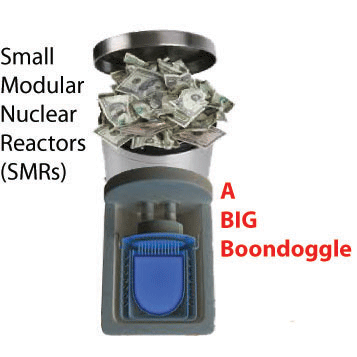
USA. Leaked review tells of ‘Significant Design Vulnerabilities’ at Hanford radioactive trash site. Disposal of nuclear waste turning out to be half the cost of reprocessing with MOX fuel. Escalating costs, expanding timelines, cast doubt on the future of modular nuclear construction. Lockheed Martin used government nuclear money to lobby for more government nuclear money. St Louis suburb contaminated by radioactive thorium. New measures to promote rooftop solar, by President Obama.
JAPAN. The Japanese Scientists’ Association joins strong public opinion against nuclear power. Sendai nuclear plant operator set to plug leaks in 5 cooling system pipes. Tepco bid to restart Kashiwazaki-Kariwa nuclear plant stymied by governor.
Fukushima:
- Oshidori Mako Interviews Experts Regarding Excess Occurrence of Pediatric Thyroid Cancer in Fukushima. (very long, but very thorough)
- Persistence of radioactive caesium in ocean floor near Fukushima Daiichi.
- Fukushima operator’s mounting legal woes to fuel nuclear opposition.
- Nuclear disaster evacuees promised 2017 return but ‘ineffective’ clear-up may take 200 years.
TAIWAN. Taipei prosecutors lose legal case against anti nuclear protestors.
Mass climate action is needed as world readies for December Paris conference
 Tutu, Klein and Chomsky call for mass climate action ahead of Paris conference, Guardian, Emma Howard, 26 Aug 15 Artists, journalists, scientists and academics among 100 signatories calling for mobilisation on scale of slavery abolition and anti-apartheid movements Desmond Tutu, Vivienne Westwood, Naomi Klein and Noam Chomsky are among a group of high-profile figures who will issue a mass call to action on Thursday ahead of the UN’s crunch climate change conference in Paris in December.
They call for mass mobilisation on the scale of the slavery abolition and anti-apartheid movements to trigger “a great historical shift”.
Their statement, published in the book Stop Climate Crimes, reads: “We are at a crossroads. We do not want to be compelled to survive in a world that has been made barely liveable for us … slavery and apartheid did not end because states decided to abolish them. Mass mobilisations left political leaders no other choice.”…..
There are now less than 100 days until the UN’s Conference of the Parties (COP21) in Paris, where leaders from more than 190 countries will gather to discuss a potential new agreement on climate change. Last week the EU’s climate commissioner Miguel Arias Cañete warned that negotiations ahead of the conference must accelerate if any agreement is to be meaningful.
Artists, journalists, scientists and academics are among the 100 signatories to the statement alongside activists Vandana Shiva, Nnimmo Bassey and Yeb Sano, the Filipino diplomat who lead a fast of hundreds at the 2013 UN climate change summit in Poland after typhoon Haiyan devastated his country.
They target corporations and international trade, calling for an end to government subsidies for fossil fuels and a freeze on extraction.
“Decades of liberalisation of trade and investments have undermined the capacity of states to confront the climate crisis. At every stage powerful forces – fossil fuel corporations, agro-business companies, financial institutions, dogmatic economists, sceptics and deniers, and governments in the thrall of these interests – stand in the way or promote false solutions. Ninety companies are responsible for two-thirds of recorded greenhouse gas emissions worldwide. Genuine responses to climate change threatens their power and wealth, threatens free market ideology, and threatens the structures and subsidies that support and underwrite them,” they state……..http://www.theguardian.com/environment/2015/aug/26/campaigners-mass-climate-action-paris-conference-noam-chomsky
Leaked review tells of ‘Significant Design Vulnerabilities’ at Hanford radioactive trash site
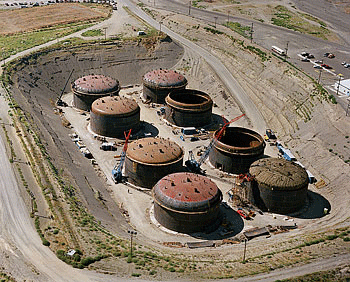 ‘Significant Design Vulnerabilities’ Plague Massive Nuclear Waste Site, Leaked Internal Review Reveals, Common Dreams,
‘The fact that the Department of Energy has not released this report, prepared last year, is alarming and indicative of a safety-last culture.’
A leaked internal review of the nation’s largest nuclear clean-up site found hundreds of “significant design vulnerabilities” and begs questions about the Energy Department’s transparency, a watchdog group says.
The Hanford Nuclear Reservation near Richland, Washington houses radioactive waste from the production of plutonium for nuclear weapons, and the decades-long clean-up effort has been costly and plagued by leaking underground nuclear waste storage tanks.
Seattle-based Hanford Challenge, which advocates for safe clean-up of the site, says it received the Department of Energy document from a whistleblower who has worked at the site for many years as an engineer.
“The fact that the Department of Energy has not released this report, prepared last year, is alarming and indicative of a safety-last culture,” said Tom Carpenter, Executive Director of the group.
The document is a 2014 draft review called “Low-Activity Waste Facility Design and Operability Review and Recommendations.” That LAW facility, Hanford Challenge explains in a statement, “is designed to treat waste from Hanford’s high-level nuclear waste tanks that will be pre-treated to remove the highly-radioactive materials before being mixed with glass formers in a facility designed to vitrify the low level waste.”
From the executive summary of the leaked report: ……
The leaked review comes the same month as whistleblower Walter Tamosaitis, who raised safety concerns regarding operations at the site, reached a $4.1 settlement with Hanford subcontractor AECOM.
And last year, documents obtained by the Associated Press showed there were “significant construction flaws” in some of the double-shell storage tanks at the facility. U.S. Sen. Ron Wyden (D-Ore.) urged the Energy Department to provide an action plan of how it would deal with the risks the flaws pose, writing in a letter (pdf) to Energy Secretary Ernest Moniz: “It is time for the Department to stop hiding the ball and pretending that the situation at Hanford is being effectively managed.”
The Washington site has proven itself an “intractable problem” that “costs taxpayers a billion dollars a year,” author and history professor Kate Brown wrote earlier this year. “Corporate contractors hired to clean up Hanford have made hundreds of millions of dollars in fees and surcharges, and, since little has been accomplished, the tab promises to mount for decades.”http://www.commondreams.org/news/2015/08/26/significant-design-vulnerabilities-plague-massive-nuclear-waste-site-leaked-internal
Radiation exposure to Fukushima workers and the community
 Fukushima today: A first-person account from the field and the conference table, Bulletin of the Atomic Scientists, 26 Aug 15 Subrata Ghoshroy “……….the building containing the failed reactors has radiation levels as high as 4,000 to 5,000 milliSieverts per hour (400,000 to 500,000 millirems per hour), making even the operation of robots difficult. In fact, two power company robots had to be abandoned while inside the depths of the plant. And some spots, such as inside the primary containment vessel, went as high as 9.7 Sieverts per hour (970,000 millirems per hour). In addition, it has not been possible to precisely locate the melted core. (Another conference speaker, Jun Tateno, who was a former research scientist with the Japanese Atomic Energy Research Institute, accused the government of suppressing voices from the scientific community that were critical of the safety of power plants. He said that we have reached a situation in which we do not even know how much plutonium is in the core.) In the meantime, huge amounts of water must be pumped in to keep the reactors cool; this liquid then mixes with ground water, contaminating it as a result.
The picture is not much better when it comes to the land. In an effort to decontaminate residential areas, radioactive soil is being dug up from approximately 1,000 sites. The government wants to consolidate this contaminated material in semi-permanent storage sites in the “difficult-to-return zones” in Futaba and Okuma towns. Local residents, meanwhile, fear that these could turn into permanent repositories of radioactive material……….
We were told that most workers did not wear dosimeters to record their cumulative radiation dose. There was good money to be made in decontamination work. They did not want to know.
But if one does the math, what the workers and their supervisors were ignoring—or were being told to ignore—could be significant. If a person spent one week working at this part of a supposedly safe parking area for 8 hours per day, then he or she would have been exposed to 40 microSieverts per day. And if that person was there for a 5-day workweek, then over the course of a single week that person would have been exposed to 200 microSieverts. In a year, that person could receive 10 milliSieverts, a significant dose. Of course, scientists are rightly cautious of such “anecdotal” evidence; our Geiger counter readings could have been off, or the machine calibrated incorrectly, or some other source of error introduced—though I doubt it because it had earlier read the background correctly. But the result of such quick and dirty, back-of-the-envelope calculations for what is supposedly a low-risk parking area, well away from the restricted hot zones, do give one pause—especially as the ongoing lack of dosimeters means that no one really knows a given individual’s cumulative dose. The amount of exposure to a thing that you cannot see, hear, smell, taste, or feel sneaks up on you. Even when you think you are safe, you are not.
If nothing else, the fact that a simple, random spot-check registered so highly is an eye-opener, and counter to what has been officially portrayed. ……..An important item seemed to lie further down in the article, which noted: “However, the health ministry said the number of workers surveyed is different from the total number of cleanup personnel reported by the Environment Ministry, which could mean the association failed to record radiation doses of all individuals working around the Fukushima plant.”
No wonder there has been public distrust and charges of a lack of clarity about the radiation clean-up operation, as can be seen in the title of a 2013 Guardian newspaper article: “Life as a Fukushima clean-up worker—radiation, exhaustion, public criticism.”Even when the approximately 7,000 workers involved in the clean-up do wear dosimeters, that is no guarantee of accuracy; there have been reports of a Tokyo Electric Power Company executive who tried to force clean-up workers to manipulate dosimeter readings to artificially low levels by covering their devices with lead shields………http://thebulletin.org/fukushima-today-first-person-account-field-and-conference-table8683#.Vd6Rj7YbwEs.twitter
No proper assessment of radioactive iodine in Fukushima food and water
 no iodine would be detectable at all, it was announced that a whole body counter study will begin to measure the internal exposure dose of Fukushima residents. Now, however, dose assessment is said to be impossible due to “the lack of direct measurements in residents immediately after the accident.” Government experts should have been well aware of the half-life of iodine 131. Why did they not conduct a thorough survey at the time while iodine 131 was still detectable?
 Oshidori Mako Interviews Experts Regarding Excess Occurrence of Pediatric Thyroid Cancer in Fukushima, Fukushima Voice, English Version 6 Aug 15,”…….Issue to be considered #3:
 Boeing wanted to quietly dispose of radioactive trash, without accountability
 Judge rejects Boeing’s bid to demolish and dispose of radioactive waste without accountability Eturbo News, SANTA MONICA, CA, Jan 2015 – Sacramento Superior Court has denied Boeing’s motion for summary judgment in a California Environmental Quality Act (CEQA) lawsuit over the demolition and disposal of radioactively contaminated structures from the site of a partial nuclear meltdown near Los Angeles, Consumer Watchdog said today.
“This is an important step on the way to ensuring that state regulators must consider the demolition and disposal of any radioactively contaminated structures at the Santa Susana Field Lab in their environmental assessment of the cleanup of this site,” said Consumer Watchdog Litigation Director Pam Pressley.
 Boeing had claimed that the Department of Toxic Substances Control (DTSC) has no regulatory
authority over the demolition and disposal of radioactively contaminated structures in the nuclear portion of the Santa Susana Field Lab (SSFL) in Simi Hills. The lab had tested small-scale nuclear reactors, rocket engines, and fuels and suffered a partial nuclear meltdown in 1959 that has never been fully cleaned up……http://www.eturbonews.com/54422/judge-rejects-boeings-bid-demolish-and-dispose-radioactive-waste
Can Japan make the switch to renewables?- Japan Scientists’ Association
Fukushima today: A first-person account from the field and the conference table, Bulletin of the Atomic Scientists, 26 Aug 15 Subrata Ghoshroy
“……… A key goal of the conference was the public announcement that the Japan Scientists’ Association formally opposed nuclear power in Japan, and that its opposition was based upon scientific analysis of the accident in Fukushima and its impact. This about-face was a major step; it meant that some of the same Japanese scientists who had been the most forceful and outspoken proponents of nuclear energy now opposed it. To bolster the impact of this statement, the association had to show both the economic and technical feasibility of alternative sources of energy. Consequently, much of the meeting focused on the lessons learned from the experiences of other countries, and the keynote speaker of the conference, professor Juergen Scheffran of Hamburg University, Germany, gave the European perspective on the implications of the transition from fossil and nuclear to renewable energy. The focus was especially on Germany, which is in the middle of its own planned transition to a non-nuclear future.
With that in mind, Reiner Braun, co-president of the International Peace Bureau in Geneva, Switzerland, spoke about the status of the German exit from nuclear power and entrance into renewables. Known as Energiewende in German (literally “energy turn”), it would entail shutting down all nuclear plants by 2022, with seven plants shut down immediately. The renewable energy sector would be expanded at the same time that there was a step-by-step reduction in fossil fuel use; modern natural gas plants are to be used as a transition technology. Structural changes would also be made to the distribution network to account for the decentralized nature of the new energy supply.
Braun, a veteran of the protest movements against nuclear weapons and nuclear power, said it was important to understand why a politically conservative government had made this U-turn. A vast majority of the German people had rejected nuclear energy and there were decades of organized resistance, starting with massive protests against the stationing of NATO’s tactical weapons on German soil. While progress was promising so far, Braun reminded his audience that Energiewende was the “largest technological challenge” faced by the country since the post-WW II reconstruction efforts. The political challenges, meanwhile, were comparable to those encountered after the reunification of the two Germanys after the end of the Cold War.
But there was no doubt it had to be done, or that Japan could learn from observing the German experience. The feeling from the meeting was best summed up by the conference chair, Tsuyoshi Kawasaki, an expert on climate science and an emeritus professor at Tohoku University. Kawasaki ended his brief remarks with the words: “The Japanese Scientists’ Association believes that human beings and nuclear power cannot coexist.”
…………Editor’s note: The conference was organized in collaboration with the International Network of Engineers and Scientists; other conference organizers included Keiiji Ujikawa, (an economics professor at Yokohama National University, Shinjiro Hagiwara (an emeritus professor of economics at the same institution), and Fujio Yamamoto, (an emeritus professor of mechanical engineering at Fukui University.)
The author had made a video presentation earlier about his visit to Fukushima at a meeting in Boston. http://thebulletin.org/fukushima-today-first-person-account-field-and-conference-table8683#.Vd6Rj7YbwEs.twitter
AUDIO: Nuclear Power: Insurance and Health
 http://www.kcet.org/shows/earth_focus/maritime-pollution-exposed.html More Airdates: Thu Aug 27 at 1:30AM on KCETLINK “Going naked” is a term the insurance industry uses to describe not having insurance. And when it comes to the worst hazards of nuclear power, America is going naked.
Correspondent Miles Benson investigates why the U.S. nuclear power industry is underinsured by hundreds of billions of dollars. He also speaks with Australian physician, author, and nuclear industry critic Dr. Helen Caldicott on the health effects of nuclear radiation, which include cancer, fetal damage, and genetic mutation.
Experts now doubt that excess thyroid cancer in Fukushima children is due to “screening effect”
Oshidori Mako Interviews Experts Regarding Excess Occurrence of Pediatric Thyroid Cancer in Fukushima, Fukushima Voice, English Version 6 Aug 15, “………Issue to be considered #2: Fraud, Corruption charges against SNC Lavalin (nuclear advisor to South Australia?)
 Is South Australia’s Royal Commission considering SNC Lavalin’s technology for South Australia? Did SNC Lavalin put in asubmission? (we won’t know, because commercial submissions are “in confidence”)
South Australia’s Nuclear Fuel Chain Commission visited Toronto on 14tth July and had discussions on
the CANDU reactor design and technology. That CANDU technology is owned and marketed by SNC Lavalin.

 RCMP charges SNC-Lavalin with fraud and corruption linked to Libyan projects Graeme Hamilton, Financial Post Staff | February
19, 2015MONTREAL – Once a jewel of the Quebec business establishment, SNC-Lavalin Group Inc. now stands criminally accused of fraud and corruption after the RCMP announced charges against the engineering giant Thursday.
The case against SNC and two of its subsidiaries stems from the company’s dealings in Libya between 2001 and 2011, when a senior executive established close ties with Saadi Gaddafi, son of dictator Muammar Gaddafi.
Court documents allege the company offered bribes worth $47.7 million “to one or several public officials of the ‘Great Socialist People’s Libyan Arab Jamahiriya,’” as Gaddafi called the nation he ruled until he was overthrown and killed in 2011.
SNC and its subsidiaries SNC-Lavalin Construction Inc. and SNC-Lavalin International Inc. are also alleged to have defrauded various Libyan public agencies of approximately $129.8 million.
“Corruption of foreign officials undermines good governance and sustainable economic development,” RCMP Assistant Commissioner Gilles Michaud said Thursday. “The charges laid today demonstrate how the RCMP continues to support Canada’s international commitments and safeguard its integrity and reputation.”
For SNC, the charges represent another black cloud in a storm the company has been trying to escape since a tip from Swiss authorities triggered the RCMP investigation, dubbed Project Assistance, in 2011……..
The RCMP investigation has already led to charges against former SNC executives Sami Bebawi and Stéphane Roy as well as Mr. Bebawi’s lawyer, Constantine Kyres. Riadh Ben Aissa, a former SNC vice-president, pleaded guilty in Switzerland last year to charges of corruption and money laundering related to SNC’s Libyan business. He has been extradited to Canada where he is facing fraud charges related to the awarding of the McGill University Health Centre contract to SNC. Former SNC CEO Pierre Duhaime is facing similar charges in connection with the MUHC project.
The charges, filed Thursday in Montreal, do not specify who received the bribes, but a previously released RCMP affidavit, containing unproven allegations, described Saadi Gaddafi as a major recipient of SNC’s largesse.
“Riadh Ben Aissa’s close relationship with Saadi Gaddafi was a major asset to SNC-Lavalin who was well aware of it and fostered the relationship,” the affidavit sworn in 2013 by Cpl. Alexandre Beaulieu said………
The contracts landed by SNC were grandiose projects with names to please the vanity of a dictator ……..
n Quebec, there was concern Thursday about the impact the new charges will have on a major economic player. The Federation of Quebec Chambers of Commerce issued a statement saying the charges cannot be allowed to harm SNC’s business. “We have to stop collectively knocking ourselves down and move to a reconstruction phase,” the federation said.
Karl Moore, a professor at McGill University’s Desautels Faculty of Management, said the charges come at a bad time for SNC. “They’ve actually really changed,” he said. “They’ve changed the culture and it’s squeaky clean. It’s one of the best engineering firms, from a compliance point of view, in the world.”
He does not think the company’s survival is at stake, but it will suffer. “This puts a bit of a cloud on them. When they’re out there seeing clients, there is some concern, and competitors will bring it up,” he said. “If I’m a competitor of SNC, I would take considerable delight in pointing out [its] weaknesses.”
The company has been ordered to appear in court in Montreal on April 14. http://business.financialpost.com/news/rcmp-charges-snc-lavalin-with-fraud-and-corruption-linked-to-libyan-projects
The Japanese Scientists’ Association joins strong public opinion against nuclear power
 Fukushima today: A first-person account from the field and the conference table, Bulletin of the Atomic Scientists, 26 Aug 15 Subrata Ghoshroy “…… It is hard to tell if the government’s promotional campaign is succeeding. The Abe government is continuing to push for the revival of nuclear power in Japan, as exemplified by the recent restart of the Sendai plant.
By doing so, it clearly sought to lay down a marker—and also perhaps to gauge public opinion before proceeding to restart other plants.
On the other hand, public opinion has been growing stronger in opposition—although the opinion polls have not been overwhelming. One of the significant aspects of the conference was the vigorous participation of women scientists like Miyake, who spoke out strongly against nuclear power and also challenged the male domination in the scientific community. Young mothers were participating in increasing numbers in anti-nuclear protests in Japan and also in Korea, we were told by Hye-Jeong Kim, a leader of the anti-nuclear movement in South Korea, who is also a member of the country’s Nuclear Safety and Security Commission, an equivalent of the NRC in the United States.
With these developments in mind, a scientific community that can speak with one voice and make a credible case against the government-industry publicity campaign is crucial. The Japanese Scientists’ Association envisioned its role as accurately communicating to people around the world the dangers of nuclear power and the seriousness of the damage suffered by the Japanese people. And the group hoped to use science to counter the forces that promote nuclear power in Japan, and demand that Japan give top priority to renewables……
…………Editor’s note: The conference was organized in collaboration with the International Network of Engineers and Scientists; other conference organizers included Keiiji Ujikawa, (an economics professor at Yokohama National University, Shinjiro Hagiwara (an emeritus professor of economics at the same institution), and Fujio Yamamoto, (an emeritus professor of mechanical engineering at Fukui University.)
The author had made a video presentation earlier about his visit to Fukushima at a meeting in Boston. http://thebulletin.org/fukushima-today-first-person-account-field-and-conference-table8683#.Vd6Rj7YbwEs.twitter
Fukushima: Excess Occurrence of children’s thyroid cancer not due to overdiagnosis
physicians actually involved with diagnosis during the thyroid examination unanimously agree that “it is not overdiagnosis.” These physicians include Dr. Akira Miyauchi from Kuma Hospital, one of nation’s top thyroid clinicians, as well as Dr. Shinichi Suzuki from Fukushima Medical University, director of thyroid examination in Fukushima Prefecture.
 Oshidori Mako Interviews Experts Regarding Excess Occurrence of Pediatric Thyroid Cancer in Fukushima, Fukushima Voice, English Version 6 Aug 15,
This is a translation of an article written by Oshidori Mako and published in the July issue of DAYS JAPAN, posted here with permission of Oshidori Mako. Pediatric Thyroid Cancer in Fukushima
The Thyroid Examination Assessment Subcommittee of
the Prefectural Oversight Committee Meeting for the Fukushima Health Management Survey
Admits Excess Occurrence of Pediatric Thyroid Cancer
In Full-Scale Screening or second round screening, 15 children were newly diagnosed similarly.
Frame By Frame Analysis Of Tianjin Explosion. Was Tianjin Nuked?

Update: Scintillation and white outs proof of nuclear explosion and temperatures over 4000 C°
Scintillation is based on the distance from the blast. The farther you get away from the blast the less neutron exposure you get. CCD Cameras will detect scintillation but only at high levels. They are not sensitive to far field radiation patterns. All CCD cameras were too far away to be sensitive enough to show scintillation properly.
So you have to look at the white out in the centre of the photo. This is where the brightness is so great that it overloads the ccd pickup chip causing a clipping effect. The fact that the fireball was whited out or clipped indicates that the colour temperature was over 4,000 degrees C. Only achievable in a nuclear blast. The cameras auto gain circuit clips the video level for being too bright so you get a white out…
View original post 74 more words
Top Scientist — Threat of Catastrophic Permafrost Thaw is “Real and Imminent”

There’s a lot of carbon stored in the Arctic’s thawing permafrost. According to our best estimates, it’s in the range of 1,300 billion tons (see Climate Change and the Permafrost Feedback). That’s more than twice the amount of carbon already emitted by fossil fuels globally since the 1880s. And the sad irony is that continuing to burn fossil fuels risks passing a tipping point beyond which rapid destabilization and release of those carbon stores becomes locked in.

(Global permafrost coverage as recorded by the World Meteorological Organization. A 2 C global warming threshold is generally thought to be the point at which enough of the Arctic permafrost will go into catastrophic destabilization, to result in a global warming amplifying feedback that then thaws all or most of the rest. The 2 C threshold was chosen because it is the bottom boundary of the Pliocene — a time when this…
View original post 659 more words
1 This Month

of the week – Shut Down Drone Warfare!


Tell the Ukrainian Government to Drop Prosecution of Peace Activist Yurii Sheliazhenko

Petition to revoke the licensing of the Near Surface Nuclear Disposal Facility (NSDF) at Chalk River. https://www.ourcommons.ca/petitions/en/Petition/Details?Petition=e-7247
To see nuclear-related stories in greater depth and intensity – go to https://nuclearinformation.wordpress.com
-
Archives
- April 2026 (103)
- March 2026 (251)
- February 2026 (268)
- January 2026 (308)
- December 2025 (358)
- November 2025 (359)
- October 2025 (376)
- September 2025 (257)
- August 2025 (319)
- July 2025 (230)
- June 2025 (348)
- May 2025 (261)
-
Categories
- 1
- 1 NUCLEAR ISSUES
- business and costs
- climate change
- culture and arts
- ENERGY
- environment
- health
- history
- indigenous issues
- Legal
- marketing of nuclear
- media
- opposition to nuclear
- PERSONAL STORIES
- politics
- politics international
- Religion and ethics
- safety
- secrets,lies and civil liberties
- spinbuster
- technology
- Uranium
- wastes
- weapons and war
- Women
- 2 WORLD
- ACTION
- AFRICA
- Atrocities
- AUSTRALIA
- Christina's notes
- Christina's themes
- culture and arts
- Events
- Fuk 2022
- Fuk 2023
- Fukushima 2017
- Fukushima 2018
- fukushima 2019
- Fukushima 2020
- Fukushima 2021
- general
- global warming
- Humour (God we need it)
- Nuclear
- RARE EARTHS
- Reference
- resources – print
- Resources -audiovicual
- Weekly Newsletter
- World
- World Nuclear
- YouTube
-
RSS
Entries RSS
Comments RSS
 nuclear-news