Typhoon Soudelor hits Taiwan, then China’s coast – danger to nuclear stations
 Typhoon Soudelor toll rises to 17 in China: state media http://news.yahoo.com/typhoon-downgraded-china-killing-five-taiwan-030301544.htmlShanghai (AFP) – The number of people killed by Typhoon Soudelor in China rose to 17, state media reported on Monday, with five more missing.

Three people were killed by a mudslide and one was missing after being swept away by floods in Ningde, in the eastern province of Fujian, the Fujian Daily reported.
In neighbouring Zhejiang province 14 were killed and four were missing, the official news agency Xinhua said earlier, quoting local officials as saying that the dead and missing may have been washed away by floods or buried under ruined homes.
The total direct economic losses in the two provinces were estimated at around eight billion yuan ($1.31 billion), figures from state media showed.
Billed as the biggest typhoon of the year last week with winds of up to 230 kilometres (140 miles) an hour, Soudelor — named for a Micronesian chief — has since weakened.
It made landfall in Fujian on Saturday night after leaving six people dead in Taiwan — including two twin sisters and their mother, who had all been swept out to sea.
It also knocked out power to a record four million households on the island. [Taiwan’s nukes in danger from typhoon,too]

Some 379 people were injured by the storm in Taiwan, which saw rivers break their banks under torrential rain and towering waves pound the coastline.
The China Meteorological Administration lifted its typhoon warning Monday as the storm weakened and moved further inland.
Radioactive area of Chernobyl again on fire
 Chernobyl exclusion zone on fire again http://www.rt.com/news/311976-chernobyl-exclusion-
zone-fire/ 9 Aug, 2015 As many as 32 hectares of new wildfires have been registered in the exclusion zone close to the Chernobyl nuclear power plant, report Ukraine’s emergency services report. Firefighters are battling new fires that have flared up in the Kiev region.
The fires started in three locations close to the villages of Zamostye and Kovshilovka in the Ivankovsky area. As of 7am on Sunday, the fires have been reportedly localized, with firefighters continuing to extinguish burning dry grass and forest cover.
Shortly afterwards, Ukraine’s Ministry of Emergency Situations reported that another forested area, known as Chernobylskaya Pushcha, had caught fire.
“The fire has spread to the abandoned villages of Kovshilovka and Buda Varovichi, located in the exclusion and unconditional (mandatory) resettlement zones,” the ministry said on their website.
The situation has now been brought under control.
Forest fires in Chernobyl’s exclusion zone began in April this year. The head of the State Emergency Service of Ukraine Nikolay Chechetkin said that up to 70 percent of all the wildfires in Chernobyl exclusion zone are due to arson.
Experts warned that radioactive nuclides absorbed by the foliage around Chernobyl nuclear power plant from the soil contaminated as a result of the 1986 disaster can easily be released into the air and have a cumulative negative effect on the health of those who breathe in particles.
While firefighters were dealing with wildfires near Chernobyl from April through to July, the Kiev authorities gave assurances that there was no radiation threat. Territory engulfed by fires in the exclusion zone had reached 400 hectares by the beginning of May.
READ MORE: Chernobyl fire: Kiev claims no radiation threat, experts ring alarm bells
However, locals recalling the 1986 catastrophe fear that just as then officials are concealing the truth.
If the trees, which have been absorbing radioactivity for almost 30 years, are on fire, then radioactive elements “may spread with wind over long distances,” Yury Bandazhevsky, a scientist working on the sanitary consequences of the Chernobyl disaster, said in May.
READ MORE: ‘No one tells us the truth’: Locals near Chernobyl fear radiation, Kiev says fire put out
Greg Boertje-Obed , Megan Rice & Michael Walli continue their fight for nuclear disarmament
Let us never repeat the sin of nuclear destruction Seventy years after Hiroshima and Nagasaki, we continue to call on all people to eliminate the evil of atomic weapons, Aljazeera America, August 9, by Greg Boertje-Obed , Megan Rice & Michael Walli

On July 28, 2012, we entered the Y12 Nuclear Weapons Complex at Oak Ridge, Tennessee, and shut it down in an act of non-violent resistance. We hung protest banners, poured human blood and spray-painted graffiti with messages of peace on the uranium facility’s walls. Calling ourselves the Transform Now Plowshares, we tried to stop the continuation of our country’s nuclear weapons production, because it is illegal, immoral and irrational. The reckless quest for enduring nuclear superiority has led our country and our world into a harrowing danger zone in which the threat of planetary annihilation hangs over all of creation.
Because of our action, Y12, a charter facility of the Manhattan Project from which the uranium that obliterated Hiroshima 70 years ago was issued, stopped its deadly work for more than two weeks. We were subsequently charged for property damage and sabotage, tried and sentenced to three to five years in federal prison. After two years imprisonment, an appellate court threw out our sabotage conviction this past May and ordered our resentencing. Our next court date is Sept. 15.
But the challenge to resist nuclear weapons is not ours alone. It is a shared responsibility, and a shared opportunity to secure a future for our human family and for Mother Earth.
Nuclear weapons remain poised to destroy all life on the planet, something no rational person would want. These weapons have been involved in many accidents, and we know they can be set off unintentionally. Despite these dangers, our government has continually updated plans to fight and supposedly win a war using nuclear weapons. Our soldiers repeatedly prepare and train to launch them. As a matter of longstanding international law, nuclear weapons, which are designed to unleash massive indiscriminate destruction on civilians, are weapons to commit war crimes. In fact, preparing to use such weapons is itself a war crime.
Simply mining for the uranium and assembling the weapons already kills many people. Workers in nuclear bomb factories regularly die from many types of cancer. The late scientist Rosalie Bertell estimated many years ago that 10 million people have died from the building and testing of nuclear weapons.
We need to be particularly concerned about nuclear weapons today because many nations are beginning the process of spending massive amounts of economic resources to upgrade and expand the death-dealing power of nuclear weaponry. The U.S. alone is preparing to spend a trillion dollars on this effort. This is unconscionable.
The great religious traditions teach that we ought to act on behalf of life and to intervene for the downtrodden and poor, the orphans and widows. The vast resources dedicated to killing and preparing to kill are a waste and a theft from those who are destitute and in need, and thus contradict that divine directive to cherish and serve life itself. In conscience, we must struggle against the massive forces of death if we are to fulfill our commitment to practice compassion and love for people, life and the planet.
Archbishop Desmond Tutu used to say to his opponents in the latter days of South Africa’s Apartheid: “Come over to the winning side.” We believe that the forces for life and love are stronger than the forces of death and destruction. We invite everyone to join the struggle in order to be on the side of hope and life, even though it often looks as if we are not on the winning side……….
Greg Boertje-Obed, a former U.S. Army officer, is a member of Veterans for Peace and co-founder of Transform Now Plowshares, a non-profit interfaith activist group that favors non-violent resistance to nuclear weapons.
Sister Megan Rice, a member of the Sisters of the Holy Child Jesus since 1950, is a co-founder of Transform Now Plowshares, an interfaith pacifist group that favors non-violent resistance to nuclear weapons. She served as a teacher in the U.S. until 1962 and until 2003 in West Africa (Nigeria and Ghana).
Michael Walli, a member of the Dorothy Day Catholic Worker House in Washington, D.C., is a co-founder of Transform Now Plowshares, a non-profit interfaith activist group that favors non-violent resistance to nuclear weapons. http://america.aljazeera.com/opinions/2015/8/let-us-never-repeat-the-sin-of-nuclear-destruction.html
Ban nuclear weapons – call from Pope Francis on Nagasaki remembrance day
 Pope Francis Calls for Nuclear Weapons Ban VOA News August 09, 2015 Pope Francis called for a global ban on nuclear weapons Sunday as Japan marked the 70th anniversary of the U.S. dropping an atomic bomb on Nagasaki days before the end of World War Two.
The pontiff said the memories of the atomic bombings of Hiroshima and Nagasaki in early August 1945 remain as a call for nuclear disarmament.”After so long that tragic event still causes horror and repulsion,” the pope said in Rome.
“It became the symbol of the boundless destructive power of man, when the achievements of science and technology are put to wrong use. It remains a permanent warning for humanity to reject war forever and to ban nuclear weapons and every weapon of mass destruction,” Francis said.
The pope said he wishes there would be “one voice” that says, “no to war, no to violence, yes to dialogue, yes to peace. With war we always lose.”
Nagasaki ceremony
Bells tolled and tens of thousands of people in Japan observed a minute’s silence Sunday to mark the Nagasaki attack that killed 74,000 people. It came three days after a similar observance to remember the attack on Hiroshima that claimed an estimated 140,000 lives…….http://www.voanews.com/content/pope-francis-calls-for-nuclear-weapons-ban/2909357.html
Ageing plant and risks raise widespread concern about Japan’s nuclear restart
Local campaigners say the plant operators – Kyushu Electric – and local authorities have yet to explain how they would quickly evacuate tens of thousands of residents in the event of a Fukushima-style meltdown.
A survey by the Asahi Shimbun newspaper found that only two of 85 medical institutes and 15 of 159 nursing and other care facilities within a 30 km radius of the Sendai plant had proper evacuation plans.
About 220,000 people live within a 30km radius – the size of the Fukushima no-go zone – of the Sendai plant; a 50km radius would draw in Kagoshima city and raise the number of affected people to 900,000.
“The local authorities may have approved the restart, but they are completely out of touch with public opinion.”

 Japan split over restart of first nuclear reactor since Fukushima disaster, Guardian, Justin McCurry, 10 Aug 15 Rising costs from gas and oil are sited by supporters of a programme to bring reactors back on line, but ageing plant and risks raise widespread concern An otherwise unremarkable town in south-west Japan will be propelled this week to the forefront of the country’s biggest experiment with nuclear power since theFukushima disaster in March 2011.
After months of debate about safety, Japan will begin producing nuclear energy for the first time in almost two years close to the town of Satsumasendai as early as Tuesday.
Restarting one of the Sendai nuclear plant’s two 30-year-old reactors represents a victory for the prime minister, Shinzo Abe, who insists that without nuclear energy the Japanese economy will buckle beneath the weight of expensive oil and gas imports.
But his call for Japan to confront its Fukushima demons has been greeted with scepticism by most voters, whose opposition to nuclear restarts remains firm, even in the face of rising electricity bills. Continue reading
UK energy analysts unhappy with super costly Hinkley nuclear project
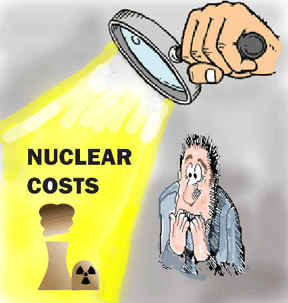
 Planned Hinkley Point nuclear power station under fire from energy industry, Guardian, Nils Pratley and Sean Farrell, 10 Aug 15 Energy analyst says that for same price as Hinkley Point C, providing 3,200MW of capacity, almost 50,000MW of gas-fired power capacity could be built. Hinkley Point, the planned £24.5bn nuclear power station in Somerset, is under intensifying criticism from the energy industry and the City, even as the government prepares to give the final go-ahead for the heavily subsidised project.
The plant, due to open in 2023, will cost as much as the combined bill for Crossrail, the London 2012 Olympics and the revamped Terminal 2 at Heathrow, calculated Peter Atherton, energy analyst at investment bank Jefferies. He said that, for the same price as Hinkley Point C, which will provide 3,200MW of capacity, almost 50,000MW of gas-fired power capacity could be built.
“This level of new gas build would effectively replace the entire thermal generation fleet in the UK – much of which is old and inefficient – with brand new, highly efficient, low carbon, gas generation,” said Atherton.
Doubts about Hinkley Point have deepened after a detailed report by HSBC’s energy analysts described eight key challenges to the project, which will be built by the state-backed French firm EDF and be part-financed by investment from China.
These challenges include: declining demand for power in the UK, currently falling at 1% a year as energy-saving measures take effect; a three-fold jump in the UK’s interconnection capacity with continental Europe by 2022, massively increasing the country’s ability to import cheaper supplies; and “a litany of setbacks” in Finland, France and China for EdF’s European Pressurised Reactor (EPR) model, the same type as planned for Hinkley Point.
HSBC’s analysts described the EPR model as too big, too costly and still unproven, saying its future was bleak. They also pointed out that wholesale power prices have fallen by 16% since November 2011 when the government agreed a “strike price” for Hinkley Point’s output – effectively a guaranteed price of £92.50 per megawatt hour, inflation-linked for 35 years and funded through household bills. “With the problems encountered by France’s EPR model and a strike price likely to be double the UK wholesale price at the scheduled 2023 time of opening of the proposed Hinkley C EPR, we see ample reason for the UK government to delay or cancel the project,” they said…….. http://www.theguardian.com/environment/2015/aug/09/planned-hinkley-point-nuclear-power-station-energy-industry
With 2020 Olympics in mind. Japan’s govt trying to coerce Fukushima evacuees back

Even with the massive cleanup, only about one-fifth of the 6,200 displaced residents of Iitate are willing to return, according to a recent head count by village officials.
4 Years After Fukushima Nuclear Calamity, Japanese Divided on Whether to Return By MARTIN FACKLER, NYT< AUG. 8, 2015 ITATE, Japan — For four years, an eerie quiet has pervaded the clusters of farmhouses and terraced rice paddies of this mountainous village, emptied of people after the disaster at the Fukushima Daiichi nuclear power plant, 25 miles away, spewed radiation over a wide swath of northeastern Japan……….
They accuse Tokyo of repeating a pattern from the early days of the disaster of putting residents at risk by trying to understate the danger from the accident. They say the central government is trying to achieve its own narrow political interests, such as restarting the nation’s powerful nuclear industry, or assuring the world that Tokyo is safe enough to host the Summer Olympics in 2020.
“If the national officials think it is so safe, then they should come and live here,” said Kenichi Hasegawa, a former dairy farmer in Iitate who has organized more than 3,000 fellow evacuees — almost half the village’s pre-disaster population — to oppose the return plan. “The government just wants to proclaim that the nuclear accident is over, and shift attention to the Olympics.” Continue reading
China’s massive solar farm going ahead fast in Gobi desert
 China builds huge solar power station which could power a million homes, http://www.independent.co.uk/environment/china-builds-huge-solar-power-station-which-could-power-a-million-homes-10446840.html
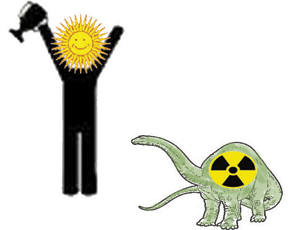
 The Independent, 08 August 2015 China is set to build a giant solar power station in the Gobi desert, which could generate enough energy to supply one million homes. The proposed power station will measure 10 square miles and generate 200 megawatts of solar energy.
29 top USA scientists back Obama’s ‘stringent’ deal with Iran
President Obama’s Iran nuclear deal gets the backing of 29 of the nation’s top scientists who call it ‘stringent’
- The president’s Iran nuclear deal was praised by the scientists who include former White house advisers, Nobel laureates, and makers of nuclear arms
- Their support will come as a welcome respite for the President who has faced stiff opposition from within his own party
- Obama has been forced to try and reach undecided members of congress in a bid to push through the deal which has already divided opinion
- But in the letter, all 29 scientists hailed the deal as ‘innovative’ and ‘stringent
By BELINDA ROBINSON FOR DAILYMAIL.COM, 10 Aug 15 ……….. http://www.dailymail.co.uk/news/article-3191369/Obama-s-Iran-nuclear-gains-support-29-U-S-scientists.html#ixzz3iM9PyKj9
Stage and screen star Maxine Peake joins campaign for nuclear disarmament
Actress Maxine Peake joins nuclear campaigners to mark the 70th anniversary of Hiroshima and Nagasaki attacks, Manchester Evening News 9 AUGUST 2015 BY DEAN KIRBY
The star of stage and screen joined supporters of nuclear disarmament in calling for an end to the Trident nuclear submarine programme at a gathering in Heaton Park Actress Maxine Peake joined peace campaigners in marking the 70th anniversary of the atom bomb attacks on the Japanese cities of Hiroshima and Nagasaki.
The star of stage and screen joined supporters of nuclear disarmament in calling for an end to the Trident nuclear submarine programme at a gathering in Heaton Park.
The event on Sunday – the anniversary of the bombing of Nagasaki – was organised by Prestwich and Whitefield CND.
Those who gathered observed a minute’s silence to remember those who died and renewed their commitment to campaigning for peace and disarmament…….http://www.manchestereveningnews.co.uk/news/greater-manchester-news/actress-maxine-peake-joins-nuclear-9822548
Transatlantic trade and investment partnership (TTIP) provisions undermine democracy
TTIP: what does the transatlantic trade deal mean for renewable energy?, Guardian, Tim Smedley, 5 Aug 15
Trade partnership between the EU and US could remove barriers facing the green energy sector, but experts warn of potential dangers. In July the transatlantic trade and investment partnership (TTIP) came a step closer to reality. Formal talks have been ongoing for two years, but trying to create the world’s biggest free trade zone is no mean feat. Essentially, if passed, the EU and US will be able to trade without each other’s pesky tariffs or regulations getting in the way.
David Cameron is a big advocate, arguing it could add £10bn to the UK economy. Many others, meanwhile, criticise the undemocratic nature of the closed-door talks and sinister influence of powerful lobbyists.
But what would TTIP mean for renewable energy?………
TTIP could even undermine the democratic authority of local government. The UK’s Local Government Association representative in Brussels, Dominic Rowles, imagines a situation “whereby a public authority, whether local or national, takes a democratic decision on energy generation … that TTIP then makes easier for corporations to challenge.”
More opportunities to sue
The bone of contention here is the investor state dispute settlement (ISDS), which allows private companies to sue governments for loss of profits connected to regulation. It is seen as a key US demand for the trade partnership. Precedents include a US tobacco firm suing the Australian government over packaging restrictions and a US fracking company suing the Québec government following a moratorium on drilling under the St Lawrence River.
“Where the US wants to engage it does so pretty forcefully”, says David Baldock, executive director of the Institute for European Environmental Policy. He questions why an ISDS provision is needed at all, given the robust nature of the courts in both jurisdictions and the “huge levels of trade already between the EU and the US”. Yet an ISDS independent tribunal which would bypass national courts (and “doesn’t sit at all comfortably with the European decision-making process”, says Baldock) appears to be strongly favoured by US negotiators.
Race to the bottom on regulation Baldock also argues, “If you add TTIP to the language coming out of the commission about being less regulatory, lighter governance, letting states off binding targets around renewables and energy efficiency, then it is another layer that feeds … angst and lack of confidence for investors.”
Chair of the UK environmental audit committee, Joan Walley, believes there is a danger of TTIP coming at “the expense of throwing away hard-won environmental and public-health protections” and that combining US and EU regulatory systems becomes a “race to the bottom” – agreeing to harmonise the lowest regulations on either side, not the highest.
Baldock believes there could also be “a chill effect”, meaning that any new, stricter regulation is less likely to pass in future. “If we’re going to have a low carbon world we’ve got to [set] more targets, more product standards, more eco design directives,” he says. “The question is how far those are going to be inhibited by TTIP and giving the Americans a seat at the table.”……..http://www.theguardian.com/public-leaders-network/2015/aug/05/ttip-free-trade-deal-renewable-energy-transatlantic-partnership-eu-us
USA top authorities worried about radioactive iodine-131 from Fukushima Dai-ichi
Fukushima plume model shows 1 Million Bq/m2 over West Coast after reactor explosions — TV: Private emails reveal highest levels of gov’t worried about health impact in US — Nuclear industry tried to bury truth, while UC Berkeley experts told public “there is no plume” (VIDEO) http://enenews.com/fukushima-plume-model-shows-1-million-bqm2-west-coast-after-explosions-tv-emails-reveal-highest-levels-govt-worried-about-health-impact-radiation-exposure-uc-berkeley-experts-claimed-publicly-pl
The Big Picture, Jun 24, 2015 — Kevin Kamps, Beyond Nuclear (emphasis added): “A recent revelation of Nuclear Regulatory Commission internal emails… reveal that there was concern at the highest levels of the U.S. government, and rightly so, about the radioactive iodine-131escaping from Fukushima Dai-ichi… and reaching the United States… Rainwater at 242 times safe drinking water act permissible levels — so you better believe we got radioactive iodine-131 in the United States. Likely people ingested it — either breathed it in, or drank it in milk, or various other ingestion pathways. It attacks the thyroid gland… it does a tremendous amount of damage. And these emails… show that US government officials were worriedabout that, were calling for studies to be done to try to track the health damage. And what do you know, those studies did not happen… The monitoring and testing and the epidemiology were woefully inadequate to non-existent… The nuclear industry will try to bury the truth, and that sure happened after Fukushima… I think there’s been a huge dereliction of duty at the federal and the state levels.”
Kamps appears to be referencing an ENENews report from earlier this month, Censored US gov’t emails reveal proposed plan to test West Coast residents for Fukushima fallout — “Many cases of cancer may end up being attributed to exposures” — Doses could exceed emergency levels
The report quoted internal emails from March 2011 by the head of UC Berkeley’s nuclear engineering department, who wrote: “UCB faculty[is in] general agreement that prompt action should be taken… Many cases of thyroid cancer, and other health problems, may end up being attributed to exposures from the Fukushima accident… on the U.S. west coast… It is possible that we will find that some people have received doses of I-131 and other radionuclidesthat could exceed the levels [which]Protective Action Guidelines are designed to prevent. It could identify individuals who have had significant exposure… alert them and their medical care professionals to monitor for potential health effects.”
On the Friday before UC Berkeley’s nuclear chair sent this proposal to a small group of government officials and experts, ABC’s San Francisco affiliate reported on public comments made by UC Berkeley’s nuclear department:
ABC (San Francisco KGO-TV), Mar 18, 2011: Nuclear engineers here at UC Berkeley say… don’t be alarmed. The tiny particles are just so small, they pose no threat at all… not harmful at all. One scientist here says you can get more radiation exposure on a flight… One model forecasts that the radiation plume… will reach California today… experts say this map is very misleading. First of all, there is no ‘plume’. Second of all, you cannot predict how the weather is going to carry radiation particles over here to the West Coast, if any at all.
The map above is a model developed by Japanese and European experts showing the strength and location of the Fukushima plume while over the West Coast on Mar. 18, 2011 — the same day as the broadcast of UC Berkeley’s claim that “there is no plume”. According to the map’s scale, dark red areas along the West Coast indicate the Fukushima fission product xenon-133 had a concentration in the air column of 1,000,000 becquerels per square meter.
Death of worker at Fukushima nuclear station – from head injury
Worker at wrecked Japan nuclear plant dies from head injury, AP The Big Story, By MARI YAMAGUCHI Aug. 8, 2015 TOKYO (AP) — A worker at Japan’s wrecked nuclear power plant died after the hatch at the back of a truck closed on his head Saturday, the latest mishap at a complex still struggling with the cleanup from the 2011 Fukushima disaster.
The operator of the Fukushima Dai-ichi plant said the 52-year-old man was rushed to a nearby hospital but was pronounced dead soon after……..
The decades-long decommissioning of the plant, which was wrecked in the March 2011 earthquake and tsunami that devastated northeastern Japan, involves thousands of workers.
The number of accidents last year, including injuries and sickness, doubled to 64 from a year earlier. Saturday’s death, the second this year, occurred weeks after the government and TEPCO announced plans to slow down projects to improve safety. In January, a worker died after accidentally falling from atop a storage tank.
The two men involved in Saturday’s incident were assigned to the truck used at the site where a frozen underground wall is being installed near highly contaminated reactor buildings, a project aimed at curbing a contaminated water problem hampering the decommissioning of the plant. http://bigstory.ap.org/article/6c411d81dfc340639f9d8b6d15d6787b/worker-wrecked-japan-nuclear-plant-dies-head-injury
1 This Month

of the week – Shut Down Drone Warfare!


Tell the Ukrainian Government to Drop Prosecution of Peace Activist Yurii Sheliazhenko

Petition to revoke the licensing of the Near Surface Nuclear Disposal Facility (NSDF) at Chalk River. https://www.ourcommons.ca/petitions/en/Petition/Details?Petition=e-7247
To see nuclear-related stories in greater depth and intensity – go to https://nuclearinformation.wordpress.com
-
Archives
- March 2026 (244)
- February 2026 (268)
- January 2026 (308)
- December 2025 (358)
- November 2025 (359)
- October 2025 (376)
- September 2025 (257)
- August 2025 (319)
- July 2025 (230)
- June 2025 (348)
- May 2025 (261)
- April 2025 (305)
-
Categories
- 1
- 1 NUCLEAR ISSUES
- business and costs
- climate change
- culture and arts
- ENERGY
- environment
- health
- history
- indigenous issues
- Legal
- marketing of nuclear
- media
- opposition to nuclear
- PERSONAL STORIES
- politics
- politics international
- Religion and ethics
- safety
- secrets,lies and civil liberties
- spinbuster
- technology
- Uranium
- wastes
- weapons and war
- Women
- 2 WORLD
- ACTION
- AFRICA
- Atrocities
- AUSTRALIA
- Christina's notes
- Christina's themes
- culture and arts
- Events
- Fuk 2022
- Fuk 2023
- Fukushima 2017
- Fukushima 2018
- fukushima 2019
- Fukushima 2020
- Fukushima 2021
- general
- global warming
- Humour (God we need it)
- Nuclear
- RARE EARTHS
- Reference
- resources – print
- Resources -audiovicual
- Weekly Newsletter
- World
- World Nuclear
- YouTube
-
RSS
Entries RSS
Comments RSS
 nuclear-news