Ill-advised promotion of the “thorium miracle”
As expert Jo Abbess states more clearly than anyone, thorium is “quite probably the most well-funded piece of astroturfing propaganda in existence.” Only through awareness and education can we hope to make rational decisions about our energy future. I recommend readers start learning about thorium nuclear from the articles above before making any decisions on the technology.
 Thorium Nuclear Information Resources https://kevinmeyerson.wordpress.com/2012/04/26/thorium-nuclear-information-resources/ There is a rash of misinformation on the net about the supposed merits of the ‘new’ nuclear energy source on the block, thorium. I am sure that in a perfect world where nobody lies, thorium would be the perfect answer to the world’s energy needs as is claimed. This is unfortunately not the case.
Apparently, every time there is a new nuclear catastrophe, the thorium ‘miracle’ is promoted again as the ‘savior’ for the world. The Fukushima nuclear radiation catastrophe was not unique and the thorium misinformation artists have come out in droves. It’s the nuclear industry’s defense mechanism – create a new ‘safety myth’ that regular people can latch onto.
In reality, the thorium nuclear fuel cycle has been under development since the very early days of the nuclear industry. India, for example, has spent decades trying to commercialize it, and has failed. The US, Russia, Germany, and many others tried and failed as well. At best, thorium based nuclear power generation may be commercialized in a few decades.
I doubt it.
Fortunately, there are a number of independent trustworthy and expert sources of information on the internet regarding thorium nuclear. Here they are:
- MIT Energy Initiative: The Future of the Nuclear Fuel Cycle
See Appendix A for the overview of thorium. Apparently MIT is far less confident than the overly enthusiastic thorium online promoters. - UK National Nuclear Laboratory: The Thorium Fuel Cycle
A thorough overview of all things thorium and nuclear prepared by the authority in the United Kingdom. The report concludes that it would take decades to build any thorium fuel cycle based on undeveloped reactor designs such as LFTR. PDF file warning. Many thanks to DARyan for this wonderful document! Please see his comments and his site I’ve introduced below! - Beyond Nuclear’s Ten Myths About Throrium As A Nuclear Energy Solution
A good brief look at myths that surround thorium. It’s a PDF file. - PSR/IEER’s Thorium Fuel: No Panacea for Nuclear Power
The thorium promoters from the nuclear industry really do prefer you not read this excellent and informational brief PDF. - IEER’s Some Characteristics of Uranium and Thorium
An easy to understand overview of thorium and uranium characteristics. Both are radioactive, toxic, known carcinogens, and cause birth defects. - LAKA’s Thorium-based Nuclear Power: An Alternative?
This source includes a good briefing on the Indian thorium nuclear white elephant as well as other in-depth information. PDF. - FoE’s Thorium and WMD Proliferation Risks
One of the most common myths about thorium is that it cannot be used to make bombs. This is absolutely false and you can learn more about it thanks to FoE Australia. - SimplyInfo’s Thorium, Not The Nuclear Savior Claimed
This is one of my favorite sources as it concisely outlines the misinformation being propagated. SimplyInfo is a fantastic project that covers many nuclear issues, especially related to Fukushima. - NIRS’ “New” Nuclear Reactors: Same Old Story
This PDF covers a number of ‘new’ nuclear solutions including thorium. Recommended! - The Guardian’s Don’t Believe The Spin on Thorium Being a Greener Nuclear Option
This is a fabulous article that originally appeared in The Ecologist. Succint. - The Hindu’s Why Kudankulam Is Untenable
This editorial piece includes a very good overview of India’s secretive failure to develop the thorium fuel cycle.
Last, but hardly least, I highly recommend anyone interested in nuclear energy to readDARyan‘s fabulous “A critical analysis of future nuclear reactors designs” which is an epic overview of the many different nuclear solutions the industry is trying to sell to society. Part 8 covers thorium, molten salt reactors (MSR), and LFTR technologies. Fanatical thorium ‘evangelists’ have taken special aim at the DARyan publications as evidenced by the various abusive comments on the blog. This critical analysis has alsoappeared in Green Blog.
As expert Jo Abbess states more clearly than anyone, thorium is “quite probably the most well-funded piece of astroturfing propaganda in existence.” Only through awareness and education can we hope to make rational decisions about our energy future. I recommend readers start learning about thorium nuclear from the articles above before making any decisions on the technology.
Top bank advises UK government to delay or cancel Hinkley nuclear project
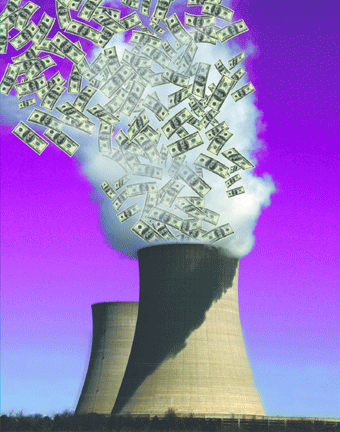 Too expensive…Not needed…top bank report hits out at plans for £25bn Hinkley C nuclear plant, This is Money, By NEIL CRAVEN FOR THE MAIL ON SUNDAY, 2 August 2015 Plans for Britain’s first nuclear reactor in almost 30 years have come under sustained attack from politicians and City bankers.
A report from a top bank this weekend warned that the cost of the £25billion Hinkley Point C plant was ‘becoming harder to justify’. HSBC concluded: ‘We see ample reason for the UK Government to delay or cancel the project.’
And former Tory Energy Secretary Lord Howell of Guildford – the self-described ‘pro-nuclear’ architect of a drive into nuclear power under Margaret Thatcher – has told the House of Lords that the reactor plan in Somerset was ‘one of the worst deals ever for British households and British industry’.
He added that he would ‘shed no tears if it was abandoned’.
Plans for Hinkley Point C have been controversial from the start with the Government guaranteeing what many saw as a sky high price electricity generated at the site.
The Department of Energy and Climate Change shrugged off HSBC’s report and the criticism seems unlikely to stop the nuclear plan. The Secretary of State for Energy, Amber Rudd, said on Friday that Britain could sign a deal as early as October during a visit by China’s President Xi Jinping.
EDF announced on the same day that it had chosen preferred suppliers for £1.3billion worth of work linked to the new plant.
But with the chorus of disapproval growing louder the Government and nuclear industry are set to be under huge pressure throughout the project to prove it is value for money for British energy users.
Key to the criticisms levelled by HSBC’s analysts is that the electricity produced by the reactor is likely to be too expensive, as European wholesale prices are expected to fall along with demand for energy from UK users. It warned of ‘huge difference between UK forward prices and the Hinkley price’.
Among HSBC’s eight key concerns is that the reactor will be economically unviable due in part to a rising number of electricity grid links with the Continent providing a ready source of cheaper supply.
At the same time it said projections by National Grid to 2025 all point to flat or declining demand. HSBC said its demand estimates are for a fall of one per cent a year.
HSBC also highlighted the ‘bleak’ future of large nuclear reactors which have a history of escalating costs and sliding deadlines. ……..
The Austrian and Luxembourg governments launched a legal complaint last month, followed by a challenge from ten German and Austrian green energy firms.
The complainants say the UK Government’s subsidies may reach £76 billion and are in breach of European rules relating to state aid. Some observers say the dispute could lead to delays of six years.: http://www.thisismoney.co.uk/money/news/article-3182406/Too-expensive-Not-needed-bank-report-hits-plans-25bn-Hinkley-C-nuclear-plant.html#ixzz3hhFWKFaE
Postponed indefinitely – the opening of U.S. government’s Waste Isolation Pilot Plant
The opening of an underground nuclear waste dump in New Mexico just got delayed indefinitely http://www.businessinsider.com.au/r-officials-delay-reopening-of-new-mexico-nuclear-waste-site-2015-8 JOSEPH J. KOLB ALBUQUERQUE, N.M. (Reuters) – The planned March 2016 reopening of an underground nuclear waste dump in New Mexico has been pushed back indefinitely because of unanticipated challenges, U.S. officials said.
A radiation leak at the U.S. government’s Waste Isolation Pilot Plant that originated in a disposal chamber half a mile (1 km) below ground at the center near Carlsbad, New Mexico, exposed more than 20 workers to small amounts of radiation in February 2014, officials have said.
The accident led to the suspension of key operations at the site, the Energy Department’s only permanent underground repository for certain types of radiological waste tied to U.S. nuclear labs and weapons sites.
Dana Bryson, acting manager for the Department of Energy’s Carlsbad Field Office, said in a statement on Friday: “We are disappointed that we will not meet the original target date for beginning waste emplacement.”
He did not provide a date for reopening the facility.
“While the WIPP recovery program continues to make significant progress, the original target date of March 2016 for resuming waste emplacement operations is no longer viable due to a variety of unanticipated issues,” said a news release from the U.S. Department of Energy that contained Bryson’s statement.
Key challenges that remain include the need to implement heightened safety standards from the Department of Energy and to resolve problems with the ventilation system, officials said.
“The department is committed to resuming operations at the Waste Isolation Pilot Plant as soon as it is safe to do so,” Bryson said.
(Editing by Alex Dobuzinskis)
Fukushima Daiichi Unit 3 – leak may have consequences for the global nuclear industry
Leak of contaminated water at Fukushima Daiichi Unit 3 may have international safety impact http://enformable.com/2014/01/leaks-contaminated-water-fukushima-daiichi-unit-3-may-international-safety-impact/ On Saturday, workers at the Fukushima Daiichi nuclear power plant in Japan were operating a remote-controlled robot to remove debris on the first floor of the Unit 3 reactor building when they discovered a stream of water nearly a foot wide flowing through the first floor the reactor building before escaping into a drain on the floor.
After an investigation found that the water contained levels of radioactive materials equal to highly contaminated water which is accumulating in the basement of the reactor building, Tokyo Electric announced that water leaking inside of the Unit 3 reactor building is likely coming from the containment vessel where it was used to cool the melted nuclear fuel, rather than rain water.
The operators used the robot to sample water flowing into the basement of the reactor building. The investigation revealed some 24 million becquerels per liter of beta ray-emitting radioactive materials, which includes strontium, 700,000 becquerels per liter of Cesium 134, and 1.7 million becquerels per liter of Cesium 137.
Tokyo Electric also found that the temperature of the water, 20 degrees Celsius, is consistent with the same as water found at the bottom of the reactor. he water is coming from a room which houses a main steam isolation valve, which is causing concern among experts around the world. The latest details have raised questions as to whether the main steam isolation valve or any of its ancillary systems may have failed during the disaster.
There are two main steam isolation valves in each of the four pipes which carry steam from the reactor vessel to the turbine. In case of accident or power loss, the MSIV’s are supposed to fail in a closed configuration.
After the reactor shut down on March 11th, 2011, the main steam isolation valves should have closed with the turbine tripped. Even if workers had manually re-opened the MSIV’s when emergency diesel generators restored power to plant equipment before the tsunami hit the plant, the pressure inside of the condenser should have automatically re-closed the MSIVs shortly thereafter.
The fact that water is leaking from a room which houses the main steam isolation valve may indicate that the valve did not close, or was damaged during the course of the disaster.
In 2011, Dave Lochbaum of the Union of Concerned Scientists drew attention to the fact that water levels in the Unit 3 reactor dropped below zero by 16:00, without any information available that would explain why.
If the MSIV did not close or broke, operators could have been facing a Loss of Coolant Accident without even knowing how the coolant water in the reactor could have leaked out.
If the MSIV was damaged or failed open, this would represent an unanalyzed condition which could affect every other operating Boiling Water Reactor in operation currently, who count on the MSIV’s to work as planned.
Source: Union of Concerned Scientists
Source: Asahi Shimbun
Scottish firms warned that their reputation at stake, if involved in Hinkley nuclear build
French energy giant EDF yesterday announced its preferred bidders for the UK’s first such facility in more than 20 years. The list includes three Scottish firms – the Weir Group, Doosan Babcock and Clyde Union Pumps – which will find out in the coming months if they have been successful.
But Dr Richard Dixon, director of Friends of the Earth Scotland, told The National: “With one false start already, active legal action in Europe and a spectacular history of cost overruns and missed deadlines, getting involved with the nuclear industry is a huge reputational risk.”
He added: “Scottish engineering firms should be helping us exploit our huge potential in renewable energy rather than chasing the nuclear dream.”……..The EU approved the project last year after the Government agreed a subsidy contract with EDF, but the development is far from certain, with a challenge by Austria to the subsidy and green groups pondering a legal challenge.
Negotiations between the French company and potential investment partners have yet to result in a final decision.
Scottish Green MSP Patrick Harvie said: “This announcement is a reminder that the UK Conservative Government is in denial about the disastrous economics of new nuclear. Scottish consumers face paying to line the pockets of multinationals like EDF who have been promised double the current market price of power for the next 35 years. And that doesn’t take into account the … toxic waste legacy that this deal will simply add to.” http://www.thenational.scot/news/nuclear-contract-will-be-toxic-for-your-reputation-scots-firms-warned.5852
Should the UK really be putting its money into nuclear power in 2015?
The Independent, CHRIS GREEN 4 August 2015 Pressure is mounting on the Government over the cost of the new Hinkley Point C nuclear power plant, and a final decision on its construction has not been made “…….more than seven years down the line, the Government has still not announced its final decision on whether to proceed with the £25bn project, which has been hit by a series of safety setbacks, legal challenges and other problems. Put simply, the debate boils down to the central question: should the UK really be putting its money into nuclear power in 2015?……… http://www.independent.co.uk/voices/comment/should-the-uk-really-be-putting-its-money-into-nuclear-power-in-2015-10436365.htmlSpecial NRC inspection of leak from A southern Illinois uranium-conversion plant
NRC inspecting Illinois uranium-conversion plant after leak, WT By – Associated Press – Tuesday, August 4, 2015 METROPOLIS, Ill. (AP) – A southern Illinois uranium-conversion plant is undergoing a special inspection after a weekend leak of uranium hexafluoride, a gas used to produce enriched uranium for nuclear power plants, Nuclear Regulatory Commission officials said.
A valve installed during maintenance at the Honeywell plant in Metropolis began to leak just before 6 p.m. Saturday, triggering an emergency alert and activation of large water sprays, the NRC said in a news release. The leak was stopped almost two hours later; the company said nobody was injured and the leak did not leave the site.
Honeywell’s Metropolis plant, about 5 miles northwest of Paducah, Kentucky, is the only place in the U.S. that converts uranium ore to uranium hexafluoride, which can be toxic when exposed to moisture in the air………
The company has experienced other uranium hexafluoride leaks, including last October, the (Carbondale) Southern Illinoisan reported (http://bit.ly/1MKIM2G ). In December 2013, Illinois Attorney General Lisa Madigan fined Honeywell $90,000 for three prior releases, in December 2008, December 2010 and October 2011. http://www.washingtontimes.com/news/2015/aug/4/nrc-inspecting-illinois-uranium-conversion-plant-a/
Renewable energy headlines
Race to store renewable energyCosmos-3 Aug 2015
In-Depth-Computerworld-3 Aug 2015
Local anxieties in Germany, over French nuclear waste plan
 French nuclear waste plan irks Germans near site, DW, 4 Aug 15 France wants to build a permanent nuclear waste storage facility not far from the German border. The plan has irked many in the region, but the government in Berlin sees no need for action.
Nuclear power plants produce radioactive waste, which emits radiation for thousands of years. Even Germany, which is set to phase out nuclear power, is looking for a final repository for its spent nuclear fuel, but has not yet decided on the location. Finding a geologically suitable site is not the problem, but rather, the protests over the location. Nobody wants to live with a nuclear waste dump at their doorstep.
For many decades, France has focused and relied on nuclear power, and now, plant operators are under pressure to find repositories for the radioactive waste.
The French government seems to have its sights set on Bure, a town in eastern France, around 120 kilometers (74 miles) from the German border. There, scientists have spent years investigating whether highly and moderately radioactive waste can be disposed of 500 meters underground. ANDRA, the French national agency for radioactive waste, believes that Bure offers what a repository requires: Nuclear waste can be stored there for 100 years; then, the site can be closed off and ultimately, the nuclear waste can decay there for 100,000 years until the radiation no longer poses a threat to humans.
‘Unbearable coup’
Opponents of the site feel less bothered by the repository itself then by the decision-making process that led to choosing it. In mid-July, the government added a last minute clause to a legislative package promoting business development but did not hold a debate or vote in parliament. And since no other potential nuclear waste sites have been explored in France, critics believe that the Bure location was practically predetermined. The Green party group in the French national assembly calls the procedure an “unbearable coup,” while the nation’s nuclear regulatory body and the French Institute for Radiological Protection and Reactor Safety (IRSN) have expressed “numerous reservations” about the plans………http://www.dw.com/en/french-nuclear-waste-plan-irks-germans-near-site/a-18627896
Indian Point nuclear station not safe – should be closed down
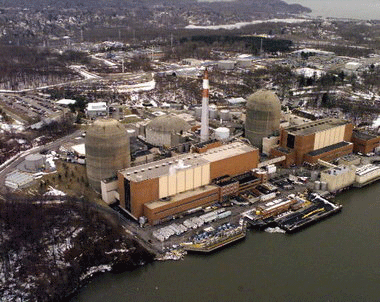 Aging Nuclear Power Plant Must Close Before It Closes Us http://ecowatch.com/2015/06/22/indian-point-aging-nuclear-plant/ Paul Gallay | June 22, 2015 We must face facts regarding the Indian Point nuclear plant. It’s infrastructure is aging, its safety is dubious and most everyone knows it. What many people don’t know is that it can be replaced at little cost to ratepayers—and energy technologies taking its place would create new economic opportunities for New York.
Indian Point—just 38 miles north of New York City—is vulnerable to terrorism, has 2,000 tons of radioactive waste packed into leaking pools and relies on an unworkable evacuation plan. While some argue that transformer accidents—such as the one that occurred last month—can happen at any power facility, they happen with astonishing frequency at Indian Point. Its age is problematic: You wouldn’t rely on a 40-year-old appliance, why extend this trust to a nuclear plant? Moreover, the Nuclear Regulatory Commission (NRC) says Indian Point 3 has the highest risk of earthquake damage of all the nation’s reactors. About 20 million people live within 50 miles of Indian Point. If a catastrophic accident occurred, the consequences would be unimaginable.
The NRC permits Indian Point to evade its own safety standards requiring that electrical cables controlling emergency reactor shutdowns have insulation that lasts 60 minutes in a fire. When the NRC found that the plant’s insulation lasted just 27 minutes, it gave Indian Point an exemption. Your own home likely has more insulation on its electrical cables than does the plant. Continue reading
Radiation health study needed – call by New Zealand’s nuclear test veterans
Nuclear protesters call for radiation health study NZ Herald Aug 3, 2015 Veterans of New Zealand’s frigate protest at nuclear tests in the South Pacific are calling for a study into the effects of radiation on their health and their children and grandchildren.
About 500 men served on HMNZS Otago and HMNZS Canterbury during the 1973 official Labour Government’s sea-borne challenge to testing in the atmosphere at a French Polynesian atoll.
Mururoa Nuclear Veterans Group president Wayne O’Donnell said the group wanted to monitor medical problems of the veterans and their families.
However, without a full list of those who served on the frigates, the group needed to get in touch with crew, or their widows and families.
The group aims to set up a trust fund to enable medical testing of veteran’s children and grandchildren.
It sought data on issues suffered by the children and also mothers during conception and child birth.
“It is hoped the results will establish the truth of the genetic transfer of illnesses related to the nuclear exposure encountered by the crews that were sent to Muruoa Atoll in 1973,” said Mr O’Donnell.
Since the group formed two years ago, he said it had met Veterans Affairs Minister Craig Foss and senior officials and more communication was expected from both sides……….http://www.nzherald.co.nz/nz/news/article.cfm?c_id=1&objectid=11490895
Radiophilia vs. Radiophobia Vodoo Science and the Zombie Myth that Will Not Die
 Is Radioactivity Really Good for You? – NRC to be The Decider NoNukesCA.netAugust 1, 2015 by James Heddle
“………..It is both amazing and distressing that the long-discredited notion of ‘hormesis’ continues to surface after all these years, and that the NRC would further damage its credibility by seriously considering it. It is an indicator of the desperation afflicting the international nuclear establishment in the wake of the still-on-going Fukushima disaster.
The zombie notion seems to have been exhumed by government and industry hacks in Japan as a way of reducing liability for radiological contamination of an area the size of New Jersey, and inducing refugees to return to contaminated lands with fraudulent assurances that low doses of radiation are not harmful.
As Krooth, Edelson and Fukurai report in their book Nuclear Tsunami: The Japanese Government and America’s Role in the Fukushima Disaster,
Even after Fukushima reactors exploded and massive radiation fallout contaminated many regions, the Japanese government and corporate media began to engage in another propaganda campaign to create a new kind of the myth – “low-level radiation is safe,” especially in Fukushima where more than millions of people were still trapped in radiation-contaminated areas.
The notion was long ago demolished by the research of such radiological pioneers as Drs. Alice Stewart, Ernest Sternglass and John Goffman………… http://nonukesca.net/?p=692
How the Fukushima nuclear disaster happened
The Worst Disaster That You’ll Never Hear Anything About, Criticl, 2 Aug 15 The Fukushima Daiichi nuclear disaster embodies one of the worst man-made calamities in human history that day-by-day receives a dearth of coverage. Three nuclear reactors melting down on March 11th, 2011 ushered in the beginning of one of the most effective and insidious works of misinformation and obfuscation of reality that has been seen in recent memory.
The impetus for the disaster arose from the 2011 Tohoku earthquake, which was estimated to be the most powerful earthquake to ever hit the island in recorded history. The magnitude of the 869 Jogan Sanriku quake (the previous record holder) is only an approximation due to the lack of seismograph technology, nonetheless the Tohoku earthquake was more powerful than the plant was designed to withstand.
Nuclear reactors are designed to shutdown at the slightest event, quickly reducing the amount of heat produced; yet any heat inside the reactor (comprised of the radioactive decay of short lived fission products) is still a magnanimous amount. Backup diesel generators were quickly ushered into action at Fukushima after outside power was destroyed by the quake in order to keep the reactors cool to prevent a meltdown.
However, standard operation procedures for the plant flew out the window when tsunami waves of 14-20 meters struck the Fukushima prefecture shortly after the earthquake, rendering the 5.7-meter seawall beyond useless and knocking out the generators. Interestingly enough, the nearby Onagawa plant was saved by a 14.8-meter seawall despite being struck by a more powerful wave. Yanosuki Hirai fought bureaucracy for years that clamored for the same 5.7-meter seawall at Onagawa, and got his higher wall, remarking, “Corporate ethics is different from compliance, just being ‘not guilty’ is not enough.” The wall was remarkably effective to the point that local residents sought shelter in the plant’s gymnasium after their homes were destroyed by the wave.
The resulting influx of water into the Fukushima reactor led to a station blackout, meaning the operators lost all monitors and the ability to remotely control the reactor. Isolation condensers can cool the reactor with no electricity as long as the condenser is filled with water. Regrettably, operators had no idea that the reactor was quickly running out of water and that the valves opening the condensers were not working, rendering the first line of defence against a potential meltdown useless.
Authorities decided next to depressurize the reactors and inject water from fire engines to flood the reactors, yet unseen diversions to steam condensers via small bypasses meant injected water was not sufficient to prevent an overheating of the core. Reactor 1 saw a hydrogen explosion resulting from molten fuel cladding three hours after the tsunami. Vents and piping intended to filter hydrogen were either severely damaged by the earthquake or unable to operate due to a lack of power.
Unit 2 and the Unit 3 Reactor Core had steam-powered turbines that would circulate cooling water, but suffered a hydrogen explosion due to the pressure in the reactor becoming too low for the turbines to operate. Operators were too inexperienced to properly inject water via the fire engines, which again resulted in a meltdown of both reactors. Leading the cleanup efforts several days later, Japanese authorities quickly created a temporary cover over Unit 1 and begin to filter out contaminated water and repair the other components of the reactors, while devising a plan to contain exposed radioactive material from the damaged reactors……………. Like what you see? https://thefirsttruth.wordpress.com/
https://criticl.me/post/worst-disaster-youll-never-hear-anything-about-3562
The choice: Start World War III, or support the Iran nuclear deal
LA Time,s Marcy Winograd, Santa Monica,30 July 15 John Bolton’s rush to a radioactive World War III was not palatable even to George W. Bush, the man who took us to war in Iraq and appointed Bolton as ambassador to the United Nations. Neither the International Atomic Energy Agency nor the Central Intelligence Agency has found evidence that Iran has developed nuclear weapons.
In contrast to Israel, widely assumed to be a nuclear state, Iran is a signatory to the Nuclear Non-Proliferation Treaty, which sanctions the development of nuclear power for peaceful purposes.
To suggest that either Israel or the U.S. could surgically strike Iran’s scattered nuclear facilities is to ignore the fact that such strikes could plunge Iran and the entire Middle East into a fiery hell that would dwarf the annihilation of Hiroshima and Nagasaki.
Rather than plot world demise, Bolton would be well advised to support the Obama administration’s agreement for inspections and verification and let the American people begin a dialogue with Iran’s next generation of leaders. Sixty percent of Iran’s 75 million people are under the age of 30. Bolton is yesterday’s news; Iran’s youth are tomorrow’s hope.
http://www.latimes.com/opinion/readersreact/la-le-0730-thursday-iran-bolton-nuclear-20150730-story.html
1 This Month

of the week – Shut Down Drone Warfare!


Tell the Ukrainian Government to Drop Prosecution of Peace Activist Yurii Sheliazhenko

Petition to revoke the licensing of the Near Surface Nuclear Disposal Facility (NSDF) at Chalk River. https://www.ourcommons.ca/petitions/en/Petition/Details?Petition=e-7247
To see nuclear-related stories in greater depth and intensity – go to https://nuclearinformation.wordpress.com
-
Archives
- March 2026 (251)
- February 2026 (268)
- January 2026 (308)
- December 2025 (358)
- November 2025 (359)
- October 2025 (376)
- September 2025 (257)
- August 2025 (319)
- July 2025 (230)
- June 2025 (348)
- May 2025 (261)
- April 2025 (305)
-
Categories
- 1
- 1 NUCLEAR ISSUES
- business and costs
- climate change
- culture and arts
- ENERGY
- environment
- health
- history
- indigenous issues
- Legal
- marketing of nuclear
- media
- opposition to nuclear
- PERSONAL STORIES
- politics
- politics international
- Religion and ethics
- safety
- secrets,lies and civil liberties
- spinbuster
- technology
- Uranium
- wastes
- weapons and war
- Women
- 2 WORLD
- ACTION
- AFRICA
- Atrocities
- AUSTRALIA
- Christina's notes
- Christina's themes
- culture and arts
- Events
- Fuk 2022
- Fuk 2023
- Fukushima 2017
- Fukushima 2018
- fukushima 2019
- Fukushima 2020
- Fukushima 2021
- general
- global warming
- Humour (God we need it)
- Nuclear
- RARE EARTHS
- Reference
- resources – print
- Resources -audiovicual
- Weekly Newsletter
- World
- World Nuclear
- YouTube
-
RSS
Entries RSS
Comments RSS
 nuclear-news