Too cheap to meter? Not nuclear–solar!

 The nuclear power industry certainly rues the day the concept that atomic electricity would be “too cheap to meter” entered the public’s mind. The phrase has become inextricably linked with nuclear power, but not in the way its creators envisioned: instead of as a success story, it has become a symbol of nuclear power’s economic failure.
“Too cheap to meter” too quickly became “too expensive to use” and “too costly to build.”
So the headline above is offered with some trepidation and a grain of salt; over-promising on solar power will prove no more beneficial than it was for nuclear.
Still, the comparison is obvious. As giant nuclear utilities seek new ways to game the system and bleed ratepayers for every penny they can–whether or not those ratepayers have any anything left to bleed–to prop up reactors that produce electricity normal people simply can’t afford and shouldn’t have to pay…
View original post 1,022 more words
Premature Degradation of Nuclear Dry Cask Structures and Components due to Environmental Moisture


 http://pbadupws.nrc.gov/docs/ML1232/ML12320A697.pdf
These dry cask brands belong to French State owned AREVA.
As illustrated above, “Spent fuel pools are needed to unload failed canisters and cask. However, the NRC allows pools to be destroyed after all fuel is loaded into dry storage, claiming nothing will go wrong. This December 1, 2010 Peach Bottom TN-68 cask event report is an example of why the pools are needed in case of cask or canister failure. http://pbadupws.nrc.gov/docs/ML1100/ML110060275.pdf
[NOTE: The Areva thick steel TN-68 cask worked as designed. It has a lid monitoring early warning system, so casks can be unloaded and repaired (e.g., seal replaced) before a radiation leak. If this had been a thin steel canister that leaked, there is no early warning system and the canister cannot be repaired.]” http://sanonofresafety.org/nuclear-waste/
Rather interesting that the French used to know about galvanic corrosion in the 1880s but AREVA apparently hadn’t heard of…
View original post 1,533 more words
July 1 Energy News

Science and Technology:
¶ Samsung researchers developed a technology that enables coating silicon battery cathodes with high crystal graphene. They can now virtually double the capacity of lithium-ion batteries! This energy density increase could almost double the range of electric vehicles without adding a single pound of weight. [CleanTechnica]
World:
¶ China has submitted a United Nations climate Intended Nationally Determined Contribution (INDC). The Chinese greenhouse gas emitter’s contribution means plans from the 193 UN nations now cover over half the world’s GHG emissions. China’s plan is to cut the emissions relative to its GDP by 60% by 2030. [CleanTechnica]
 Yangtze River, China (cc via travelojos.com)
¶ Kyocera TCL Solar LLC, a joint venture of Kyocera Corp and Century Tokyo Leasing Corp, has commenced construction of a 23-MW solar power plant on an abandoned golf course in Kyoto Prefecture, Japan. The plant will generate an estimated…
View original post 630 more words
June 30 Energy News
Science and Technology:
¶ This morning, June 29th, 2015, at 3:03 am local time in Nagoya, Japan (6:03 pm GMT on June 28th), Swiss pilot André Borschberg took off in the single-seater aircraft from Nagoya endeavoring to reach Hawaii, in what will be the longest exploration leg of the Solar Impulse’s “Round-The-World” mission. [CleanTechnica]
 Photo Credit: Solar Impulse
World:
¶ South Korea vowed Tuesday to cut greenhouse gas emissions by 37% from the estimated business-as-usual level by 2030, raising the aim from previous proposals, but still facing opposition from the involved sectors with criticism that the target is insufficient. One issue is planned use of carbon credits. [The Korea Herald]
¶ A giant solar farm near the English village of Laceby that could power almost 6,500 homes won council approval. The successful application affects 36.66 hectares (90.6 acres) of land and will generate up to 27.14…
View original post 660 more words
Still more ratepayer bailouts needed, says Entergy exec
!["I've made it clear FitzPatrick [pictured here, from NRC] has been a marginal unit for a while," he said. "We're really counting on some positive changes in market design to be able to continue to run it," says Entergy exec William Mohl.](https://nuclear-news.net/wp-content/uploads/2015/07/fitzpatricknrc.jpg) “I’ve made it clear FitzPatrick [pictured here, from NRC] has been a marginal unit for a while,” he said. “We’re really counting on some positive changes in market design to be able to continue to run it,” says Entergy exec William Mohl. The nuclear power industry increasingly reminds one of nothing so much as the spoiled brat (or, possibly, the greedy king Midas) who, upon receiving a gift, instantly wants “more!”
“I’ve made it clear FitzPatrick [pictured here, from NRC] has been a marginal unit for a while,” he said. “We’re really counting on some positive changes in market design to be able to continue to run it,” says Entergy exec William Mohl. The nuclear power industry increasingly reminds one of nothing so much as the spoiled brat (or, possibly, the greedy king Midas) who, upon receiving a gift, instantly wants “more!”
Thus, when the Federal Energy Regulatory Commission (FERC) June 10 approved a plan put forth last December by the PJM grid–the largest of the three major grids in the U.S.–to reward high-performing power plants and penalize low-performing units, Entergy’s (the second largest nuclear utility) instant reaction was “more.”
A little translation may be in order. After all, it would seem to make perfect sense to reward the best and penalize the worst. But the real intent of PJM’s plans…
View original post 1,088 more words
Canada UK Strengthen Nuclear Cooperation; CANDU MOX?
Canada Press Release:
Canada and the United Kingdom Strengthen Nuclear Cooperation
June 29, 2015
Ottawa
Natural Resources Canada
The Honourable Greg Rickford, Canada’s Minister of Natural Resources, today announced the signing of a Memorandum of Understanding (MOU) with the United Kingdom (U.K.) on nuclear energy cooperation. This MOU will help position Canada’s nuclear industry to capture opportunities in the growing U.K. nuclear energy market.
The U.K. Nuclear Industrial Strategy calls for the construction of at least 12 new nuclear power plants to produce 16 gigawatts-electric by 2030 to replace its existing fleet and to help meet projected growth in demand. The MOU will provide benefits to a wide array of stakeholders in the nuclear energy industry in both Canada and the U.K., including small and medium-sized enterprises, by facilitating stronger industry-to-industry connections and encouraging collaborative work between laboratories and university research networks.
The MOU follows through on the commitment for…
View original post 689 more words
Firefighters working around the clock as wildfires rage near Chernobyl nuclear site
 Wildfires Once Again Rage Nearby the Chernobyl Nuclear Site https://news.vice.com/article/wildfires-once-again-rage-nearby-the-chernobyl-nuclear-site By VICE News July 1, 2015 A fire is raging across half a square mile of drought-stricken land surrounding the remains of the Chernobyl nuclear power plant in Ukraine, the site of one of the worst nuclear disasters in history. It’s the second fire to hit the area since late April. After a reactor exploded at the plant in 1986, authorities established an 18-mile exclusion zone that remains off-limits to most people today. Some parts of the zone remain highly contaminated.
Ukraine’s State Emergency Situations Service reported early Tuesday that the fire was within the exclusion zone, according to the Ukrainian news service Interfax. But the country’s Minister of Ecology and Natural Resources later told reporters the fire is burning outside of the zone. He added that the blaze started due to drought.
The fire started Monday night and was still burning Tuesday morning, the Associated Pressreported.
Firefighters are working 24 hours a day amidst strong winds, according to a post on the emergency service’s Facebook page. Radiation levels are within normal, the agency said.
In late April, the largest forest fire in Ukraine since 1992 came within 12 miles of the Chernobyl plant.
In February, researchers warned that fires nearby Chernobyl “pose a high risk of redistributing radioactivity.” And, say scientists, wildfires in the area could become more frequent and more intense due to climate change.
Fukushima nuclear facility under control – no way!
Fukushima Not Even Close To Being Under Control Oil Price, By ZeroHedge , 28 June 2015 “……….In late 2014, Helen Caldicott, M.D. gave a speech about Fukushima at Seattle Town Hall. Pirate Television recorded her speech
Dr. Helen Caldicott is co-founder of Physicians for Social Responsibility, and she is author/editor of Crisis Without End: The Medical and Ecological Consequences of the Fukushima Nuclear Catastrophe, The New Press, September 2014. For over four decades Dr. Caldicott has been the embodiment of the anti-nuclear banner, and as such, many people around the world classify her as a “national treasure”. She’s truthful and honest and knowledgeable.
Fukushima is literally a time bomb in quiescence. Another powerful quake and all hell could break loose. Also, it is not even close to being under control. Rather, it is totally out of control. According to Dr. Caldicott, “It’s still possible that Tokyo may have to be evacuated, depending upon how things go.” Imagine that!
Fukushima- The Real Story
According to Japan Times as of March 11, 2015: “There have been quite a few accidents and problems at the Fukushima plant in the past year, and we need to face the reality that they are causing anxiety and anger among people in Fukushima, as explained by Shunichi Tanaka at the Nuclear Regulation Authority. Furthermore, Mr. Tanaka said, there are numerous risks that could cause various accidents and problems.”
Even more ominously, Seiichi Mizuno, a former member of Japan’s House of Councillors (Upper House of Parliament, 1995-2001) in March 2015 said: “The biggest problem is the melt-through of reactor cores… We have groundwater contamination… The idea that the contaminated water is somehow blocked in the harbor is especially absurd. It is leaking directly into the ocean. There’s evidence of more than 40 known hotspot areas where extremely contaminated water is flowing directly into the ocean… We face huge problems with no prospect of solution.”
At Fukushima, each reactor required one million gallons of water per minute for cooling, but when the tsunami hit, the backup diesel generators were drowned. Units 1, 2, and 3 had meltdowns within days. There were four hydrogen explosions. Thereafter, the melting cores burrowed into the container vessels, maybe into the earth……http://oilprice.com/Latest-Energy-News/World-News/Fukushima-Not-Even-Close-To-Being-Under-Control.htm
Study of over 300.000 nuclear workers confirms increased health risks from low dose radiation
 Researchers pin down risks of low-dose radiation Large study of nuclear workers shows that even tiny doses slightly boost risk of leukaemia. http://www.nature.com/news/researchers-pin-down-risks-of-low-
 dose-radiation-1.17876 Alison Abbott 30 June 2015 For decades, researchers have been trying to quantify the risks of very low doses of ionizing radiation — the kind that might be received from a medical scan, or from living within a few tens of kilometres of the damaged Fukushima nuclear reactors in Japan. So small are the effects on health — if they exist at all — that they seem barely possible to detect. A landmark international study has now provided the strongest support yet for the idea that long-term exposure to low-dose radiation increases the risk of leukaemia, although the rise is only minuscule (K. Leuraud et al. Lancet Haematol. http://doi.org/5s4; 2015).
The finding will not change existing guidelines on exposure limits for workers in the nuclear and medical industries, because those policies already assume that each additional exposure to low-dose radiation brings with it a slight increase in risk of cancer. But it scuppers the popular idea that there might be a threshold dose below which radiation is harmless — and provides scientists with some hard numbers to quantify the risks of everyday exposures.
“The health risk of low-dose radiation is really very tiny, but the public is very concerned,” says Bill Morgan, who heads a systems-biology programme in low-dose radiation at the Pacific Northwest National Laboratory in Richland, Washington, and chairs the committee on radiation effects at the International Commission on Radiological Protection (ICRP) in Ottawa, Canada. That concern has driven a lot of investment in programmes trying to quantify the risk, he says. The European Commission, for example, has a 20-year road map to assess the problem. “We don’t do a very good job of explaining ourselves to the public, which finds it hard to put radiation risks in context — some people go to radon spas to treat their rheumatism while others won’t board planes for fear of cosmic rays,” he adds.
Radiation risks
Ionizing radiation — the kind that can pull electrons from atoms and molecules and break DNA bonds — has long been known to raise the risks of cancer; the higher the accumulated dose, the greater the damage. But it has proved extremely difficult to determine whether this relationship holds at low doses, because any increase in risk is so small that to detect it requires studies of large numbers of people for whom the dose received is known. A study of more than 300,000 nuclear-industry workers in France, the United States and the United Kingdom, all of whom wore dosimeter badges, has provided exactly these data. A consortium of researchers coordinated by the International Agency for Research on Cancer (IARC) in Lyon, France, examined causes of death in the workers (one-fifth of whom had died by the time of the study) and correlated this with exposure records, some of which went back 60 years. Continue reading
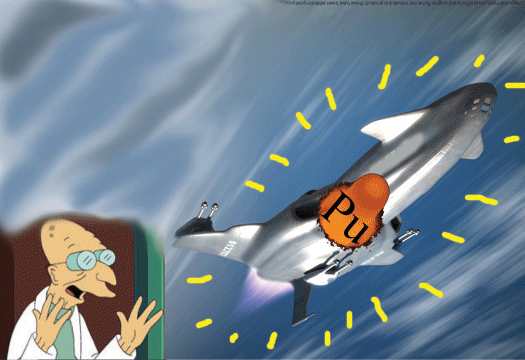
NASA cancelling solar space missions, favouring plutonium fuelled space flights
Debate over future of nuclear power systems in space, Enformable, Karl Grossman 29 Jun 2015NASA has released a study claiming there is a need for continued use of plutonium-energized power systems for future space flights. It also says the use of actual nuclear reactors in space “has promise” but “currently” there is no need for them.
The space plutonium systems—called radioisotope thermoelectric generators (RTGS)—use the heat from the decay of plutonium to generate electricity in contrast to nuclear reactors, usually using uranium, in which fission or atom-splitting takes place.
The “Nuclear Power Assessment Study” describes itself as being done as a “collaboration” involving “NASA centers,” among them Johnson Space Center, Kennedy Space Center and the Jet Propulsion Laboratory, “the Department of Energy and its laboratories including Los Alamos National Laboratory, Idaho National Laboratory, Sandia National Laboratories,” and the Johns Hopkins University Applied Physics Laboratory.
The study, released this month, comes as major breakthroughs have been happening in the use of solar and other benign sources of power in space. The situation parallels that on Earth as solar and wind power and other clean, safe technologies compete with nuclear, oil, coal and other problematic energy sources and the interests behind them. Examples of the use of benign power in space include the successful flight in May of a solar-powered spacecraft named LightSail in a mission funded by members of the Planetary Society. Astronomer Carl Sagan, a founder of the society, was among those who have postulating having a spacecraft with a sail propelled through the vacuum of space by the pressure of photons emitted by the sun. LightSail demonstrates his vision.
Yet, meanwhile, NASA cancelled its own solar sail mission scheduled for this year. Continue reading
UK government and EDF anxious about Austria’s lawsuit against state aid for Hinkley Point nuclear station

 Government and EDF in talks over liabilities if Austria wins nuclear state aid appeal, Telegraph, Energy giant and Government yet to agree what would happen if Austrian challenge against state aid for Hinkley Point C is successful By Emily Gosden, Energy Editor 30 Jun 2015 The Government and EDF are in talks over who will pick up the costs if Austria wins its appeal against the proposed Hinkley Point C nuclear plant once construction has begun.
Plans for the £16bn Hinkley Point plant received state aid clearance from the European Commission last year but Austria has vowed to challenge this, alleging that subsidies for the project constitute illegal state aid.
Although the Government and EDF both insist the appeal, expected to be lodged this week, has no merit, it is understood they are yet to agree on what would happen in the unlikely event Austria does win.Andrea Leadsom, the new energy minister, said on Tuesday she was “confident that the key investment decision on Hinkley C will happen soon, which will enable construction to start”.
But speaking on the fringes of the Nuclear Industry Association’s annual conference, Ms Leadsom also confirmed that the Government was “looking very closely” at the issue of how the project could go ahead with a state aid challenge ongoing.Austria’s state aid appeal is likely to hang over the project for at least a year and potentially as long as six years – during which time billions of pounds would be spent on construction.
The Government and EDF are believed to be targeting a final investment decision by October.A series of issues remain outstanding including EDF’s takeover of reactor-maker Areva’s nuclear business, deals with Chinese investors, and finalising contracts with the Government.
• Hinkley Point new nuclear power plant: the story so far………
Writing on legal website Lexology, lawyers at Shearman and Sterling LLP wrote: “While the prospect of success is low, even a small chance of success creates additional risk for project financiers.
“In a worst-case scenario, where the Commission makes an adverse decision, the UK Government’s support scheme – including the strike price and guarantee – would be ruled unlawful and unenforceable, with any aid already received having to be repaid. A competitor or other party with standing could apply to the UK national court to enforce this.
“While this outcome is the least likely, it may have a severely adverse impact on investors in the Hinkley Point C project.”
They added that “investors may find insuring themselves contractually (e.g., via indemnities or similar means) difficult” and that “any provision seeking protection from the UK Government for such an eventuality could itself risk being struck down as unlawful State aid”…..http://www.telegraph.co.uk/finance/newsbysector/energy/11709083/Government-and-EDF-in-talks-over-liabilities-if-Austria-wins-nuclear-state-aid-appeal.html
‘Scorpion’ robot to help develop new robots that could go deeper into Fukushima nuclear reactor unit 2
Officials hope the robot can see the fuel in the pressure vessel in the middle of the reactor. The fuel hasn’t been located exactly and studied because of the high radiation levels.
The difficult work of decommissioning the Fukushima plant damaged by the 2011 earthquake and tsunami will take decades. The scorpion robot is the second to enter a primary containment vessel, after “snake” robots were sent in April inside the worst-hit Unit 1. One of the two robots used in that reactor became stuck and had to be left behind, and neither was able to spot the melted fuel debris.
This time, the scorpion crawler, which is 54 centimeters (21 inches) long when it is extended, will enter through a duct designed as a passageway for fuel rods. Toshiba has no back up machine……….
Toshiba officials said they hope the robot can capture images of deeper areas of the vessel, though the primary focus is the platform area, so they can design suitable robots that can go deeper into the vessel……
The robot’s entry is just the beginning of the reactor investigation required before the most challenging task of removing the melted fuel.: http://phys.org/news/2015-06-small-robot-interior-fukushima-daiichi.html#jCp
Poor health of Fukushima radiation refugees
Nonprofit Group: “Every single person” we hosted from Japan has had health problems… Blood stains found in almost all of their beds — Japanese Mom: Most mothers I’ve met from Tokyo and Fukushima are suffering thyroid problems, eye problems, nose bleeds… It’s been very surprising (VIDEO) http://enenews.com/video-mothers-ive-met-tokyo-fukushima-suffering-thyroid-problems-eye-problems-nose-bleeds-very-surprising-nonprofit-group-every-single-person-weve-hosted-japan-health-problems-found-blood-stains-ev?utm_source=feedburner&utm_medium=email&utm_campaign=Feed%3A+ENENews+%28Energy+News%29
Interview with Vicki Nelson, founder of Fukushima Friends (nonprofit organization which facilitates trips to Hawaii for Fukushima radiation refugees), Nuclear Hotseat hosted by Libbe HaLevy, Jun 9, 2015 (at 16:30 in):
- Vicki Nelson, founder of Fukushima Friends (emphasis added): We have a home that’s open for them to come and experience some time of respite and eat different food. What we’ve been experiencing also is that every single person that comes has reaction to the change as soon as they come here. There’s been people who have vomited, they’ve been having nosebleeds, they’ve been dizzy, they’ve been very ashen in color.
- Libbe HaLevy, host: This is once they have left Japan? In other words, it is the lack of the radiation that allows them to then have these reactions?
- Nelson: It’s like it is expelling from their body. There’s diarrhea, there’s nosebleeds— almost every single person has had nosebleeds on their pillow. I find blood, andthey don’t want to tell me that they have these reactions, they’re embarrassed. Tokiko’s son [from Koriyama, Fukushima] vomited the whole first week practically, and diarrhea. We actually took him to the hospital because we felt that he was dehydrated. They did run tests, and they said yes he was dehydrated. So he was kept overnight at the Hilo hospital on the big island and cared for.
Meeting hosted by Andrew Cash, member of Canadian parliament, Dec 2012 — Japanese mother (at 2:12:30 in): “My home town is Sapporo [northernmost island in Japan]… In my city, no one thinks about radiation. I found a group of escaped mothers from Tokyo and the Fukushima area, and I was very surprised… Most of them had thyroid problems, or eye problems, or nose bleeds… They are very worried about it. In Japan we knew about the meltdowns two months after the meltdowns happened, so we can have no information about radiation. Now the government is telling us to eat food from Fukushima. We can’t rely on government. The TV said Fukushima is safe, no problem… Fukushima is good to live. They want to invite a lot of tourists to Fukushima.
Full interview with Nelson here | Watch the meeting in Canada here
Canada’s last shipment of weapons grade uranium. Medical radioisotopes to be made in cyclotron, not nuclear reactor
The Chalk River reactor, which began operating in 1957, is one of five major producers of molybdenum-99, which decays into the technetium-99m isotope used in 85 per cent of nuclear medicine procedures such as bone scans and other diagnostic tests.
 Other sources, such as a cyclotron operated by TRIUMF, Canada’s national nuclear laboratory for particle and nuclear physics at the University of British Columbia, are in the works.
Final shipment of weapons-grade uranium due at Ontario facility this year http://www.thestar.com/news/canada/2015/06/29/final-shipment-of-weapons-grade-uranium-due-at-ontario-facility-this-year.html By: Joanna Smith Ottawa Bureau reporter, Jun 29 2015
OTTAWA—The United States has approved what is expected to be the last shipment of weapons-grade uranium to be sent to Canada for the production of medical isotopes. The U.S. Nuclear Regulatory Commission signed an export licence June 23 to transport 8.1 kilograms of highly enriched uranium from Oak Ridge, Tenn., along a secret route to Chalk River, Ont., by the end of this year.
There, for what is expected to be the last time, the uranium will be used to produce target material for the aging National Research Universal (NRU) reactor to irradiate in order to produce medical isotopes used in nuclear medicine.
“The game is over for Canada’s unnecessary and irresponsible use of bomb-grade uranium to produce medical isotopes. Better late than never,” Alan Kuperman, coordinator of the Nuclear Proliferation Prevention Project at the University of Texas at Austin, said in a statement Monday.
THE LAST SHIPMENT Kuperman has long been tracking the controversial U.S. exports of highly enriched uranium to Canada. The Conservative government has committed to shutting down the routine production of medical isotopes at the NRU by Oct. 31, 2016, with the possibility of the NRU retaining licences to operate until March 2018 in case of unexpected shortages. The isotope has a very short lifespan, causing it to disappear within a day of being generated and so it cannot be stockpiled.
In France, nuclear power has lost its glow

 France Loses Enthusiasm for Nuclear Power, Scientific American, Nuclear’s share of electricty will drop from 75 percent to 50 percent by 2025 due to loss of know-how and requirements for more renewable sources By Umair Irfan and ClimateWire | June 29, 2015“……..
A ‘once formidable institution’ declines….nuclear plants, by their nature, are big bets and take years to build. Laponche explained that the French nuclear industry anticipated 1,000 TWh of demand, but domestic needs have yet to top 600 TWh, leaving an oversupply. With the economic downturn and increasing energy efficiency, French electricity demand has remained level or declined in some instances.
Now, some of France’s reactors are showing wrinkles—France’s oldest reactor, Fessenheim 1, started operations in 1977—and officials need to decide whether to invest in costly safety upgrades to keep them operating or to decommission them, another expensive prospect that leaves open the possibility that fossil fuels may rise to meet the shortfall.
New reactors also are struggling. Areva’s third-generation nuclear reactor, EPR, is now under construction at four sites: two in China, one in France and one in Finland. All four are behind schedule, and the French and Finnish reactors have seen their costs more than double, suffering from quality control and management problems.
“The cost of construction of new nuclear is extraordinarily expensive,” said Antony Frogatt, a senior research fellow at Chatham House, an international affairs think tank. He observed that there are ways to extend the lives of existing reactors, but upgrades get progressively more expensive, and certain components, like reactor pressure vessels, cannot be replaced, so renewed operating licenses are only prolonging the inevitable.
And while France has reduced nuclear waste, it hasn’t eliminated the need to dispose of it. No country with nuclear power has a viable underground repository for waste, and proposed sites in France face public opposition, despite more widespread support for nuclear power.
On the other hand, France is the second largest renewable energy producer and consumer in Europe. Wavering solar and wind power don’t play well with baseload nuclear plants that prefer to run at full blast, so the French must find a way to cope with this imbalance if they are to meet the European Union’s directive to generate 20 percent of their electricity from renewables by 2020…….
To sum up, it’s a shrinking client base [for nuclear power] and a competitive market,” said Mycle Schneider, an independent international energy consultant. “The financial and economic situation is devastatingly bad.”
The New York Times reported that Areva hasn’t been profitable since 2010, accrued €4.8 billion in losses in 2014 and may lay off up to 6,000 workers. EDF may take over parts of Areva’s business…….
1 This Month

Chernobyl: The Lost Tapes – A good documentary on Chernobyl on SBS available On Demand for the next 3 weeks– https://www.sbs.com.au/ondemand/tv-program/chernobyl-the-lost-tapes/2352741955560

of the week–London Campaign for Nuclear Disarmament

Tell the Ukrainian Government to Drop Prosecution of Peace Activist Yurii Sheliazhenko
To see nuclear-related stories in greater depth and intensity – go to https://nuclearinformation.wordpress.com
-
Archives
- April 2026 (173)
- March 2026 (251)
- February 2026 (268)
- January 2026 (308)
- December 2025 (358)
- November 2025 (359)
- October 2025 (376)
- September 2025 (257)
- August 2025 (319)
- July 2025 (230)
- June 2025 (348)
- May 2025 (261)
-
Categories
- 1
- 1 NUCLEAR ISSUES
- business and costs
- climate change
- culture and arts
- ENERGY
- environment
- health
- history
- indigenous issues
- Legal
- marketing of nuclear
- media
- opposition to nuclear
- PERSONAL STORIES
- politics
- politics international
- Religion and ethics
- safety
- secrets,lies and civil liberties
- spinbuster
- technology
- Uranium
- wastes
- weapons and war
- Women
- 2 WORLD
- ACTION
- AFRICA
- Atrocities
- AUSTRALIA
- Christina's notes
- Christina's themes
- culture and arts
- Events
- Fuk 2022
- Fuk 2023
- Fukushima 2017
- Fukushima 2018
- fukushima 2019
- Fukushima 2020
- Fukushima 2021
- general
- global warming
- Humour (God we need it)
- Nuclear
- RARE EARTHS
- Reference
- resources – print
- Resources -audiovicual
- Weekly Newsletter
- World
- World Nuclear
- YouTube
-
RSS
Entries RSS
Comments RSS
 nuclear-news