South Africa is warned – Nuclear power is a dying industry
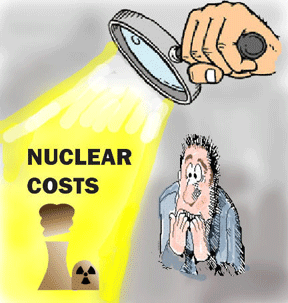 With the South African build is set to cost anywhere up to R1-trillion, that would mean the same cost (adjusted upward with inflation) would have to be born near the end of this century, he says. “Except then you will have no income coming in. Just the cost of powering the reactors while you wind down operations. And the endless cost of looking after the nuclear waste.”
“This is a dying industry and there are just too many unanswered questions for South Africa to go down this path. Except we know the element of corruption can always be present in the nuclear industry,”

 Nuclear a ‘technology of the past‘, Mail & Guardian, 27 JUL 2015 SIPHO KINGS A Russian nuclear activist has labelled South Africa’s pursuit of new nuclear capacity – with Russian support – as “naive” and advised against it. “Nuclear is not technology of the future. This is technology of the past, of the Cold War.” This is the conclusion Vladimir Slivyak, of the Russian environmental group Ecodefense, reaches when talking about nuclear technology.
In this case he was speaking at a seminar at the University of Johannesburg on Monday, titled, “Are Russian nuclear reactors a viable solution to the South African crisis?”
Slivyak is a university lecturer and an activist against what he says is the oblique way the Russian nuclear industry operates. He is in South Africa to look at the proposed nuclear build.
In September 2014, the two countries signed an intergovernmental agreement, which is still under discussion, for the possible construction of 9 600-megawatts of new nuclear energy. This is the equivalent of the Medupi and Kusile coal-fired power stations still under construction.
Under the agreement, the Russian nuclear utility Rosatom would build, own and operate the reactors with a 20-year guarantee that the power would be bought at a set price. The costs of this vary from R500-billion to R1-trillion.
SA to take responsibility for any damage
The agreement also indemnifies Rosatom from any liability from nuclear accidents during the reactor’s life. It says South Africa is “solely responsible for any damage both within and outside the territory of the Republic of South Africa”.
Slivyak says that this is probably the biggest concern with the whole build, given the track record of nuclear energy in Russia.
In the six decades where nuclear has been used to create energy, he says there have been numerous incidents. Chernobyl was the only one that caused waves because it affected so many other countries that it could not be hidden – 60% of the radioactive dust released landed outside territories belonging to the Soviet Union. Even now there are forests in Germany where people cannot hunt animals because of their contamination, he says.
The state nuclear regulator – Rostekhnadzor – said last year that 39 incidents had occurred in 2013. The main reasons were “mismanagement, defects in equipment and design errors”. The country’s fleet of 34 reactors has had much of its life extended by 15 years, despite being built to operate for about 30 years.
Slivyak says that even with this extension, Russia itself has stopped investing heavily in nuclear power for its own economy. More than half of the primary energy mix comes from natural gas, with nuclear contributing around 5%.
“Russia has a large but outdated energy industry,” he says.
This industry was focused on other energy sources and in the coming decade nuclear will only make up about 3% of the total energy mix, Slivyak says. This is because plants will retire without new ones being built.
The country’s 2008 energy plan called for 13 000-megawatts of new nuclear capacity to start construction within five years.
This had shrunk to 5 500-megawatts in the last few years because the Russian economy is ailing and Rosatom only has the technical capacity to build one new reactor a year, says Slivyak. “It is hard to see how – even with all the desire in the world – Rosatom can afford to build so many reactors and carry that cost up-front, before they start selling energy.”
The utility said last year that it had 27 orders worth $100-billion. But it is only building new plants in China and Belarus.
…………..With the South African build is set to cost anywhere up to R1-trillion, that would mean the same cost (adjusted upward with inflation) would have to be born near the end of this century, he says. “Except then you will have no income coming in. Just the cost of powering the reactors while you wind down operations. And the endless cost of looking after the nuclear waste.”
While the agreement between Russia and South Africa ensured that Rosatom carried the cost of this part of the process, Slivyak says the country does not yet know how to decommission nuclear plants. This meant South Africa was agreeing to a process that nobody yet knew the technical outcome of, he says.
Instead, he says the country should be looking at renewable technology. Unlike nuclear – where the cost per unit of energy was always increasing – renewable technology was rapidly decreasing in cost. With less construction there would also be less research in nuclear, and consequently less chance of costs going down, he says.
France – one of the world’s largest builders of nuclear plants and also in the bidding to build South Africa’s fleet – said earlier this year that it would cut nuclear’s share of the energy mix from 80% to 50% in a decade.
“This is a dying industry and there are just too many unanswered questions for South Africa to go down this path. Except we know the element of corruption can always be present in the nuclear industry,” says Slivyak. http://mg.co.za/article/2015-07-27-nuclear-too-old-too-complicated-too-uneconomic
No comments yet.
1 This Month

of the week – Shut Down Drone Warfare!


Tell the Ukrainian Government to Drop Prosecution of Peace Activist Yurii Sheliazhenko

Petition to revoke the licensing of the Near Surface Nuclear Disposal Facility (NSDF) at Chalk River. https://www.ourcommons.ca/petitions/en/Petition/Details?Petition=e-7247
To see nuclear-related stories in greater depth and intensity – go to https://nuclearinformation.wordpress.com
-
Archives
- April 2026 (79)
- March 2026 (251)
- February 2026 (268)
- January 2026 (308)
- December 2025 (358)
- November 2025 (359)
- October 2025 (376)
- September 2025 (257)
- August 2025 (319)
- July 2025 (230)
- June 2025 (348)
- May 2025 (261)
-
Categories
- 1
- 1 NUCLEAR ISSUES
- business and costs
- climate change
- culture and arts
- ENERGY
- environment
- health
- history
- indigenous issues
- Legal
- marketing of nuclear
- media
- opposition to nuclear
- PERSONAL STORIES
- politics
- politics international
- Religion and ethics
- safety
- secrets,lies and civil liberties
- spinbuster
- technology
- Uranium
- wastes
- weapons and war
- Women
- 2 WORLD
- ACTION
- AFRICA
- Atrocities
- AUSTRALIA
- Christina's notes
- Christina's themes
- culture and arts
- Events
- Fuk 2022
- Fuk 2023
- Fukushima 2017
- Fukushima 2018
- fukushima 2019
- Fukushima 2020
- Fukushima 2021
- general
- global warming
- Humour (God we need it)
- Nuclear
- RARE EARTHS
- Reference
- resources – print
- Resources -audiovicual
- Weekly Newsletter
- World
- World Nuclear
- YouTube
-
RSS
Entries RSS
Comments RSS
 nuclear-news
Leave a comment