Congo’s forgotten uranium mine
In Congo, silence surrounds forgotten mine that fuelled first atom bombs, Aljazeera America
The US sourced uranium for the weapons used on Japan from Shinkolobwe; though the site is closed, locals mine illegally July 23, 2015 by Tom Zoellner One of the manifest ironies of the nuclear age is just how primitive it all is. A complicated war was brought to an end within a week by a pair of indiscriminate hammer blows. The logic behind the next 45 years of Cold War military strategy — hit us and we both die — was as simplistic as it was problematic. And driving everything was a bomb fashioned out of dirt.
A particular kind of dirt, of course, and one that required a lavish industrial process before it could be made into a fissile device. That dirt is uranium, and it lies all around the world in abundant quantities. A place where it was concentrated to levels of freakish purity is now just a curious footnote of the nuclear age, but at one time, it was treated with intense secrecy.
Shinkolobwe was a small settlement in the Katanga province of what was then the Belgian Congo……….
The mine produced uranium for U.S. nuclear weapons until 1960, when enough uranium mines had opened up in the American Southwest to meet the nuclear hunger, and Shinkolobwe was closed. The Belgians poured concrete down the mineshaft and closed off the pit.
I visited Shinkolobwe in 2007, 120 miles from the city of Lubumbashi over disintegrating roads through the rain forest. A permit to go there cost $80, payable to a member of the presidential staff. We had to walk the last several kilometers until we reached a decrepit fence overgrown with vines.
Sharp’s hill had given way to an immense pit, which had been chewed over for decades by local freelance miners. The mineshaft the Belgians built and then filled with concrete had been dug away to a depth of about 100 feet and fallen over. The scene was disquietingly peaceful. Though we had been told it was heavily guarded, no soldiers or police were there to challenge us.
The birthplace of the Bomb has been forgotten by the outside world but not by everyone. Teams of Congolese miners kept slipping inside the old pit to dig out residual supplies of copper and cobalt, which they sell on the black market. There have been persistent rumors — and some occasional instances — of local businessmen selling uranium to outside parties. There is also evidence that some of the Shinkolobwe uranium has found its way into Iranian centrifuges, though this remains publicly unconfirmed by Western intelligence agencies…….http://america.aljazeera.com/articles/2015/7/23/in-congo-silence-surrounds-forgotten-mine-that-fueled-first-atomic-bombs.html
Control of electricity at the local level, with batteries for renewable energy
In the end, the solution might lie on a smaller scale: giving everyone the power to store their own power. Tesla is one company of several in this game: it recently announced a device called the Powerwall, designed for homes and businesses. It uses the same batteries as electric cars to store energy, either from renewables or cheap night-time electricity, ready to be used during the day.
If such systems become commonplace, we might all become a little more aware of where our energy is coming from, and how our own behaviour affects its use and production

The battery revolution that will let us all be power brokers, New Scientist 22 July 15
Companies are racing to find better ways to store electricity – and so provide us with cheaper energy when and where we want it “……... Although they are still dwarfed in most respects by the bulky lead-acid batteries found in almost every car on the road today, in 2015, lithium-ion batteries will account for around a third of the money spent on rechargeable batteries globally (see “Turn it on”), and just under a sixth of the total energy stored, according to French research firm Avicenne.
Fukushima will likely go down in history as the biggest cover-up of the 21st Century
 Cover-up: Fukushima Nuclear Meltdown a Time Bomb Which Cannot be Defused, duanetilden, 21 July 15, Four years after the Fukushima nuclear disaster which has caused incredible an ongoing destruction, in the meantime authorities have tried to cover up the serious consequences. Sourced through Scoop.it from: oilprice.com
>” […] Fukushima will likely go down in history as the biggest cover-up of the 21st Century. Governments and corporations are not leveling with citizens about the risks and dangers; similarly, truth itself, as an ethical standard, is at risk of going to shambles as the glue that holds together the trust and belief in society’s institutions. Ultimately, this is an example of how societies fail.
Tens of thousands of Fukushima residents remain in temporary housing more than four years after the horrific disaster of March 2011. Some areas on the outskirts of Fukushima have officially reopened to former residents, but many of those former residents are reluctant to return home because of widespread distrust of government claims that it is okay and safe. […]
According to Japan Times as of March 11, 2015: “There have been quite a few accidents and problems at the Fukushima plant in the past year, and we need to face the reality that they are causing anxiety and anger among people in Fukushima, as explained by Shunichi Tanaka at the Nuclear Regulation Authority. Furthermore, Mr. Tanaka said, there are numerous risks that could cause various accidents and problems.”
Even more ominously, Seiichi Mizuno, a former member of Japan’s House of Councillors (Upper House of Parliament, 1995-2001) in March 2015 said: “The biggest problem is the melt-through of reactor cores… We have groundwater contamination… The idea that the contaminated water is somehow blocked in the harbor is especially absurd. It is leaking directly into the ocean. There’s evidence of more than 40 known hotspot areas where extremely contaminated water is flowing directly into the ocean… We face huge problems with no prospect of solution.”……..
Mari Yamaguchi, Associated Press (AP), June 12, 2015: “Four years after an earthquake and tsunami destroyed Japan’s Fukushima nuclear power plant, the road ahead remains riddled with unknowns… Experts have yet to pinpoint the exact location of the melted fuel inside the three reactors and study it, and still need to develop robots capable of working safely in such highly radioactive conditions. And then there’s the question of what to do with the waste… serious doubts about whether the cleanup can be completed within 40 years.” […]
According to the Smithsonian, April 30, 2015: “Birds Are in a Tailspin Four Years After Fukushima: Bird species are in sharp decline, and it is getting worse over time… Where it’s much, much hotter, it’s dead silent. You’ll see one or two birds if you’re lucky.” Developmental abnormalities of birds include cataracts, tumors, and asymmetries. Birds are spotted with strange white patches on their feathers.
Maya Moore, a former NHK news anchor, authored a book about the disaster:The Rose Garden of Fukushima (Tankobon, 2014), about the roses of Mr. Katsuhide Okada. Today, the garden has perished: “It’s just poisoned wasteland. The last time Mr. Okada actually went back there, he found baby crows that could not fly, that were blind. Mutations have begun with animals, with birds.” […] “< http://duanetilden.com/2015/07/22/cover-up-fukushima-nuclear-meltdown-a-time-bomb-which-cannot-be-defused/
Stephen Harper, Canada’s PM blocking action on climate change

 Canada’s PM blocking climate reform, says Ontario premier Kathleen Wynne, Guardian, Suzanne Goldenberg , 21 July 15 Leader of country’s biggest province condemns Stephen Harper ahead of elections: ‘There isn’t a collaborative process around any of this’ The leader of Canada’s biggest province has escalated her feud with the country’s prime minister, accusing Stephen Harper of obstructing efforts to fight climate change and calling on Canadians to make global warming a decisive issue in the coming elections.
In an interview with the Guardian, Kathleen Wynne, the Liberal premier of Ontario, brought long-simmering tensions with Harper over energy and economic policy to a rollicking boil, repeatedly calling out the Conservative prime minister for blocking efforts to cut carbon pollution.
When it came to fighting climate change, Harper was an obstruction rather than a help, she said……….
Wynne called on Canadians to vote on climate change in the October elections. “I hope that climate change and taking action on climate change is an election issue,” she said.
As premier, Wynne has championed the efforts of Ontario and other provinces to deal with climate change. Last week’s meeting of 22 states, provinces and territories called for setting a price on carbon.
Ontario won positive attention when it phased out the use of coal in its power plants last year.
But the environmental commissioner said on 7 July that theprovince would have to do much more to meet its 2020 target for cutting greenhouse gas emissions.
Wynne’s advisers said she hoped to cut carbon pollution from transport by investing in public transit and easing congestion.
Climate change looms even larger over Harper, who faces increasing criticism at home and abroad tying Canada’s economic future to the development of the tar sands.
At international climate conferences, the Harper government now is routinely handed out mock “fossil” awards for its failure to deal with climate change. Campaigners have accused Harper of treading on the rights of government scientists……..
Wynne said Canada should have put forward a more ambitious climate pledge ahead of the UN negotiations in Paris.
Canada will not meet its 2020 target for cutting emissions because of the tar sands, and it has retreated still further from those earlier promises in its pledge ahead of the Paris climate talks……..http://www.theguardian.com/world/2015/jul/21/canada-climate-change-kathleen-wynne-stephen-harper-ontario
US Military Industrial companies benefit greatly from aggravating US-Russian tensions
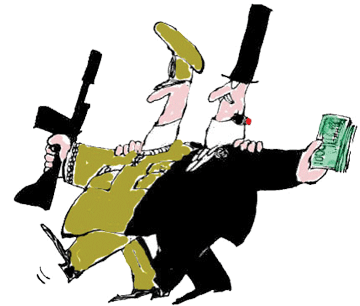 Nuclear Buildup in EU: Who Benefits From Aggravating US-Russian Tensions? Sputnik News, 23 July 15 While beefing up NATO’s military presence in Europe Washington should refrain from deploying more US nuclear weapons in EU countries, senior fellow of the Brookings Institution Steven Pifer said.
what forces are playing the first fiddle in Washington, urging the White House to drag the country into new overseas conflicts and increase its military spending? US investigative journalist Robert Parry is pointing the finger at US neocons, who “still dominate Official Washington’s inside-outside game.” The journalist underscored that wars have long become a profitable business for transnational corporations and their influential lobbyists in the White House.
“So, to understand the enduring influence of the neocons… you have to appreciate the money connections between the business of war and the business of selling war,” Parry remarked.
These wars cost trillions and trillions of dollars and multinational corporations including the US military-industrial complex benefit a lot from them. ……..: http://sputniknews.com/politics/20150723/1024969193.html#ixzz3gkc7anUQ
Jon Stewart demolishes US Republicans’ opposition to Iran nuclear deal
Jon Stewart Skewers GOP Over Iran Nuclear Deal Complaints (includes video)
“Basically, you’re treating this critical international accord like some kind of bizarro iTunes user agreement.”
Dominique MosbergenNews Editor, The Huffington Post 23 July 15 “……..The Obama administration sent the nuclear agreement to Congress on Sunday, and as Stewart noted, many Republicans expressed their extreme unhappiness with it. Some, like Sen. Lindsey Graham (R-S.C.) even called it a “historically bad” deal.
But is it as awful as they claim?
Stewart skewered Graham and others for baselessly criticizing the agreement, and for not offering any viable alternatives despite their grousing.
“You didn’t even read the deal?” Stewart said of Graham, who admitted to not having read the agreement. “Basically, you’re treating this critical international accord like some kind of bizarro iTunes user agreement. Blah, blah, blah, blah, just skip all the details.”
Watch the video above to see if Stewart was really able to keep mum about Trump throughout the whole segment. The comedian also offers details of an alternative deal with Iran. http://www.huffingtonpost.com/entry/jon-stewart-gop-iran-nuclear-deal_55b0a51fe4b08f57d5d3b1d5
Effects of Fukushima radiation on pale grass blue butterfly
The biological impacts of the Fukushima nuclear accident on the pale grass blue butterfly / 福島原子力発電所事故のヤマトシジミへの生物学的影響 http://csrp.jp/posts/654
Atsuki Hiyama, Chiyo Nohara, Seira Kinjo, Wataru Taira, Shinichi Gima, Akira Tanahara & Joji M. Otaki
AffiliationsContributionsCorresponding author
Scientific Reports 2, Article number: 570 doi:10.1038/srep00570
Received 06 June 2012 Accepted 24 July 2012 Published 09 August 2012 Updated online 06 August 2013
Corrigendum (August, 2013)
The collapse of the Fukushima Dai-ichi Nuclear Power Plant caused a massive release of radioactive materials to the environment. A prompt and reliable system for evaluating the biological impacts of this accident on animals has not been available. Here we show that the accident caused physiological and genetic damage to the pale grass blue Zizeeria maha, a common lycaenid butterfly in Japan. We collected the first-voltine adults in the Fukushima area in May 2011, some of which showed relatively mild abnormalities. The F1 offspring from the first-voltine females showed more severe abnormalities, which were inherited by the F2 generation. Adult butterflies collected in September 2011 showed more severe abnormalities than those collected in May. Similar abnormalities were experimentally reproduced in individuals from a non-contaminated area by external and internal low-dose exposures. We conclude that artificial radionuclides from the Fukushima Nuclear Power Plant caused physiological and genetic damage to this species.
http://www.nature.com/srep/2012/120809/srep00570/full/srep00570.html
Hiyama A, Nohara C, Kinjo S, Taira W, Gima S, Tanahara A, Otaki JM. (2012)
The biological impacts of the Fukushima nuclear accident on the pale grass blue
butterfly. Scientific Reports 2: 570. DOI: 10.1038/srep00570
Published on 9 August 2012
要旨
福島第一原子力発電所の崩壊は環境への放射性物質の大規模な放出を引き起こした。この事故の動物への生物学的影響を評価する迅速で信頼に足る実験系は現在のところ報告されていない。我々はここに、この事故が日本で普通に見られる鱗翅目シジミチョウ科ヤマトシジミへの生理的・遺伝的損傷の原因となっていることを示した。第一化の成虫を福島地域で 2011 年 5 月に採集したところ、そのうちいくつかは比較的軽度の異常を示した。第一化の雌から産まれた F1 には親世代より高い異常が観察された。この異常は次世代 F2 に遺伝した。2011 年 9 月に採集した成虫の蝶には 5 月に採集されたものに比べ、より過酷な異常が観察された。同様の異常は、非汚染地域の個体において、外部および内部の低線量被曝により、実験的に再現された。我々は、福島原子力発電所由来の人工放射性核種がこの生物種に生理的・遺伝的損傷を引き起こしたと結論する。
http://w3.u-ryukyu.ac.jp/bcphunit/Hiyama_et_al_2012_verJP.pdf
-
Archives
- February 2026 (240)
- January 2026 (308)
- December 2025 (358)
- November 2025 (359)
- October 2025 (376)
- September 2025 (258)
- August 2025 (319)
- July 2025 (230)
- June 2025 (348)
- May 2025 (261)
- April 2025 (305)
- March 2025 (319)
-
Categories
- 1
- 1 NUCLEAR ISSUES
- business and costs
- climate change
- culture and arts
- ENERGY
- environment
- health
- history
- indigenous issues
- Legal
- marketing of nuclear
- media
- opposition to nuclear
- PERSONAL STORIES
- politics
- politics international
- Religion and ethics
- safety
- secrets,lies and civil liberties
- spinbuster
- technology
- Uranium
- wastes
- weapons and war
- Women
- 2 WORLD
- ACTION
- AFRICA
- Atrocities
- AUSTRALIA
- Christina's notes
- Christina's themes
- culture and arts
- Events
- Fuk 2022
- Fuk 2023
- Fukushima 2017
- Fukushima 2018
- fukushima 2019
- Fukushima 2020
- Fukushima 2021
- general
- global warming
- Humour (God we need it)
- Nuclear
- RARE EARTHS
- Reference
- resources – print
- Resources -audiovicual
- Weekly Newsletter
- World
- World Nuclear
- YouTube
-
RSS
Entries RSS
Comments RSS
 nuclear-news