The Cree Nation backs the report advising against uranium mining in Northern Quebec
 The Cree Nation urges the Quebec Government to heed the BAPE’s recommendations regarding the uranium sector in northern Quebec http://www.newswire.ca/en/story/1572491/the-cree-nation-urges-the-quebec-government-to-heed-the-bape-s-recommendations-regarding-the-uranium-sector-in-northern-quebec
NEMASKA, EEYOU ISTCHEE, QC, July 17, 2015 /CNW/ – The Cree Nation welcomes the recommendations of the Bureau d’audiences publiques sur l’environnement (BAPE) regarding the uranium sector in Quebec. The BAPE’s report was released to the public today, following a year-long, province-wide inquiry and public consultation process, which included the largest number of public submissions ever received by the BAPE.
“The BAPE’s report confirms what the Cree Nation has long maintained: that uranium development poses unique and significant risks for our lands, our environment, our communities and our future generations,” said Grand Chief Dr.Matthew Coon Come. “The report reflects what we observed in the consultation process, that the overwhelming majority of the population, in Cree communities and across Quebec, oppose uranium development.”
“We have said from the start that once Quebecers learn the facts about uranium, the risks it poses, and the questions that cannot be adequately answered, they would join with us in opposing uranium development,” Grand Chief Coon Come continued. “The Cree Nation greatly appreciates the support we have received on this issue from other Aboriginal peoples and from individuals, groups and municipalities across Quebec.”
In its report, the BAPE Commission concluded that there remains significant uncertainty and gaps in existing scientific and technological knowledge regarding uranium mining, the management of uranium waste, and the associated health and environmental impacts. In regard to the territory subject to the James Bay and Northern Quebec Agreement, including the Cree Nation’s territory of Eeyou Istchee, the BAPE Commission recommended that social acceptability must be a priority consideration in any future decisions regarding uranium development.
“The social acceptability of proposed development projects in Eeyou Istchee is a fundamental part of the successful relationship of partnership and respect between the Crees and Quebec,” Grand Chief Coon Come noted. “The BAPE has recognized that the special legal framework and social institutions that govern in Eeyou Istchee must play a central role in legitimate decision-making about development in our territory.”
The Cree Nation’s stand against uranium development began in 2008 when Strateco Resources applied to the Quebec Government to pursue the Matoush advanced uranium exploration project. Located on the family hunting grounds of the Cree Nation of Mistissini, at the crest of two major watersheds that bring water throughout Eeyou Istchee, the Matoush project was the most advanced uranium project to date in Quebec. The Government of Quebechas since denied the required permit for the Matoush project, due largely to its lack of social acceptability amongst the Cree Nation.
For more information on the Cree Nation’s position on uranium development, please visit:http://standagainsturanium.com/
Bureau d’audiences publiques sur l’environnement (BAPE) – no go ahead for uranium mining in Quebec
 BAPE cites ‘uncertainties’ and ‘low acceptability’ in report on future of uranium mining in Quebec, Montreal Gazette, PRESSE CANADIENNEJuly 17, 2015 By Stéphanie Marin
The Bureau d’audiences publiques sur l’environnement (BAPE) concluded that would be inappropriate to give the green light to uranium mining in Quebec right now. Their findings were presented to the provincial government on Friday afternoon.
According to the BAPE, there are too many uncertainties and unanswered questions regarding the risks posed by uranium mining to human health and the environment.
“These uncertainties are compounded by the radioactivity of uranium residues, which may remain problematic for thousands of years,” the agency wrote in its 600-page report, dated May 2015 and entitled “The challenges of the uranium industry in Quebec.”
The report noted that social acceptability is also an issue for uranium mining.
“Because of the uncertainty and sometimes significant gaps and limitations in scientific and technological knowledge, we are very far from reaching a social and political consensus and there is very low acceptability in Quebec.”
And in areas where the potential mines would be located, “the rejection of the uranium industry is almost unanimous.”
The city of Sept-Îles, which is near a uranium mining project, has been the scene of many protests in recent years. In 2009, 20 doctors resigned from a Sept-Îles hospital to protest the construction of a uranium mine on the North Shore.
The BAPE notes that the Institut national de santé publique du Québec states that the presence of a uranium mine could create additional exposure to radiation for people living nearby.
Quebec’s environment minister asked the BAPE to address the mining industry in March 2014. Uranium mines are considered different from other mines because they emit radiation……….http://montrealgazette.com/news/quebec/bape-cites-uncertainties-and-low-acceptability-in-report-on-future-of-uranium-mining-in-quebec
New impediments to plans for Yucca nuclear waste storage
 The Plan for Storing US Nuclear Waste Just Hit a Roadblock Wired 16 July 15 AMERICA’S FAVORITE PROBLEM to ignore—what to do with radioactive waste—just got worse. Since 1987, the grand (and controversial) idea was to put it all in one place, a series of tunnels deep below Nevada’s Yucca Mountain. Well, last week America got three new national monuments, including the 704,000 acres of the Basin and Range National Monument. And guess what? The train that was supposed to carry all that nuclear guck to Yucca Mountain runs right through it.
“It’s another nail in the coffin for Yucca Mountain,” says Timothy Frazier, a former Department of Energy official who now works on nuclear waste for the Bipartisan Policy Center. “It certainly adds time, and would require more money to resolve.”………
radioactive waste doesn’t disappear if you ignore it. The US has 75,000 tons of high-level radioactive waste—spent reactor fuel and the byproducts of processing it—that now sit in pools or dry casks at nuclear power plants, facilities never intended for long-term storage. The risk of leaks is high. Because the stuff stays radioactive for millennia, the safest course of action is supposed to be entomb ingit in rock like at Yucca Mountain, where it can remain inaccessible to future humans.
Now, Yucca Mountain plans have dragged on so long that all the high-level radioactive waste in the country exceeds its storage capacity. The Department of Energy hasn’t even built the repository yet, and the country already needs a second…….http://www.wired.com/2015/07/plan-storing-us-nuclear-waste-just-hit-roadblock/
Notes on Climate Change News
Climate Change
Caring about Climate Change – Global Citizens and Moral Decision Making.
In a recent cogito blog post, Clive Hamilton claims that the greatest crimes of recent years will surely prove to be human interference with and disruption of the Earth’s climate.
http://theconversation.com/caring-about-climate-change-global-citizens-and-moral-decision-making-44771
One by one – church leaders speak out on climate change
Religious leaders around the world keep coming out in support of efforts to reduce or combat climate change.
http://www.biblesociety.org.au/news/one-by-one-church-leaders-speak-out-on-climate-change
Cold now but June the warmest ever
Last month was the hottest June on record by a wide margin, Japan Meteorological Agency said, increasing the likelihood that 2015 will also be the warmest.
http://www.smh.com.au/environment#ixzz3g5ZrN0jn
Hotter, wetter, stormier – study finds 2014’s climate melted records
Global sea levels swelled to a high, tropical cyclones continued to multiply and the world’s thermometer set a record in 2014, according to a new report tracking the earth’s climate.
http://www.smh.com.au/environment#ixzz3g5ZywnRv
Progress is being made, in climate talks, quietly, behind the scenes
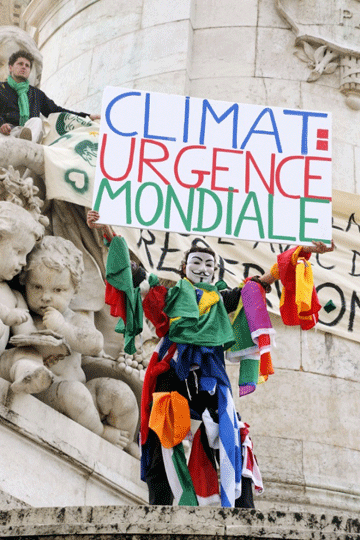 Climate Talks Nearing Consensus in Behind-the-Scenes Meetings http://www.bloomberg.com/news/articles/2015-07-15/climate-talks-nearing-consensus-in-behind-the-scenes-meetings by Alex Nussbaum July 16, 2015 Publicly, the United Nations climate-change talks look mired in disputes over everything from money to the length of the proposed agreement.
Behind the scenes, a deal may be closer than it seems, according to a report today from two veteran negotiators who’ve organized a series of unofficial meetings among key countries.
With almost five months to go before a critical Paris meeting, nations are coalescing around a deal that would commit every country to restricting greenhouse gases but bind none to specific targets. While that may seem a tepid effort, given scientists’ warnings of catastrophic climate change, it’s still an improvement over the last big meeting, when talks in Copenhagen in 2009 ended without an expected global deal, and with finger-pointing among the U.S., China and other big polluters.
Dovland, who also participated in past UN climate talks, along with former South African environment minister Valli Moosa, led almost 100 hours of “informal discussions” over the past 16 months with officials from the U.S., China, the European Union, Brazil and other countries. The sessions were organized by the Center for Climate & Energy Solutions, an Arlington, Virginia-based advocacy group
‘Snail’s Pace’
The process left them optimistic about the chances of reaching a global deal this year, even as the UN’s public negotiating sessions have bogged down over issues including how much funding rich nations will provide to poorer states to deal with climate change. UN Secretary General Ban Ki-moon last month bemoaned the “snail’s pace” of the talks.
While much remains to be hashed out, “I believe governments are more serious than ever about tackling this issue,” Moosa said on a conference call with reporters Wednesday. “We have the makings of a good deal in Paris.”
A “hybrid” structure, in which nations would be legally bound to make some climate pledge but free to decide the specific steps they must take, has helped bridge divides between developed and developing countries, Moosa said. While that leaves it to individual nations to follow through on their promises, it bows to political realities in places like the U.S., where legally binding cuts would face a tough sell in Congress.
“The biggest consideration here has been what is it that will make countries put forward ambitious plans,” Moosa said. “It’s very clear to everybody that the tighter the legal requirements, the less ambitious will be the plans.”
St. Louis’ connection to nuclear waste contamination explored in new film
 New documentary explores St. Louis’ connection to nuclear waste contamination (includes AUDIO) St Louis Public Radio, By EVITA CALDWELL • JUL 14, 2015 During World War II, a St. Louis-based company took on a project that turned out to be detrimental to the health of its employees.
Mallinckrodt Chemical Company was responsible for refining massive amounts of uranium for the Manhattan Project. As a result, some of Mallinckrodt’s employees succumbed to various illnesses caused by exposure to nuclear waste.
The radioactive work completed decades ago continues to have impacts on people and the environment at several sites throughout the area, including West Lake Landfill, Coldwater Creek, and Weldon Spring. Weldon Spring has since been cleaned up, but concern remains on the effects of contamination prior to the area being cleared.
Filmmaker and St. Louis native Tony West directed a documentary about the Manhattan Project titled “The Safe Side of the Fence.” The film explores first-handaccounts of former employees of Mallinckrodt and residents who live near the contaminated sites. At 1 p.m. on July 19, the Tivoli Theatre will screen the documentary as part of Cinema St. Louis’ Filmmakers Showcase.
“I started off focusing on the workers because these are people who worked in contaminated buildings day in and day out,” West said. “When you see this film and what these workers are going through, you’ll get a sense of what you’re up against.”………
Although there’s coverage of contamination at West Lake Landfill, Coldwater Creek and Weldon Spring, West said he wanted to make a film to tie the three sites together.
“The government is not in a hurry to spend a lot of money on anything, especiallycleaning up things,” West said. “I think that if you live by this material or you’ve got a family member that worked in one of these plants, this really hits home for you.” http://news.stlpublicradio.org/post/new-documentary-explores-st-louis-connection-nuclear-waste-contamination
1 This Month


Tell the Ukrainian Government to Drop Prosecution of Peace Activist Yurii Sheliazhenko

Petition to revoke the licensing of the Near Surface Nuclear Disposal Facility (NSDF) at Chalk River. https://www.ourcommons.ca/petitions/en/Petition/Details?Petition=e-7247


of the week – STOP SMALL MODULAR REACTORS IN CANADA
To see nuclear-related stories in greater depth and intensity – go to https://nuclearinformation.wordpress.com
-
Archives
- March 2026 (212)
- February 2026 (268)
- January 2026 (308)
- December 2025 (358)
- November 2025 (359)
- October 2025 (376)
- September 2025 (258)
- August 2025 (319)
- July 2025 (230)
- June 2025 (348)
- May 2025 (261)
- April 2025 (305)
-
Categories
- 1
- 1 NUCLEAR ISSUES
- business and costs
- climate change
- culture and arts
- ENERGY
- environment
- health
- history
- indigenous issues
- Legal
- marketing of nuclear
- media
- opposition to nuclear
- PERSONAL STORIES
- politics
- politics international
- Religion and ethics
- safety
- secrets,lies and civil liberties
- spinbuster
- technology
- Uranium
- wastes
- weapons and war
- Women
- 2 WORLD
- ACTION
- AFRICA
- Atrocities
- AUSTRALIA
- Christina's notes
- Christina's themes
- culture and arts
- Events
- Fuk 2022
- Fuk 2023
- Fukushima 2017
- Fukushima 2018
- fukushima 2019
- Fukushima 2020
- Fukushima 2021
- general
- global warming
- Humour (God we need it)
- Nuclear
- RARE EARTHS
- Reference
- resources – print
- Resources -audiovicual
- Weekly Newsletter
- World
- World Nuclear
- YouTube
-
RSS
Entries RSS
Comments RSS
 nuclear-news